Reptile & Amphibian Forums

Welcome to kingsnake.com's message board system. Here you may share and discuss information with others about your favorite reptile and amphibian related topics such as care and feeding, caging requirements, permits and licenses, and more. Launched in 1997, the kingsnake.com message board system is one of the oldest and largest systems on the internet.

Click for 65% off Shipping with Reptiles 2 You
Click to visit DM Exotics

Compiling the ideas..

lbenton Sep 27, 2007 05:50 PM

These are my thoughts going down from most likely on down to very possible regarding dead but fully developed in the eggs, deformed hatchlings and infertility issues with alterna.

1 – Moisture (usually too much) can play a number of games on eggs:
a: electrolyte imbalance for the developing embryo
b: increased pressure inside the egg
c: reduced oxygen for the embryo (via contact with wet substrate)

2 – Temperatures too hot or cool, I personally feel like most people with an incubation system are “pushing the redline” to get the fastest possible hatch without a fatal impact of the embryo. Maybe if we back it down closer to room temps the embryo will develop a little slower and healthier? Maybe we should set the date back a few days and run a little cooler?
3 – Diet of the adult breeders, white lab mice are not a natural prey item in the wild:
a: could be a lack of calcium or vitamin d3 to process the calcium
b: could be a lack of carotenoids in the food chain (insect->lizard->alterna)
c: could be other missing or deficient trace elements in the captive diet

4 – Improper hibernation of the adults (temps, light cycle, or some other seasonal stimulus) causing an impact on ovulation or sperm production.
5 – Genetics, maybe with line breeding or back-crossing we picked up something bad in some individual animals?

Did I miss anything?

Lance
Replies (15)

jim_d Sep 27, 2007 08:50 PM

Good deal Lance, the basics seem to be:

-temp should fluctuate between say 78 to 80 degrees.

-no contact with substrate is preferred.

-proper cycling & nutrition for the breeders.

-allow for about 70 days incubation.

-allow for some air flow.

Seems to me that the formula for captive breeding / hatching graybands is pretty much like any other snakes, just that you need to keep the moisture level down and oxygen up.

There are still alot of interesting questions about how they incubate in the wild, and what those differences might be.

Jim

Sighthunter Sep 27, 2007 08:52 PM

How about offering the female a temperature gradient most of my gravid females like to regulate their body temperature around 88F. I find that seems to be a magic number for gravid females across the board. They might be better able to synthesize the calcium, vitamins etc when cooking eggs at a higher temperature.

I also spike the temperature the last week of incubation to get the unborn neonates moving inside the egg. I feel that this in no way hurts the youngsters just gets um moving to slit the egg better.

You also missed clearing the female of fecal matter just before she is due to lay eggs quite a few egg bound females have had a stool blocking passage of eggs and delayed egg laying could affect the outcome. A suitable nesting site would also fit in this category
-----
"Life without risk is to merely exist."

Sighthunter Sep 27, 2007 09:45 PM

Too much heat during the breeding session, cooking the sperm. Also fat male snakes and skinny females, not a good combination.
-----
"Life without risk is to merely exist."

jim_d Sep 28, 2007 04:57 AM

Good pointers for breeding a majority of species. There are a ton of little options like that.

I generally do not spike the temperature at the end, although it probably doesn't hurt.

I pretty much agree on the warm spot, I keep a heat tape on all the graybands, male or female but make sure it is mild heat, the temp may reach 88 at imes , but it doesn't maintain 88.

I disagree on the topic of clearing the females, although they seem to do that instictively. This however might depend on how you feed them. Generally gravid females will feed very agressively and will not wait for a f/t mouse to hit the ground. a few days prior to laying, they do hesitate on the mouse and I do not leave the mouse in there for them to decide....if they don't wack it, they don't get it. also at times a female will not feed a few days prior to laying but will eat something small just before laying, I don't have any problems with this.

I don't think we "forgot" anything, we are just not going to go into every general detail of keeping and breeding snakes.

chrish Sep 29, 2007 12:58 AM

2 – Temperatures too hot or cool, I personally feel like most people with an incubation system are “pushing the redline” to get the fastest possible hatch without a fatal impact of the embryo. Maybe if we back it down closer to room temps the embryo will develop a little slower and healthier? Maybe we should set the date back a few days and run a little cooler?

I had this problem with Rubber Boas for a few years. My females would produce a clutch of viable young, but many of the young were stillborn. They were fully formed, but DOA. I also noticed that the DOAs were pretty thin for newborn erycines.

I talked it over with Richard Hoyer and he suggested I was giving the female a basking area that was too warm (90°). His hypothesis is that the elevated gestation temperatures were accelerating the metabolism of the embryos and they were dying "in utero" because they had used up all of their yolk resources prior to being born.

I lowered the temperature of the hot end of the cage to the mid 80s and the next year I got 100% live births.

I bet alterna eggs incubate at at an average temperature that isn't much more than 75° in the wild. So they have enough yolk to develop for X number of days at an average of 75°. Put them in an incubator at 80° and they run out of nutrients before they are ready to hatch.
-----
Chris Harrison
San Antonio, Texas

jim_d Sep 29, 2007 07:51 AM

Thanks, Great perspective on it. I do not think they use all the yolk at 80, but it could be an imbalance of some similar type. Good point to keep in mind about high temps.

Basically a warm room temp in the 70's might be about right for alterna.

swwit Sep 29, 2007 11:31 AM

>>Thanks, Great perspective on it. I do not think they use all the yolk at 80, but it could be an imbalance of some similar type. Good point to keep in mind about high temps.
>>
>>Basically a warm room temp in the 70's might be about right for alterna.

I've never kept alterna eggs as high as 70 degrees. Mine average between 72 and 77. At those temps I've had an excellent hatch rate. 80 degrees has always seemed to be on the hot side to me. I've had some spikes that have taken it that high but it was temporary. Good air flow and less moisture seems to work for me.
-----
Steve W.

swwit Sep 29, 2007 11:32 AM

>>I've never kept alterna eggs as high as 70 degrees. >>-----
>>Steve W.

Sorry, meant to say 80 degrees.

-----
Steve W.

antelope Sep 29, 2007 11:07 AM

I would tend to agree with Chrish's evaluation. And when you put Richard Hoyers' word to it...golden!
-----
Todd Hughes

Sighthunter Sep 30, 2007 10:02 PM

I never recalled Richard Hoyers addressing a post. Please inform me as I am all about learning.
-----
"Life without risk is to merely exist."

antelope Oct 01, 2007 02:07 AM

Chrish said he talked it over with Richard Hoyer in his above post, yep, you missed it!
-----
Todd Hughes

Sighthunter Sep 29, 2007 10:57 PM

First I will say I respect you and your opinion as you spend many hours in the field. What if they had more usable yoke? Are we both reaching the same conclusion in a different way?
-----
"Life without risk is to merely exist."

Sighthunter Sep 29, 2007 11:40 PM

If there was more usable yoke would the hatchlings be more robust and be able to endure harsher environmental hardships?
-----
"Life without risk is to merely exist."

jim_d Sep 30, 2007 04:06 AM

I am thinking the yolk that is in the egg is usually enough, and the amout of absorbtion of the yolk by the embryo is tied into water content and temperature, The temperature can vary within a range say 73 to 82 degrees but the amount of moisture and egg water content is where most of us make the mistakes leading to fluid heavy eggs - the wrong development rate and side effects like kinks, water on the brain or simply fully developed "dead in the egg".

Has anyone determined the proper percentage of weight increase during incubation of grayband eggs that leads to healthy neonates? Gravid females do this instictively in the wild, maybe we need to monitor air flow to maintain optimal humidity and water absorbtion by weight differently for each clutch?

Jim

Sighthunter Sep 30, 2007 03:04 PM

It is funny but the other snake that experiences the exact same problem as you all are describing is the Indigo. I have been active on the Indigo forum for quite a while and we seemed to have figured out how to overcome the obstacles you are dealing with right now.

Indigo are known to throw infertile eggs and have full term youngsters dead in the egg. I have worked with an individual that had quite a few breeding pairs that only ever produced a handful of snakes a year. After a year or two of back and forth conversation it all turned around. Now he produces between 80 and 100 hatchlings a year and here is the breakdown.

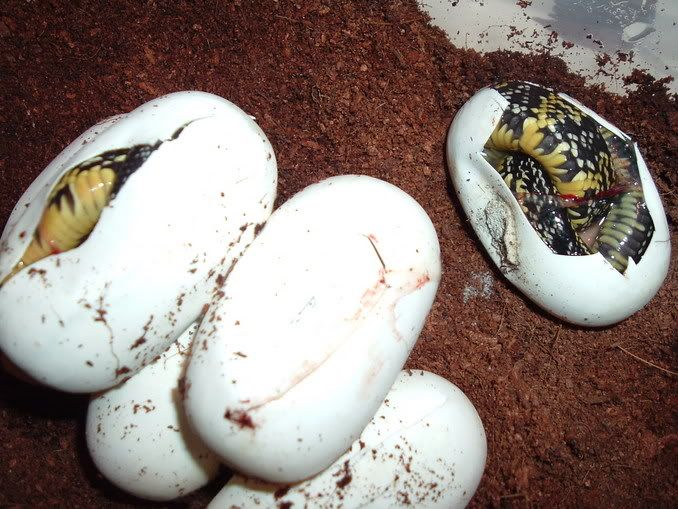
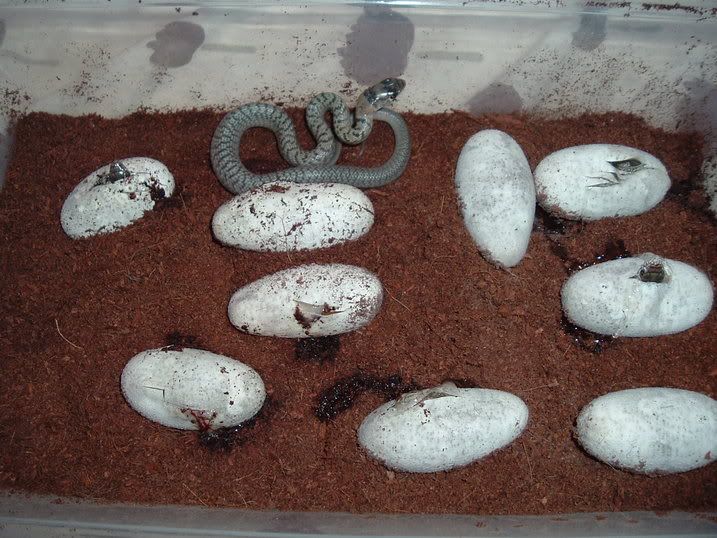
The breakdown is as follows, the bulk of the problem was diet for the adults and yes controlling the moisture to the eggs to a much lesser degree. All my eggs and all of his eggs have little or no dimpling clear up to the hatch. Again same problem solved mostly by diet. Here are some egg pics plump right up to the hatch with no kinks and nothing dead in the egg.

I think dimpling is actualy reducing the airspace inside of egg from too much negative pressure. I think a healthy egg should be plump right up to the pip stage. It shows that the airspace is intact and egg is exchanging thre right amount of oxygyn.


Image
-----
"Life without risk is to merely exist."

Site Tools