<?xml version="1.0" encoding="UTF-8"?>
<rdf:RDF xmlns:dc="http://purl.org/dc/elements/1.1/" xmlns:h="http://www.w3.org/1999/xhtml" xmlns:hr="http://www.w3.org/2000/08/w3c-synd/#" xmlns:rdf="http://www.w3.org/1999/02/22-rdf-syntax-ns#" xmlns="http://purl.org/rss/1.0/">
<channel rdf:about="https://forums.kingsnake.com/rss/?catid=222">
  <title>Kingsnake.com - Herpforum - Rosy Boas</title>
  <link>https://forums.kingsnake.com/forum.php?catid=222</link>
  <description><![CDATA[The Rosy Boa (Lichanura trivirgata) is one of only two members of the Boidae family native to the United States. Found in the southwestern United States in the states of California and Arizona, and northwestern Mexico in the states of Baja California and Sonora, in California, the Rosy Boa ranges throughout the Colorado and Mojave deserts and also occupies the coastal areas of Los Angeles, Orange, Riverside, and San Diego counties. In Arizona, the Rosy Boa occupies the Mojave desert and the western areas of the Sonoran desert. In Sonora, the Rosy Boa ranges from the border with the United States south throughout the Sonoran Desert to at least as far south as Ortiz. In Baja California, the Rosy Boa ranges throughout the entire peninsula except in areas of extremely dry or rockless desert. Here you may post messages or questions pertaining to all aspects and issues regarding the keeping, breeding, health, and conservation of Rosy Boas. If you are a new user to this forum, please take the time to review the rules first before posting: Terms of Service.]]></description>
  <items>
    <rdf:Seq>
      <rdf:li rdf:resource="https://forums.kingsnake.com/view.php?id=2115848" />
      <rdf:li rdf:resource="https://forums.kingsnake.com/view.php?id=2115755" />
      <rdf:li rdf:resource="https://forums.kingsnake.com/view.php?id=2112589" />
      <rdf:li rdf:resource="https://forums.kingsnake.com/view.php?id=2112018" />
      <rdf:li rdf:resource="https://forums.kingsnake.com/view.php?id=2111836" />
      <rdf:li rdf:resource="https://forums.kingsnake.com/view.php?id=2111528" />
      <rdf:li rdf:resource="https://forums.kingsnake.com/view.php?id=2110626" />
      <rdf:li rdf:resource="https://forums.kingsnake.com/view.php?id=2110617" />
      <rdf:li rdf:resource="https://forums.kingsnake.com/view.php?id=2110596" />
      <rdf:li rdf:resource="https://forums.kingsnake.com/view.php?id=2110547" />
      <rdf:li rdf:resource="https://forums.kingsnake.com/view.php?id=2110544" />
      <rdf:li rdf:resource="https://forums.kingsnake.com/view.php?id=2110454" />
      <rdf:li rdf:resource="https://forums.kingsnake.com/view.php?id=2028477" />
      <rdf:li rdf:resource="https://forums.kingsnake.com/view.php?id=2027989" />
      <rdf:li rdf:resource="https://forums.kingsnake.com/view.php?id=2027890" />
      <rdf:li rdf:resource="https://forums.kingsnake.com/view.php?id=2026656" />
      <rdf:li rdf:resource="https://forums.kingsnake.com/view.php?id=2025408" />
      <rdf:li rdf:resource="https://forums.kingsnake.com/view.php?id=2019332" />
      <rdf:li rdf:resource="https://forums.kingsnake.com/view.php?id=2017500" />
      <rdf:li rdf:resource="https://forums.kingsnake.com/view.php?id=2014483" />
    </rdf:Seq>
  </items>
</channel>

<item rdf:about="https://forums.kingsnake.com/view.php?id=2115848">
  <title>Rosy Diarrhea? Help appreciated</title>
  <link>https://forums.kingsnake.com/view.php?id=2115848</link>
  <description><![CDATA[<div class="rss-post"><p><strong>Original post</strong> by Alora_Danon &mdash; 2020-09-27 22:01:48 GMT</p><p>Hi all,</p>
<p>I'm new to the forum and want to provide some back history before I proceed to possibly diarrhea issue,may be connected.</p>
<p>I purchased an adult (4-5 yrs old)rosy boa male from a locally owned pet store August 1st. <br />
The pet shop had poor husbandry, no hides for the snake, not enough substrate, and a small, flimsy Tupperware dish for water. I assume the snake just knocked it over any time he went to drink. <br />
4 days after I had the snake home I realized he had a mite infestation and was fairly dehydrated. <br />
I treated both and he seemed to bounce back well enough. <br />
Today I found what I can only assume is diarrhea in his tank. (Picture included)<br />
He ate an adult mouse on the 21st, has had completely normal poops afterward. <br />
Is this possibly parasites, or something else the mites may have passed on to him?</p>
<p>For his husbandry; he's in a 20g long with hides on both warm and cool side. Warm side is 88-89°, cool side is 75-76°<br />
He does get live fed, only because that is what the previous owner had fed him all his life and he has stubbornly refused FT.<br />
Any insight into if this is, in fact, diarrhea and if I need to worry or set up a vet appointment etc.</p>
<p>Thank you<br />
<img class="img-fluid" src="https://ibb.co/9tkvZwM" alt="Image"></p></div>
<div class="rss-post"><p><strong>Reply</strong> by markg &mdash; 2020-11-02 06:54:48 GMT</p><p>Too much water can result in loose stools, as can other things. As long as the rosy is digesting and not regurgitating, then I would not worry about parasites. Treat the mites and keep the cage dry. Under tank heat, a thermostat and a substrate of aspen or paper works well. If you have a screen top then you can have a water dish in there all the time. But if using a tub, only have water in there  when the snake has not fed recently.</p></div>
<p><a href="https://forums.kingsnake.com/view.php?id=2115848">View full thread on Kingsnake.com</a></p>]]></description>
  <dc:date>2020-11-02T06:54:48+00:00</dc:date>
  <dc:creator>Alora_Danon</dc:creator>
</item>
<item rdf:about="https://forums.kingsnake.com/view.php?id=2115755">
  <title>I have a question</title>
  <link>https://forums.kingsnake.com/view.php?id=2115755</link>
  <description><![CDATA[<div class="rss-post"><p><strong>Original post</strong> by eddie_the_yeti &mdash; 2020-07-06 22:25:01 GMT</p><p>OK, It has been a while since I was actively breeding herps and I have not ever bred rosies. I also find that some of my knowledge is outdated (like when did corns stop being Elephae and start being Pantherophis?) So I need someone with more specific knowledge.  I was in my local pet store getting rats for my Juvie carpet python's when my wife called me over to see 2 Rosy boas actively mating. I bought the pair and they kept on mating after I got them home, really just separated for the first time today.  Anyway, to the point.  The store was selling them as "harlequin albino rosy boas". I had not heard of this morph and suspected that it was a mispronunciation of "harquhala" which is a locality I have heard of and I have seen albinos from there that look very much like what I bought. I did a search and do not see a harlequin morph of Rosy boas,but just because I have not heard of them, can't find them, and have little faith in the local pet store's knowledge, does not mean that they are not right and I am not wrong. Anyone out there with more knowledge or expertise than me want to chime in please? Not sure how to post an image but when I figure it out I will as I know how hard it can be to id a morph without one.  In the mean time is there even such a thing as a "Harlequin rosy boa"  Thanks in advance.</p></div>
<div class="rss-post"><p><strong>Reply</strong> by markg &mdash; 2020-11-02 06:45:51 GMT</p><p>No harlequin. Probably Harquahala, and there is indeed an albino Harquahala rosy strain.</p></div>
<p><a href="https://forums.kingsnake.com/view.php?id=2115755">View full thread on Kingsnake.com</a></p>]]></description>
  <dc:date>2020-11-02T06:45:51+00:00</dc:date>
  <dc:creator>eddie_the_yeti</dc:creator>
</item>
<item rdf:about="https://forums.kingsnake.com/view.php?id=2112589">
  <title>trivirgata</title>
  <link>https://forums.kingsnake.com/view.php?id=2112589</link>
  <description><![CDATA[<div class="rss-post"><p><strong>Original post</strong> by Mojave_Torts &mdash; 2017-08-28 03:07:12 GMT</p><p>Trying to contact trivirgata. He hasn't posted in a few years, but I'm hoping he is still around</p>
<p>thanks,</p></div>
<p><a href="https://forums.kingsnake.com/view.php?id=2112589">View full thread on Kingsnake.com</a></p>]]></description>
  <dc:date>2017-08-28T03:07:12+00:00</dc:date>
  <dc:creator>Mojave_Torts</dc:creator>
</item>
<item rdf:about="https://forums.kingsnake.com/view.php?id=2112018">
  <title>Test</title>
  <link>https://forums.kingsnake.com/view.php?id=2112018</link>
  <description><![CDATA[<div class="rss-post"><p><strong>Original post</strong> by Osira &mdash; 2017-03-16 02:20:47 GMT</p><p>Testing<br />
<a href="https://m.flickr.com/photos/148744332@N04/33425299626/?xajax=1">Link</a></p></div>
<div class="rss-post"><p><strong>Reply</strong> by Osira &mdash; 2017-03-23 16:53:47 GMT</p><p>Thank you! What a beast of a male you had!</p></div>
<div class="rss-post"><p><strong>Reply</strong> by racrouc &mdash; 2017-03-21 02:05:41 GMT</p><p>I caught a male coastal rosy in 1975 that was 32 inches. He was 36 inches when he died 29 years and 3 month later.  The picture looks to be a male probing can verify sex.</p></div>
<div class="rss-post"><p><strong>Reply</strong> by Osira &mdash; 2017-03-17 05:25:05 GMT</p><p>In the above post "test" There's a link to my Flickr with boa pics. I hope you guys can find them ok. I'm kinda newish with boas, well keeping them and definitely sexing them. Haha But this boa clearly has spurs. And is a coastal locality. It's also at least 32-33 inches in length and seems girthy to me. It may be because I'm used to seeing Desert boas which I know tend to be smaller, but it seems large for a male to me. And I've hard there are females with spurs among certain localities. What are your thoughts on this?</p></div>
<p><a href="https://forums.kingsnake.com/view.php?id=2112018">View full thread on Kingsnake.com</a></p>]]></description>
  <dc:date>2017-03-23T16:53:47+00:00</dc:date>
  <dc:creator>Osira</dc:creator>
</item>
<item rdf:about="https://forums.kingsnake.com/view.php?id=2111836">
  <title>Neonates and water</title>
  <link>https://forums.kingsnake.com/view.php?id=2111836</link>
  <description><![CDATA[<div class="rss-post"><p><strong>Original post</strong> by nella1987sb &mdash; 2016-11-18 05:55:25 GMT</p><p>My first litter of rosy boas was just born!  Had a quick question:  How often should the neos get water?  My adults get water once a month, but I thought the little guys might need more.  Also, any extra tidbits on raising them would be appreciated.  Thanks.</p></div>
<div class="rss-post"><p><strong>Reply</strong> by markg &mdash; 2017-02-03 20:11:21 GMT</p><p>Great, I am glad for you. Rosies always come around, it just takes time for some of them.</p></div>
<div class="rss-post"><p><strong>Reply</strong> by nella1987sb &mdash; 2017-02-02 01:36:44 GMT</p><p>Thanks so much to everyone who weighed in.  All neos are now feeding and doing great, and I'm excited to start sending them out to new homes.</p>
<p>Just for fun, a pic of Dad.<br />
<img class="img-fluid" src="http://www.timschreier.com/wp-content/uploads/2017/01/TNS_4176-768x1021.jpg" alt="Image"></p></div>
<div class="rss-post"><p><strong>Reply</strong> by markg &mdash; 2016-12-16 19:43:34 GMT</p><p>Yeah, baby rosies can be a pain, they are not like colubrids which just either eat or don't eat. Rosies have to be coaxed sometimes.</p>
<p>If feeding thawed pinks, warm them up. Rosies do not like thawed food cold.</p>
<p>Many rosy babies will not take thawed period. I have found with warming and trying time and time again, many will give in and eat, but it can be frustrating. Babies can go a long time without food, so they can afford to be picky at first.</p>
<p>Usually baby rosies will eat live prey immediately. If a baby rosy does not eat, perhaps it is that it is Winter and they instinctively refuse food. I cool them down to 65 deg when that happens. In Feb I warm them, and they usually eat willingly soon after, and often thawed food at that.</p>
<p>In my experience, it seems baby rosies like fuzzies rather than pinks. You would be surprised how a tiny rosy can eat a fuzzy no problem.</p>
<p>I have a few adult rosies that were real pains as babies, and now they will eat your hands. So be patient.<br />
<img class="img-fluid" src="http://gallery.kingsnake.com/data/25LowDesert_Rosy_Habitat3-med.jpg"></p>
<p><img class="img-fluid" src="http://gallery.kingsnake.com/data/25lcrosy_m1_pose1-med.jpg"></p></div>
<div class="rss-post"><p><strong>Reply</strong> by nella1987sb &mdash; 2016-12-12 17:54:37 GMT</p><p>Thanks for the info!  Any tips on getting them feeding?  I have two that didn't feed on the first try. despite braining.</p></div>
<div class="rss-post"><p><strong>Reply</strong> by markg &mdash; 2016-12-12 08:34:32 GMT</p><p>Rosies do not do well if kept in elevated humidity for too long, like for weeks on end.</p>
<p>As long as you avoid that scenario, the babies will do fine.</p>
<p>The type of caging used, the size of the water bowl relative to the cage, where you live - it all factors in.</p>
<p>I find that my rosies will often drink a little when I first put water in their cage. Mine seem to avoid water after it has been standing for more than a day. For that reason, I made it a practice to just leave it in for a day or two, then remove it for the next 5-6 days. That formula has worked well for the rosies here, and it makes it easy for me, so I stick with that routine.</p></div>
<div class="rss-post"><p><strong>Reply</strong> by nella1987sb &mdash; 2016-12-05 16:30:42 GMT</p><p>Thank you so much for your response.</p></div>
<div class="rss-post"><p><strong>Reply</strong> by racrouc &mdash; 2016-12-05 14:52:45 GMT</p><p>I have kept rosy boas since 1975 and always keep a small bowl with water.  I've had adult wild caught live over 29 years and wild caught deserts live over 28 years.</p>
<p>Take care</p></div>
<p><a href="https://forums.kingsnake.com/view.php?id=2111836">View full thread on Kingsnake.com</a></p>]]></description>
  <dc:date>2017-02-03T20:11:21+00:00</dc:date>
  <dc:creator>nella1987sb</dc:creator>
</item>
<item rdf:about="https://forums.kingsnake.com/view.php?id=2111528">
  <title>Rosys boa sex</title>
  <link>https://forums.kingsnake.com/view.php?id=2111528</link>
  <description><![CDATA[<div class="rss-post"><p><strong>Original post</strong> by snakeboy40 &mdash; 2016-07-08 23:02:40 GMT</p><p>I am curious about the sexy of my rosy boa. It is believed to be a female and spurs are not present. I have tried to breed "her" for two years now and nothing has happened. Only a couple of times I have seen the male on top of her. My question is if thatf they were both males would they try to breed?</p></div>
<div class="rss-post"><p><strong>Reply</strong> by markg &mdash; 2016-08-16 06:08:13 GMT</p><p>When did you try to breed them? How long did you leave them together? Are they related?</p>
<p>Is the male a definite male? Usually, female rosies that are mature will be a bit (sometimes quite a bit) larger than males of the same type. Not always but usually. May depend on locality for that.</p>
<p>Timing is important. I have always housed them together during Spring for best results. After the male breeds the female, he will often coil up on the cool side of the cage the next morning. That is when I know they have bred. Otherwise I would not always know - they are not always quick to breed when first introduced.</p>
<p>Also, for success, the female needs lots of food prior to breeding. Once gravid, she needs a nice toasty 88-90 deg F belly heat source constantly available.</p></div>
<p><a href="https://forums.kingsnake.com/view.php?id=2111528">View full thread on Kingsnake.com</a></p>]]></description>
  <dc:date>2016-08-16T06:08:13+00:00</dc:date>
  <dc:creator>snakeboy40</dc:creator>
</item>
<item rdf:about="https://forums.kingsnake.com/view.php?id=2110626">
  <title>Regurgitating &amp; Setup - My Experience</title>
  <link>https://forums.kingsnake.com/view.php?id=2110626</link>
  <description><![CDATA[<div class="rss-post"><p><strong>Original post</strong> by Ameron &mdash; 2015-10-28 02:34:36 GMT</p><p>I"m very new to Rosy (Desert) Boas, although I have decades of King, Milk & Rat snake experience.  As a keeper of reptiles, I'm uncommon in several ways:</p>
<p>1.  I keep animals as Animal Companions, not as Pets, and I handle & interact with them often.</p>
<p>2.  I set up vivariums to match natural habitat as closely as possible.  My focus is on animal well being, as opposed to a focus on convenience or sales.  In each vivarium I use a large salad bowl as a soak pool, concealed & covered, with purified water.  I"ve NEVER had mite problems.</p>
<p>Vivarium Features:  Three levels of usable space.  Design is precisely engineered to simulate nature, while maximizing accessories & space.  Branches are highly strung to leave a clear view of the bottom accessories & rock wall.  Water pool in left corner > open space with cacti > boulder pile in right corner covers 33% of the space.</p>
<p>Branches: Nine - forming full-circle, front & rear loop.  Basking spot is open, warming rocks below.  Three levels of thermal graduation. <br />
Driftwood: Two, Ironwood, Hidden Canyon root.<br />
Plants: Fourteen fake species, two live species (moss & lichens).<br />
Hide Spots: Two, one at each end.<br />
Rocks: Twelve - mostly basalt & volcanic rocks of dark brown, gray & black.</p>
<p>3.  I feed live.  My snakes all prefer to be hunters, not scavengers.  (Just curious:  How many of YOU prefer frozen foods over live, fresh food??)</p>
<p>4.  I don't breed, so I can focus on just two snakes with two setups.</p>
<p>When I got my Rosy Boa, I worried about Regurgitation rumors, too, but my common sense told me that in the wild, most snakes live near a water source.  Why then, should I take out my water??  I left my soak pool in her vivarium to experiment.  She has fed once so far, on a small hopper, with no regurgitation.</p>
<p>My Rosy Boa also seems to be quite uncommon in several ways:</p>
<p>1.  She is often daytime-active.  In only one month, I've seen her active during all hours.<br />
2.  She LOVES to climb!  With 9 branches in her setup, I *seldom* see her on the ground.<br />
3.  She prefers to bask under an overhead basking bulb - day or night.  If not directly under it, she is usually partially concealed near it.</p>
<p>Although there are many categorical truths regarding animal species, the Individual matters.  There have always been individuals that defy typical behavior and are very unique, and I suspect that there always will be if Nature is allowed her normal evolutionary course.</p>
<p>Don in Vancouver, WA<br />
Network Engineer, 55  (Explorer, Discoverer, Herpetologist, Naturalist, Writer)</p>
<p>1.0 Lampropeltis getula splendida<br />
1.0 Terrapene carolina carolina<br />
1.0 Terrapene carolina triangus<br />
0.1 Lichurana trivirgata trivirgata<br />
<a href="http://s1372.photobucket.com/user/desert_don/library/?sort=3&page=1">Link</a></p></div>
<div class="rss-post"><p><strong>Reply</strong> by Ameron &mdash; 2015-11-11 17:43:37 GMT</p><p>My boa is now using her rock pile more often. Comprised of 7 rocks, it is almost a foot high, and occupies about 25% of her vivarium at the right corner. It has a cave-like cavity where she can hide in low light.</p>
<p>She still very much loves to move around often, and is surprisingly active - for both a boa and a female. (My males usually tended to be much more active than females, across species.)</p>
<p>I'm really glad that I do not use an under-tank heater. They tend to encourage the snake to stay in that spot only, usually concealed. Overhead basking mimics natural sunlight and encourages my snake to be seen much more often.</p>
<p>My design strategy works - and I get my reward. She's out & about right now.  Happy Herper! (;</p></div>
<div class="rss-post"><p><strong>Reply</strong> by markg &mdash; 2015-11-09 18:08:43 GMT</p><p>Not all snakes are rosies obviously. Some snakes are very mobile in nature, as their body shapes show, and do cover distance in the wild way more than snakes that live in a network of tunnels and crevices. Those mobile species need room. I agree with you there for sure. Keepers need to be knowledgeable of the species and be fair in their offerings of enclosures.</p>
<p>In nature, snakes do a good deal of avoiding nature - the part of nature they do not want. Inclement weather is handled by retreating somewhere. Dry conditions are met by staying under things that reduce evaporation from the snake. You get the picture. They are selective about what part of nature they use.</p>
<p>Regarding your rosy ignoring the rock pile. I have tried that too years ago. It was not used much at all. I had a CHE above the rocks. That particular rosy usually stayed under a piece of newspaper I put in there next to the rocks. Then I moved the rocks out and put in some more newspaper to cover a wider area under the heat and extending out. I rarely saw the snake - she stayed under the paper. Her feeding response became even more pronounced. My thought is that although the rocks look more natural, it was the newspaper/heat/substrate combo that better matched what the snake was looking for. Humans may be drawn to ambiance, but I think snakes are drawn to functional conditions. They are happy to use anything that gives them what they want, whether it be plastic, paper, whatever. They have no concept of "looks". If you can make functional <u>and</u> look good, awesome.</p></div>
<div class="rss-post"><p><strong>Reply</strong> by Ameron &mdash; 2015-11-07 16:14:05 GMT</p><p>I understand, and acknowledge, what you state.  I also know that a child has a different mental capacity than that of an animal - particularly that of a reptile.  However, keep in mind that NO serious, long-term studies of reptile intelligence have been done.  Proper intelligence testing must also be done with a Reptilian format & expected end result - not the same processes used for mammals.  I know of one Gray Parrot with a larger vocabulary than that of many "Human" teenagers.</p>
<p>I disagree, however, with many Keepers about snake attitudes.  I feel strongly, based on my experience, that reptiles LOVE naturalistic setups - whether or not plants are fake.  They like being concealed, true, but only part of the time.  They also like variety (all life forms seem to have this in common, even starfishes) and enjoy new things and exploration.</p>
<p>My adult female, which I suspect was wild-caught & poached, has two hide spots.  One is a rock pile - just like she'd have in nature.  She spends LITTLE time in either.  Day & night, I usually see her on the branches, either basking or climbing around.  (In the wild, their home range is at least 3-5 acres, one of the smallest ranges known for a snake.  Rat snake home ranges can exceed 17 acres.)</p>
<p>I think that housing setup, accessories & space matter very much - with any captive.  I also think that the common practice of a housing setup with only a hide box and water dish, with no branches, is a recipe for an unhealthy & bored reptile.  In that scenario, it's only activity, it's only "fun", is to eat a frozen-thawed rodent every week or two.  (That same existence for any Human would likely result in insanity, death - or a breakout.)</p>
<p>What I'd like to convey to other Herpers is this:  How would I want to be treated as a captive?  What considerations & accessories, along with outside exercise, would I want??</p></div>
<div class="rss-post"><p><strong>Reply</strong> by markg &mdash; 2015-11-06 20:21:57 GMT</p><p>Well, a rosyboa does not have quite the mental capacity of a child, but I get what you are saying. Look at the rosy body shape - they are not meant for distance travel. They are meant for friction on the ground but smooth sailing through tunnels and crevices. They are built for the ability to grab prey while in a resting position, or even in a tunnel. That is the body shape.</p>
<p>Humans are built for distance coverage. Two legs is for energy-conserving locomotion for covering general distance. Not the fastest in a straight line - 4-legs with a high center of mass is much faster. So, a human and a snake, especially a heavy-bodies snake, are by no means in the same realm of needing the same kind/amount of exercise.</p>
<p>If a keeper really wants to stimulate the mind of a rosy, my advice would be a cage with tunnels, perhaps like PVC with elbows and all. Or hides that are somewhat low in height and dark and connected. But a cage with some aspen, a few hides that have lots of room in them height-wise, some branches, etc - that does little for a rosyboa. They want to "feel" the hide on all sides. They want a small opening to stick their head out but otherwise remain concealed in a lie-and-wait predatory mode, or they want to crawl in a hole and find a rodent nest. They want cover. They want to be inside stuff, not on branches. You can take them out and let them crawl for exercise. In the cage, they want to be mostly concealed. They are really happy that way.</p></div>
<div class="rss-post"><p><strong>Reply</strong> by Ameron &mdash; 2015-11-06 13:59:43 GMT</p><p>Your child is sitting at the TV, bored.  He or she has been lethargic all day.  You suddenly disturb them and make them go outside for some exercise.  They resist at first, as a knee-jerk reaction.  A few moments later, however, they are dashing around, laughing & playing.</p>
<p>When you say that it's time to go back inside, they resist.  They want to play longer - now that you have aroused them and encouraged them to do so.  (Positive behavior must often be encouraged.)</p>
<p>Same thing with my snakes.  I see this time & again.  When I encourage activity, they respond favorably.  When put back into their habitat, they are active for at least 30-60 minutes, as they wind down.  It's a dramatic change from their behavior just moments earlier when they had nothing to do and no incentive to explore.</p>
<p>Is the lethargic kid at the TV set as happy as the one who was roused and encouraged to be active?  I don't think so.  I'd love to see this theory tested in clinical tests.</p></div>
<div class="rss-post"><p><strong>Reply</strong> by markg &mdash; 2015-11-02 18:34:44 GMT</p><p>I appreciate the dialogue, Ameron. You were right - I try to spread info that I think is beneficial for the animals. Me coming across as a know-it-all is an unfortunate side-effect. No hard feelings I hope!</p>
<p>I guess the best approach is to look at things from the perspective of the animal. Rosies live in habitats where they conserve water by preventing evaporation and usually avoiding conditions of high evaporation rate. Coupled with the ability to warm up without drying out too quickly. All good stuff for them. As long as we provide them with the ability to do that, then they are good.</p>
<p>So if my cages are different than yours, all fine if the snakes can do what they need to do. Good discussion.</p>
<p>I still disagree with your active snake = more happy. Agree to disagree <img class="img-fluid" src="https://forums.kingsnake.com/images/smiles/smile.gif" border="0" alt=""></p></div>
<div class="rss-post"><p><strong>Reply</strong> by Ameron &mdash; 2015-10-31 15:11:55 GMT</p><p>If a Martian or other race suddenly usurped power and somehow enslaved Humanity as pets, how would I want to be kept & treated?  With one hide box and a water dish - our equivalent of a tiny closet with a wash basin?  On paper towels?  With minimal accessories?  At the very least, I'd want to be kept in a small gymnasium, with many accessories and much space to exercise.  I'd absolutely need a variety of diet, clean (not tap) water and exercise to be happy.  (If I also had the option of interacting with a more intelligent, more powerful Being, expanding my sphere of understanding and increasing my home range - I'd jump at the chance, and would establish a mutually beneficial relationship right away!)</p>
<p>RIGHT NOW, my boa is climbing all over her biome.  She has been active for hours.  She refused food yesterday, so she's not hungry.  She has both a warm & cool area, and a rock pile with a concealed cave cavity.  She does NOT stay still.  She is NOT waiting for her next meal (like a Veg Head on a couch, watching television).  She is actively exploring her home, and enjoying it, because my basic design allows & encourages her to.</p>
<p>In conclusion, I was mostly challenging the myth that having water in the enclosure would cause a knee-jerk regurgitation.  So far, my soak pool has had no effect.  The benefit is that it provides a place for my snake to purge itself of all mites or ticks, if ever infested.  (Mites & ticks breath air, via their exoskeleton "skin".  A 30-minute soak in water drowns them and completely disinfects the soaking snake itself.)</p>
<p>I look forward to your future pots & replies, and I appreciate your time & engagement.</p>
<p>Don in Vancouver, WA<br />
Network Engineer, 55  (Explorer, Discoverer, Herpetologist, Naturalist, Writer)</p>
<p>1.0 Lampropeltis getula splendida<br />
1.0 Terrapene carolina carolina<br />
1.0 Terrapene carolina triangus<br />
0.1 Lichurana trivirgata trivirgata</p></div>
<div class="rss-post"><p><strong>Reply</strong> by Ameron &mdash; 2015-10-31 15:11:28 GMT</p><p>Whenever I have gotten a new snake from a pet store or other source, they typically come from a 20-gallon setup with one hide box and water dish.  (No hard surfaces to rub against to aid in shedding.)  When placed into my naturalistic vivarium setups, with rocks, branches, soak pool and space, they seem DELIGHTED!  They explore for hours, usually for about 3-5, the record is over 8 hours.</p>
<p>I change my vivarium setup often, moving some rocks or branches - or doing an entirely new setup that I enjoy even more.  When I make any changes, my snakes notice right away.  They go to that spot and sniff for as long as 30 minutes.  They are keenly aware of additions, removals or changes to their setup, and they like variety.  (Just like we do.)</p>
<p>* In general, reptiles & other animals are much more intelligent than most people think.  Elephants communicate via low-frequency sounds in a structured language.  In ideal conditions, they can communicate for up to 150 miles.  Kingsnakes have been seen luring birds out in the open, exposing themselves to temporary attack, to learn in which trees the parent birds nest.  They then immediately seek that tree to attack the nest, saving themselves much time away from ital-and-error stalking.  Horned lizards have been found sleeping under the sand with their arms around each other.  Rattlesnakes have complex social relationships; at favored den & basking sites they have separate areas for each sex or age group.  I've seen a juvenile Russian Ratsnake learn an escape route down a large shrub with many branches within seconds.  He then duplicated that exact route when placed back in that shrub later. *</p>
<p>Enclosure size & setup?  That is a VERY individual decision.  I'm not any better than any other Herper because I use a naturalistic setup.  Rather, what I try to convey to other Keepers (Breeders have other needs & considerations, I understand) is that I defer back to the Golden Rule:  Do unto other as you would have them do unto you.</p></div>
<div class="rss-post"><p><strong>Reply</strong> by Ameron &mdash; 2015-10-31 15:10:16 GMT</p><p>I've seen you post often in the past, and I sense that you aim to help spread useful knowledge on this forum.  I'm grateful for your reply.</p>
<p>One of my lifetime dilemmas is that I'm often misperceived.  My thought processes sometimes differ from those of other persons, or, I may be looking at the scenario from a broader or deeper perspective.  I'm much more experienced & savvy than I seem to be.  (I"ve personally explored much of western North America, and I've studied & researched both the natural & social worlds around me for decades.)</p>
<p>I'm very aware of Rosy Boa general habits, and of their subterranean tendencies.  I was mainly pointing out two things:</p>
<p>1.  Water in my setup did not result in regurgitation after feeding- as I expected.<br />
2.  My ground-dwelling boa loves to climb - like my former Nelson's Milksnake, and many other snakes.</p>
<p>However, before you & I proceed with this discussion any further, it's important to acknowledge a profound truth about this topic:</p>
<p>* Little is known about Rosy Boa behavior in the wild - especially regarding locale-specific behavior. *<br />
(I have only found one documented field study, with minimal information.)</p>
<p>Rosy Boas are highly adaptable animals, thus I would expect different behavior, and maybe even prey preference differences,  from location to location.  Much prime habitat lacks climbing material, but other habitat does not.  As I did recent research online about scarring & sexing, I noticed many photos showing boas climbing on rocks, or up slopes.  It's natural to assume that they also climb on low shrubs & trees, in search of bird nestlings or lizards, especially as juveniles.  (Ironwood, Cat claw & Mesquite are all common in their home range.)</p>
<p>(CONTINUED)</p></div>
<div class="rss-post"><p><strong>Reply</strong> by markg &mdash; 2015-10-30 23:51:01 GMT</p><p>4. In the wild rosies can live in some areas where standing water is rather rare. Rosies adapt by conserving moisture. They avoid drying conditions. For example, warming up under rocks or in burrows is less drying than warming up in the open air. Crawling at night is less drying than during the middle of the day.</p>
<p>If the cage is prone to drying, like with the use of overhead lights and a screen top, then constant water in the cage may not be an issue for even a rosyboa. For a more closed cage, the use of a water bowl should be limited or the water bowl small.</p>
<p>One thing is certain - it is far better for a keeper to err on the side of providing water less often than it is to end up with too much humidity for too long and have the snake regurgitate. Not drinking for a week is nothing for a rosy - no problem. Regurgitating on the other hand is traumatic and leads to real issues, like a reduction of good bacteria in the gut leading to further regurges. Given the two scenarios, it is far better to offer water less often. I have been keeping rosies a long time. Regurgitation is preventable, and it is the last thing you want to happen especially when it is caused by the fallacy that snakes need water 24/7.</p>
<p>This was a good post by you, as it is a seed for discussion. One last comment:<br />
Keeping one rosy is one thing. It is when a keeper breeds them and attempts to have the results be nice fat healthy babies that attention to detail is important. One learns alot that way. I can tell you from experience that the best results for me have occurred in setups different than setups one often sees on youtube with all of the decorations. A cage where a rosy hides much of the time is IMO better. A snake on the move all of the time is either hungry or wants to breed or is trying to find better conditions. When you have a cage where the snake is active only when hungry or looking for a mate but is otherwise hiding - that is when you know the cage is more effective.</p></div>
<p><a href="https://forums.kingsnake.com/view.php?id=2110626">View full thread on Kingsnake.com</a></p>]]></description>
  <dc:date>2015-11-11T17:43:37+00:00</dc:date>
  <dc:creator>Ameron</dc:creator>
</item>
<item rdf:about="https://forums.kingsnake.com/view.php?id=2110617">
  <title>rosy regurging</title>
  <link>https://forums.kingsnake.com/view.php?id=2110617</link>
  <description><![CDATA[<div class="rss-post"><p><strong>Original post</strong> by janome &mdash; 2015-10-24 15:06:31 GMT</p><p>I purchased a rosy boa at the Tucson reptile show few weeks ago. I was told is a female about 2 yrs old. he said she was eating live but would eat frozen thawed. I fed her a ft hopper. she ait it no problem. I thought she digested it but found a little remains in her cage. so I thought maybe a live would be better. I waited a week to ten days and fed her a live hopper. she ate it no problem. again about week later there was the obvious remains of the mouse. I'm like...ok..must be to big for her. so I waited again and then fed her a ft fuzzy mouse about 5 days ago. AGAIN she barffed up the remains. its like the internal stuff of the mice are digesting but the rest isn't. she's active. I have her in a 5 gallon talk with a light on during the day for a heat source. what's going on with" coco" ? she has brown strips. I've had lots of snakes from corns, milks, redtail boa, jcp, but never had a rosy boa. any ideas? ??</p></div>
<div class="rss-post"><p><strong>Reply</strong> by markg &mdash; 2015-12-07 17:30:50 GMT</p><p>Glad it worked out!</p></div>
<div class="rss-post"><p><strong>Reply</strong> by janome &mdash; 2015-11-09 00:58:43 GMT</p><p>Thanks for the help. I got a night heat light that is helping. The other items are not in budget. I'm also feeding smaller food item. No regurging!</p></div>
<div class="rss-post"><p><strong>Reply</strong> by markg &mdash; 2015-10-26 03:30:26 GMT</p><p>Here is a very simple yet effective neonate to small rosy setup. For a larger rosy, use a larger box. I use Cambro polycarbonate food pans from Smart & Final.</p>
<p>Soft pine shavings, some newspaper for a hide, and some heat tape. Very minimal yet provides all they need in terms of being able to thermoregulate while hidden.</p>
<p>I only have the water bowl in there for about 1 day per week.<br />
<img class="img-fluid" src="http://gallery.kingsnake.com/data/25Neonate_rosy_setup.jpg"></p></div>
<div class="rss-post"><p><strong>Reply</strong> by markg &mdash; 2015-10-26 03:13:15 GMT</p><p>The reason is the heat source: lights are generally not effective heaters for rosy boas. The air may be warm, but the ground where much of the snake's mass is in contact with may be conducting heat away from the snake. It is like being in a warm room but lying on a cold floor (and being cold-blooded at that). Rosies need warm objects - e.g. the ground, a warm crevice, etc.</p>
<p>You have 2 choices:<br />
1) Use an undertank heat pad with a thermostat. I use soft pine shavings for bedding. The crevices between the chips hold heat very well, and the rosy will nestle in the shavings better than aspen or anything else.</p>
<p>or<br />
2) Use a ceramic heat emitter (CHE). Put enough bedding in the tank so that the heat emitter surface is about 6-7 inches from the bedding. Of course use a temp controller with probe on the bedding below the heater and set for 85. CHE's are way more effective than lights. They direct heat down, and the wavelength of the energy is more like that of a heat pad.</p>
<p>Rosies will regurgitate far sooner than kings and corns and such. Rosies do not need high temps persay - 85 deg hotspot is fine for regular maintenance, but they need that heat available on their bodies, not in the air.</p>
<p>Heating the snake rather than the air will fix the problem.</p></div>
<p><a href="https://forums.kingsnake.com/view.php?id=2110617">View full thread on Kingsnake.com</a></p>]]></description>
  <dc:date>2015-12-07T17:30:50+00:00</dc:date>
  <dc:creator>janome</dc:creator>
</item>
<item rdf:about="https://forums.kingsnake.com/view.php?id=2110596">
  <title>My rosy wont eat.</title>
  <link>https://forums.kingsnake.com/view.php?id=2110596</link>
  <description><![CDATA[<div class="rss-post"><p><strong>Original post</strong> by KsNeff1 &mdash; 2015-10-17 14:34:49 GMT</p><p>I have a baby that I purchased in april of this year as a hatchling. I got her from Backwater. She has not fed on her own since Ive had her. Ive tried live, f/t pinkies. I have her in a small tub. Her temps are 90 on the hot, 80s on the cool. She has 2 hides. I put a water dish in there every other day. Ive been told they really dont need water. She will not eat. Ive tried scenting with lizard, brained, really warm, putting her in a dark container over night, everything. Ive had to force feed her like 5 times. I know that really stresses her out so I leave her alone after only to put another pinky in about 7 days later. I wait to FF her as long as I can in the hopes she will eat but she never does. What can I do? I cant FF her her entire life can I? Sooner are later it will be too stressful for her and me right? Backwater said that all their snakes eat at least 3 times before they sale them. But she was so tiny when I received her, and she has never, ever even shown interest in food. She is on aspen bedding. Ive just run out of ideas with her. I feel so bad. I really have left her alone to let her settle, but this has been since April. Are there defective snakes? I know in the wild most do not make it, but man. Is it possible to get a snake that is inbred and just off?</p></div>
<div class="rss-post"><p><strong>Reply</strong> by RobertPreston &mdash; 2019-10-29 14:55:32 GMT</p><p>I'm having a similar problem, just not as long term as you. I bought a baby in August. It hadn't even had its first shed when I bought it. A few days after I got it home, it shed. I figured it'd be ready to eat then. I've tried pinkies and mealworms but it just won't eat. It hasn't shed again. I've also tried pieces of pinkies but no luck there, either. Warm end is 85-87, cools down to room temperature (mid-70s) on the other end. I found a few mites on her a month ago so I took her off the aspen shavings and put her on newspaper. I'm about to go back to aspen. She doesn't seem to be otherwise in ill health but she just won't eat. I'm used to ball pythons going on long fasts. I also had some large Burmese that wouldn't eat from October to February. But a snake this size having never eaten in its life concerns me. Any tricks anyone has used? BTW, I have a nice colony of Mediterranean house geckos that live in and around my house. Will they eat baby geckos or pinkies scented with the geckos?</p></div>
<div class="rss-post"><p><strong>Reply</strong> by markg &mdash; 2015-10-19 17:25:32 GMT</p><p>You received this boa in April, and it was really tiny? With rosies being born in Aug or Sep, one would think a baby would be a bit more sizeable by April. I am just going on your words when you said it was tiny.</p>
<p>I have babies that were born this Aug. They are big enough for fuzzies easily. I have Ariz, Baja, Sonora and California locales. Just giving you an idea of size.</p>
<p>Before you throw in the towel, here are some suggestions:</p>
<p>>Warm end: 83-84 deg (babies do not need warmer)<br />
>Cool end: Less than 80 (down to 65)<br />
>Substrate: Soft pine shavings like 1/2 inch deep to burrow. No, pine is not bad. Aspen is fine to use too.<br />
>Hide: Just some newspaper or similar paper over the substrate.<br />
>Water: Once a week at most for 24 hrs. That is it. More often if the ambient humidity is low, otherwise do not keep water more than 24 hrs.</p>
<p>Too much local humidity for more than a few days is not good for rosies. Babies are more sensitive.</p>
<p>>Food: Rosy babies prefer fuzzies over pinkies, or rat pinks over mouse pinks. They can handle the size typically.</p>
<p>What kind of rosy??? - I had a litter of trivirgata from Baja some years ago, and those things would not feed for anything. I finally cooled them from Oct-Feb. They started eating in Feb with gusto. So that is something else you can try.</p>
<p>Lastly, I don't know Backwater, but I have heard some stuff. Rosies are sensitive snakes (but when kept correctly - e.g. no high humidity, no super cold temps) - they are very strong and robust captives). If the snake was not kept correctly from the beginning, well, you can get this. Or maybe you got a weak one, but then why would they ship a snake that was not in good condition (unless they really do not care..)?</p></div>
<p><a href="https://forums.kingsnake.com/view.php?id=2110596">View full thread on Kingsnake.com</a></p>]]></description>
  <dc:date>2019-10-29T14:55:32+00:00</dc:date>
  <dc:creator>KsNeff1</dc:creator>
</item>
<item rdf:about="https://forums.kingsnake.com/view.php?id=2110547">
  <title>Dome Rock</title>
  <link>https://forums.kingsnake.com/view.php?id=2110547</link>
  <description><![CDATA[<div class="rss-post"><p><strong>Original post</strong> by markg &mdash; 2015-10-01 23:24:59 GMT</p><p>Dome Rocks. A rather short mountain range in Az.<br />
<img class="img-fluid" src="http://gallery.kingsnake.com/data/25Dome_Rock_2.jpg"></p>
<p><img class="img-fluid" src="http://gallery.kingsnake.com/data/25DomeRock_Female1.jpg"></p></div>
<p><a href="https://forums.kingsnake.com/view.php?id=2110547">View full thread on Kingsnake.com</a></p>]]></description>
  <dc:date>2015-10-01T23:24:59+00:00</dc:date>
  <dc:creator>markg</dc:creator>
</item>
<item rdf:about="https://forums.kingsnake.com/view.php?id=2110544">
  <title>Some Bahia Magdalena rosies</title>
  <link>https://forums.kingsnake.com/view.php?id=2110544</link>
  <description><![CDATA[<div class="rss-post"><p><strong>Original post</strong> by markg &mdash; 2015-10-01 18:16:16 GMT</p><p>From Leah the Great - Bahia Magdalena stock (Baja California Sur)<br />
(photographed on an iPhone, sorry..)<br />
<img class="img-fluid" src="http://gallery.kingsnake.com/data/25Magdalena_young.jpg"></p>
<p><img class="img-fluid" src="http://gallery.kingsnake.com/data/25Magdalena_head1.jpg"></p>
<p><img class="img-fluid" src="http://gallery.kingsnake.com/data/25Magdalena_mbaby.jpg"></p></div>
<p><a href="https://forums.kingsnake.com/view.php?id=2110544">View full thread on Kingsnake.com</a></p>]]></description>
  <dc:date>2015-10-01T18:16:16+00:00</dc:date>
  <dc:creator>markg</dc:creator>
</item>
<item rdf:about="https://forums.kingsnake.com/view.php?id=2110454">
  <title>Sexing Research - Many Mislead by Myths</title>
  <link>https://forums.kingsnake.com/view.php?id=2110454</link>
  <description><![CDATA[<div class="rss-post"><p><strong>Original post</strong> by Ameron &mdash; 2015-09-09 22:15:52 GMT</p><p>A well respected, local pet store recently sold me a rescue Mexican Rosy Boa as a female.  "We are quite confident", I was told.  Plus, twice previously, I had used that store to probe snakes to determine gender.  I got looking at this boa, however, and noticed how long & thick the tail is.  Not content with information told to me (which conflicted with my prior experience), I began researching online text & photos.</p>
<p>After much searching, I found these two gems:</p>
<p>====================================================================================================================</p>
<p>1)  http://www.[url ban]/Answers/ReptileProblem.aspx?Id=31840</p>
<p>jbt123	Justyne Lobello		Macon, GA	Jurassic Reptiles<br />
PS- the spurs really tell you nothing. I have females with HUGE spurs, and males with teeny ones. I also have males with short tails and females with really long tails. The probe is the most accurate way to sex them- but its easier to tell when they're about a year old. When I'm not certain, I just probe them every couple of weeks ( to not stress them) to confirm my findings.</p>
<p>I have about 40 rosies. My boy is only about 2.5 feet long- and that may be pushing it. His girlfriends are nearly double his size and girth. The Mexican locales tend to be smaller. When you get into coastals and Arizona locales they are bigger.</p>
<p>2)  http://www.reptileforums.co.uk/forums/snakes/467521-atb-probing-issues.html</p>
<p>A couple years ago, I bought a pair of Amazon Tree Boas.  The male was proven and the female was a 3 year old virgin. She had been apparently sexed twice (probed) and I did not sex her myself. The person I got her from is someone I know and trust, and the person who did the sexing if someone I know of and he is an expert with 20 years of experience.  The male has wrapped the female on several occasions this month.</p>
<p>I recently traded them to another breeder and he sexed the female as a male. He indicated that he used the proper size of probe, did not perforate any tissue, and probed 12-15 scales deep on both sides. The person who probed the snake a male is someone with a lot of experience with Tree Boas (mostly Emeralds) and lots of other snakes.</p>
<p>I always say unless it probes male it can only be 100% sexed if it has been bred. A male can tense up and probe as a female, some people with loads of experience claim to probe 100% accurate but it is impossible unless you are putting them to sleep to do it.</p>
<p>====================================================================================================================</p>
<p>I have a male with tiny spurs, but his hemipenes can be felt by running my finger on each side.  At 34 inches total length, his tail is about 3.5 inches long, nowhere near the 14% figure quoted so often online for males.  (His tail would need to b 4.76 inches to be 14% of total length, per the Myth.)</p>
<p>Did the pet store owner who sold me the boa simply look for spurs, found tiny ones or none at all, and ASSUMED the sex to be female?  Or, did he probe and the snake TENSED, so the probe only penetrated partway?</p>
<p>Sexing mistakes likely happen WAY too often.  How many of you are *CERTAIN* of your snake's gender?</p>
<p>1.0 Lampropeltis getula splendida<br />
1.0 Terrapene carolina carolina<br />
1.0 Charina trivirgata trivirgata</p></div>
<div class="rss-post"><p><strong>Reply</strong> by Ameron &mdash; 2015-10-28 00:59:08 GMT</p><p>See my late reply above.  Mine is likely a female.</p>
<p>I really appreciate your feedback.  You defend your assertions with logic, reason & specific examples.  So refreshing!</p>
<p>Always learning on the long Herp Road...</p></div>
<div class="rss-post"><p><strong>Reply</strong> by Ameron &mdash; 2015-10-28 00:56:24 GMT</p><p>I'm convinced that mine is a female.</p>
<p>I also know now to disregard tail comparisons, so useful with Kingsnakes & Ratsnakes.  Rosy, Rubber & Sand Boas are just different that way - no comparison.</p>
<p>Mine has very broad, dark stripes.  Upper, light stripes are tan, lower body is beige.  Belly has dark bars & speckles.</p>
<p>Research from the Internet, and the book, Rosy Boas, Patterns In Time, shows that she most resembles snakes from mid Baja, from San Ignacio on the west to Mulege on the east.  (Dark stripes get slimmer by the time you reach Cabo San Lucas.)</p>
<p>She also has considerable scarring on her right side, for over 10 inches, and the extent of the damage suggests other than a single rodent attack.  She may be wild-caught.</p>
<p>I'm STILL trying to get decent photos of her scars.  If I succeed, I'll post them later.</p></div>
<div class="rss-post"><p><strong>Reply</strong> by AncientDNA &mdash; 2015-09-23 16:59:23 GMT</p><p>You may have done some research, but none of your examples are from Rosy-specific sites.<br />
IMO, the most accurate way to sex a rosy is a visual inspection of the presence or absence of spurs. <br />
1. No spurs = female<br />
2. Well defined, pointed & curved spurs = male<br />
3. 1 spur, small and/or bulbous spurs = probable female</p>
<p>Probing is problematic with rosies. I have personally seen well-intentioned pet store employees mislabel sex based on incorrect probing. <br />
I've seen a number of posts on the subject on the rosy forums and on Facebook and the majority of experienced rosy-keepers will agree.<br />
I've had nearly 1,000 rosies born since I started breeding them and I can't recall ever being wrong unless the spurs fell into the 3rd category above.<br />
<a href="http://www.[url ban]/HusbandryPropagation.cfm">Link</a></p>
<p>-----<br />
Thanks,<br />
-JC<br />
<a href="http://www.rosyboas.to" target="_blank">www.rosyboas.to</a></p></div>
<div class="rss-post"><p><strong>Reply</strong> by markg &mdash; 2015-09-16 17:19:15 GMT</p><p>BTW, 34 inches for a Mexican rosy? They are often smaller, especially males. What color is the snake, tan with relatively straight black stripes?</p></div>
<div class="rss-post"><p><strong>Reply</strong> by markg &mdash; 2015-09-15 00:33:38 GMT</p><p>Post a pic if you can. I say spurs equals male. Also, pet shop employees often do not know.</p></div>
<div class="rss-post"><p><strong>Reply</strong> by markg &mdash; 2015-09-15 00:29:07 GMT</p><p>With rosies it is not about tail length.</p>
<p>As a guideline, males have spurs, females do not. Yes there have been exceptions, but the exceptions are not common, hence they are exceptions. I have never seen a female with spurs large enough for me to call them spurs. I have heard they exist however.</p>
<p>Female rosies tend to be larger than males. Of course, when you do not have another similar locality animal, the comparison is probably not useful for you.</p>
<p>Like one of the posters said, put 2 rosies together in Spring, you will know what you have.</p>
<p><img class="img-fluid" src="http://gallery.kingsnake.com/data/25lcrosy_m1_rustic1-med.jpg"></p></div>
<p><a href="https://forums.kingsnake.com/view.php?id=2110454">View full thread on Kingsnake.com</a></p>]]></description>
  <dc:date>2015-10-28T00:59:08+00:00</dc:date>
  <dc:creator>Ameron</dc:creator>
</item>
<item rdf:about="https://forums.kingsnake.com/view.php?id=2028477">
  <title>rosy bite!</title>
  <link>https://forums.kingsnake.com/view.php?id=2028477</link>
  <description><![CDATA[<div class="rss-post"><p><strong>Original post</strong> by SanDiegoBRB &mdash; 2015-06-15 03:44:44 GMT</p><p>lol got bit by my new Whitewater rosy albino. i made the mistake of handling her right out of the fedex box lol. i couldnt wait to see her though lol<br />
<img class="img-fluid" src="http://gallery.kingsnake.com/data/21247020150609_094626-med.jpg"></p>
<p><img class="img-fluid" src="http://gallery.kingsnake.com/data/21247020150609_212836-med.jpg"></p></div>
<div class="rss-post"><p><strong>Reply</strong> by markg &mdash; 2015-09-15 00:13:56 GMT</p><p>I love Whitewaters, normal and albino. Some of mine would bite just like that, holding on.</p></div>
<div class="rss-post"><p><strong>Reply</strong> by GitaBooks &mdash; 2015-08-30 00:05:37 GMT</p><p>She is beautiful!</p>
<p>The bite looks pretty painful though.</p></div>
<p><a href="https://forums.kingsnake.com/view.php?id=2028477">View full thread on Kingsnake.com</a></p>]]></description>
  <dc:date>2015-09-15T00:13:56+00:00</dc:date>
  <dc:creator>SanDiegoBRB</dc:creator>
</item>
<item rdf:about="https://forums.kingsnake.com/view.php?id=2027989">
  <title>color change</title>
  <link>https://forums.kingsnake.com/view.php?id=2027989</link>
  <description><![CDATA[<div class="rss-post"><p><strong>Original post</strong> by neiltrais &mdash; 2015-03-10 18:02:29 GMT</p><p>My rosy seem to go from dark, almost monopolist, to light with full stripes and patterning again. Is this caused by temp or something else?</p></div>
<div class="rss-post"><p><strong>Reply</strong> by markg &mdash; 2015-03-23 15:58:48 GMT</p><p>The most obvious color change happens when a rosy is in shed. Aside from that, I have seen slight differences based on temperature and hydration (hydrated rosies look a tad lighter).</p></div>
<p><a href="https://forums.kingsnake.com/view.php?id=2027989">View full thread on Kingsnake.com</a></p>]]></description>
  <dc:date>2015-03-23T15:58:48+00:00</dc:date>
  <dc:creator>neiltrais</dc:creator>
</item>
<item rdf:about="https://forums.kingsnake.com/view.php?id=2027890">
  <title>rosy project advise?</title>
  <link>https://forums.kingsnake.com/view.php?id=2027890</link>
  <description><![CDATA[<div class="rss-post"><p><strong>Original post</strong> by geckoejon &mdash; 2015-02-15 13:25:27 GMT</p><p>hello,</p>
<p>i am strongly considering getting my first rosy boa project. i have kept various other reptiles as a hobbyist for around 3 decades, but never rosies. i have read several threads on care, and i'm already set up for some new members of the family <img class="img-fluid" src="https://forums.kingsnake.com/images/smiles/smile.gif" border="0" alt=""> i'm patient though, and like to do my research first...</p>
<p>i could mainly use some feedback / advise on genetics and compatibility.</p>
<p>the albino and snows really caught my eye. i am thinking about trying to acquire a trio that will make pure white rosies with a little variety. possibly...</p>
<p>1.0 limburg snow or snow white<br />
0.1 limburg albino or whitewater albino<br />
0.1 limburg or morongo axanthic</p>
<p>thoughts on limburg vs snow white?</p>
<p>would any of the above combinations make pure white rosies? thoughts on possible combinations? i would like one of each... all white, albino, and axanthic / anery, whith them all being compatible.</p>
<p>another concern would be outcrossing bloodlines. would rather not breed siblings. thoughts?</p>
<p>thanks!<br />
jonathan</p></div>
<div class="rss-post"><p><strong>Reply</strong> by markg &mdash; 2015-02-16 09:39:57 GMT</p><p>If I remember correctly, the axanthic Limburg does not produce the really white snows. It is the axanthic Morongo that does a better job of eliminating color. I hope someone can offer additional or more accurate info on the white snow subject, and correct me if I am wrong.</p>
<p>The Limburgs (hets, albinos and axanthics) get nice and big. They feed without trouble and are more tolerant of husbandry mistakes. They originated from a locality that has a bit higher average humidity than the Morongos or Borregos, so they are less sensitive to humidity problems. That is their draw, apart from being beautiful.</p>
<p>I used to breed rosies way back, but nothing like snows. After much trial, I found that they do very well with limited ventilation as long as I did not keep water in the cage more than a day or two at a time. When ambient humidity was moderate, I just did not offer water. When ambient humidity was low, I offered water. Worked very well. I also kept heat on all Winter, though the rest of the cage got into the 50s F.</p>
<p>Some people use screen tops for more ventilation to remedy too much humidity. Make sure you offer a tight hide if doing so. I am not a fan of screen tops for snakes. Too drying. IMO, much simpler to just take out the water bowl. Rosies in the wild do not have burrows with water bowls. They conserve water by avoiding dessicating conditions.</p>
<p>I find rosies to be similar to hognose snakes in temperature preferences. Even they way they feed reminds me of hognose, well except for the constriction. I find that rosies really seemed to like the use of plain packing paper crumpled up. I use packing paper in rolls from Home Depot - it is really just unprinted newspaper. Rosies like to hide under it, with the weight of it on them. You can use aspen too with the paper, or just aspen, or just paper. See what works for yours. My rosies  seemed less stressed with paper. In fact, I had to be careful. When in feed mode, they would erupt from under the paper. I got nailed a few times. Rosies have strong jaws believe it or not.</p>
<p>Pic is Whitewater rosy habitat. Beautiful.<br />
<img class="img-fluid" src="http://gallery.kingsnake.com/data/25Low_desert_road_cmp-med.JPG"></p></div>
<p><a href="https://forums.kingsnake.com/view.php?id=2027890">View full thread on Kingsnake.com</a></p>]]></description>
  <dc:date>2015-02-16T09:39:57+00:00</dc:date>
  <dc:creator>geckoejon</dc:creator>
</item>
<item rdf:about="https://forums.kingsnake.com/view.php?id=2026656">
  <title>NEW ROSY MORPH !</title>
  <link>https://forums.kingsnake.com/view.php?id=2026656</link>
  <description><![CDATA[<div class="rss-post"><p><strong>Original post</strong> by albinorosy &mdash; 2014-09-26 15:53:40 GMT</p><p>So, first a short refresher as to what constitutes a Rosy Morph:<br />
Rosy Boas run a gamut of visual expression in their normal wild type form ranging from brightly colored hues to awash in dark monotones. However, to qualify as a morph, a rosy boa must appear distinctly different from its normal wild type population, and this different appearance must be an inheritable trait. In Rosy Boas there seems to be two types of inheritable traits, simple recessive, and those that are created through the process of selective breeding. Simple recessive mutations can only be produced if both parents carry at least one gene for the trait being bred for. Desired, or artificially enhanced traits, can be accomplished by selectively breeding similar appearing Rosy’s over several generations. <br />
Rosy boa morphs can be divided into three distinct categories:<br />
1. A <b>&quot;Natural&quot;</b> morph exhibiting a genetic deviation of appearance in the normal wild type example such as albinism or anerythrism. <br />
2. The captive bred genetic confluence of two different natural morphs creating a <b>&quot;Designer&quot;</b> morph such as a snow. <br />
3. A <b>&quot;Selectively Bred&quot;</b> morph by manipulation of colors or patterns through artificial selection to create a desired affect over multiple generations.</p>
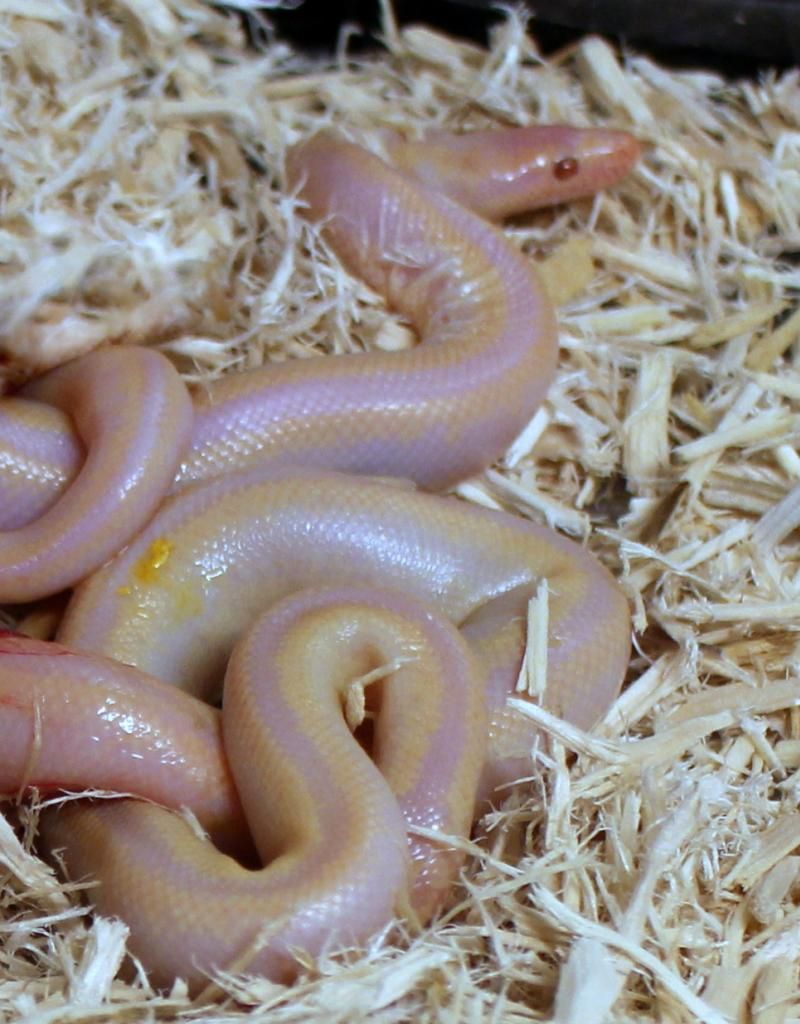
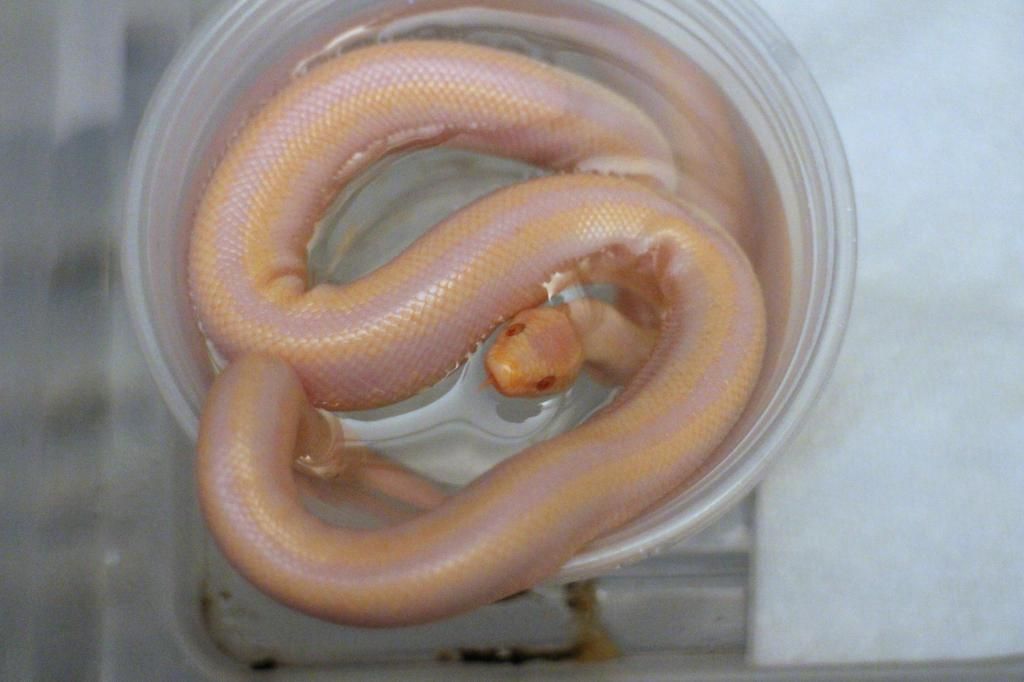
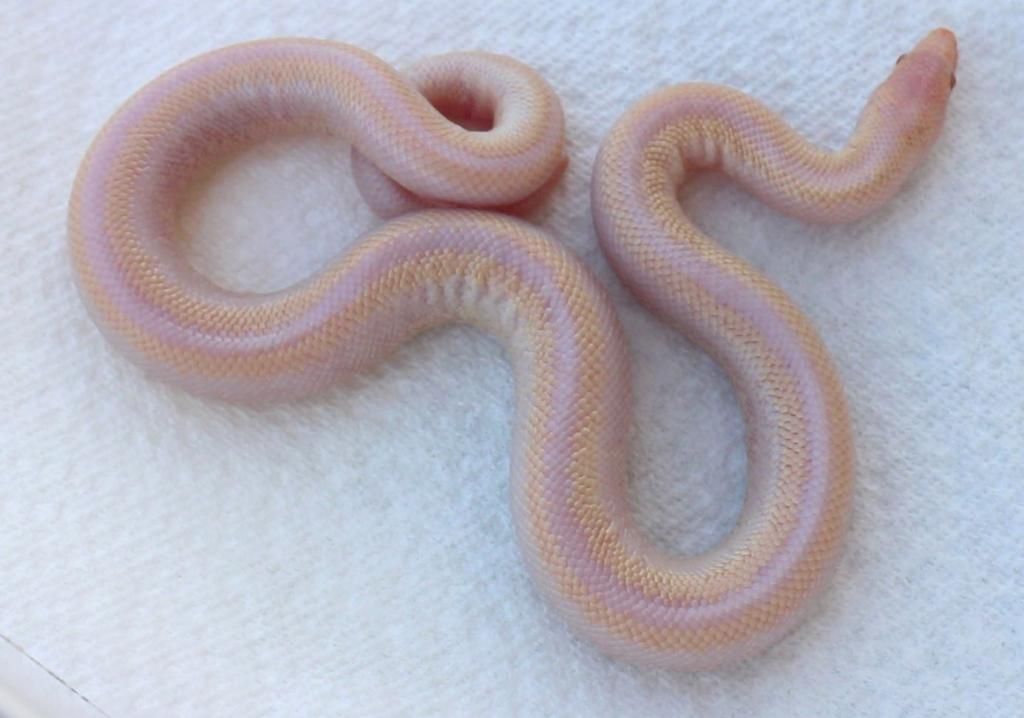
<p>This project was started in 2003 and represents the first completion of several morph projects we hope to bring to fruition over the next two years. The idea behind this project was to create a rosy boa that would express a beautiful new and outrageous color palette. The alteration of color and pattern variation was slowly accomplished through the combination of selectively breeding naturally occurring locales, and adding the introduction of a Natural morph gene. <br />
Multiple females producing identical outcomes this season establishes that the project Rosy’s do carry an inheritable trait, thus qualifying it as a new “Morph.”<br />
Two of the three defining categories were combined in the eventual outcome making these new examples a “Natural, Selectively Bred” morph.<br />
Working with various albino genes over the years had led to an understanding of how certain naturally occurring colors would visually appear when expressed in albino form. Additionally, the manipulation of Rosy Boa patterns could allow for placement of new color locations. It was with both of these concepts in mind that the ending morph result was achieved.<br />
An eleven year project may sound ridiculous to some (and at this point even to me) but I just keep thinking those ball python guys have no idea what they’re missing!</p>
<p>Introducing the <b>PICASSO’S</b></p>
<p><img class="img-fluid" src="http://i57.photobucket.com/albums/g204/albinorosy/IMG_1021recrop_zpsfcac094c.jpg"></p>
<p><img class="img-fluid" src="http://i57.photobucket.com/albums/g204/albinorosy/IMG_1153res_zps87963011.jpg"></p>
<p><img class="img-fluid" src="http://i57.photobucket.com/albums/g204/albinorosy/MVI_1035_zpsceaa4939.jpg"></p>
<p><img class="img-fluid" src="http://i57.photobucket.com/albums/g204/albinorosy/picassologo_zpsb5ce38fe.jpg"></p></div>
<div class="rss-post"><p><strong>Reply</strong> by electricbluescat &mdash; 2015-10-31 06:15:11 GMT</p><p>nice!</p></div>
<div class="rss-post"><p><strong>Reply</strong> by Miloradovich &mdash; 2015-01-15 15:21:48 GMT</p><p>Wow! Congratulations on a long project come to fruition. Beautiful boa, love the lavender coloration.</p></div>
<div class="rss-post"><p><strong>Reply</strong> by markg &mdash; 2014-10-06 18:27:13 GMT</p><p>Congrats to you! I appreciate you folks who continue to work with these fantastic snakes.</p>
<p>On a purely aesthetic view, I still think albino rosies are stunning snakes, all of them. And this is coming from me who to this day still loves the look of the butt-ugliest rosies nature has to offer. (Yeah, I like the darkest coastals, they are big, friendly, tolerant, never in a hurry, ugly, but they are beautiful.)</p></div>
<p><a href="https://forums.kingsnake.com/view.php?id=2026656">View full thread on Kingsnake.com</a></p>]]></description>
  <dc:date>2015-10-31T06:15:11+00:00</dc:date>
  <dc:creator>albinorosy</dc:creator>
</item>
<item rdf:about="https://forums.kingsnake.com/view.php?id=2025408">
  <title>to dust or not to dust?</title>
  <link>https://forums.kingsnake.com/view.php?id=2025408</link>
  <description><![CDATA[<div class="rss-post"><p><strong>Original post</strong> by mustacheman5 &mdash; 2014-07-15 21:08:56 GMT</p><p>I am the new proud owner of a rosy boa. I have one question. Should I dust my pinkies or not? Any feedback is appreciated. Thank you.</p></div>
<div class="rss-post"><p><strong>Reply</strong> by Mntkingdave &mdash; 2014-08-14 00:36:35 GMT</p><p>I have been breeding rosies very successfully for 25 years, and I have never dusted food items with supplements.  I have always believed for nocturnal reptiles it is critical to feed rodents that have been given a high quality diet, such as Teklad lab pellets.  That being said, I don't think dusting would hurt in very small quantities.</p></div>
<div class="rss-post"><p><strong>Reply</strong> by mustacheman5 &mdash; 2014-07-18 23:20:04 GMT</p><p>Ok.  Thank you.</p></div>
<div class="rss-post"><p><strong>Reply</strong> by markg &mdash; 2014-07-18 23:07:57 GMT</p><p>No, not necessary. I do not think it hurts at all. I used it (with D3) with no issues on rosies. Snakes like rosies are fossorial most of the time, or else usually move at night. I doubt they get much direct sunlight. No, I don't doubt, I know they don't. So sunlight is not used for D3, kind of like our hair does not generate D3 (scales are alot like fingernails or hair) which means D3 is likely not needed in a supplement. Does it hurt to have it? I don't think so. Light dusting won't hurt anything.</p>
<p>I think mine does not have phosphorous. I can't remember that argument, which is better for what. Time for me to google that.</p></div>
<div class="rss-post"><p><strong>Reply</strong> by mustacheman5 &mdash; 2014-07-18 19:10:36 GMT</p><p>Ok.  Thank you.  Is vitamin d3 calcium necessary? I have an indoor snake.</p></div>
<div class="rss-post"><p><strong>Reply</strong> by markg &mdash; 2014-07-18 18:59:49 GMT</p><p>With calcium? Or with vitamins plus calcium? I would not do vitamins at every feeding. Calcium is OK at every feeding.</p>
<p>I used to dust with all snakes species years ago, then I quit. Then I started again. IMO it seems to make a difference in vigor when the diet is thawed mice vs fresh mice.</p>
<p>I do vitamins about once every 3 feedings, and I do a light dust of calcium each feeding. Most probably falls off, but some gets in.</p>
<p>Calcium-supplemented female rosies always produced well for me back in the day. I don't think it is the only difference, but it is part of the overall equation.</p>
<p>Too many vitamins all the time is not good. Better to go sparingly on vits. With sinaloan milks, vits produced nice color. Probably beta-carotene. Just a little goes far.</p>
<p><img class="img-fluid" src="http://gallery.kingsnake.com/data/25lcrosy_m1_pose1-med.jpg"></p></div>
<p><a href="https://forums.kingsnake.com/view.php?id=2025408">View full thread on Kingsnake.com</a></p>]]></description>
  <dc:date>2014-08-14T00:36:35+00:00</dc:date>
  <dc:creator>mustacheman5</dc:creator>
</item>
<item rdf:about="https://forums.kingsnake.com/view.php?id=2019332">
  <title>Hypo Morongo Rosies</title>
  <link>https://forums.kingsnake.com/view.php?id=2019332</link>
  <description><![CDATA[<div class="rss-post"><p><strong>Original post</strong> by Tony D &mdash; 2013-11-04 15:27:26 GMT</p><p>Anyone know about these?  Are they a local based morph or a cross?<br />
-----<br />
<b>“Nothing is at last sacred but the integrity of your own mind.”  Emmerson</b></p>
<p><a href="http://WWW.TDSNAKES.BLOGSPOT.COM" target="_blank">WWW.TDSNAKES.BLOGSPOT.COM</a></p></div>
<div class="rss-post"><p><strong>Reply</strong> by markg &mdash; 2013-11-28 00:51:34 GMT</p><p>Locality. From at least one (if not more) wild caught hypo-ish individuals.</p>
<p>Same happened with Borrego rosies. I have also seen very hypo-ish light-colored rosies from Verbenia Rd that bred true. Have no idea if anyone still breeds the Verbenias.</p></div>
<p><a href="https://forums.kingsnake.com/view.php?id=2019332">View full thread on Kingsnake.com</a></p>]]></description>
  <dc:date>2013-11-28T00:51:34+00:00</dc:date>
  <dc:creator>Tony D</dc:creator>
</item>
<item rdf:about="https://forums.kingsnake.com/view.php?id=2017500">
  <title>albino whitewater rosy boa</title>
  <link>https://forums.kingsnake.com/view.php?id=2017500</link>
  <description><![CDATA[<div class="rss-post"><p><strong>Original post</strong> by zamatattoo &mdash; 2013-09-17 15:00:37 GMT</p><p>I know Ball Pythons. A gentleman here is trying to trade an albino whitewater rosy boa and have no idea the price of this snake or how big it gets or really anything. Any help?</p>
<p>Jason</p></div>
<p><a href="https://forums.kingsnake.com/view.php?id=2017500">View full thread on Kingsnake.com</a></p>]]></description>
  <dc:date>2013-09-17T15:00:37+00:00</dc:date>
  <dc:creator>zamatattoo</dc:creator>
</item>
<item rdf:about="https://forums.kingsnake.com/view.php?id=2014483">
  <title>Rosy habitat, So Cal near the low desert</title>
  <link>https://forums.kingsnake.com/view.php?id=2014483</link>
  <description><![CDATA[<div class="rss-post"><p><strong>Original post</strong> by markg &mdash; 2013-08-05 21:53:59 GMT</p><p>Took this pic on May 26, 2013. On the way home, I lost the camera (small cheapy). Just found it this morning under my car seat.</p>
<p>I climbed around this area in the late morning. Too warm and dry for me to expect to see anything, but it was fun anyway to simply survey the rocks and crevices and get lots of scrapes on my legs.<br />
<img class="img-fluid" src="http://gallery.kingsnake.com/data/25rosy_habitat_SJM_cmp-med.JPG"></p></div>
<div class="rss-post"><p><strong>Reply</strong> by markg &mdash; 2014-03-03 18:10:13 GMT</p><p>Thank you. Nice pics - who is that?</p></div>
<div class="rss-post"><p><strong>Reply</strong> by bluerosy &mdash; 2014-01-16 05:54:51 GMT</p><p>First off all good job on giving sound advice here mark.</p>
<p>Actually we used to keep rosys in smaller tank than 20gallon with screen lids.But 20's won't hurt for larger female.  a lot of us had the best success with the screen top and basic glass gallon type aquaria with watr offere sparingly with the exception of gravid female and neonates.</p>
<p>. All the oldies kept them this in tanks w/ screen lids. I kept kept a collection of over a hundred of rosys for over 30 years like this. Then so did Gary Keelser and today Jerry Hartly still does. Ventilation is important and rosys just don't do well with high humidity and rack systems. They also do better with bottom heat instead of heated rooms or back heat.</p>
<p><img class="img-fluid" src="http://www.fototime.com/{DA139676-3A9C-4246-A32A-97C3967A858E}/sspict/640/exp=f&modt=41515.870271412&ssdyn=1/ScannedImage047_047_047.JPEG"></p>
<p><img class="img-fluid" src="http://www.fototime.com/{EE60499A-FE17-4060-8402-C2C49C89789A}/sspict/640/exp=f&modt=41515.8703137269&ssdyn=1/ScannedImage048_048_048.JPEG"><br />
-----<br />
&quot;So I will end with, your now aware of the problem, what YOU do is entirely up to you. Now if you make THIS mistake, its not because you are ignorant.&quot;</p>
<p>Frank Retes</p></div>
<div class="rss-post"><p><strong>Reply</strong> by markg &mdash; 2013-08-30 23:52:31 GMT</p><p>That is awesome. I would love to see the cage.</p>
<p>I always found rosies to be a bit different in needs in comparison to kingsnakes, cornsnakes, pituophis. The thing about rosies is that you can see success or failure pretty quickly. The ability to produce healthy, fat young, or not, is a good indicator. Unhealthy or unhappy rosies typically do not produce well at all.</p></div>
<div class="rss-post"><p><strong>Reply</strong> by tectovaranus &mdash; 2013-08-30 18:20:56 GMT</p><p>Thanks for the responses.<br />
The habitat shots are great thank you.<br />
I've been keeping and breeding reptiles for over 20 years, mostly varanids and I own a naturalistic fabrication company that designs and builds zoo exhibits all over the country.<br />
I respectfully disagree with your husbandry protocols and my experiences have been quite the opposite of yours.<br />
I'll be providing a fairly small exhibit size equivalent to a 4x2x4tall. Deep natural substrate (dirt sand mix) and will provide a large thermal and humidity gradient.I'll probably get a female to go with the male and let them go year round. Hopefully they will burrow and I'll only see them when they cruise. <br />
Thanks again.</p></div>
<div class="rss-post"><p><strong>Reply</strong> by markg &mdash; 2013-08-30 18:10:40 GMT</p><p>I urge you to experiment, as you may just find out something. Here is what I found out.</p>
<p>I tried a few different caging strategies out. Im my experience, keep cages somewhat small. A 20 gal long is sufficient for an adult. My rosies fed and bred well when the cage was nothing more than a glass tank with screen top (or plastic cage with ample ventilation), some substrate (aspen or sani chips), a heat pad or ceramic emitter, and some newspaper or packing paper thrown over the top of the substrate. That's it. I tried rock hides, large cages, decorations, racks, etc, and came back to the very simple setups with more ventilation than for a typical kingsnake or cornsnake setup.<br />
<img class="img-fluid" src="http://gallery.kingsnake.com/data/25lcrosy_m1_pose1-med.jpg"></p></div>
<div class="rss-post"><p><strong>Reply</strong> by markg &mdash; 2013-08-30 18:01:01 GMT</p><p>Cool</p>
<p><img class="img-fluid" src="http://gallery.kingsnake.com/data/25lcrosy_m1_rustic1-med.jpg"></p>
<p><img class="img-fluid" src="http://gallery.kingsnake.com/data/25Low_desert_park_cmp-med.JPG"></p>
<p><img class="img-fluid" src="http://gallery.kingsnake.com/data/25Low_desert_road_cmp-med.JPG"></p></div>
<div class="rss-post"><p><strong>Reply</strong> by markg &mdash; 2013-08-30 17:57:43 GMT</p><p>Low desert going up into the foothills.<br />
<img class="img-fluid" src="http://gallery.kingsnake.com/data/25LowDesert_Rosy_Habitat3-med.jpg"></p>
<p><img class="img-fluid" src="http://gallery.kingsnake.com/data/25WW_Canyon_Preserve2-med.jpg"></p>
<p><img class="img-fluid" src="http://gallery.kingsnake.com/data/25Riverside-Rosy-Habitat2-med.jpg"></p></div>
<div class="rss-post"><p><strong>Reply</strong> by tectovaranus &mdash; 2013-08-27 17:15:13 GMT</p><p>cool, I just came over to this forum to see if anyone had any rosy habitat pics from So Cal to share and see this!<br />
Do you have any other habitat shots from this area?<br />
I was just given a rosy (supposedly) from this area and will be building a naturalistic exhibit for him in the next few months, so any habitat shots anyone has would be appreciated.<br />
I have lots of habitat shots from where I've found rosys in the Mojave but none from So. Cal.<br />
Also what are the current rosy books you guys recommend here? I have all the old T.F.H style stuff (Walls) but obviously it's dated. <br />
Thanks!</p></div>
<p><a href="https://forums.kingsnake.com/view.php?id=2014483">View full thread on Kingsnake.com</a></p>]]></description>
  <dc:date>2014-03-03T18:10:13+00:00</dc:date>
  <dc:creator>markg</dc:creator>
</item>
</rdf:RDF>