Original post by CH4 — 2012-10-02 17:05:04 GMT
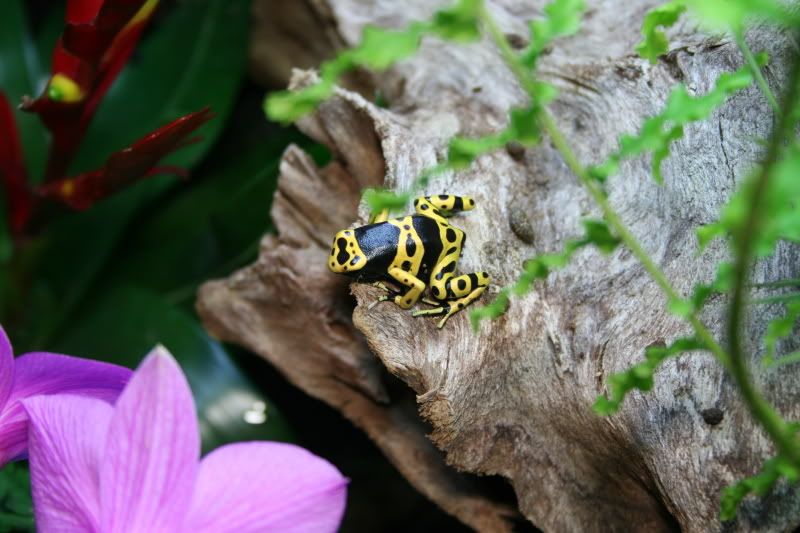
Has anyone seen this before? What would you call it? No yellow or blue. Any information will be appreciated. It is a 3 month oow imitator "baja huallaga".

 Uploaded with ImageShack.us" alt="Image">
Original post by FirstFear — 2015-11-16 18:48:07 GMT
I am new to the hobby and doing some research. I am looking for a good habitat to set some darts up in. I have the ecoterra tank for a milk snake and was thinking it might be a good way to do darts, but was concerned the wingless fruit flies would be able to crawl out of the mesh portion or where the top latches down.
Has anyone had this issue before? I was at a reptile show over the weekend and saw some acrylic "boxes" they were using to house tarantulas etc and thought those might work. Does anyone have suggestions as to the type of tank or habitat. I used to keep a mantis that had babies and we were feeding them the fruit flies and it was a concern back then.
Any help or suggestions would be very welcomed.
Thank you,
Scott
]]>Original post by FrogSwabber — 2015-06-27 00:23:34 GMT
Does anyone know how likely it is that Mantellas exported from Madagascar might be infected with chytrid fungus? A few months ago I heard that chytrid was found all over Madagascar, but then a survey after that one did not find it anywhere: http://journals.plos.org/plosone/article?id=10.1371/journal.pone.0125330
What do you guys think is the situation over there with chytrid?
Madagascar Chytrid Survey Results
Original post by CH4 — 2012-10-02 17:05:04 GMT
Has anyone seen this before? What would you call it? No yellow or blue. Any information will be appreciated. It is a 3 month oow imitator "baja huallaga".
Uploaded with ImageShack.us" alt="Image">
Original post by zainramzey — 2012-06-17 21:53:19 GMT
I am looking at starting up a dart frog habitat and I was wondering what species if any I could house together.
]]>Original post by AnnaCB — 2012-05-14 01:37:53 GMT
Hi there.
This is crossposted from the health forum.
I had a few animals come in as rescues a few weeks ago, mostly amphibians.
Most seem quite sprightly, but I've got a large adult dart frog who has grey patches on his skin.
I know they shed, yes, but this seems a little too localized (top of the head, along those strong lines of the back, etc.), not the overall slight dullness... he's also not showing any other signs of being about to slough, like the yawning or anything similar.
He's eating and has been active, but this is kind of worrisome. My experience with dart frogs has been mainly with healthy ones, so this is new to me.
All of the frogs/toads are separated and he's being switched to just moist paper towel substrate in a Sterilite until this is figured out.
IS he going to shed and I'm just over-cautious? Is this a fungus? Any suggestions or ideas? I've attached a few pictures. I'm also going to crosspost to the dart/mantella board, but it seems pretty dead there.
If you're finding it hard to see the spots, you can go to the actual picture link and zoom in.
Thanks!


Original post by dadeherper — 2011-08-14 07:52:41 GMT
http://www.youtube.com/user/dadeherper
]]>Original post by snakemanRuss — 2011-08-09 18:09:04 GMT
Is UV light a requirment for proper dart frog husbandry? I have talked with several dart frog keepers and have received several different answers or idea's concerning the use of UV light for not only adult frogs but for froglets and tadpoles. Does anyone know if their has been any credible scientific research done dealing with this subject? Thanks Russ
Reply by EdK — 2011-08-13 20:16:07 GMT
Technically if you properly supplement the frogs then you do not need to use UVB for them however there are issues with some frogs because the size of the metamorphs makes dusting thier food items very difficult (such as newly emerged pumilo) and the metamorphs tend to feed on small food items like springtails and mites. In those species, it isn't uncommon for there to be high levels of mortality between the time of metamorphosis and six months of age. In those species, people who have added UVB exposure as an option for the frogs have an increased level of success with those species as the froglets can then get D3 through behavioral exposure.
In the literature it is known that at least some dendrobatids avoid excess exposure to UVB by choosing less exposed calling sites and/or having activity periods when exposure is reduced (for example one popolation of pumilio and auratus, had the highest levels of activity before 10 AM and after 3 PM.
some comments,
Ed
Original post by igren — 2011-07-30 12:09:13 GMT
Hiked about 8 miles into the jungle in Costa Rica and found this. Im not sure if its a frog or a toad and no park employees or guides were able to tell me what it is. Id say it was about 1" to 2". I heard that some real experts lurk these forums and might be able to tell me.
Thanks!
http://a7.sphotos.ak.fbcdn.net/hphotos-ak-ash4/284926_10150242486240028_550165027_7598727_3967083_n.jpg

Reply by EdK — 2011-08-17 02:32:47 GMT
Not even in the same genera. It is a toad, which species exactly I'm not sure as I'm not up on all of the leaf litter species. Post it over on the field herp forum, the real big wigs hang out there http://www.fieldherpforum.com/forum/
Ed
Reply by dadeherper — 2011-08-16 18:36:20 GMT
I believe this is what you may have found.
http://www.blackjungleterrariumsupply.com/Froglet--Epipedobates-anthonyi-Pasaje-Sarajunga_p_1924.html Or a possible sub species.
Link
Original post by dadeherper — 2011-07-19 01:35:12 GMT
I got two Blue Dart frog tadpoles on May 7th and are now sub-adult
frogs. Here are a few tricks I have used in my feeder fly mix. Beech nut Brand Multigran baby cereal runs around 2 dollars at the grocery store.the ingredients consist of whole wheat flour oat flower rice flour and sunflower lecitin also wheat. I went to Lowes and got some organic bone meal I mix a little bit of that in with it as well for added calcium. I assume just from my studys from the last few month the higher the mineral content in the food the better.More than likely this attributes fertility issues as well. So basically speaking the better the diet your feeders receive the better outcome you will have. For instance my female Veiled chameleon is huge compared to what I have seen in books but she has been feed a highly nutritious diet.Next month I will be posting pictures of my findings/research.
Reply by dadeherper — 2011-08-05 08:07:18 GMT
Well I will try my method and you can try yours thanks for the comment though. I will keep that in mind but the truth of the matter is my frogs are growing at a faster rate than most would.
Reply by EdK — 2011-08-01 17:20:25 GMT
You can't raise the calcium levels of flies by adding calcium to the media, they are exceedingly efficient in excreting any surplus calcium so the flies still have a negative calcium to phosphorus ratio. This requires that the flies have to still be dusted.
If you want to look at inexpensive medias check out the recipes here http://doylesdartden.com/fruitfly.html#MEDIA as some of them cost just cents per culture.
What is required to produce a nutritious fly is much better known now than in the past but is a little too much to sit down and type out here, but your recipe just isn't it...
Original post by kyleherp — 2011-04-04 21:41:37 GMT
I am just wondering where everyone thinks the best place for me to get some Cobalt Dart frogs is. I have been looking a lot and I am just wondering if anyone know of a place that has better looking ones or whatever. Let me know 
Thanks
Kyle
Kyle's Reptyles
www.freewebs.com/kyleherp/
Original post by — 2011-03-30 16:07:39 GMT
EUREKALERT (Washington, DC) 29 March 11 Fitness tests for frogs? - Treadmill tests for poison frogs prove toxic species are more physically fit (Contact: Robin Ann Smith, rsmith@nescent.org 919-668-4544, National Evolutionary Synthesis Center (NESCent))
Durham, NC: The most toxic, brightly colored members of the poison frog family may also be the best athletes, says a new study.
So-named because some tribes use their skin secretions to poison their darts, the poison dart frogs of the Amazon jungle are well known for their bitter taste and beautiful colors. The spectacular hues of these forest frogs serve to broadcast their built-in chemical weapons: skin secretions containing nasty toxins called alkaloids. Like the red, yellow and black bands on a coral snake or the yellow stripes on a wasp, their contrasting color patterns warn would-be predators to stay away, said lead author Juan Santos of the National Evolutionary Synthesis Center in Durham, NC.
As it turns out, the most boldly-colored and bad-tasting species are also the most physically fit, the authors report this week in the journal Proceedings of the National Academy of Sciences.
In forests in Colombia, Ecuador, Venezuela, and Panamá, Santos subjected nearly 500 poison frogs — representing more than 50 species — to a frog fitness test. He measured their oxygen uptake during exercise using a rotating plastic tube, turning the tube like a hamster wheel to make the frogs walk.
Santos estimated the frogs' metabolic rates while at rest, and again after four minutes of exercise. The result? The most dazzling and deadly species had higher aerobic capacity than their drab, nontoxic cousins.
"They're better able to extract oxygen from each breath and transport it to their muscles, just like well-trained athletes," Santos said.
Poisonous species owe their athletic prowess to their unusual foraging habits, explained co-author David Cannatella of the University of Texas at Austin. Unlike snakes and other poisonous animals which make their own venom, poison frogs get their toxins from their food.
"They acquire their alkaloid chemicals by eating ants and mites," Cannatella said.
Because of their picky diet, poisonous frogs have to forage far and wide for food. "Nontoxic species basically stay in one place and don't move very much and eat any insect that comes close to them," Santos said. "But the bright, poisonous frogs are very picky about what they eat."
"It's not like a buffet where they can get everything they need to eat in one place," Cannatella added. "Ants and mites are patchy, so the frogs have to move around more to find enough food."
This combination of toxic skin and bold colors — a syndrome known as aposematism —evolved in tandem with specialized diet and physical fitness multiple times across the poison frog family tree, the authors explained. In some cases the frogs' physical fitness may have evolved before their unusual diet, making it possible to forage for harder-to-find food. But the specific sequence of events was likely different for different branches of the tree, Santos said.
The findings appear in the March 28 issue of Proceedings of the National Academy of Sciences.
###
CITATION: Santos, J. and D. Cannatella (2011). "Phenotypic integration emerges from aposematism and scale in poison frogs." Proceedings of the National Academy of Sciences. www.pnas.org/cgi/doi/10.1073/pnas.1010952108.
Fitness tests for frogs?
Reply by DocOp — 2012-10-09 04:48:43 GMT
I'd have the read what species they used. Seems to be dart from are pretty physically fit because several species wrestle (combat)...which leads to increased "fitness" (fitness as in physically fit).
Original post by Darcey — 2011-02-08 04:00:38 GMT
Greetings,
I am new to the group, but not to the love of Poison Dart Frogs. My Old fish tank is nearly void of fish and I am currently looking to gather as much information on poison darts as I can. A friend from work told me I could put about 1 frog per 10 gallons. I have a stand 36l by 18w so I was planning on getting as large of an enclosure as possible to fit on it. I plan on live plants, and have heard I would be best off with Petri Dishes for water so that the water isn't too deep. I know to spray mist so that there is beaded water on the wall of the enclosure but not drenching it for worry of drowning the little guys.
I have been told that the females are more territorial than males on average, which leads me to believe that if I want multiple frogs, I should consider a variety of Pairs. Is this a plausable idea? Do I have to worry about different varieties breeding together? I know there is a need to keep lines pure. I do not want any accidents.
Are there any books, Tips, Tricks, Preferances you have that you are willing to reccomend or pass on? Favorite Recsources?
Thanks so much for any help you can give me.
Brightest Blessings,
Darcey
Reply by Darcey — 2011-02-13 01:55:38 GMT
Thanks so much for the web site reccomendation, I truely appreciate it. A friend had reccomended the Vanishing Jewels site-but i have had no luck finding it. Do you happen to know if they make dividers for such tanks? Or what other tank mates I might be able to add for diviersity that would not put the dart frogs in jeapordy? The stand I have is for a 40 gallong Breeder, and while I will be looking into ordering a more frog friendly tank, we carry a brand at work that works wonderfully-they have had Mantellas in them on display in the past and it worked beautifully! They even make this misting thing by the same company called the Monsoon (Handy for when I am gone at work and they may need a spritz-I was planning on having it hooked up to a hydrometer).
Thanks again,
Darcey
Reply by df92484 — 2011-02-12 04:17:17 GMT
Hey Darcy,
I think you've got the right idea on size requirements, in general dart frogs prefer more horizontal space than vertical. A tank to match the size of your stand would be enough for a small group. Females are more territorial in certain groups such as Tincs, but given enough space you would be fine with multiple females. Generally they don't get overly aggressive without the presence of a male. You don't want to mix multiple species of frogs in one tank, they can interbreed creating "morphs" which is considered a no no. In my own opinion I've always found that one species of frog per tank is more than satisfying anyway. For more information and care related articles check out www.dendroboard.com
-----
2.2.9 Crested Geckos
0.1 packman frog
1.1.1 Box Turtles
3 green and black auratus
Original post by tomcovert — 2011-01-24 18:30:04 GMT
I have a 55 gal tank that as of last month became vacant due to savi grew out of it and now i would like a nice viv with dart frogs. I have been researching for about a month now and to my heart break per my nov. 2010 reptile mag. i cannot keep my preferred D.Azureus in groups (so now im setting up a 10 gal viv too lol). I would would like to put a group of 5 to 7 frogs in my 55 gal. My design has in mind a 1 inch deep water feature as well so i would like species suggestion thats not prone to drowning. Also the water feature is still a reluctantly removable factor if need be (if not recomended for any pdf's). Most of my research has been on dendrobates and thumbnail frogs and would prefer to stay w S.American frogs but if someone thinks that mantellas would be a better choice i will also look into them. Any input would be great and thanks a head of time.
]]>Original post by kati537 — 2010-11-29 01:00:36 GMT
Hello,
I recently bought a pair of painted mantellas, which I believe are Mantella madagascariensis. However, they are not black and orange like the pictures I have seen. They both have patterns that are identical to Mantella madagascariensis. They both have orange legs until the upper thigh which turns to a bright green. Their bodies are bright green where other painted mantellas are orange. One (who looks like a male) has a green eyebrow and the other (who looks like a female) has a yellow eyebrow. I could not find any pictures of mantellas that are identical to these. Are these just a different locale or subspecies of Mantella madagascariensis? or a different species? Any help is appreciated, thanks
Original post by brucealbinos — 2010-09-17 15:01:46 GMT
Defenders of Wildlife files petition to list Non-Native Amphibians on Lacey Act
The U.S. Fish and Wildlife Service (Service) is
reviewing a petition to list, under the Lacey Act, all live amphibians
or their eggs in trade as injurious unless certified as free of
Batrachochytrium dendrobatidis (chytrid fungus). The importation and
introduction of live amphibians infected with chytrid fungus into the
natural ecosystems of the United States may pose a threat to interests
of agriculture, horticulture, forestry, or to wildlife or the wildlife
resources of the United States. An injurious wildlife listing would
prohibit the importation of live amphibians or their eggs infected with
chytrid fungus into, or transportation between, States, the District of
Columbia, the Commonwealth of Puerto Rico, or any territory or
possession of the United States by any means, without a permit. We may
issue permits for scientific, medical, educational, or zoological
purposes. This document seeks information from the public to aid in
determining if a proposed rule is warranted.
DATES: We will consider information received or postmarked on or before
December 16, 2010.
ADDRESSES: You may submit comments by one of the following methods:
Federal eRulemaking Portal: http://www.regulations.gov.
Follow the instructions for submitting comments to Docket No. FWS-R9-
FHC-2009-0093.
U.S. mail or hand-delivery: Public Comments Processing,
Attn: Docket No. FWS-R9-FHC-2009-0093, Division of Policy and
Directives Management, U.S. Fish and Wildlife Service, 4401 North
Fairfax Drive, Suite 222, Arlington, VA 22203.
FOR FURTHER INFORMATION CONTACT: Susan Jewell, Branch of Aquatic
Invasive Species, U.S. Fish and Wildlife Service, MS 770, 4401 N.
Fairfax Drive, Arlington, VA 22203; telephone 703-358-2416. If you use
a telecommunications device for the deaf (TDD), call the Federal
Information Relay Service (FIRS) at 800-877-8339.
SUPPLEMENTARY INFORMATION: On September 9, 2009, Department of the
Interior Secretary Ken Salazar received a petition from the Defenders
of Wildlife requesting that live amphibians or their eggs in trade be
considered for inclusion in the injurious wildlife regulations (50 CFR
part 16) under the Lacey Act (18 U.S.C. 42) unless they are free of
Batrachochytrium dendrobatidis (chytrid fungus). The Defenders of
Wildlife is concerned that unregulated trade--primarily for pet use and
as live animals for consumption as frog legs--continues to threaten the
survival of many amphibian species, including domestic and foreign
species listed by the Service under the Endangered Species Act of 1973
as amended (ESA; 16 U.S.C. 1531 et seq.), candidate species, and other
species.
Please stay tuned for further updates from USARK.
Reply by OHI — 2010-12-04 21:21:06 GMT
There are only 95 comments on the proposal to ban all trade in amphibians without expensive screening. You folks need to wake up. Don't be lazy. This effects the entire herp industry but especially amphibian keepers. I want to see everyone on this forum make comments right now. There is a link on the Herp Law Forum (upper right of web page). If you plan on breeding and selling your frogs you better comment or you will be banned. If you want to be able to purchase amphibinas in the future you better comment. Just a friendly suggestion to get off your hineys!
Welkerii
Original post by ChristinaK — 2010-09-07 02:02:07 GMT
I am not new to the world of snakes but I am new to the world of Dart Frog. I have wanted to do a dart frog tank for a few years now but never knew where to start. I guess my first question should be is there alot of care needed to take care of dart frogs?
Reply by ChristinaK — 2010-09-19 16:10:47 GMT
The tank I have is a Exo Terra Glass Terrarium. Its top covering is a metal screen and a section for the light to sit in. My question is will I have to cover this screening with something else to keep the moisture from excaping or is it fine the way it is?
Original post by willowtigris — 2010-07-26 15:49:17 GMT
Hi everyone,
I am new to the dart frog world and am in the process of contructing a terrarium. I am using hydroballs, plants, running water, etc etc. I was wondering what type of substrate should I get for the terrarium. I usually use coconut subtstrate, but I did not know if the plants will grow in this well.
Thanks!
Original post by burnziesballs8 — 2010-07-20 16:43:03 GMT
hey guys have an eco terra 24.24.24 habitat with 5 live plants and flowers.... i have 7 mantellas in there... is that okay? or do i need a larger habitat? thanks!
-----
17 BP
2 GTP
3 Chameleons
6 Beardies
1 Crested
2 Huskies
1 blue and gold macaw
1 african grey
1 patternless albino Burmese
2 Reticulated pythons (*purple and lav. albino tiger)
1 savannah monitor ("Spike"
6 treefrogs
2 Brazilian Rainbow boas
Original post by twiztedbizkit — 2010-06-20 06:29:53 GMT
So I've been keeping herps for my whole life along with planted freshwater tanks and one reef over the past five years and have recently decided to start planning a big terrarium for darts. I've set up a few false bottoms in my day, so I'm not worried about that. The problem I'm running into is that everywhere I look for info regarding the plants themselves, nobody says specifically what levels of light various plants need. I see a lot of people saying that certain plants need "high light," but as someone who's used to thinking in terms of watts per gallon, that really doesn't help.
I guess what I'm looking for here is some info from other users regarding what lighting they have, how their plants like it, and what those plants are. That or if anyone knows of a good site that provides specific info on what certain plants like in terrariums, I'd be much obliged.
Jeff
-----
0.2.0 Variable Kingsnakes (Lampropeltis mexicana thayeri)
1.0.0 Cuban Boa (epicrates angulifer)
1.0.0 Haitian boa (epicrates striata)
0.1.0 Russian sandboa (eryx miliaris)
1.0.0 House cat
Original post by alternarush — 2010-05-27 18:12:52 GMT
Just snapped a couple of shots of a new terrarium I just got done setting up. Obviously, it will be better when the plants and vines fill out, but I thought you all might like to see it. It's a 29 vert. No critters. It started out as a "gimmick tank" I call it that because I think waterfalls are cheesy particularly when they change direction and are obviously man made, but I think in the end it worked out fine.
With the front closed:

open:

Super mIni broms:

DAN
Reply by terryd — 2010-09-27 14:35:09 GMT
Yo Dan,
What type of Dart/Mantella you going to put in the new tank? You'll love these little guys really entertaining tank to keep up, and so easy too.
Maybe I'll see you in the Flint hills next spring.
-Dell