return to main index

  market - home
follow us on facebook follow us on twitter link to us on LinkedIn
International Reptile Conservation Foundation  
Click to visit DM Exotics
Locate a business by name: click to list your business
search the classifieds. buy an account
events by zip code list an event
Search the forums             Search in:
News & Events: Kingsnake out and about this weekend . . . . . . . . . .  NARBC shows how the reptile community comes together . . . . . . . . . .  kingsnake.com is coming to Tinley NARBC . . . . . . . . . .  Kingsnake battles a Rattlesnake . . . . . . . . . .  An Educational Roundup? . . . . . . . . . .  The battle for survival for the Ibiza wall lizards . . . . . . . . . .  Bringing back the Horned Lizard . . . . . . . . . .  UGA Study shows pathogens threaten snakes survival in Southern US . . . . . . . . . .  First time Sea Turtle nesting in Florida . . . . . . . . . .  New regulations on Native Species for Wisconsin Keepers . . . . . . . . . .  Heavy Metal Scorpion . . . . . . . . . .  How a python change the course of Attenbourgh's life . . . . . . . . . .  Make good choices . . . . . . . . . .  Burmese found on roadside in Wisconsin raises issues . . . . . . . . . .  Happy Earth Day . . . . . . . . . .  Kingsnake Merch Store . . . . . . . . . .  Kingsnake returns to Tinley . . . . . . . . . .  kingsnake.com joins Monitor Brains! . . . . . . . . . .  Sneak Peek . . . . . . . . . .  Amphibian gut bacteria showing promise in cancer research . . . . . . . . . .  Herp Photo of the Day . . . . . . . . . .  Herp Photo of the Day . . . . . . . . . .  Meet The Baroness - The world's longest snake . . . . . . . . . .  Herp Photo of the Day . . . . . . . . . .  Updates? . . . . . . . . . .  Herp Photo of the Day . . . . . . . . . .  The mechanics behind the viper strike . . . . . . . . . .  Snakes on a Train? . . . . . . . . . .  Tracking the animals in the Florida Everglades - Meet the Croc Docs . . . . . . . . . .  Reintroduction attempts give San Francisco Garter a second chance . . . . . . . . . .  Colorado Herp Society Meeting - July 18, 2026 . . . . . . . . . .  Chicago Herpetological Society Meeting - July 19, 2026 . . . . . . . . . .  Bay Area Herpetological Society Meeting - July 24, 2026 . . . . . . . . . .  DFW Herp Society Meeting - July 25, 2026 . . . . . . . . . .  Tucson Herpetological Society Meeting - July 27, 2026 . . . . . . . . . .  Greater Cincinnati Herp Society Meeting - Aug 05, 2026 . . . . . . . . . .  PACNWRS - Aug. 15-16, 2026 . . . . . . . . . .  Colorado Herp Society Meeting - Aug 15, 2026 . . . . . . . . . .  Chicago Herpetological Society Meeting - Aug 16, 2026 . . . . . . . . . .  DFW Herp Society Meeting - Aug 22, 2026 . . . . . . . . . . 

RE: Hydrodynastes gigas husbandry

[ Login ] [ User Prefs ] [ Search Forums ] [ Back to Main Page ] [ Back to Rear-Fanged ]

Posted by: Nightflight99 at Fri Mar 3 18:49:56 2006   [ Email Message ] [ Show All Posts by Nightflight99 ]  
   

I have been working with H. gigas for years and produce them annually. They are exceptionally hardy and very easy to maintain. Their diurnal activity pattern also makes them very suitable for large display enclosures.


Regarding their husbandry, a daytime temperature gradient of approximately 76-83 F with moderate levels of humidity works very well. Avoid temperatures over 85 F. Hydrodynastes gigas is relatively resistant to low temperatures, so NTLs in the high 60s are not a problem. A large water container should be provided, which most specimens will spend a fair amount of time in.


Their feeding response has already been mentioned, but the upcoming redundancy is well deserved. They are ferocious feeders with a feeding response that only seems to get worse with age. I have repeatedly observed large 7ft specimens literally launching themselves out of the water at any source of movement upon detecting rodent scent. They also have a relatively high metabolism, which makes for frequent feedings and cage cleanings. Other than during feedings, most specimens are fairly docile as adults. Hatchlings can be rather nippy and will often chew on your finger, if they get the chance.


Adult specimens will typically cease feeding around late October or November until January or February. Properly kept, H. gigas will readily reproduce. The clutch size is obviously variable, but the one mentioned above (24) is certainly a large one.


Hope this helps.


~TE
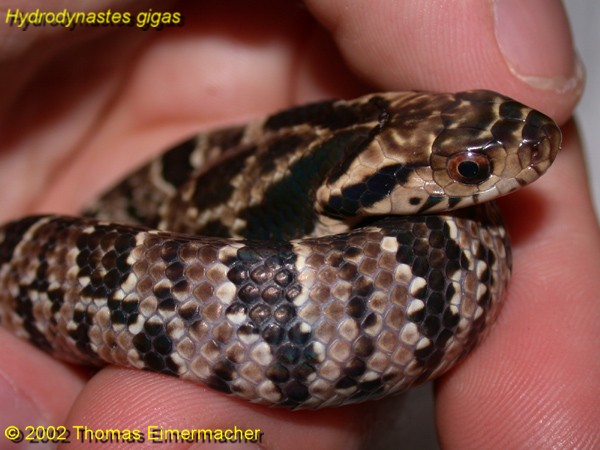


Image
-----
Thomas Eimermacher

Department of Biological Sciences

Southeastern Louisiana University

Hammond, LA 70402


[ Show Entire Thread ]


>> Next Message:  RE: Hydrodynastes gigas husbandry - rearfang, Sun Mar 5 17:17:08 2006

<< Previous Message:  Hydrodynastes gigas husbandry - NerodiaGrappler, Fri Feb 17 03:19:29 2006 image in post

Click to visit DM Exotics Click here to visit Classifieds Click to visit Classifieds
KINGSNAKE.COM

Enjoy all our content free of charge with a user account that gives you full access to every feature. For added visibility, paid options are available - post in our Classifieds, showcase your business with Banner Ads or a Directory listing, promote reptile events, and more.

Quick Links
Community
Legal & Safety
Support

Register for free ✓ Sign up!

Kingsnake.com ® is a registered trademark © 1997-