Posted by:
nategodin
at Sun Jan 24 23:12:38 2010 [ Email Message ] [ Show All Posts by nategodin ]
Shannon,
I know it must have been disappointing (to say the least!) to have waited so long for micropholis to become available in the U.S. again, only to acquire them and then find out that they were not quite what you'd been hoping for. If you're holding out for something that looks like that one from Nabuga, you may very well be waiting another 10 or 20 years! In my humble opinion, though, that's got to be the ugliest of the bunch that you posted... except maybe that drab anery... blech! If I wanted black and white, I'd get a kingsnake!  I suppose that if locality data and recessive traits are what you like, then you would think otherwise... to each his own. As for the rest of them, I don't really think that this: I suppose that if locality data and recessive traits are what you like, then you would think otherwise... to each his own. As for the rest of them, I don't really think that this:

... looks so different from this killer Colombian recently posted by Orlando Diaz:
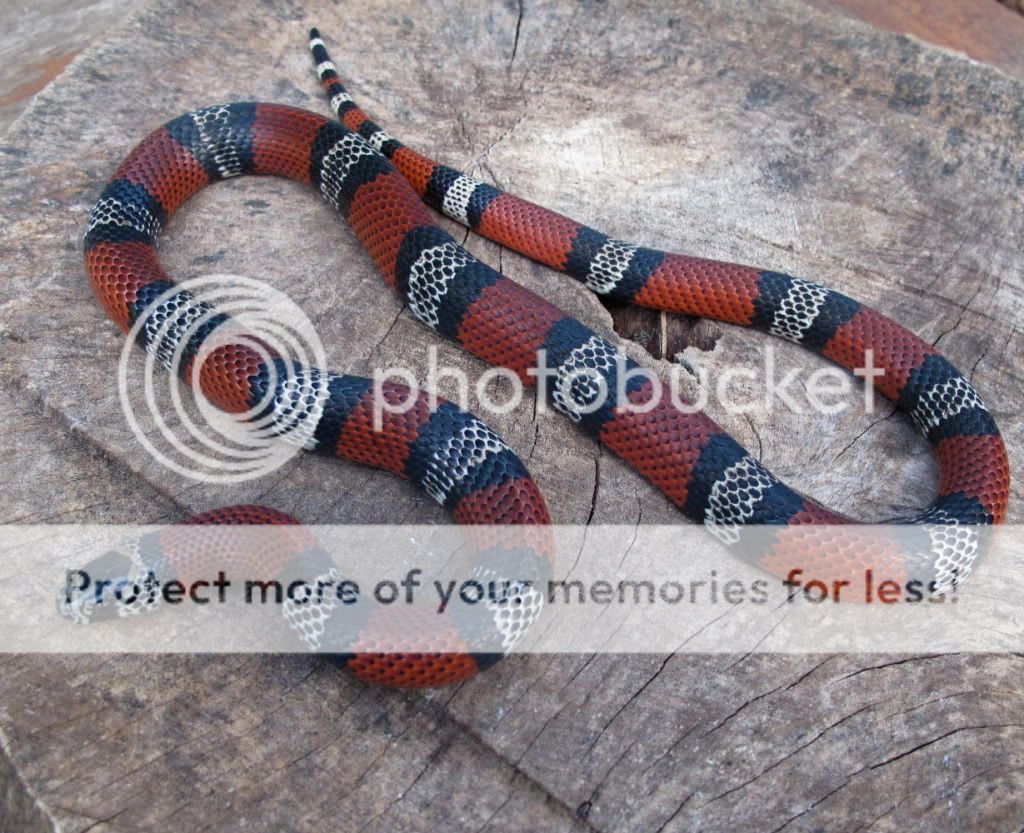
Orlando's appears to have about 16 RBR, maybe a couple more than the one you posted, but still well within the range for micropholis, and just below the range for intergrades. If you look at the head pattern, I'd say that, with that nice solid black "cap" and vertical stripe between the eye and jaw, Orlando's looks more like a micro than the other one, whose head pattern bears an alarming resemblance to that of the andesiana on the front cover of Williams' book... like a black angel. His snake also has that little "moustache" on its prefrontals and internasals, just like the one on the micropholis in the book. So maybe not all of its siblings look so good... a generation or two of selective breeding could take care of that... but it sure looks like the real thing to me.
Quite some time ago, you wrote that unless it's preceded by a locale, any subspecies classification is just a hobby term, and I would tend to agree with that. It seems to me that the situation with these Colombian milksnakes is a lot like the one with non-locale Sinaloan/Nelson's milks. They come from an intergrade zone between two subspecies, and many (considered to be lower quality by many) display traits that are intermediate between the two. Genuine nelsoni are exceedingly rare in the hobby, although their genetic influence is quite evident in many of the intergrades, and the ones that look enough like nelsoni are sold as such. Selectively breed them for fewer, wider, RBRs, and voila, you've got milks that you can sell as sinaloae, and no one's going to call you a mutt-monger for it. But, if you compare those "hobby" Sinaloan to a wide-banded beauty from Cosala... well, there is no comparison, is there? Ditto for locale vs. hobby Nelson's, although I have to say, the real nelsoni are not what I would call beauties! So my point is, these Colombian milks are as much micropholis as generic Sinaloans are sinaloae. If you want to hold out for a milksnake that's as unequivocally a micropholis as a Cosala locale milk is a sinaloae, that is certainly your prerogative, and I applaud your high standards and ideals. It just means there will be that many more mutts on the market for me!
Nate
[ Show Entire Thread ]
|