Posted by:
rtdunham
at Wed May 28 21:47:48 2003 [ Email Message ] [ Show All Posts by rtdunham ]
There have been a lot of questions about incubation on the forum recently. Please note this is ONE person's way of doing things. There are undoubtedly other, equally successful methods.
I provide most of my hondurans with tupperware layboxes roughly 10 inches square and a little more than 4 inches high. I put very damp sphagnum moss in, fluffed up but filled to the lid. The lid has a hole cut in it, about twice the diameter of the snake. NOTE: This is "long fiber" sphagnum moss, NOT sphagnum "peat" moss, a very different product. I soak the sphagnum for a few minutes and then take it out of the bag, handful by handful, and wring out each handful as much as I can by hand, before separating it and putting it loosely into the laybox. I put the boxes in with the females about six days after their pre-lay shed. Females USUALLY spend a couple days on top of the sphagnum and then burrow to the bottom of the container and out of sight, the day before they're going to lay. This year, however, this female and a number of others chose to lay on top of the mashed-down sphagnum.
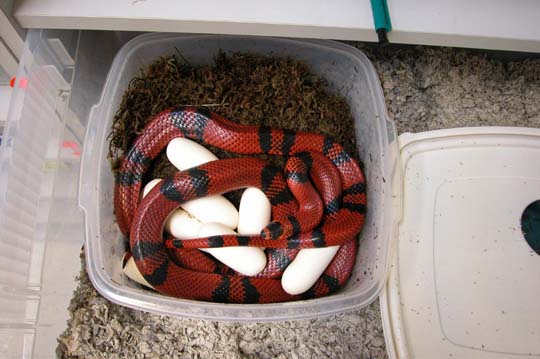
I then move the eggs to smaller tupperware containers of about the same height as the layboxes but half the width. I fill the container about one-third full with damp sphagnum and put the eggs in place, as shown below. I then fill in around them with more sphagnum, then sprinklle some more over the top.
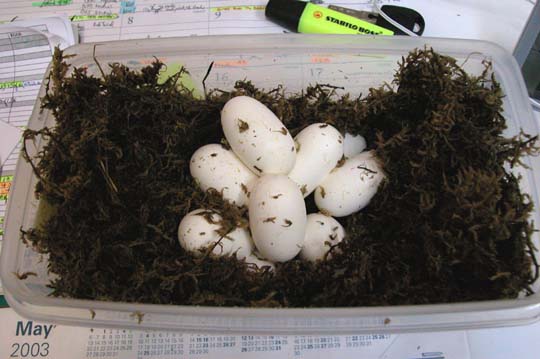
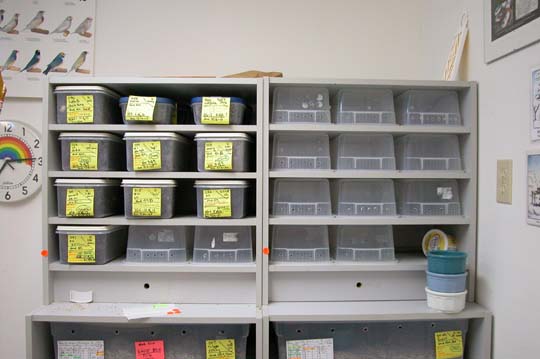
Alternately, you could keep the eggs in the laybox and replace the lids-with-holes with lids-without-holes. I keep the incubation boxes sealed airtight to keep out bugs, and open them every other day and use the lid to fan in fresh air. I prefer switching to the smaller incubation boxes because it enables me to store the eggs during incubation in half the space. I just put them on the shelves in my snake room as shown in the picture below, taken early in the laying season. (later, these shelves will house hatchlings in shoeboxes or large deli cups until they've shed, fed a couple times, and are shipped to their new owners).
Within several days the moisture from the sphagnum saturates the air in the container and condenses on the sides:

The single stick-it note on the front of each box contains a vast amount of information: the identify of the female who laid the eggs; the male that fathered them; the female's shed dates prior to breeding; the dates of copulations and levels of sperm in samples expressed; the date the eggs were laid; the number of eggs laid; the number that were good; and finally, the date the eggs are due to hatch. These stick-its start out on the breeding cages and are moved to the incubation boxes along with the eggs.
I hope this information helps. I'm sure others can share information on their equally effective methods.
Peace
Terry
Albino Tricolors Inc.
[ Show Entire Thread ]
|