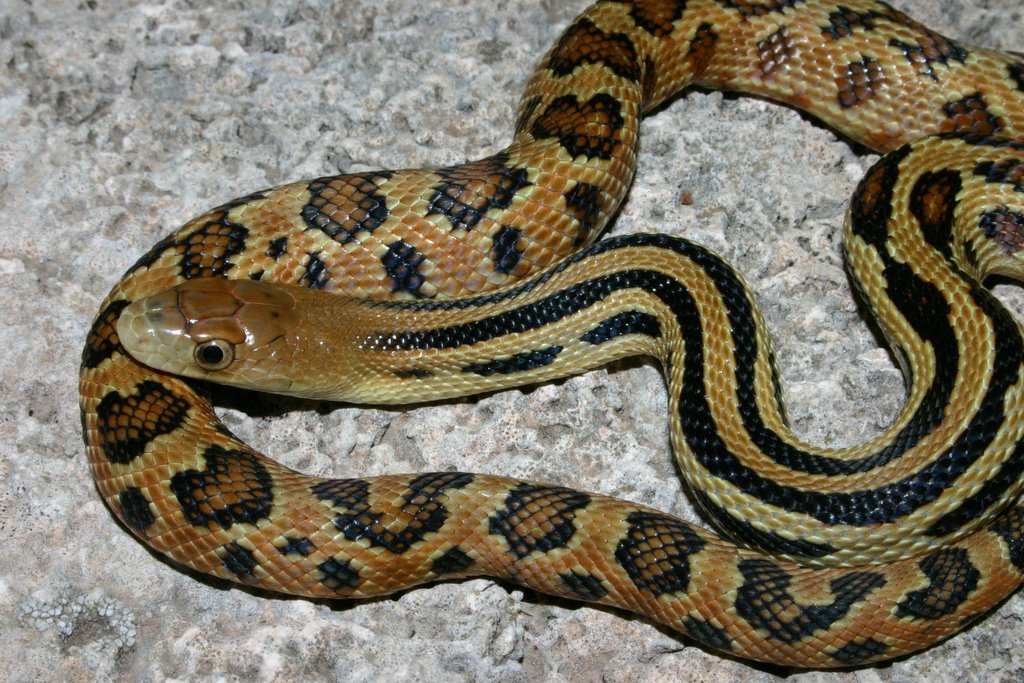
Anyone know where these snakes are found? They are so suboc-looking...it would be neat to see if they cross paths anywhere. Mike Price took this excellent photo.
Thanks!
Dusty R.
Welcome to kingsnake.com's message board system. Here you may share and discuss information with others about your favorite reptile and amphibian related topics such as care and feeding, caging requirements, permits and licenses, and more. Launched in 1997, the kingsnake.com message board system is one of the oldest and largest systems on the internet.


Anyone know where these snakes are found? They are so suboc-looking...it would be neat to see if they cross paths anywhere. Mike Price took this excellent photo.
Thanks!
Dusty R.
The subsp. pictured (P.l. lineaticollis) is found from Michoacan south through Chiapas, mainly in highland areas. The southern subspecies (my pic below), P.l. gibsoni, is found from Chiapas through western Guatemala, also in highland areas. You can find my photos of their habitat in Guatemala in the photo gallery section.
Craig

Hi Dusty
I had just finished working on this range map for the Mexican Pituophis when I finish updating my site. I thought I'd share it here. I got the range info from the "Molecular Systematics of New World Gopher, Bull, and Pinesnakes(Pituophis: Colubridae), a Transcontinental Species Complex" paper by Javier A. Rodrýguez-Robles and Jose´ M. De Jesus-Escobar from the University of California, Berkeley (1999). Hope it helps.

-----
Jonel @ Selective Propagations
www.spsnakes.com
Thanks, Jonel.
Do you care if I use this map on my blog? Non-commercial use.
Simply Subocs
Hey Dusty
Yeah, that would be fine as long as it is for non-commercial use and you apply proper credits. You know, the usual stuff. Anyway, Glad it helped. Take care.

-----
Jonel @ Selective Propagations
www.spsnakes.com
Jonel - really nice map. I'm working on one based on a couple of hundred museum specimens. For now, I can say the range of gibsoni extends north well into the state of Chiapas, and the range of l.lineaticollis extends south into Chiapas, but the 2 ranges do not meet.
The range of jani is generally east and north of that of deppei, but you have the general range of both combined right on.
Hi Craig
Thanks for the input. I've revised my original map to show approximate ranges for deppei deppei and deppei jani. Btw, would you mind sharing your research info on the lineaticollis ssp. range? I'd like to know how far I need to extend their ranges on my map geographically. Thanks.

-----
Jonel @ Selective Propagations
www.spsnakes.com
Jonel - well, I just finished inputting my data on the presrved museum specimens, about 100 lineats and 100 deppei, so I should have that to share soon. I recently found a pretty clear deppei/lineaticollis hybrid, that I'll also a pic of - the colors have faded, but the pattern is clear. All I can say about range for now is that lineaticollis is found all along the highland spine of southernmost Mex into Guatemala, with a break between the ranges of the 2 subspecies. For more detail, I should be able to get back to you in a month or so -
What the p00p is a vertibralis, I've never heard of it until now.

Check out this page for more info.
http://www.kingsnake.com/pituophis/p_c_vertebralis.html
-----
Jonel @ Selective Propagations
www.spsnakes.com
Wow, I'm a retard. Lol, I didn't recognize the scientific name, I've always heard them referred to as Cape's, I even have a pair.
Dusty, I don't know that I see the suboc there, but I do see the general ratsnake characteristics abundantly. It almost looks more like Pantherophis vulpina than any Bogertophis. An Asian rat, Elaphe carinata, comes to mind also. No joke that they're all related.
Does anyone know who is breeding P.l.gibsoni??
TC
"Dusty, I don't know that I see the suboc there, but I do see the general ratsnake characteristics abundantly. It almost looks more like Pantherophis vulpina than any Bogertophis. An Asian rat, Elaphe carinata, comes to mind also. No joke that they're all related."
Hey TC...
I honestly can't think of another snake that looks more like them than subocularis. You have got two prominent and bold dorso-lateral lines that run down the length of the neck until they fade into blotches and eventually become H's. That is the textbook description of a suboc, superficially.
When it comes to Old World rats, the one that stands out in my mind would be the ladder ratsnake, Elaphe scalaris. I definitely don't see any E. carinata there. To me the "Stinking Goddess" often looks much more like a speckled racer from extreme south TX (but with elliptical pupils) than it does a rat snake.
About them being related...Dowling and Price, the two people who, in 1988, proposed that subocularis and rosaliae be given their own genus of Bogertophis instead of Elaphe, proposed also that the Bogertophis animals were more closely related to "Pits" than to other "rat snakes" (like "Pantherpophis" and Elaphe).
My friend Mike Price, the president of the West TX Herp Society told me that he once made the mitsake of thinking that they (subocs and lineaticolis) were the same species, and Mike has more subocs than any two breeders that I know of. Don't tell him that I called him out. LOL
He also has a pair of P. lineaticolis on display at the San Angelo Nature Center where he works.
Look at Gregg Feaster's lineaticolis on his web site. Very "H-snake" looking.
Later,
Dusty
Simply Subocs
Dusty, cool post.
I honestly wasn't thinking about the pattern of the suboc. I was just looking at the head shape, scalation, and body form. I'm always thinking about evolutionary relationships, where it came from, etc. That gets me into trouble sometimes..LOL. Lineaticollis looks more like a ratsnake than a pit, imo. I think pits are ratsnakes, just a variation if you ask me. Subocs are also nocturnal, not typical ratsnake behavior.
The head reminds me of a fox snake and vaguely of a stinking goddess, haha. It's got that kinda evil eye look, part ratsnake, part racer, ya' know? The scalation is typical Elaphe, 3+2+3 supralabials, 9 large scales on crown, etc. I guess the carinata popped into my head because some ratsnake had to have come into N.A. and started things going, which one I don't know.
After reading your post I went to G. Feaster's site. You're right, subocs do look a lot like P. lineaticollis. I'm amazed really. I guess the Bogertophis could have evolved from a common ancestor along with the Pituophis. The change in head scalation could easily have happened after the adaptations to desert-like conditions. Some other things would need to be looked at to see how close the relationship is...genetics; internal organs, such as hemipenes, lungs, etc; vertebrae; and others. The body pattern is fairly typical for ratsnakes, but does strongly suggest a relationship. I'll try to look into it more. 
Here's an Eastern fox my friend, Eddie Sanchez, photoed at Pt. Pelee a couple yrs. ago...
TC

The reason I made the post was that I had read about Dowling's and Price's hypothesis about "Bogey's" being more closely related to Pituophis, and after seeing lineaticolis...I was a believer.
I have always thought that the head/jaw morphology of Bogertophis is more "Pit-like" than Pantherophis obsoleta.
I'll have to go to the museum here on campus and compare scalation and possibly hemipenes ,etc.
That's funny that you say that about body types. I have always thought the Bogertophis species and Senticolis triaspis have similar body types (delicate and slender), which makes sense since they are both N.A. desert rat snakes. A possible synapomorphy w/ a shared ancestor.
But subocs are SO different. Huge eyes creating a "pseudo-eyeshine"...their 2N number is 40 pairs of chromosomes(!!!) with 18 macro- and 22 micro-sized pairs...the subocular scales...nocturnal, small clutch sizes, etc, etc...
Another thing they have in common with Pituophis c. sayi is the ability to dual-constrict several prey items at once. Pretty cool, eh?
Have a good holiday!
Dusty Rhoads
Simply Subocs
Dusty, not to make a big deal out of this or anything, but this is the kind of stuff that's interesting for me.
According to Schulz (1996), "Dowling and Price (1988) placed Elaphe subocularis and E.rosaliae in a new genus, Bogertophis, on the basis of chromosome counts, the hemipenal structure, microdermatological traits, body form and scutellation values. According to these authors, most of these features indicated a closer relationship with the genus Pituophis than with Elaphe."
I'd have to read the paper by Dowling and Price to see what values they came up with, but I'd have to guess the hemipenes and scutellation values were closer to Pituophis. I don't know what the chromosome count for Pituophis is, but I'd guess it's closer to the Elaphe, than Bogertophis. As far as microdermal traits, I know Pituophis has generally quite heavily keeled scales. Bogertophis has weakly keeled scales mid-dorsally, as does most of the Elaphe. (Interestingly, the keeled ratsnake, E. carinata, is heavily keeled). Also, I think Pituophis generally has apical pits on their scales, not sure on this, and I know Pantherophis (Elaphe) all have paired apical pits. I don't know if Bogertophis has them, or not.
Pituophis is closely allied with Elaphe (N.A. ratsnakes). I personally consider them a type of ratsnake. In one photo I have, a gopher snake is taking the exact same defensive stance as a ratsnake would, s-curve, neck inflated vertically, flattening somewhat the ventral surface like the ratsnakes which usually have ventral keels. They have a special adaptation for making hissing noises too.
Doesn't matter to me if Pituophis is closer to Bogertophis or Elaphe (N.A. ratsnakes), because I believe they are all part of the ratsnake clade. My question is which is the ancestral form, or did they all come from a common ancestor that was here (in N.A.) at a much earlier time? All very interesting and lots we can consider. I think Pituophis may have been ancestral to Bogertophis now and will pursue that. I'm sure dna testing will also give us some answers in the future. Good luck, Dusty.
Terry
Thanks, Terry.
This interests me also. I work in a DNA sequencing lab at school doing PCR's on many tropical frogs (mainly Hylidae and Dendrobatidae), but I also help out on the Tree of Life project which is directed here at my school (BYU) under Dr. Jack Sites. The Tree of Life is a world-wide project to illuminate all of the genetic info of all life. Dr. Sites is in charge of the squamates. ..so I am at the right school. : )
I'd sure like to come across some suboc and "Pit" data...or even better...WORK on it!
I am taking Herpetology this semester (a 4 hour course!!! because it covers two clades, amphs. and non-avian "reptiles" ), and all of this phylogeny stuff is really interesting.
If I find anything out, I will definitely let you know.
Take care,
Dusty
Simply Subocs
Hi, again. I take it Dr. Sites is a herpetologist. Congrats! It sounds great. I hope to be abiding in s. AZ in a few yrs and possibly doing some herp work at U. of Arizona. I haven't been in school for a long time. I graduated from the U. of Michigan in science education and went to several other colleges along the way, but never had the chance to study herpetology. I had to learn most everything from books and the few people I know. I'll be going to a herp symposium March 4th at the Detroit Zoo (where I started with herps). A couple speakers will be Alan Holman (fossil snakes) and Jim Harding (MI herps), both from MSU. I'm really looking forward to this.
I hope you do well in school. I really like taxonomy, evolution, paleontology, ecology, etc, etc. It's hard for me to narrow things down, just too many herp interests.
I've been reading Fossil Snakes of N.A. (Holman '2000), this morning. It's interesting he considers Pituophis, Elaphe, and Bogertophis to be closely related. But that's probably because their vertebrae are very similar. I don't think he would have separated subocularis from the Elaphe had it been up to him from his fossil descriptions. It's possible Pituophis could have evolved from the same ancestor as the Elaphe, but it looks like E. vulpina may have evolved from a different ratsnake ancestor. There seems to be two main ratsnake ancestors from the fossil record.
One thing about being in school is that you have access to lots of literature. I would never have any free time if I had your library to work my way through. Good luck finding stuff and feel free to report back anytime...haha!
TC
-----
Ratsnake Haven...researching ratsnakes since 1988 
Ratsnake Haven Group...an information providing list site.
In looking at the body form and comparing Pantherophis vulpina to Pituophis lineaticollis, they both have rather thick, powerful bodies. In catching an almost six foot Western fox snake many years ago, the snake grabbed my hand bt. two fingers and ripped a gash that bled profusely. I've always admired these snakes as bold and noble, and as sort of an ancient denizen of our wilderness. The Mexican pits seem to be like that too, and lineaticollis gets much larger than the fox snake, I believe. They're really starting to get my attention.
In looking at the ranges and thinking about relationships, don't forget that the bullsnake's range overlaps that of the Western fox snake, and we don't know if one evolved from the other, or if they both evolved from a common ancestor in response to climatic change, etc, or neither. Obviously, ranges could have been a lot different in the past.
Also, Bogertophis subocularis' range doesn't meet the range of P. lineaticollis, but does come close, or meet, the range of Pituophis deppei. It also comes close or overlaps the range of the Sonoran gopher and bullsnake (P. catenifer?) The Trans-Pecos rat has head scalation more similar to the bullsnake/gopher, but seems like it could have evolved from lineaticollis or deppei too. I guess we'll have to wait for the genetics studies to find out more about those relationships.
Anyone have the recent paper on Pituophis systematics? I'd be really interested in reading it. Thanks...
TC
Here is the one that Javier Rodriguez-Robles and Jose M. De Jesus-Escobar wrote and revised in 1999. Possibly revised again later? It is in PDF format.
http://www.unlv.edu/faculty/jrodriguez/20.pdf
By the way...I found this info today...don't know if it has been revised, etc.:
"New World ratsnakes and allied genera are monophyletic. Coluber flavirufus Cope is referred to Pseudelaphe Mertens and Rosenberg. Pantherophis Fitzinger is revalidated for Coluber guttatus L. (type species) and further Nearctic species (bairdi, obsoletus, and vulpinus). Senticolis triaspis is the sister taxon of New World ratsnakes including the genera Arizona, Bogertophis, Lampropeltis, Pituophis, and Rhinocheilus."

Thanks for the info.
That quote sounds like it's from the ratsnake revision by Utiger et al.
TC
Help, tips & resources quick links
Manage your user and advertising accounts
Advertising and services purchase quick links