Reptile & Amphibian Forums

Welcome to kingsnake.com's message board system. Here you may share and discuss information with others about your favorite reptile and amphibian related topics such as care and feeding, caging requirements, permits and licenses, and more. Launched in 1997, the kingsnake.com message board system is one of the oldest and largest systems on the internet.

Click here to visit Classifieds
Click for ZooMed
Click for 65% off Shipping with Reptiles 2 You

Hydrodynastes gigas husbandry

NerodiaGrappler Feb 17, 2006 03:19 AM

I am a zoology student at Oklahoma State University. I have years of experience with snakes especially Nerodia spp. Since I have made the decision to turn my love for snakes into a career my collection of species has been steadily increasing. This being a college town and all this is one of the only venomous species I would ever consider owning. Although caution will still be first on my list, this species is no Dendroaspis. I was just wondering if anyone out there could give me any help with general care of this snake. Since it is tropical I would guess 85 farenheit daytime high average with a 5 to 8 degree drop at night is sufficient. Also is high humidity a requirement (50 - 70%)? Would this species make use of a limb to climb on? Also, any specific info on feeing would be useful. Mice of appropriate size once a week ok? Any tips would be greatly appreciated.

Replies (9)

rearfang Feb 18, 2006 08:11 AM

Also known in some lit as Cyclagras gigas is a relatively easy snake to maintain (I am writing this as my 6' pair are busy mating in the other room).

As juv's I find moist spagnum works best. These snakes (to my experience)need moisture especially when young. There seems to be something about spagnum that retards body rot so a damp enviroment is more sucessful. As adults they love a large water bowl they can soak in, but do fine on Aspen.

Temps for mine are between 73-78*F.

Feeding response is incredible WATCH YOU FINGERS! Mine eat one med sized rat every two weeks. All my juvs accept fuzzy mice as a first food

FWC's can be very territorial. Commonly they will hood and thrash if they feel intruded on. Large specimens should be removed from their habitat with a hook. Once out they are usually very tollerant of handling.

I have been bitten by this species (a three footer) and the effect was like a bee sting. Burns like crazy for about 15 min. I suffered no local swelling. However, ALL PEOPLE DO NOT REACT THE SAME TO VENOM.

I am not up on the latest nomenclature as far as their identification or their distinctness from bicinctus or if they are not just a race of the same animal. For all practicl purposes there is no difference to the keeper.

To sum. Hydrodynastes or what ever Latin you chose to use on it, is a large robust and hardy snake with a great appetite.

Lots of fun.

fRANK
-----
"The luxury of not getting involved departed with the last lifeboat Skipper..."

NerodiaGrappler Feb 20, 2006 04:03 PM

Thank you very much for the information. Its always nice to get advice from someone who has experience with the particular species. I think the breeder has come to the conclusion that they are actually Hydrodynastes bicinctus but as you said either way it makes no real difference to the keeper. Plus like many other species taxonomy change is ongoing, so this snake may experience nomenclature change even more.

Wes Feb 21, 2006 01:05 AM

I kept a pair of FWCs for a while. Unfortunately, I'm now currently a freshman in college and a dorm room isn't the best place to keep such a snake. I raised a pair from neonates. Great snakes. Pretty much everything Frank said concerning the species is dead on from what I have experienced. By far one of my favorite snakes.

As to the species of Hydrodynastes, I was always under the impression that there weren't any bicinctus in the States. Check out the link below. At least that individual doesn't look like any FWC I've seen. Much more of a tricolor color scheme. Of course, there could be regional variation.

http://mysite.verizon.net/vze7ftch/snakes_of_colombia/images/Hydrodynastes bicinctus.jpg

Here are some shots of the pair I used to keep...Sure do miss them.


Best of luck if you do end up getting a FWC.

Regards,
Wes

rearfang Feb 21, 2006 06:48 PM

Nice photos Wes.

The intelligence of these is remarkable. Mine are curious about everything.

As far as bicinctus, comparrison photos are few and far between (I have two in my books and niether is definitive. I have yet to see a reliable definition of the species or genus key.

Frank
-----
"The luxury of not getting involved departed with the last lifeboat Skipper..."

NerodiaGrappler Feb 22, 2006 11:50 AM

My snake arrived today! I am so excited to have this brand new addition to my collection. Bill at the Great Valley Serpentarium really came through. He looks to be in fantastic health and arrived very late in shed cycle (some skin came off when i was getting him in his terrarium). Here is a picture of the little guy, thanks to all of you for your help.

rearfang Feb 22, 2006 06:50 PM

Nice baby!

Frank
-----
"The luxury of not getting involved departed with the last lifeboat Skipper..."

Nightflight99 Mar 03, 2006 06:49 PM

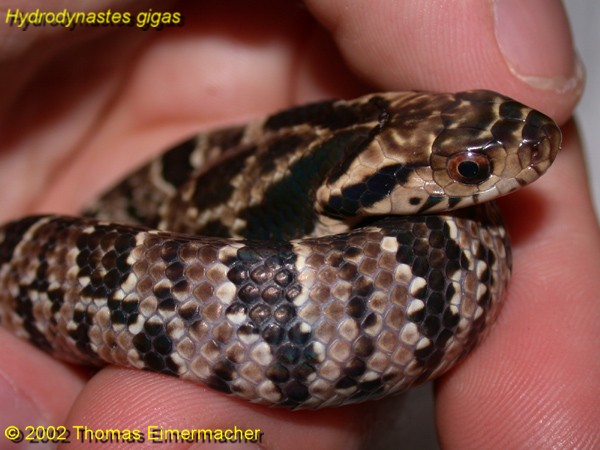
I have been working with H. gigas for years and produce them annually. They are exceptionally hardy and very easy to maintain. Their diurnal activity pattern also makes them very suitable for large display enclosures.

Regarding their husbandry, a daytime temperature gradient of approximately 76-83 F with moderate levels of humidity works very well. Avoid temperatures over 85 F. Hydrodynastes gigas is relatively resistant to low temperatures, so NTLs in the high 60s are not a problem. A large water container should be provided, which most specimens will spend a fair amount of time in.

Their feeding response has already been mentioned, but the upcoming redundancy is well deserved. They are ferocious feeders with a feeding response that only seems to get worse with age. I have repeatedly observed large 7ft specimens literally launching themselves out of the water at any source of movement upon detecting rodent scent. They also have a relatively high metabolism, which makes for frequent feedings and cage cleanings. Other than during feedings, most specimens are fairly docile as adults. Hatchlings can be rather nippy and will often chew on your finger, if they get the chance.

Adult specimens will typically cease feeding around late October or November until January or February. Properly kept, H. gigas will readily reproduce. The clutch size is obviously variable, but the one mentioned above (24) is certainly a large one.

Hope this helps.

~TE

Image
-----
Thomas Eimermacher
Department of Biological Sciences
Southeastern Louisiana University
Hammond, LA 70402

rearfang Mar 05, 2006 05:17 PM

Good info there (except for the slowdown in feeding). Mine are at their most glutenous in the winter months. Raises the question. I am in S. Florida. Might the geographical location with it's associated climatic conditions have a bearing on this contradiction? Mine mated heavily two weeks ago. Prior to that they also mated durring Wilma.

Frank
-----
"The luxury of not getting involved departed with the last lifeboat Skipper..."

Nightflight99 Mar 05, 2006 08:27 PM

Might the geographical location with it's associated climatic conditions have a bearing on this contradiction?

Certainly, especially with south Florida having a climate that is unique in the United States. Reproductive cycles are usually not very difficult to trigger in captive reptiles, which is evident by the common captive births/hatchings of neonates at times of the year when their wild counterparts do not.

In this area (SE LA), mature Hydrodynastes gigas show a strong tendency to cease feeding during the winter months, and usually resume during late January or early February.

~TE
-----
Thomas Eimermacher
Department of Biological Sciences
Southeastern Louisiana University
Hammond, LA 70402

Site Tools