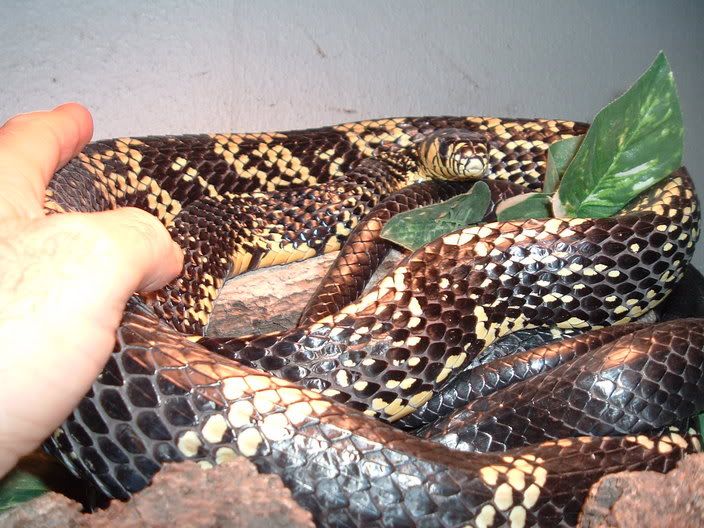
My hunch is that there is no colubrid in captivity in the United States that can break fourteen feet.
-----
Welcome to kingsnake.com's message board system. Here you may share and discuss information with others about your favorite reptile and amphibian related topics such as care and feeding, caging requirements, permits and licenses, and more. Launched in 1997, the kingsnake.com message board system is one of the oldest and largest systems on the internet.



My hunch is that there is no colubrid in captivity in the United States that can break fourteen feet.
-----
What's the longest Psuestes you've seen? Do you have anything close to that?
Ten feet so far is the biggest.
-----
The longest colubrid I know of in the States is a Boiga (Dog tooth cat snake)at 12 feet.
-----
WhoooH Dude..?12' in the continental US?? The only Catsnake I'm aware of in the US is 3-4' MAX in W TX, NM and AZ.. Care to clarify??
-----
Carl W Gossett
Garage Door Herps
Monument,Colorado...northern territory of the Great Republic of Texas 
Boiga cynodon is an Asian cat snake. Mangrove snakes are one of the subspecies. Dan lives in Florida and claimes he can grow it to 14 feet. He is the person that shiped me a ten foot plus yellowtail.
-----
But I too have a difficult time believing someone can produce a Boiga cynodon in excess of 400cm, as the largest specimen I am aware of is 320cm (a hair over 10.5’), and considered to be a MONSTER as the species rarely grows over 275cm, and I am aware of Spilotes pullatus and D. corais here in the US of that size, and larger.
There are a few Zaocys dhumnades floating around in the US and they certainly harbor the potential to grow greater then 320cm, quite easily I might add.
As for Ptyas carinata, the largest representative of the species, I am aware of, is a 412cm monster residing within a university collection in Thailand and I know of a Ptyas mucosaresiding within a private European collection at just under 400cm.
However, it's only fitting that Boiga cynodon be brought up on this forum, as the species was first described by Boie, the same man credited for first describing D. couperi…
Best regards,
Jeff
-----
Jeff Snodgres
University of Arkansas
snodgresjeffreys@uams.edu
501.603.1947
but I think that Ptyas ssp. are the longest colubrid (not including King cobras). Anyone know of the longest Ptyas?
Doug T
It is either Ptyas mucosa or carina but I have not found anyone who has them.
-----
>>It is either Ptyas mucosa or carina but I have not found anyone who has them.
>>-----
>>"Life without risk is to merely exist."
I think it is one of those. Has to be.
I guess no one has 'em because they're very difficult and bitey.
That's my understanding at least. I'd like to see some good pics of them though. I guess if I was going to get into venomous, I'd train with one or two. Or maybe a dyrmobius ?
Might be fun though.
Or not LOL.
"collection"
-----
Thane
There are actually quite a few people, here in the States, wishing to work with both Ptyas carinata and Ptyas mucosus. Unfortuantely, the problem is importation to the US, as the few that do make it out of their country of origin alive, both species of the genus are popular within traditional Asian medicine, usually end up within European collections...
Best regards,
Jeff
-----
Jeff Snodgres
University of Arkansas
snodgresjeffreys@uams.edu
501.603.1947
>>There are actually quite a few people, here in the States, wishing to work with both Ptyas carinata and Ptyas mucosus. Unfortuantely, the problem is importation to the US, as the few that do make it out of their country of origin alive, both species of the genus are popular within traditional Asian medicine, usually end up within European collections...
>>
>>Best regards,
>>
>>Jeff
>>-----
>>Jeff Snodgres
>>University of Arkansas
>>snodgresjeffreys@uams.edu
>>501.603.1947
Aha !!!
I think perhaps, we've found the next Doug Taylor project maybe ?
LOL. I don't know. Maybe not though. I'm not so sure he'd want to work with animals like this. Maybe if he wants a pretty wild challenge or something
Would be cool I think.
-----
Thane
I just went to europe and made no connections with herpers. Darn... I so wanted to work with a big angry, fast, biting snake too. 
>>>>There are actually quite a few people, here in the States, wishing to work with both Ptyas carinata and Ptyas mucosus. Unfortuantely, the problem is importation to the US, as the few that do make it out of their country of origin alive, both species of the genus are popular within traditional Asian medicine, usually end up within European collections...
>>>>
>>>>Best regards,
>>>>
>>>>Jeff
>>>>-----
>>>>Jeff Snodgres
>>>>University of Arkansas
>>>>snodgresjeffreys@uams.edu
>>>>501.603.1947
>>
>>
>>
>>Aha !!!
>>
>>I think perhaps, we've found the next Doug Taylor project maybe ?
>>
>>LOL. I don't know. Maybe not though. I'm not so sure he'd want to work with animals like this. Maybe if he wants a pretty wild challenge or something
>>
>>Would be cool I think.
>>-----
>>Thane
I thought you were there cheering on a friend at the WPLC!
had I known you wanted to hook up with some European herpers, I would have placed you into contact with a few, as most are always game for a few rounds at the local pub with a yank!
Jeff
-----
Jeff Snodgres
University of Arkansas
snodgresjeffreys@uams.edu
501.603.1947
I did some pretty extensive research on Ptyas sp. over the last couple years because I was hoping to work with Ptyas mucosa or for that matter any other species. Most of what I read indicated that Ptyas mucosa was the longest non-venomous, non-boid snake with lengths reportedly up to 14 feet. Over on www.venomdoc.com Dr. Bryan Greig-Frye mentions working with some Ptyas carinatus that were big enough at 12 feet to come right up off the floor and hit you in the face - apparently [masochistically so] one of his favorite snakes to work with. Alas, I could never get any Ptyas imported and I've since sworn off exotics and have switched my collections focus to native U.S. herps.
-----
Matt Campbell
Big animals, little animals, plants - right down to the sea itself. We need them, not just for their own sake, but because all this has to be here for everybody forever. Only one thing is certain: if we are to preserve our environment and save this priceless wildlife we need much, much more knowledge.
Harry Butler from 'In the Wild With Harry Butler' 1977
Where did you see the lengths of Ptyas mucosa indicated as excededing 400cm? I would like to know, as the largest specimen I am aware of is just shy of 400cm and considered to be one of the largest specimens of the species known, though I know of a few 400cm plus Ptyas carinatus, with the largest being 412cm...
Best regards,
Jeff
-----
Jeff Snodgres
University of Arkansas
snodgresjeffreys@uams.edu
501.603.1947
I just did a quick check to see what source I had that quoted 14' lengths and I was wrong. Everything I've got says they routinely attain lengths up to 12'. So, no 14-footers I guess. I must've been wishfully remembering it incorrectly.
-----
Matt Campbell
Big animals, little animals, plants - right down to the sea itself. We need them, not just for their own sake, but because all this has to be here for everybody forever. Only one thing is certain: if we are to preserve our environment and save this priceless wildlife we need much, much more knowledge.
Harry Butler from 'In the Wild With Harry Butler' 1977
I was got a bit excited about that! Thought you may have stumbled upon some data I overlooked...
Thanks for double checking though,
Jeff
-----
Jeff Snodgres
University of Arkansas
snodgresjeffreys@uams.edu
501.603.1947
Well, 12 feet is still pretty impressive, but I guess the King Cobra pretty much still holds the record for total length outside of the the boidae. My research went so indepth as to get a couple photocopies of a Chinese and Vietnamese paper detailing the breeding of Ptyas species - I think it might have been P. korros, as that was what I was hoping to get from an importer. I've heard of some guys getting them in specifically to feed to Kings, but other than that they are pretty much unheard of in the pet trade. Of course now, I probably wouldn't touch one with a ten foot pole, primarily because of my new focus on native U.S. species - still if I had the space...
-----
Matt Campbell
Big animals, little animals, plants - right down to the sea itself. We need them, not just for their own sake, but because all this has to be here for everybody forever. Only one thing is certain: if we are to preserve our environment and save this priceless wildlife we need much, much more knowledge.
Harry Butler from 'In the Wild With Harry Butler' 1977
I was wondering why you have sworn off exotic species? Just curious.
Doug T
Doug Taylor Reptiles
I haven't entirely sworn off of exotics. I still have a pet project of 0.0.6 Sheltopusiks [European Legless Lizards] that I'm hoping to breed and I kept a fair number of other exotic odds and ends [4 Ball Pythons, 3 African House Snakes, a JCP, my Taiwan and Blue Beauty Snakes, some Plated Lizards {3 species}, and last but not least a Blue-tongue Skink] - However, to answer your question - I had gotten myself into a postage stamp type collection that seemed to have little direction and was composed of a lot of animals that I seemed to acquire through adoptions and in some cases poorly conceived whims. I seemed to be lacking any direction and frankly I just wasn't interested anymore in a lot of what I was keeping. Interestingly enough, for Christmas my brother gave me a copy of 'Snakes of the Southeast' by Whit Gibbons and Mike Dorcas [I used to live in the Deep South - my brother still does, poor guy]. Anyway, that book singlehandedly showed me how incredibly diverse our own species are here in the U.S.. Also, I liked the idea of concentrating on snakes that I could also go out and collect myself, or merely observe and photograph - something that is all but impossible for me to do when talking about African, or Asian species for example. Also, I have a strong interest in education and conservation and turning my attentions to herps in my own backyard appeals to me a lot more. Anyway, when so many people seem to be so focused on the exotics, I think it's kind of nice to work with the mostly-neglected natives.
-----
Matt Campbell
Big animals, little animals, plants - right down to the sea itself. We need them, not just for their own sake, but because all this has to be here for everybody forever. Only one thing is certain: if we are to preserve our environment and save this priceless wildlife we need much, much more knowledge.
Harry Butler from 'In the Wild With Harry Butler' 1977
You are to be applauded for such efforts. It seems that many of us get so caught up in the challenge of keeping exotic species; we tend to forget the amazing variability residing within our own backyards and how little we actually know, regarding the successful captive husbandry of such.
I always grin whenever I see a fledgling biology student doing double takes, when he / she discover their first actual herpetology class covers little more than native species and the new outlook they entail, once the class and lab has been completed.
Best regards,
Jeff
-----
Jeff Snodgres
University of Arkansas
snodgresjeffreys@uams.edu
501.603.1947
Jeff,
It's funny but I had a Vertebrate Natural History class at University of Georgia in which we covered all those same snakes that are in Gibbons and Dorcas' latest book. I had forgotten how cool some of the snakes are that we have right here in the U.S. until I saw them again in that book. I'd gotten so into the exotics end of things that I had hardly even been out to do any field herping for the last 10 years probably.
-----
Matt Campbell
Big animals, little animals, plants - right down to the sea itself. We need them, not just for their own sake, but because all this has to be here for everybody forever. Only one thing is certain: if we are to preserve our environment and save this priceless wildlife we need much, much more knowledge.
Harry Butler from 'In the Wild With Harry Butler' 1977
Help, tips & resources quick links
Manage your user and advertising accounts
Advertising and services purchase quick links
