Ok I have read a few things on bloodred and am still as confused as I was when I started. My g/f would like to one day get into breeding pewters actually she wants to try motley pewters which is a little odd since the idea of a pewter is to get a solid greyish snake but its what she wants. Now I do not fully understand the bloodred part of that equation. I know there is bloodred color and bloodred pattern. Which do I want and are they both co-dominant is one recessive or what. I would appreciate some help. Thanks
-----
1.1 Motley het butter corns
0.1 Snow corn
0.1 Okeetee corn
1.0 Anery mutt corn
0.1 Stripe Ghost corn
0.1 Amelanistic corn het carmel
2.1 Colombian Redtails
1.0 Hypo Colombian redtail
1.0 Brazilian Rainbow Boa
Reptile & Amphibian Forums
Welcome to kingsnake.com's message board system. Here you may share and discuss information with others about your favorite reptile and amphibian related topics such as care and feeding, caging requirements, permits and licenses, and more. Launched in 1997, the kingsnake.com message board system is one of the oldest and largest systems on the internet.



please explain bloodred
tsusnakeguy
Feb 28, 2006 08:14 AM
Replies (22)
cornsnake00
Feb 28, 2006 08:46 AM
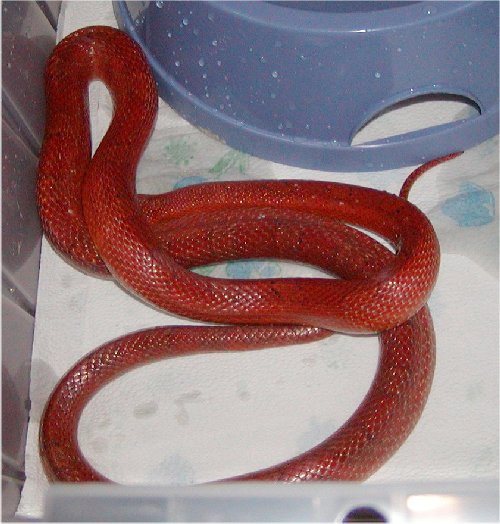
Here is a picture of a bloodred and a pewter. The belly of a bloodred is almost like the belly of a motley(lacking a pattern) . As the bloodred gets older it will turn almost all red,this is called a diffused pattern. They have a look all to themselves. It's possible that a pewter as it ages will become an all grey snake. Time will tell.


tsusnakeguy
Feb 28, 2006 10:47 AM
What I am trying to figure out is what are they geneticly. Are the co-dominant or recessive or what? When I am working with the crosses what would I get and how to do I work bloodred into a cross?
-----
1.1 Motley het butter corns
0.1 Snow corn
0.1 Okeetee corn
1.0 Anery mutt corn
0.1 Stripe Ghost corn
0.1 Amelanistic corn het carmel
2.1 Colombian Redtails
1.0 Hypo Colombian redtail
1.0 Brazilian Rainbow Boa
HerpZillA
Feb 28, 2006 12:43 PM
Ok, I know I Will catch heck for this but. Let me start by saying I do not know much on corn genetics. I'm jumping in too. Actually started due to bloodreds.
I spoke to Kathy Love about the first one that fell in my lap. She said the true genetics were not understood totally.
Heres my heck part. TO ME, the widely used co-dominant" is miss used. Co-dom is a very special type of genetic event. The only one I can think of is blood type. If you had co-dom roses, 1 red and 1 white, you'd end up with red and white roses. Variegated might be the best word.
Incomplete dom is white and red rose and you get pink. Seems to me that if I bred "co-dom" light yellow ball pythons to normal. The babies would be a mix of the two, (normal and light blotches) not just the lightening of some, or making some more yellow. Hence incomplete dom IMHO
Back to bloods. Bloods vary, I had a very very nice one, but lighter than most. There may be several genes that also apply to this trait, much like a humans eye color or skin color.
So IMHO as you breed a bloodred into most other corns, you will infuse the red to different degrees. It also depends on the bloodred you stared with. I hope that makes sense? Been fighting a respiratory infection myself. So, been way off my feet. But the topic is something I also want to play with. Bloods with other morphs.
good luck
-----
Computers don't make errors. What they do, they do on purpose. (Dale Gribble)
AOL IM Mettzilla
I forgot my password for herpzilla, and gave a bad email,, major OOPS
1.3 Bearded Dragons
6 baby female Western hognose, 3.5 adults some friend some mine,,,building breeding stock)
1 Corn snake (bloodred) 0.2 1 MIA In the house I hope
1 baby creamcycle 0.1
2 Okeettes I think? 1.1 youngens
ochrocephala oratrix 0.0.1? Adult, and a killer!
ochrocephala auropalliata 0.0.1? Adult
2.0 Dogs,
0.2 Cats,,
0.1 Wives, (Long term captive!,, I mean ME!)
1.1 Kids (Paininthearsius takamemonii) J/K great kids
-----
tom

Paul Hollander
Feb 28, 2006 07:29 PM
>Co-dom is a very special type of genetic event. The only one I can think of is blood type. If you had co-dom roses, 1 red and 1 white, you'd end up with red and white roses. Variegated might be the best word.
The word "codominant" came out of blood typing. Early on, human blood types A and B were determined to be codominant. If blood cells in an AB individual were variegated, then some cells would be type A, some type B, and either some or none type AB. But ALL of the blood cells have both A and B molecular configurations. So "variegated" is not the answer.
In the theoretical rose example, the codominant heterozygote has a red gene paired with a white gene. It has pink flowers. The white gene is producing a functional product that would result in a white rose. The red gene is also producing a functional product that would result in a red rose. And the mixture of the two products in the heterozygote would produce pink flowers.
In incomplete dominance, using our theoretical rose example, the incomplete dominant heterozygote has a red gene paired with a white gene. It also has pink flowers. The white gene makes a nonfunctional product that does nothing. The red gene makes a functional product that makes the flower red. But one red gene cannot make as much product as two red genes can. And the lesser amount of red produced by the heterozygote is the cause of the pink flowers.
In both codominance and incomplete dominance, the plant with two red genes makes red flowers. The plant with two white genes makes white flowers. And the heterozygote, the plant with a red gene paired with a white gene, makes pink flowers. The only way to really identify a given example is to get into the cell biochemistry. The breeding results are the same in both cases. And the biochemical data is usually lacking. Those are the two reasons why many people (including me) use the two terms interchangably. Though I usually use "codominant" because it contains fewer characters. 
Paul Hollander
HerpZillA
Feb 28, 2006 07:44 PM
Paul that is the very first time I ever heard that. And not the way I was taught, I may ask for a refund.
You have no idea how much I have tried to read on the web. And not just herp sites of web sites that are here then gone. I try to get most of this from college study sites for good back ground.
I just thought my nieces husband is in the middle of his doctorate degree, as hes doing research on aides. I know hes had a good background in genetics (not to say you have not).
But you complicated my life totally lol. I love to learn topics like this. I mean learn, not memorize a statement. I know you know what I mean. Great post. I will class a professor to get her view, then I've been planning a trip to NC to see my niece.
Also do you have any good sites on genetics. More indepth. Even classes sometimes tweak reality at first to get a point across. As with the pink and white and red roses.
Much thanks
-----
Computers don't make errors. What they do, they do on purpose. (Dale Gribble)
AOL IM Mettzilla
I forgot my password for herpzilla, and gave a bad email,, major OOPS
1.3 Bearded Dragons
6 baby female Western hognose, 3.5 adults some friend some mine,,,building breeding stock)
1 Corn snake (bloodred) 0.2 1 MIA In the house I hope
1 baby creamcycle 0.1
2 Okeettes I think? 1.1 youngens
ochrocephala oratrix 0.0.1? Adult, and a killer!
ochrocephala auropalliata 0.0.1? Adult
2.0 Dogs,
0.2 Cats,,
0.1 Wives, (Long term captive!,, I mean ME!)
1.1 Kids (Paininthearsius takamemonii) J/K great kids
-----
tom
cornsnake00
Feb 28, 2006 01:22 PM
When you cross a bloodred into another morph you cannot say you will get this or you will get that! It's a wait and see what you get.
tspuckler
Feb 28, 2006 01:11 PM
To the best of my knowledge there are no co-dom colubrids. I define "co-dom" in the ball python sense, meaning by breeding a co-dom (let's say mojave) to a normal, you'll get half mojaves and half normals. There are no hets in these types of breedings.
Bloodred can best be described as a color variation - like miami phase and Okeetee phase corn snakes. They have been refined through selective breeding to have almost no pattern as adults. This is different from a simple recessive genetic trait like anerythristic or amelanistic.
If you bred an Okeetee phase to a normal, you get a few babies that look like each parent, but most would fall somewhere in-between in appearance. The same would be true with bloodreds.
I reckon there may be those that have similar or different points of view on this, but that is the way I currently view bloodreds.
Tim

Third Eye
HerpZillA
Feb 28, 2006 01:38 PM
Ok, I respect my elders. Tim is very knowledgable I know. All I can say is I asked my old college professor about this issue. As I recall, she said: "co dom is a very special type of trait" Both traits are fully expressed in all off spring that have both co doms genes. But she did say "it is splitting hairs" as most people use co dom and incomplete almost interchangably.
OK, simply put, bloods vary, and can effect color of a clutch if mated to another morph.
back to sleep I hope.
-----
Computers don't make errors. What they do, they do on purpose. (Dale Gribble)
AOL IM Mettzilla
I forgot my password for herpzilla, and gave a bad email,, major OOPS
1.3 Bearded Dragons
6 baby female Western hognose, 3.5 adults some friend some mine,,,building breeding stock)
1 Corn snake (bloodred) 0.2 1 MIA In the house I hope
1 baby creamcycle 0.1
2 Okeettes I think? 1.1 youngens
ochrocephala oratrix 0.0.1? Adult, and a killer!
ochrocephala auropalliata 0.0.1? Adult
2.0 Dogs,
0.2 Cats,,
0.1 Wives, (Long term captive!,, I mean ME!)
1.1 Kids (Paininthearsius takamemonii) J/K great kids
-----
tom
Paul Hollander
Feb 28, 2006 06:21 PM
Unfortunately, the ball python people (other than Randy Remington and a few others) don't know beans about genetics. 
I use the loose definition of codominant and incomplete dominant that I was taught when I worked at the Iowa State University Genetics Laboratory. Loosely defined, both codominant and incomplete dominant mutant genes have heterozygotes that can be reliably distinguished from both homozygotes. In other words, a snake with a codominant (or incomplete dominant) mutant gene paired with the normal version of the gene doesn't look like a normal snake (with two normal genes) and doesn't look like a snake with two copies of the mutant gene.
The only way to distinguish a codominant from an incomplete dominant mutant is to get data on the functionality of the gene products. That is practically nonexistant for snake mutants. So there is no point in making a big deal on codominant vs. incomplete dominant. And, for what it's worth, functionality of the gene products is not part of the definition of either a dominant mutant gene or a recessive mutant gene.
As for blood red, we have to separate the red color from the mutant gene that affects the pattern when we talk about the blood red morph. The red coloration is reputed to be the result of selective breeding. Cross a blood red to a normal corn, and the babies are likely to be redder than the normal but less red than the blood red. But the red coloration is of no great concern because pewters aren't red.
The pattern mutant is called "diffused", "blood red", "blood red pattern mutant", or some such. The genetics have not been fully worked out yet, as far as I know. The first mention that I saw said that it was a recessive mutant. Other people say that you can tell the difference from normal if the snake has even one copy of the blood red pattern mutant. Even if that is true, my impression is that the pattern is much less defined when there are two copies of the blood red pattern mutant than when there is only one in the gene pair. So in my opinion, a good pewter should get a copy of the blood red pattern mutant from both parents, so that it has two copies of the mutant rather than one copy paired with a normal gene.
Hope that helps.
Paul Hollander
HerpZillA
Feb 28, 2006 06:59 PM
OK, just kidding tim.
Paul, this may does not mean much to you, but I agree.
And I forgot all about the washing out of the pattern as another possible gene contributor.
I guess what bugs me, in short, is selective breeding to the point where people call a herp a, lets say leucistic.
I am no scholar. I did go to college, lots of math, 1 great genetics course, and I did stay at a holiday inn express TWICE!
But a selective breeding to, again a leucistic, is not the same, as an honest to goodness morph to a leucistic. This is not much of an issue in corns, but I see it in other areas. And maybe I'm totally wrong on this point too. It's been known to happen! lol
Thanks Paul, Your posts are always good to read.
-----
Computers don't make errors. What they do, they do on purpose. (Dale Gribble)
AOL IM Mettzilla
I forgot my password for herpzilla, and gave a bad email,, major OOPS
1.3 Bearded Dragons
6 baby female Western hognose, 3.5 adults some friend some mine,,,building breeding stock)
1 Corn snake (bloodred) 0.2 1 MIA In the house I hope
1 baby creamcycle 0.1
2 Okeettes I think? 1.1 youngens
ochrocephala oratrix 0.0.1? Adult, and a killer!
ochrocephala auropalliata 0.0.1? Adult
2.0 Dogs,
0.2 Cats,,
0.1 Wives, (Long term captive!,, I mean ME!)
1.1 Kids (Paininthearsius takamemonii) J/K great kids
-----
tom
Paul Hollander
Feb 28, 2006 07:32 PM
:
tspuckler
Mar 01, 2006 07:06 AM
Paul,
That's about as good of an explanation as I've ever heard. I specifically gave my definition of "co-dominant," since the word was being used, I wanted it to be clear what my interpretation of it is.
Yes, ball python breeders seem to make up their own terms (like calling hypo balls "ghost" balls). But then again, corn snake breeders like to use the term "albino" when in the "real world" it usually refers to an all-white animal.
I stand by my statement that there are no co-dom colubrids when using the ball python breeders definition of "co-dominant."
Tim
HerpZillA
Mar 01, 2006 08:04 AM
Tim, on the classified there are phenotype normals. corn section. Also talked to Kevin from D dragon, totally agreed with me on the selective breeding leusistic not being the same.
I got at least one right. lol
-----
Computers don't make errors. What they do, they do on purpose. (Dale Gribble)
AOL IM Mettzilla
I forgot my password for herpzilla, and gave a bad email,, major OOPS
1.3 Bearded Dragons
6 baby female Western hognose, 3.5 adults some friend some mine,,,building breeding stock)
1 Corn snake (bloodred) 0.2 1 MIA In the house I hope
1 baby creamcycle 0.1
2 Okeettes I think? 1.1 youngens
ochrocephala oratrix 0.0.1? Adult, and a killer!
ochrocephala auropalliata 0.0.1? Adult
2.0 Dogs,
0.2 Cats,,
0.1 Wives, (Long term captive!,, I mean ME!)
1.1 Kids (Paininthearsius takamemonii) J/K great kids
-----
tom
Paul Hollander
Mar 01, 2006 10:16 AM
>I stand by my statement that there are no co-dom colubrids when using the ball python breeders definition of "co-dominant."
I agree with that statement.
The relationship between the ultra and amelanistic mutant genes in the corn snake does not fit the ball python breeders' definition of "codominant". Or my definition.
Paul Hollander
HerpZillA
Mar 01, 2006 10:56 AM
Your definition, Tim's definition, the ball python people. Lets not leave out the boa people, and beardies.
NO MAS NO MAS
2 of my non herps
http://www.herpzilla.com/fun/1/33/
Now they are both sub species of oratrix, so if they were to breed? Would I,,,,,,,,
Nyuk Nyuk Nyuk
-----
Computers don't make errors. What they do, they do on purpose. (Dale Gribble)
AOL IM Mettzilla
I forgot my password for herpzilla, and gave a bad email,, major OOPS
1.3 Bearded Dragons
6 baby female Western hognose, 3.5 adults some friend some mine,,,building breeding stock)
1 Corn snake (bloodred) 0.2 1 MIA In the house I hope
1 baby creamcycle 0.1
2 Okeettes I think? 1.1 youngens
ochrocephala oratrix 0.0.1? Adult, and a killer!
ochrocephala auropalliata 0.0.1? Adult
2.0 Dogs,
0.2 Cats,,
0.1 Wives, (Long term captive!,, I mean ME!)
1.1 Kids (Paininthearsius takamemonii) J/K great kids
-----
tom
draybar
Mar 01, 2006 05:31 PM
>>Unfortunately, the ball python people (other than Randy Remington and a few others) don't know beans about genetics.
>>
>>I use the loose definition of codominant and incomplete dominant that I was taught when I worked at the Iowa State University Genetics Laboratory. Loosely defined, both codominant and incomplete dominant mutant genes have heterozygotes that can be reliably distinguished from both homozygotes. In other words, a snake with a codominant (or incomplete dominant) mutant gene paired with the normal version of the gene doesn't look like a normal snake (with two normal genes) and doesn't look like a snake with two copies of the mutant gene.
>>
>>The only way to distinguish a codominant from an incomplete dominant mutant is to get data on the functionality of the gene products. That is practically nonexistant for snake mutants. So there is no point in making a big deal on codominant vs. incomplete dominant. And, for what it's worth, functionality of the gene products is not part of the definition of either a dominant mutant gene or a recessive mutant gene.
>>
>>As for blood red, we have to separate the red color from the mutant gene that affects the pattern when we talk about the blood red morph. The red coloration is reputed to be the result of selective breeding. Cross a blood red to a normal corn, and the babies are likely to be redder than the normal but less red than the blood red. But the red coloration is of no great concern because pewters aren't red.
>>
>>The pattern mutant is called "diffused", "blood red", "blood red pattern mutant", or some such. The genetics have not been fully worked out yet, as far as I know. The first mention that I saw said that it was a recessive mutant. Other people say that you can tell the difference from normal if the snake has even one copy of the blood red pattern mutant. Even if that is true, my impression is that the pattern is much less defined when there are two copies of the blood red pattern mutant than when there is only one in the gene pair. So in my opinion, a good pewter should get a copy of the blood red pattern mutant from both parents, so that it has two copies of the mutant rather than one copy paired with a normal gene.
>>
>>Hope that helps.
>>
>>Paul Hollander
>>
>>
And this goes back to what I have complained about forever.
Bloodred is the worst name out there.
Bloodred, as stated, is actually a pattern morph and not the actual color.
That is why it drives me crazy when I see things like anery bloodred, or lavender bloodred.. etc.
There are some that are moving towards the name diffused, also as mentioned, which is a better direction in my opinion.
This is one of the better definitions I have seen.
From Serp.
Diffused - This is the pattern trait invloved in the "Bloodred" morph. The pattern trait diffuses the blotches out and makes the pattern a lot less distinct. It also removes the checkering from the belly, and often stretches the head pattern. It is quite variable in the amount of effect it will have on any individual's pattern.
-----
Corn snakes and rat snakes..No one can have just one.
"resistance is futile"
Jimmy (draybar)
Draybars Snakes
_____
HerpZillA
Mar 01, 2006 06:01 PM
I want to breed a yellow corn. Xanthic I think? But co dom.
Then cross it with a snow, I'll call it
Yellow snow!
-----
Computers don't make errors. What they do, they do on purpose. (Dale Gribble)
AOL IM Mettzilla
I forgot my password for herpzilla, and gave a bad email,, major OOPS
1.3 Bearded Dragons
6 baby female Western hognose, 3.5 adults some friend some mine,,,building breeding stock)
1 Corn snake (bloodred) 0.2 1 MIA In the house I hope
1 baby creamcycle 0.1
2 Okeettes I think? 1.1 youngens
ochrocephala oratrix 0.0.1? Adult, and a killer!
ochrocephala auropalliata 0.0.1? Adult
2.0 Dogs,
0.2 Cats,,
0.1 Wives, (Long term captive!,, I mean ME!)
1.1 Kids (Paininthearsius takamemonii) J/K great kids
-----
tom
draybar
Mar 01, 2006 06:27 PM
>>I want to breed a yellow corn. Xanthic I think? But co dom.
>>
>>Then cross it with a snow, I'll call it
>>
>>Yellow snow!
>>-----
Just don't eat it!!!!!!!!
-----
Corn snakes and rat snakes..No one can have just one.
"resistance is futile"
Jimmy (draybar)
Draybars Snakes
_____
LizardMom
Mar 02, 2006 11:08 PM
Jimmy, I agree with you that it is confusing, but the one thing you must consider is that to get an anery bloodred, you need just that...an anery and a bloodred.
While you can seemingly seperate the diffusion from the red color of the bloodreds, you cannot separate out the red from the diffusion. In other words, you can't get just the severe red of the bloodred without the diffusion.
There are still things about the bloodred that are not completely understood. There was talk that the original old-style bloodred was selectively bred to get that color, but the new 'old-style' bloodred line that I discovered being bred has not been selected for, unless you call the guy catching the snakes to be 'selection.' As my babies grow up I plan to do some experimenting to see just how the diffused pattern holds up in crosses, but the red color does not. Not sure if I'll ever figure it out, but it will be fun trying.
Leslie
HerpZillA
Mar 03, 2006 09:04 AM
I also agree, a very very nice blood was my first corn, and at the time we had no idea what it was til I talked to Kathy Love. But mine was not near as dark red, and I really liked her. Sad she died shortly after her first clutch, and me not knowing that much about them, and thought my blood was like the rest, I kept only one baby. And she excaped, and still MIA. OK, that a bit of my history.
She was bred to what we called a het male. Washed out pattern, but much closer to normal. She had 9 eggs. Here I wish I had known what to look for, hind site is 20/20, and it is why I lurk in here so much.
Babies looked from near normal(but good normals), to almost okeetee, to the more classic silver head and sides. So my knowledge from 1 clutch is the pattern fade is as variable and maybe more important independent of the red. Some red babies had great saddles, while a near normal looking one was a tad hypo.
I really hope my female pops up here, but I do know who bought 1 of the males, although it was not 1 of the better ones, more pattern than a blood should and some black on the belly.
That variation in that first clutch is what got me so excited to breed bloods. Although my first was by far the best.
-----
Computers don't make errors. What they do, they do on purpose. (Dale Gribble)
AOL IM Mettzilla
I forgot my password for herpzilla, and gave a bad email,, major OOPS
1.3 Bearded Dragons
6 baby female Western hognose, 3.5 adults some friend some mine,,,building breeding stock)
1 Corn snake (bloodred) 0.2 1 MIA In the house I hope
1 baby creamcycle 0.1
2 Okeettes I think? 1.1 youngens
ochrocephala oratrix 0.0.1? Adult, and a killer!
ochrocephala auropalliata 0.0.1? Adult
2.0 Dogs,
0.2 Cats,,
0.1 Wives, (Long term captive!,, I mean ME!)
1.1 Kids (Paininthearsius takamemonii) J/K great kids
-----
tom
LizardMom
Mar 04, 2006 12:10 AM
Yes, the bloodreds are fascinating. Along with eventual crosses to make other morps, I want to experiment a bit with the bloodline I have to see if it is possible to figure out how the deep red color connects to the diffusion gene. I really feel that there is more than one thing going on with the bloodred.
Time will tell, I hope.
Leslie
candb
Feb 28, 2006 06:48 PM
This is off of Micks Cornsnake program.
Male is, Bloodred Pattern
Female is, Pewter*
Offspring are predicted to be...
100.00%, Bloodred Pattern, Het for Charcoal
*Pewter, for the purpose of this program, is defined by the combination of Charcoal and Bloodred PATTERN. In real life, a true 'Pewter' would also be influenced by Bloodred COLORATION, but the genetics of Bloodred Color cannot be modeled. Keep this in mind when evaluating results.
I dont know if that is what your looking for but i hope it helped in some way.
-----
Cameron
