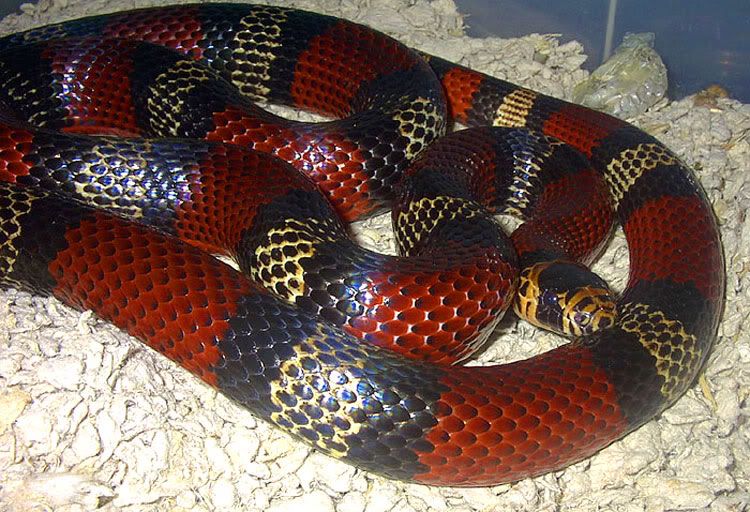
Andesiana is similar and is an altitudinal morph as is L.t. gaigaeae in the high elevations of the mountains of Costa Rica and Panama. These morphs have both been designated as subspecies of the species triangulum.
A group of andesiana came to us at the Dallas Zoo years ago that we bred in the late 70s and thus started this subspecies into circulation to the general public. It tends to have a high number of red rings and the white ring is only about 2-3 scales wide in most individuals although they vary throughout the range. The lower elevations are populated with the subspecies micropholis which as I said was the original triangulum recognized from South America.
The problem with micropholis is that it freely intergrades (if andesiana is truly a subspecies) as does stuarti with gaigaea in Costa Rica. The issue is with such a large range for micropholis and to a lesser extent with andesiana, extending from sea level to high montain cloud forests from Panama to Ecuador, the gene pool is quite diverse and thus the "look" one associates with micropholis can vary greatly!
I posted some pics in earlier posts showing what one would associate with typical micropholis as Williams illustrates in his book. The photo is the same male I scaned a slide of and posted except it is older and more orange/red ground color as opposed to the red of the younger ones. The snakes that came in at that time in the early 70's were from Coastal areas of Ecuador and had fewer red/orange rings with 5-6 scale rows wide white or yellow-orange rings.
This classic look has firmly "stuck" in the minds of most herpers and is a "great look". That same look can be found in Panama and along areas of the West Coast of Colombia, ie. a picture of micropholis exhibited in Campbell's and Lamar's first book on "Venomous snakes of Tropical America" I may have the title a little off but it was the single volume book. he took the shot of a live specimen from the district of Choco of a snake from low elevations. As you move towards the mountains and increase in elevation in Colombian population,the look changes a bit to more red rings with the white ring from 2-5 scales wide as Nathan demonstrates in a photo he posted showing one of the breeding females that has quite wide white rings.
So yes the population of micropholis that is presently being produced are somewhere in the "middle" of the classic andesiana look and ground color and the classic micropholis look and ground color. Once again it is such a small sample from one highland area of Colombia but were not collected at the higher elevations of the andesiana. In this area they key to "pure" micropholis as given in the keys by Williams, they do not key to intergrades. We never were able to obtain more specimens of the Coastal look from any of the countries they are found in. Obtaining a female seems to be one of the most difficult problems with setting up a breeding colony, most that are collected are males.
This information posted are of my personal observations and readings as well as collecting trips to Costa Rica to photograph gaigeae and stuarti. As well many phone calls and emails to Bill Lamar,Nathan Wells and Steve Osborne (that years ago attempted to obtain a group of the costal morph from Ecuador) but could never obtain a female as mentioned and in the mid 70s the import permits for Ecuador ceased to be issued.
The information posted here is as factual as I have access to at this time! Possibly with additional specimens, DNA profiling etc. more information will be gained in the future on this huge group of snakes from the Northern US all the way down to Ecuador, all grouped under one species "triangulum".
Some day the costal morph may also be available to the herp community but at this time these are the only ones being produced in the US or from what I understand in Europe also!
If you breed this population enough, I'm sure you could produce some that have the wide white rings since some of the breeding group do exhibit this trait.
Good luck with the andesiana, as said by one of the greats of the zoo world the late Joe Lazloe of the San Antonio Zoo: "Keep them Coool Maan" delivered with a great and well known Hungarian accent on the English!
Bill Lamoreaux
Pictures below: 1. Ecuadorian Coastal phase 2.Colombian mid mountain specimen taken by Nathan Wells (one of his breeders) and last but not least from 2.3 I presently am raising that are out of the Popeyan gene pool.