I am trying to decide if I should do vermuculite and perlite for incubation or just perlite w/ the ceiling tile (don't know what this method is called). Opinions welcomed.
Thanks,
Kyle
Welcome to kingsnake.com's message board system. Here you may share and discuss information with others about your favorite reptile and amphibian related topics such as care and feeding, caging requirements, permits and licenses, and more. Launched in 1997, the kingsnake.com message board system is one of the oldest and largest systems on the internet.


I am trying to decide if I should do vermuculite and perlite for incubation or just perlite w/ the ceiling tile (don't know what this method is called). Opinions welcomed.
Thanks,
Kyle
One or the other...but not both.
Perlite with the light diffuser plastic(says eggcrate on the bar code sticker,ironically enough)is referred to as the no substrate method.
The eggs get their needed humidity from the air this way,instead of through direct contact with vermiculite.
good luck Kyle
-----
Charles Glaspie
Tanstaafl:
"There ain't no such thing as a free lunch".
An acronym created by my favorite author Robert A. Heinlein.
I myself used a hovabator and I just had them on vermiculite. Didn't have any problems and all 7 eggs hatched out perfectly well.

-----
red-
I have been using a blend of the two for 3 - 4 years (it works)
Before that I used just the vermiculite, it also worked, but I like adding the perlite.
10 cups dry perlite - 20 cups dry vermiculite - and 6 cups water, thoroughly mixed. A recipe from Dr. Mark Sewards "Ball Python Breeding Video"
Most importantly not too wet.
Good luck, Mike
I have never used the mediumless method so I will not comment on this.
I first explored horticulture techniques over 20 years ago.
here is my take.
Striaght vermiculite is good, but it compacts over time
(especially if more water is added). this will restrict air pockets through it.
Perlite doesn't absorb water as much, and thus will create more air pockets throughout the medium while still holding a good ballance of water/air mixture.
I cant give you a ratio, as I go by the texture and feel of my mixure(I have never measured it).
You will probably have good success with striaght vermiculite, but I like to know my eggs can get air from beneith as well from above.
just my 2 cents
TomChambers
People probably get tired of me coming on here and humping the no-sub method. The reason why I do it is because I believe in it. I think it is far superior in SMALL incubators (I think the best method is the "room" incubators ala the Sutherlands, VPI, Ralph). The problem that folks have in smaller incubators is maintaining proper humidity. In my opinion, this is much harder using dampened vermiculite in the traditional sense. In this traditional method, you can lose eggs by 1) starting out too damp, 2) starting out too dry, 3) starting out too dry, adding water and getting too wet. I worried far too much with the tradtional method.
My "modified" no-sub method that I have shared here many times was adapted from a chondro method I read about. This is what I do:
1) get an egg box deep enough to hold a large clutch plus a couple more inches.
2) fill the box with at least 1.5 inches of dry perlite.
3) add water until the perlite is so wet that it sloshes around.
4) flourescent lens ("egg crate" sit on top of sloshing wet perlite.
5) eggs go on top of the lens. This is the beauty of the set up. The eggs are 100% completely dry, do not contact anything the slightest bit damp, but yet are subjected to near 100% humidity from the air only.
6) I open egg boxes about once a week for the first 5 or 6 weeks, then every few days thereafter to change the air.
Since going to this method, I've hatched nearly 100% of my fertile eggs (In fact, I've only lost three eggs on this method...all were laid in my old apartment last year and had to be moved in my pick-up truck into my new house. I think the move was detrimental to their development).
To me, this "no-sub" method is far superior, you never have to worry about your set up being too wet or too dry, you never have to add water. I sleep very well knowing my eggs will be great (I even went away for a weeks vacation with three clutches in the incubator...thats how confident I am in the method).
Pictures (the proof is in the pudding):
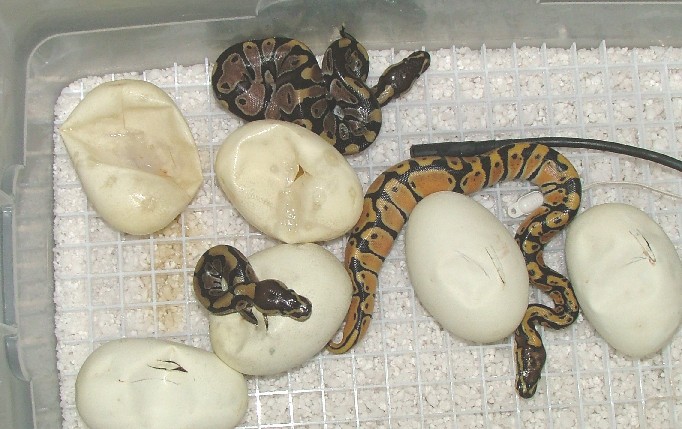
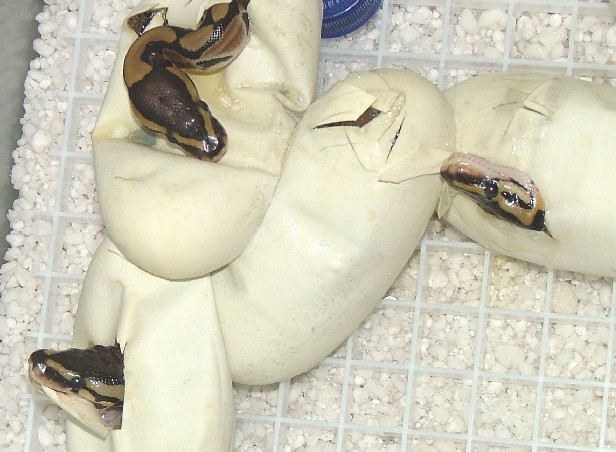

JP,
Excellent advice. I was speaking with a friend last night about this same method with Perlite. I appreciate your detailed explanation and photos. Have a great weekend.
Sincerely, Kyle
-----
Kyle J. Stevens
Royal Variations Ltd.
Many a false step is made from standing still.
JP.........I am considering using this method with a few clutches this year. What does the perlite actually do other than support the grate? What would happen if you supported the grate with some type of structure, and just filled your container with the proper amount of water? Thanks for your help.
-----
Louis Kirkland
Cornerstone Reptiles
The perlite would keep the water from sloshing around and getting on the eggs when you had to pick up the box to open it. Otherwise I think it would work just as well with only water.
Mike
Well, the incubation method I adapted mine from used just water and no perlite (and apparently works just fine). The just double stacked the plastic and added water in the bottom. I decided to use the perlite for 2 reasons really. 1) I hated the idea of just plain water sitting around at 90 degrees for 2 months plus. I know about all the creepy things that can grow in standing water. I doubt its really much different with the perlite, but I feel better about it. 2) Adding the perlite give even more mass inside the egg box, which in theory ought to help regulate the temps even more (more stuff at 90 degrees = less temp variation when I open the egg boxes). As mike said, it also keeps the water from "sloshing" to violently if you had to move the egg box, although I rarely find a reson to move them.
.
-----
Louis Kirkland
Cornerstone Reptiles
The total surface area that water can evaporate from in the perilite is enormously greater than standing water. Therefore, humidity levels will be higher and return to high levels much faster (after opening the egg box) if you use some substrate in the bottom instead of just water...
-----
when life hands you lemons, make super lemons, bumblebees, etc...
Help, tips & resources quick links
Manage your user and advertising accounts
Advertising and services purchase quick links
