I have bred them also for years. I nearly always start them out on hatchling brown anoles since they are hatching at around the same time here. When that doesn't work, I'll give them skinks or use a skink tail to scent just about anythingand take it from there. Brahminy blind snakes are taken from time to time.
Here's a tiny little one I produced years back.

The guy who got her also grabbed the parents. He lives in Germany and has produced striped scarlet kings from this line.
Anyway, I also wanted to try my hand at getting larger hatchlings by using larger breeders. My largest were right around 25". While they produced sometimes larger clutches up to 9, there wasn't really any noticible difference in average hatchling size that I could see from my 16" breeders.
After this girl passed late last year,
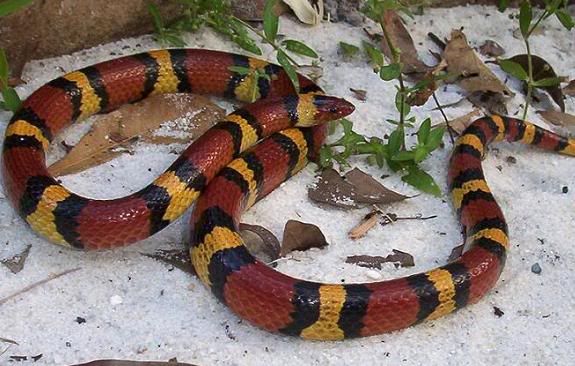
I just may skip this year breeding them and rebuild my stock to include the more aberrant or hi yellow or black (or whatever I think is cool)
Come to think of it there may be something here (I can't edit it right now) to help you, I don't know, I wrote it a few years back to help out :
Scarlet King Care
Caring for young scarlet kings (Lampropeltis triangulum elapsoides) can be a lot of work. Because of their small size they require much more attention than most other king snakes and milk snakes. Especially at the neonate stage. Below are some hints and observations to help care for them.
Housing
Set- up can be as elaborate as you want, but simpler probably is better. I avoid a lot of "furniture" for the very small babies, as they can get "lost" in it and dry out QUICKLY. I use a small deli container that has a water bowl, a hide box, and substrate that is easily checked and cleaned. For young scarlet kings a simple home can be made from an 8 oz. deli cup (air holes of about1/16" in diameter punched in it around perimeter) along with two 1/2 to 1 oz. containers w/lid for one (the kind you might put mayo in at a restaurant). Holes for access are cut in them. In 1(placed upside down with lid on) put moistened sphagnum moss. In the other (placed right side up) will need to be fresh water for drinking. PVC end caps of 1" to 1 1/2" diameter can also be used as water bowls. They are inexpensive too. The enclosure you choose must be very secure with a tight fitting lid. Many commercial enclosures have loose fitting tops and holes that are big enough for hatchlings to escape. Check yours carefully. Although scarlet kings like to bury themselves, they will also climb, and if given half a chance will escape." Shoe box" type cages are o.k. for juvenile to small adults. Substrate can be paper toweling that is easily monitored for waste or uneaten food items, but does dry out fast. Sphagnum can be used too, but food items tend to get lost or stuck to it. Same with sani-chips or aspen. Make sure the enclosure is neither too dry nor too wet. Snakes can develop skin problems from constant contact with damp substrate.
Providing a hide box filled with damp sphagnum moss and as always, fresh drinking water are a must. Ambient temperatures between 75 and 82 degrees should be maintained.
Feeding
Feeding captive bred scarlet kings is usually not a problem as long as you give them what they want! In the wild scarlet kings seem to prefer anoles and skinks.( I think decaying wood is a major factor in that it feeds termites that feed skinks.. and so on..) Anyway, I try to start the babies on newly hatched anoles because they are readily available where I live. Some will not take a live one and are offered a dead one next. ( Captive hatched scarlet kings seem to be more apt to accept dead prey items). If they still refuse, a baby ground skink or 5 lined skink is offered. Sometimes a tail from either anole or skink can be cut to appropriate sized "bites". For stubborn newborns, a puree of the tail and water is rubbed on the desired food item to induce feeding response. If dead or cut food items are offered, I put them on a small plastic lid to keep track of feeding.. Which item they choose to eat is a key to switching them over to a desired (by you) food item later. I think they can live out their lives just fine on lizard prey items and I really never try to get my scarlet kings to eat anything else until they're much bigger since I always have a supply of feeder lizards. The possibility of introducing parasites from live food items is a consideration. Therefore, freezing food items for a week or so is best. Then thaw them well before feeding. Some keepers try this method FIRST in order to get their snakes accustomed to eating dead prey. Feed them as often as every 3-4 days to promote a desirable growth rate. I rarely handle these snakes( as they can be nervous and easily stressed), and never handle them just after a meal. When you've established a good feeding regimen they will respond and do well. Many people are frustrated when they try to get their scarlet kings to eat rodents. They'll try scenting mouse tails or pinkie mouse parts with the preferred food item as well as many other "tricks". For some it works, others it does not. Remember that keepers and snakes are individuals. When they ARE big enough, I'll rub a freshly taken tail (of the lizard species they've been feeding on) over the smallest pinkie mouse I can find, and try that.
Again, sometimes it works, sometimes it doesn't .It seems every keeper has his or her method and many different ones have worked. I do hear from customers who have little or no trouble with feeding their babies. I suspect many are experienced keepers and are willing to go the extra mile when caring for theirs. They knew what they were up against and did their homework BEFORE buying one .Some are very dedicated and quite resourceful. A man I know got his hatchling to eat pinkies (parts first) by scenting with chicken soup- like you might do to get a stubborn python to feed on thawed rats ! In a year it was on (small) pinks. So you can be hopeful. Be very attentive to them.
I have had babies that are eating well and otherwise in good shape die without showing any symptoms. It can be very frustrating and sad to lose an animal after so much work. You will get attached to them! You can expect a shedding cycle about every 6 weeks or so. More often if they are eating and growing well. They will probably refuse food during this time. Watch to make sure all skin is shed, paying close attention to the eye caps and the tip of the tail. Again, moist sphagnum seems to help them through this process. When shed is complete, resume feeding as usual.
Breeding
Scarlet kings are very much like other colubrids in this aspect. I treat mine exactly like the other kings and milks in my care. The major difference I have found is that a wild caught scarlet king that is but 15" may well be 4 or 5 years old and sexually mature. Whereas a 15"captive bred snake that is but half that age may not be ready to breed. I cycle them by cutting off food supply in Nov.( Thanksgiving), gradually reducing temps to near 60 if possible for 6-8 weeks. In Feb. (Valentine's day) warm them up, feed them and introduce male to female after her first shed. Mating is often within minutes. I usually repeat this in a few days and again in a week or so, only separating to feed. Laying takes place in a box of damp sphagnum 45-60 days after. Incubation @ 82 degrees and 80-100 % humidity will result in a few (2-6) of the prettiest, tiniest gems you ever saw in 49-56 days!
Notes From 2002
I acquired a 15" female in early 2002 in a trade and bred her with an "apricot" male ( 16" ) in Feb. Although they bred right away, I kept them together for over a week. She laid 5 good eggs on 4/26. The eggs were incubated as above and began to pip on 6/15. All were out and in good shape by 6/17. 52 days.
#4-*hatch 6/16/02*shed 6/25, ate live anole,7/8,? refused 7/18 (skink scent 7/19)
#5-*hatch 6/16/02*shed 6/25, ate live anole 6/29,? refused7/18,(skink scent 7/19)
#6-*hatch 6/16/02*shed 6/25, ate live anole 6/29,7/11,18,
#7-*hatch 6/17/02*shed 6/25,, ate live anole 6/29,7/11,18,,
#8-*hatch 6/17/02*shed 6/25, ate live anole 7/8,11,18,*most aggressive feeder*
Misc Thoughts
Scarlet kings are one of the most beautiful snakes native to America. It seems everyone wants one and each year many are taken from the wild. Some do make the adjustment to captive care, but in my experience, only robust larger animals thrive. Many never do take to a lot of handling. Wild caught babies are not as tough and often perish... At this point I'm obliged to tell you that there are professional collectors who, with little or no regard for the environment, strip pine and other trees clean to find snakes hiding there. This can cause serious problems for much of the wildlife living in these habitats. PLEASE do not support this! Ask how and where the animals were acquired. Often a seller with an abundance of wild caught animals in Apr.-May has obtained these (either directly or indirectly) by using stripping methods. Arm yourself with all the knowledge you can, share stories and accounts, join a herp club, and ask questions of everyone interested!
Although others and I do provide captive hatched babies, c.b. juveniles and adults are hard to come by. If you do succeed in rearing your scarlet king from hatchling to "pinkie eatin" size you'll understand why no one wants to part with them!
Good luck!
Mark Kenderdine---Crimson King
Questions or comments: markk15@msn.com
2002 Crimson King
:Mark
-----
Surrender Dorothy!
www.crimsonking.funtigo.com



 ,
,


 )
)