Hey everyone i just wanted to know if i breed a pastel to a normal im going to get 50 percent pastels, 50 percent normals right? and if i breed a pastel to a pastel i have a chance of 25 percent super pastels. i kno thats how it goes for ball pythons.
Reptile & Amphibian Forums
Welcome to kingsnake.com's message board system. Here you may share and discuss information with others about your favorite reptile and amphibian related topics such as care and feeding, caging requirements, permits and licenses, and more. Launched in 1997, the kingsnake.com message board system is one of the oldest and largest systems on the internet.


breeding pastels and producing
chris61988kb
Mar 15, 2006 10:20 PM
Replies (13)
JohnLokken
Mar 15, 2006 11:16 PM
I have only heard of one person in the boa world (I could be wrong) that has claimed his pastels are co-dominant. We have the same pastel bloodline from the originator. I will still not go as far as saying that a pastel is co-dominant. I personally think that it is missleading.
Here's my biggest reason. The originator (Jeff Ronne) of the boa "pastel" name has dubbed a pastel polygenetic. Meaning the more generations of pastels you breed the better the animals and future animals look. This also means that you could take a nice pastel looking boa that is not associated by any known bloodline and breed it with another pastel that is not associated by a known bloodline and "create" a new pastel bloodline. This breeding process takes years and really knowing what a pastel is. Reduction of black.........Not color.
So this, in my opinion, is the official description of a pastel from the originator. It's polygenetic.
Now, to muddy the waters a little. LOL!
The litter I was lucky enough to produce was a Ronne Pastel female bred with a pastel anery male. The outcome "followed" the dominant trait somewhat. There were some amazing pastels in the litter. There were some nice pastels from the litter. There were a few "low appearing" pastels in the litter. Out of the whole litter of 21 babies.......I would only really call one animal a normal.
I also just had a litter from the same Ronne pastel momma who was bred with a ghost male. The pastel gene has really affected the quality of the hypos in my opinion. (Can you tell I'm a pround new daddy? LOL!) What is going to be really interesting for me now is to see how the non hypo animals develope. There are already quite a few babies I would call a pastel. But, it's still kind of early to tell. They were just born on the 13th and I'm really trying hard not to bug them. 
Like you stated....What adds even more confusion to the "pastel debate" is that it means different things to different animals. (ie ball world and the boa world.)
Another thing to note is that some people will call a boa that is a pastel a "good looking normal" and that's it. Generally I get my feathers ruffled a little.....Or, my panties in a bunch....I can't remember which.......When I hear this.
There are two sides to this coin.
1)There are a lot of breeders that work hard at developing great pastel animals. They take pride in their animals and bloodlines. They take the time to find the right animals and breed them accordingly.
2)The other side is people either don't know what a pastel is or they attach the name to their animal in hopes to sell it for more money.
Obviously, things are not always this black and white. But, I'm beginning to write a novel here. LOL!
I always state that the pastel boa is a buyer beware animal. I think that if you are getting into pastel you should do a few things before you buy one.
1)Understand what the name identifies as far as traits and characteristics.
2)Look around and see different pastels. Find out what a nice one looks like and what a "beginner" pastel looks like.
The first pastel I bought was a pretty bad one. If I were to see it now I wouldn't spend the money on it. Then you see others and go WOW!! I have to own that!!!
3)Ask the seller about their bloodline.
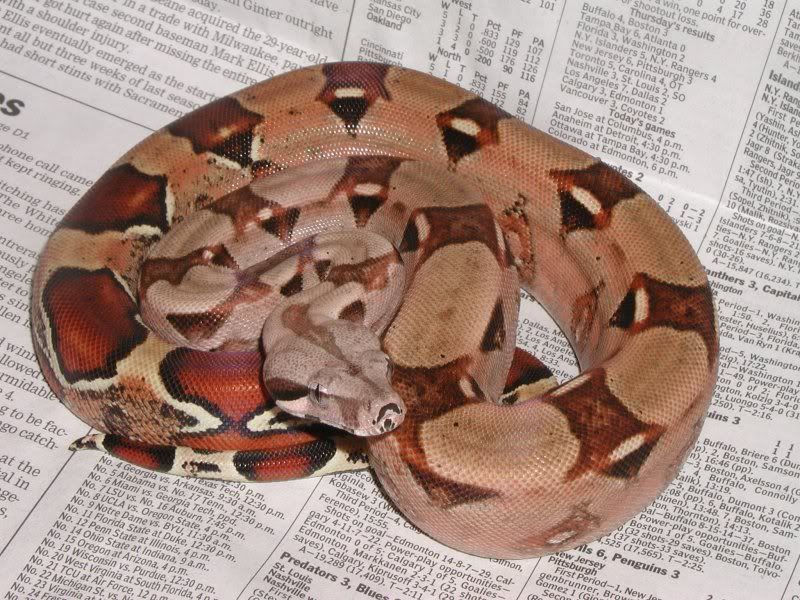
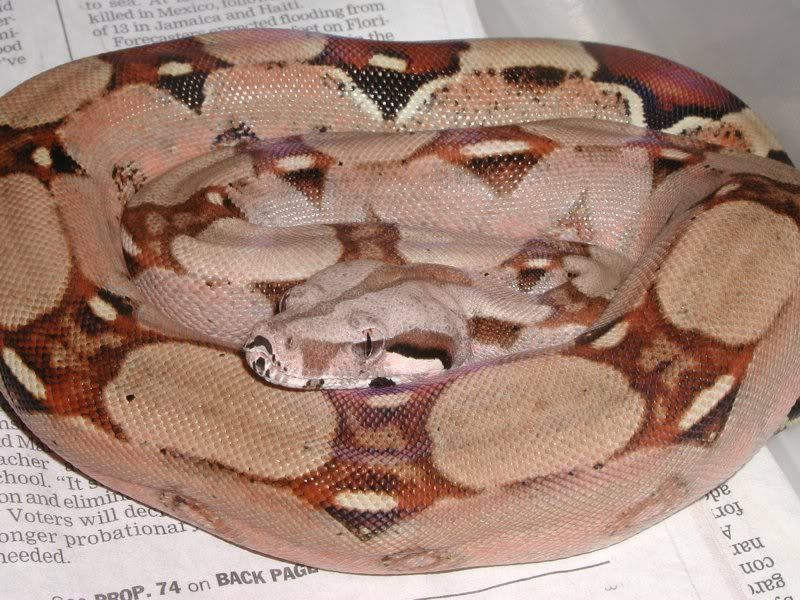
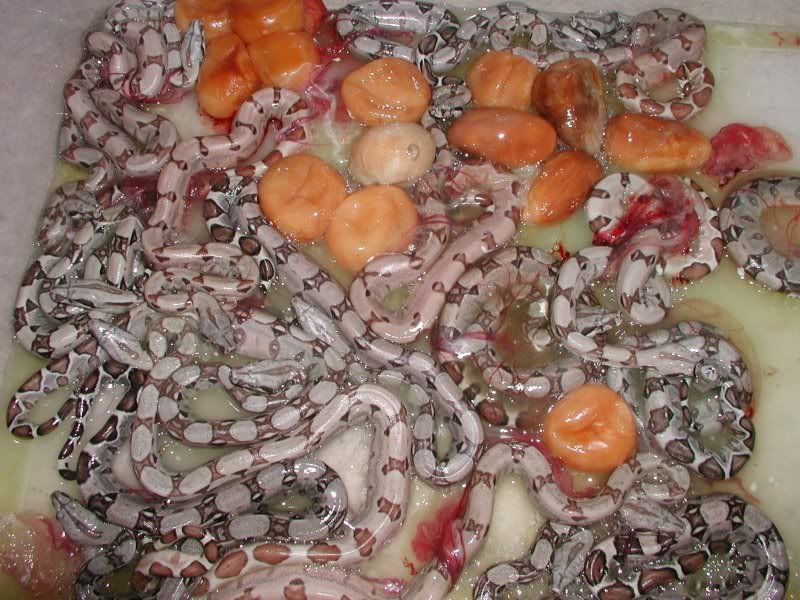
Here are a couple of pics of my pastel litter from 2004. This was from a pastel x pastel
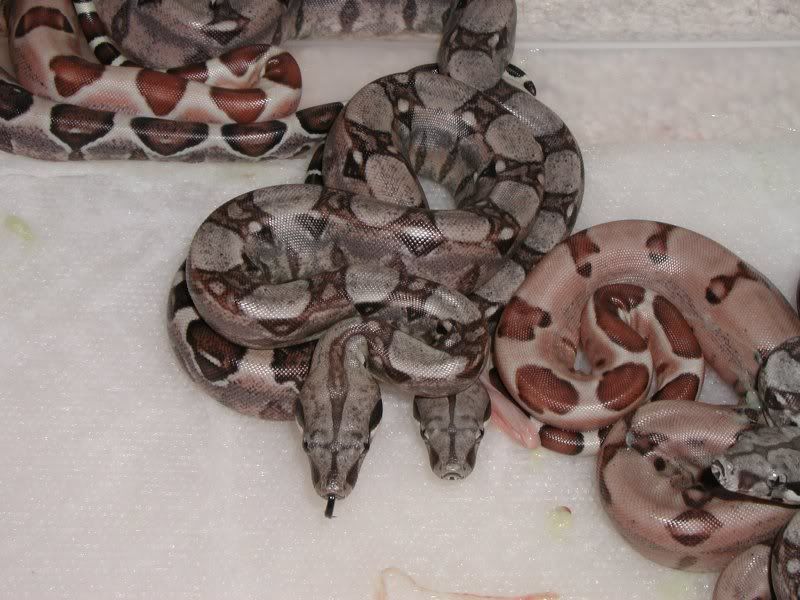
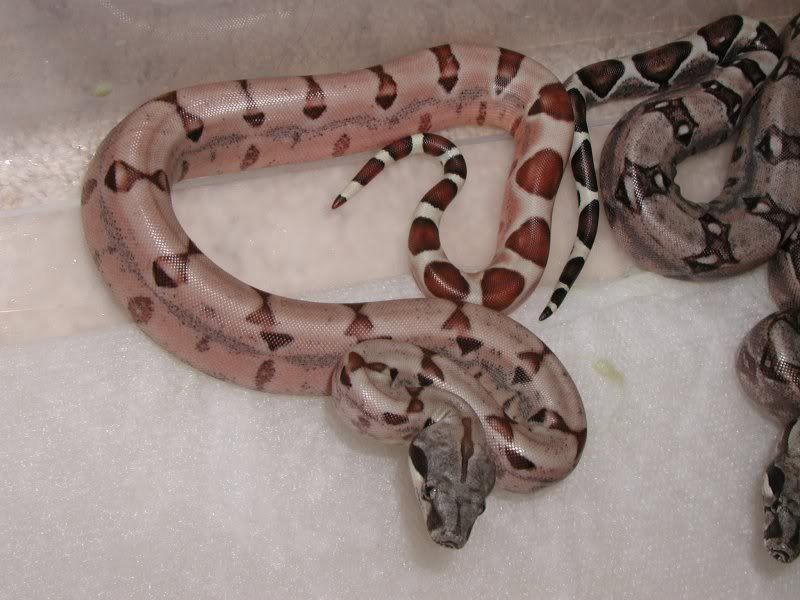
Here are a couple of pics from my 2006 litter. Mind you, there are pastel hypos in there. This was from a pastel x ghost
Here's a link to Ronne's pastel description.
http://www.boaconstrictor.net/forums/showthread.php?t=386
Here is a write up I did sometime ago.
Here is my half a cup of coffee/trying to get the kids ready in the morning pastel definition .
For me, since the Pastel term was coined by Ronne I have stuck to what his definition is. It is an animal that is line bred, which exhibits an overall reduction of black. Breeding two animals, which have this look, should result in some offspring exhibiting a more noticeable reduction of black. Pastel is almost a misnomer in my eye. It has nothing to do with color at all. This is a natural hang up due to the name. It is almost misleading. (Which I am sure it was not meant to be.)
It is a line driven morph plain and simple. THIS IS WHERE the labeling questions begin. Like you, I have also seen many, many animals being sold as pastels that I would never buy. Like you said, they look just like normals. This morph is a VERY buyer beware animal in my opinion. You have to know what a Pastel really is before you can buy one. It really is a sad truth. People will ride on the coat tails of know names to sell their animals. American Jungles, almost Motleys, Arabasqueish, and lets not forget Pastel. I have been around for quite some time. Luckily, I pretty much know a fake when I see one. (A side note Since Jungles have been posted here so much it is my prediction we will see a lot more Jungles in the classifieds which will only end up being aberrant boas.)
Sorry, I am digressing. Here is where the real confusion lies .
Since the pastel is a line driven animal all you need to start off with are a couple of boas that have a noticeable reduction of black. The some of the babies would/could be first generation pastels. Since it is a line driven animal. It does not have to come from the founder’s name only. (Even though some of them have. Ex. EBV reds) So, this is where the different pastel line names come from. Davey pastel is a great example of this. His bloodline has no association with Ronnes that I know of. But, they are an awesome example of the beauty of a pastel. Seeing some of Larry Keller's animals posted on here are a great example of a pastel. (But, I think he just labels them as nice normals only.) So, people use the description of the animal by try and show that this is their line.
Genetics????????//
Again, I will wait for the founder of the line to officially say how he thinks the genetics are. I can however share my experience with breeding pastels.
I had a Ronne Pastel bred to a male Church Pastel Anery. (The Ronne is a know line of pastels. The anery was always/still is a very light animal. Still a reduction of black on him) Breeding these two animals together brought about 21 babies. Only one looked like a normal boa. The rest exhibited the pastel trait from their parents. There was obviously a varying degree as well. In my opinion, there are lesser pastels and high-end pastels. All are differentiated by their overall reduction of black. Color was a nice byproduct. But, has nothing to do with being a pastel. It's just icing on the cake.
Here are things I look for in a pastel.
And, for the sake of the examle...I'm only talking about normals . No Anerys....Etc.
1) Overall look. Speckling/black??? How light is the animal? How much contrast does the animal have?
2) Side medallions. Are they faint....Or, dark??? Do they have low/medium/high degree of black within it?
3)The belly. Is the speckling/black? Again, low/medium/high.
4)The side of the tail. Where the tail bands are. Is the speckling/black? Again, low/medium/high.
5)I erased five.
6)Saddles. Are they tan. How much black is there? low/medium/high.
7)I will even look at the moustache . Is it all there? Or, does it appear to be smaller than normal. We've all heard this technique talked about with hypos.
8)Color. Now this has nothing to do with an animal being a pastel...But, I want it all
So it really is an overall reduction of black. And, there are many variables to it. It can't be helped unfortunately. So, I look at all these things and then think to myself....This animal will darken with age.....Will this be a light or dark adult?
Hope my post makes sense. It's the ramblings of a madman.
OK, I'm spent. I'm going to bed!! 
Take care,
John
-----
"To be the best..........You must lose your mind."
michaelburton
Mar 15, 2006 11:45 PM
Thanks for explaining all of that. It makes it a little clearer for me. LOL. My one question is explaining the difference between hypos and pastels to other people who don't know anything about boas. I was explaining pastels to my little brother the other day and he said "Wait, I thought hypos had reduced black." I really didn't know what to say. He could see the difference between the two but if I didn't have pictures to show I would have no idea how to explain the difference. Hypo meens reduced black pigment and pastels have reduced black. Any ideas on explaining the difference?
Also, obviously(sp) if you breed a pastel to a salmon you get pastel salmons. But its hard to explain this one too. They both have reduced black, now do the babies have extra reduced black (I know that didn't make any sense). But my point is that I have heard that pastel has NOTHING to do with color. But all of the pastel salmons I have seen have an extra pink and red look to them, so in my mind it does have something to do with color. Any thought? Thanks.
"Britney" my salmon het sharp and "Willy" my sharp albino Michael Burton

jasongonzo
Mar 15, 2006 11:50 PM
Could you shoot me an e-mail real quick? Sorry to get off the topic guys. Thanks.
Jason Gonzalez
jason-gonzalez@cox.net
michaelburton
Mar 16, 2006 12:01 AM
.
JohnLokken
Mar 16, 2006 12:45 AM
Thanks. I hope it helped.
Yes, another fun thing that "clouds" the pastel description.
Both animals by definition have a reduction of black/melanin. My biggest comparison between the two is that the hypomelanistic boa has been proved to be co-dominant in nature. Pastels have not. Past that, you are correct. It is a hard definition to differentiate.
Generally yes. You get a little extra added "umph" (is that a scientific term? LOL!) out of your hypos when you add the pastel gene to them. The pastel hypos I just had have no speckling as of yet. But, it's still early in the game. I will never go on record saying that pastels will erase all speckling from animals. It just wouldn't be true. But, in my opinion and limited breeding experience....The pastel gene sure "cleans a boa up". With pastels what you are really hoping for is a good amount of black/melanin reduced. This pastel trait will add to any morph or normal as far as I am concerned. We have seen it with anerys, ghosts, normals, pastels, hypos, etc.
Here's my biggest reason for me wanting and enjoying the pastel trait. I know that all boas will darken with age. For my collection, I want to own a full grown boa that still looks nice and light. I don't want a dark adult. (I love normals. Don't get me wrong.) It's just my personal preference. That is what I am drawn to. Babies are great, and they generally look great. I'm into big boas. There's nothing better in my eyes. If it's light and colorful........I'm a happy guy.
This does touch on something that should be stated as well. If you breed animals that have an overall reduction of black they should not darken up as much as adults. The mother pastel is now six years old. She looks dark now because she just gave birth but she is a real stunning 6-7 foot animal. I imagine this will hold true with her. Time will tell. But, that's my goal with pastels. Nice clean babies that grow to be nice clean adults.
Color is a byproduct. But, it's a nice one. LOL! I specifically selected Ronne's Lucy bloodline because they are great pastels first. Second, they are really colorful. It's the best of both worlds for me. This is where line breeding comes into play again. There are pastels out there that are not so colorful. Davey has his own bloodline of pastels that are high yellow. But, they have a "drab" look to them. I am in no way saying this in a bad way. It's late and I'm not articulation well. I love his pastels. I want some!! But, it's a totally different pastel look. I can't even imagine what his hypo will turn out being like. They will be amazing!
From Ronne's description it is the continual washing away of the melanin that brings about the color. I think it's this as well as other line driven traits. Heck, I do that. From my last litter I picked two of the cleanest babies out of the litter. They are also very colorful. So, in future breedings I will be passing on the pastel trait as well as color into another bloodline.
Hope that helps somewhat. Forgive all the spelling and grammer mistakes. It's late and I'm being lazy. I don't want to spell check.
John
>>Thanks for explaining all of that. It makes it a little clearer for me. LOL. My one question is explaining the difference between hypos and pastels to other people who don't know anything about boas. I was explaining pastels to my little brother the other day and he said "Wait, I thought hypos had reduced black." I really didn't know what to say. He could see the difference between the two but if I didn't have pictures to show I would have no idea how to explain the difference. Hypo meens reduced black pigment and pastels have reduced black. Any ideas on explaining the difference?
>>Also, obviously(sp) if you breed a pastel to a salmon you get pastel salmons. But its hard to explain this one too. They both have reduced black, now do the babies have extra reduced black (I know that didn't make any sense). But my point is that I have heard that pastel has NOTHING to do with color. But all of the pastel salmons I have seen have an extra pink and red look to them, so in my mind it does have something to do with color. Any thought? Thanks.
>>"Britney" my salmon het sharp and "Willy" my sharp albino Michael Burton
>>
-----
"To be the best..........You must lose your mind."
michaelburton
Mar 16, 2006 01:41 AM
have any ideas on how to explain the difference between hypos and pastels to people who know nothing about boas? Just throw out some ideas so at least I will make some sense when I'm explaining all of these wonderful locales(sp) and morphs to all of my friends who think I've absolutely lost it. I am an actor and hip hop teacher and I have yet to find someone in my profession who shares this passion with me. I am constantly met with blank stares when I try to explain what a super is and how the jungle gene works. Gotta love it. Thanks again John for all of the information.
Now a pic of "Ashley" who is hopefully cooking up DH sharp sunglows. Michael Burton

ChrisGilbert
Mar 16, 2006 08:30 AM
if not you can find the answer in Jeff's description.
michaelburton
Mar 16, 2006 01:33 PM
John definately covered the pastel trait well. I have a much better idea of what I'm looking for in them now. I just wanted a few more ideas on how to explain the difference between a pastel and a hypo to people who don't know anything about boas. When I am explaining their appearance, I feel like I'm saying the exact same thing.
Michael Burton
ChrisGilbert
Mar 16, 2006 02:06 PM
in pictures, or live examples. In my collection I have no two of the same morph, and all my normals are different locality or selectively bred for different color and to me the are obviously different. Still I have people that think they look alike (except for the Albino), and others who think they are not all boas (Leopard). So as long as you know how to define it, I think that is what matters.
ajfreptiles
Mar 16, 2006 08:43 AM
The way I understand Pastels.....
The Pastel trait is Polygenic period. - This means that within any given animal you have what I call a string of genetic traits....along this string you can stock-pile certain specific traits...both good and bad....
When we come across a normal animal exhibiting a reduction in melanin....we breed that to another visible normal animal exhibiting similar reductions and the species genetic string is compounded or layered with genetic traits to intensify that particular look.
In basic terms...we take a light normal colombian and breed it to a light normal colombian....most think they look better...while some like the particularly darker variety...it all adds flavor!
Now just like you refined the animal you can UN-refine it as well...it all works in reverse....
Now I have seen ....Basically....white boas....pink boas...red boas...yellow boas...blue boas...all normals!!!!.....so as for color this may be passed on in a Co-dom form as it seems to show up in litters this way...but the pastel trait which is reduction of black melanin...is Polygenic....in my opinion.
As for The Hypo trait....
As was stated...it is a Co-dom trait with a Dominant super form. You can distinguish red phase animals from the normals clearly...and it does not matter what type of normal you breed they will produce Red hypo babies.
Hope this helps Andy
-----

Hypoboa1
Mar 16, 2006 10:45 AM
>>Hey everyone i just wanted to know if i breed a pastel to a normal im going to get 50 percent pastels, 50 percent normals right? and if i breed a pastel to a pastel i have a chance of 25 percent super pastels. i kno thats how it goes for ball pythons.
I believe John basically said it all in his quotes below.I would like to first say I am NOT trying to argue just trying to better understand what an why their has been an arguement for years on what makes a pastel an what doesnt?We have well known bloodlines of pastels out their that came from Jeff Ronnes line of pastels an as john explained different degrees of pastelism.Then you have very high pink animals that meet the definition of pastels,without using a salmon or hypo to make these animals that way that arent pastels at all[in somes definition]Like mine for example I just called them abberant very high pink redtails until some of the bigger guys started calling them pastels?Then one takes a normal very clean female that isnt a pastel,An breeds a hypo to her an she in her own isnt a pastel but because a hypo is known to reduce the black pigment an add alot of color,We call the normals in that litter pastels when the only reason for being clean an pink are from the inherited genes from the hypo.How does this make this boa a pastel?This is confusing to me.An I dont understand these things,when we all know that when a litter is produced we have animals that look like mom,some like dad an some like bothe an even like Andy said some that can possibly backfire an look completely different.Wow long winded,An I hope this isnt confusing an everyone understands what I am trying to say.Thanks,Eric[Hypoboa]
For Example[Sorry old pics an I only have the one really abberant male now]As babies the one male shows alot of coloration an cleanness even as a baby an the other don't,But now as a juvinile the abberant male that wasnt that hot pink as a baby is now.Does this make him a pastel or not?Thanks again Eric[Hypoboa]


-----
E&C's Exotic House of Reptiles
ajfreptiles
Mar 16, 2006 11:25 AM
Eric,
I think where everyone gets confused is that the term pastel makes you think the word (color) and also makes you think easter which also makes us think of pretty pastel colors like pinks....
That is what throws everyone off track...
Technically Pastels are not pink animals at all. They are reduced black pigment boas.
If you already have a pink animal or a blue animal ...that does not make it a pastel....according to Jeff Ronne info....
Years of breedings of non-pastels could create pastels if you pick out certain qualities and breed for them...or you can just get a reduced black animal now and get them that much faster.
One reason Pastels are in demand is they reduce the blacks and show the real underlying color of the animal...whatever color that may be....
Red Pastels are in demand because of what they create when bred in the albinos. Everyone loves the red albinos!
Hope this helps. Andy
-----
bcijoe
Mar 16, 2006 12:05 PM
here are a few


-----
Thanks and take care - Joe Rollo
'Tis not the stongest of the species that will eventually survive, nor the most intelligent, but the one most responsive to change' Charles Darwin
