not up on the correct information. Praomys natalensis also known as African soft furred rats, seem to have you guys confused. They live socially with no difficulty what so ever, Praomys natalensis is thought to be one of the most gentle rodents in existence. And as for their litter size, 3-4 pups is the most ridiculous thing I have ever heard. They average litters of over 20 babies! And this is evident by their 20 tits. Tell me why an animal would evolve to have 20 something nipples but only produce an average of 3-4 pups? Is it so they have enough nipples to help nurse other female Praomys natalensis' litters? But then you would have to rethink the whole idea of them not being social animals right? Tosha I think you need to edit the WIR were you stated PHLdyPayne gave good info on why the guys controlling the market, do what they do. And PHLdyPayne, I think you need to do a little more research before you give out incorrect info anymore. Just thought I would help inform the uninformed thanks
Will Wohlers
Reptile & Amphibian Forums
Welcome to kingsnake.com's message board system. Here you may share and discuss information with others about your favorite reptile and amphibian related topics such as care and feeding, caging requirements, permits and licenses, and more. Launched in 1997, the kingsnake.com message board system is one of the oldest and largest systems on the internet.



PHLdyPayne, Tosh, and other that are....
Replies (6)
OK - then I stand corrected in thanking her for her information since it appears to be incorrect - however - after a bit of research I have found that there are actually several species that are referred to as "African soft-furred rats" so the mistake is an easy one to make.
Anyway - if this is really an issue for anyone (reads if anyone really cares) - I have found the following information on the appropriate species:
Reproduction
One of the most fecund of African mammals, the Multimammate Rat breeds prolifically when conditions are favourable in its natural habitat, occasionally reaching plague proportions when hundreds or even thousands of individuals may be seen at a time. It breeds throughout the year, but breeding peaks towards the end of the rainy season and the beginning of the dry season when vegetation is at its most luxuriant and food most easily attainable. With a species that is this prolific, captive populations can soon rise to an unmanageable level if homes cannot be found promptly for the offspring.
Females have 8-12 pairs of teats, rather than the usual 5 or 6 pairs possessed by other small rodents, but as many as 16-18 pairs are not unknown. This is, at first, surprising because litters are hardly ever that big. The average litter consists of about 8 babies. The explanation is possibly because females practise the 'aunty' system, in which species the nursing instinct is so strong that they will temporarily 'adopt' babies which are not their own. Spiny Mice also indulge in this curious, altruistic behaviour. However, unlike Multimammate Rats, Spiny Mice are not equipped with extra teats, but then there is no need because Spiny Mice produce fewer babies.
The oestrus cycle is 7-8 days. Female Multimammate Rats produce two or more litters per season. In common with many other rodents, they experience a postpartum oestrus and males remain with the females after the babies are born, often standing guard at the entrance to the burrow.
Gestation
Usually 23 days, but it can be as little as 21 or as long as 26 days.
Young
6-12 (usually about 8). Singletons are rare and, in these cases, it is not always certain whether just a single baby was born or whether the others had been destroyed at an early age. Litters can be much larger, although this is comparatively rare. The record is for 22 foetuses found in a single female. Birth weight is about 1.8g. At birth the young are blind and covered with sparse hairs. Eyes open at 14-16 days. They are weaned at 21-24 days, but remain in the nest for several more days even though the female may have another litter within 25 days of the first birth. Sexual maturity is attained at 3½ months.
Life Span
Males live up to 3 years; females to about 2 years old, but occasionally older animals have been recorded. The wide age discrepancy between the sexes is probably the result of stress imposed on the female during breeding activities.
-----
Tosha 
"Nihil facimus sed id bene facimus"

6.42.0 Ball Python (Harry and Fluffy and gang)
1.0.0 Angolan Python (Anakin Skywalker)
0.0.1 Green Tree Python (Verdi)
0.1.0 Bredls Python (Smurfette)
0.2.0 Feline (Pippen and Pandora)
0.0.1 Desert Tortoise (Pope John Paul aka JP )
2.2.1 Fish (1,2,3,4)
0.0.0 frogs rescued from pool skimmer
0.0.1 Lizard of unknown origin
Tosha,
I really like people who can admit if they have made a mistake! I did somemore research on them as well and have found a site that claims 10-15 being the average. Who knows, I guess I may be wrong as well. But atleast we can agree they are good in groups and have more then 4 babies! I think we need to ask some of the big boys who are breeding them to see what kind of average they are getting out of domesticated generations. It would be interesting to find out. Either way I dont mind the price, but also can relate to a lot of others when they say we need some females. Its something about the convience to be able to not have to worry about going to a show in Florida to pick some up, you know what I mean? I understand the frozen thing, but I really do prefer to feed live over frozen, especially if the animal has never fed in captivity. It all boils down to convience. I did get a line on some females that I should have in about 3 months or so, and when I do I am going to do my best to help others in my area out. But hey, I guess we can agree they are kinda cute for a rat though, huh? I appreciate the talk Tosha
Will Wohlers
I agree - I think a little more information from the people that are actually breeding and trying to sell these things would have cleared up a bunch of the questions, concerns and overall chaos that arose this week. But I think they were quickly put in a defensive position by some of the people that posted and clammed up quick.
Good luck with your batch and let us know how they turn out!
-----
Tosha
"Nihil facimus sed id bene facimus"
6.42.0 Ball Python (Harry and Fluffy and gang)
1.0.0 Angolan Python (Anakin Skywalker)
0.0.1 Green Tree Python (Verdi)
0.1.0 Bredls Python (Smurfette)
0.2.0 Feline (Pippen and Pandora)
0.0.1 Desert Tortoise (Pope John Paul aka JP )
2.2.1 Fish (1,2,3,4)
0.0.0 frogs rescued from pool skimmer
0.0.1 Lizard of unknown origin
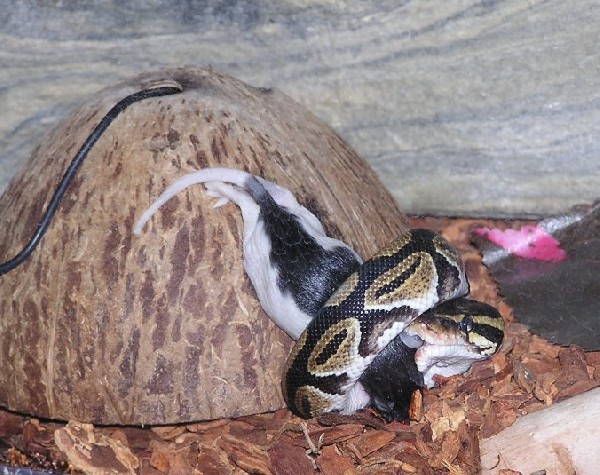
I'm finding this whole African rat thing very amusing. Real information makes the whole debate more interesting and adds an educational component. I also come away from every set of posts feeling thankful that my little girl is taking f/t domestic rats. She even takes rats that are not solid white in color.
Bill
-----
It's not how many snakes you have. It's how happy and healthy you can keep them.
The information I gave up were for African pouched rats, not soft furred rats. I dont' recall any of the posts indicating the African rats were soft furred, or maybe I missed it. I have done further research and there are alot of different kinds of African Rats, including giant pouched rats, gambians, soft furred, spiny etc.
yes I am aware of that, but I am also aware that almost ever post was refering to african soft furred rats.
Will Wohlers
