Can someone post pictures of how this is done/set up in the egg box? Thanks in advance.
Reptile & Amphibian Forums
Welcome to kingsnake.com's message board system. Here you may share and discuss information with others about your favorite reptile and amphibian related topics such as care and feeding, caging requirements, permits and licenses, and more. Launched in 1997, the kingsnake.com message board system is one of the oldest and largest systems on the internet.



No Substrate Incubation??
nextland
Mar 23, 2006 07:08 AM
Replies (11)
JP
Mar 23, 2006 08:39 AM
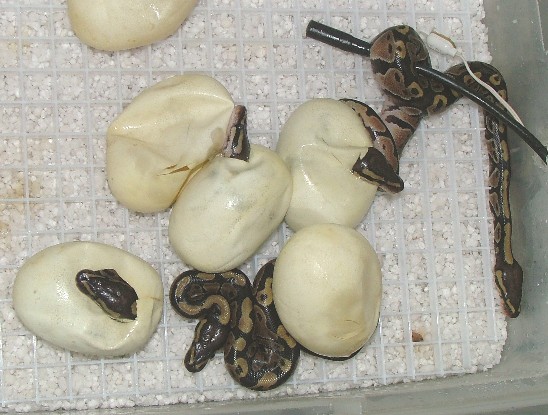
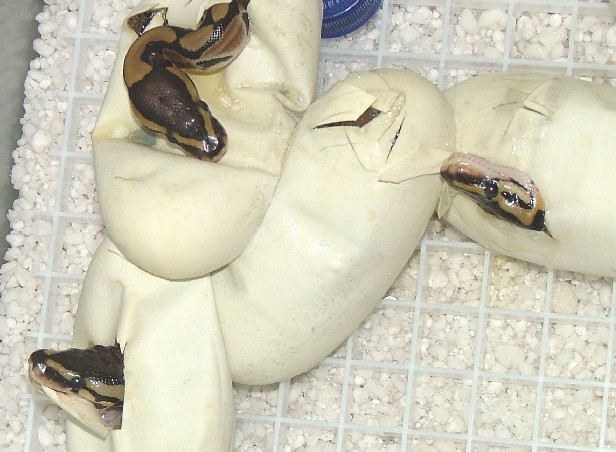
I posted a fairly detailed description of what I do in a thread below (1.5 to 2 weeks ago, I would guess). The thread was titled something like "perlite vs. vermiculite", or something like that. Here are a few more pics to show you what I'm talking about. I LOVE the (modified) no-sub method and will never do anything else as long as I'm using small (i.e. not room sized) incubators.


RoyalVariations-
Mar 23, 2006 09:38 AM
JP,
What is the blue thing in the third photo? Much appreciated.
Sincerely, Kyle
-----
Kyle J. Stevens
Royal Variations Ltd.
Many a false step is made from standing still.
JP
Mar 23, 2006 09:44 AM
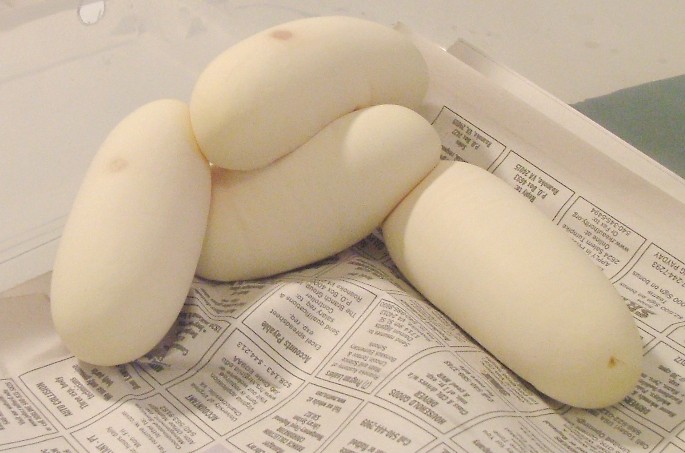
Well, as you can see in the first picture, the eggs were already fused together before I found them. The right side of the top egg was not supported by anything underneath, so it was sagging. I used a plastic bottle cap from a bottle of dasani water to prop of the right side of the top egg (second photo). I just didn't like the idea of the egg sagging like that, although I'm sure it would have been fine.
RoyalVariations-
Mar 23, 2006 11:15 AM
LOL, it seems to have worked nicely. I appreciate the information and the helpful hints about incubating.
Sincerely, Kyle
-----
Kyle J. Stevens
Royal Variations Ltd.
Many a false step is made from standing still.
TomChambers
Mar 23, 2006 05:24 PM
I liked your write up so much last time that I threw together an incubator, and decided to try it out on a few clutches this year.
I've had one clutch in there for a week so far, all is well.
one question, I assume that you can't have air holes in the egg box if you want to maintain the humidity.
I used a piece of 1/4" plexi to cover the egg box, and it is covered with condensation in a few days.
I'm worried about drips onto the eggs when I lift it for air exchange.
ok maybe two questions.
TomChambers
JP
Mar 23, 2006 07:36 PM
Well, I never get too much condensation until a couple of weeks before hatching. Does your incubator have a faen in it? I ask because I've read that if the top of the incubator is a bit cooler than the bottom, which is the typical situation due to the old "heat rises" thing, that leads to condensation. I have a fan that circulates the air in the incubator and seem to have pretty good success. No, I don't include air holes in my egg boxes, except for one hole for the probe and thermostat to go through. ITs just slightly larger than the diameter of the probe. I've always just used the lids that come with the rubbermade/sterlite boxes. Don't have any experience with the plate glass lids. Either way, I still think you are fine. Even with a bit of condensation. When you lift the lid from one side, water shou.ld run down the opposite side back into the perlite. Hope I've helped. Good luck!
TomChambers
Mar 23, 2006 09:46 PM
thanks your probably right, I let air in yesterday morning, but I wasn't watching were the drops fell.
after, I wiped the plexi dry, and this is a day and a half later.

I don't have a fan, I just threw this together fast, because I knew I had a clutch due, and wanted to try this out.
also I used a vermiculite/perlite mix instead of straight perlite, because I ran out. I was more concerned with making sure the temps were stable.
as it turned out I finished 2 hours before she started laying eggs.
thanks
TomChambers
JP
Mar 24, 2006 11:55 AM
I'm not entirely sure how you've got everything set up, but I still think you'll be ok. You may want to consider setting one end of the egg box slightly higer than the other. I would guess that would allow the excess condensation to drain to one side, rather than dripping straight down. I bet everything will be just fine.
JDouglas
Mar 23, 2006 01:36 PM
This is how I do it. 2 inch pvc connectors hold up the egg crate over water. Set the eggs in a small container on the grate. For a lid I use a 1/4 inch piece of glass and seal it with foam tape that is meant to be used to seal a window or door. Every couple weeks I crack it open to allow fresh air in even though it is probably not neccesary. Towards the end of incubation I open it more often and I lower my temps a little. This incubator is heated by flexwatt and has two fans that circulate air. It is 100% humidity with very little condensation!

-----
Jaremy Douglas

JDouglas
Mar 23, 2006 01:40 PM
I keep the water in water bottles until the eggs are laid. This keeps the water and containers clean until the eggs are laid eliminating possible contamination. It also keeps the water the correct temperature. When eggs are laid I pour the water into the chamber and put in the eggs.

-----
Jaremy Douglas
JP
Mar 23, 2006 01:49 PM
Nice set-up you got there. I've mentioned before the many reasons why I like to use perlite below the plastic grating, as opposed to just plain standing water. Does the water get funky at all during the 2 month incubation period? Do you put multiple clutches in each chamber (seems like you would have to). If so, does the water get nasty/stinky after the first clutch hatches and oozes egg juice into the water?
I think the obvious lesson that people should take from the variety of methods used to hatch python eggs is this: Inubating eggs is really very simple. 1) get the temps steady at the appropriate temp. and 2) get humidity near 100% while keeping the eggs dry. You do those two things, your eggs will hatch.
