Can anyone confirm this? My temp-sexed females are already significantly larger than my temp-sexed males. Has this happened to anyone? THey're too young to tell, but changes can already be seen.
Reptile & Amphibian Forums
Welcome to kingsnake.com's message board system. Here you may share and discuss information with others about your favorite reptile and amphibian related topics such as care and feeding, caging requirements, permits and licenses, and more. Launched in 1997, the kingsnake.com message board system is one of the oldest and largest systems on the internet.



Star females grow faster than males?
Columbia
Mar 30, 2006 03:20 PM
Replies (16)
Columbia
Mar 30, 2006 03:25 PM
Also, the larger females are showing signs of bumpy growth. Some of the scutes are actually indented a bit. This is definitely not pyramiding, but almost like the reverse of it. I've been feeding them normally on mazuri tortoise chow and mixed greens sprinkled every so often. Can someone help?
scott pasqua
Mar 31, 2006 08:30 PM
I think your problem may be the Mazuri Tortoise Chow.
This should really be only offered once maybe twice a week.
Ask any experienced tortoise breeder and they will probably tell you the same thing.
It sounds to me by the way you were talking about it in your post that this is an everyday thing.I would definitely hold back on the tortoise chow and only offer it as a treat once in a while,or if in fact a tortoise needs to rapidly gain weight.
Good luck,
Scott
PS
I am in no way implying that who ever responded prior to me isn't an expert, or didnt know what they were talking about. I am also not implying that I know more.(I know how sensitive everyone is on the site)lol
Just my two pennies.


ScottE
Apr 03, 2006 05:29 PM
Scott:
Are those twins in that bottom picture?
--scott
scott pasqua
Apr 14, 2006 01:26 PM
They were actually triplets which obviously didnt survive.
The larger one actually pipped the egg.
Amazing
ScottE
Mar 31, 2006 07:24 AM
Yes, they do.
BUT--it shouldn't be a big difference in growth rates right off the bat. Visually-obvious size-dimorphism shouldn't be there until the second year.
Pyramiding is normal, especially for females. Pyramiding shouldn't be evident in the first year, however.
Depressions at the center of scuite as you've described isn't normal at any time. My first instinct is something metabolic. Are they getting calcium? D3?
Exactly what greens are you feeding them? Are Kale, Spinach in that mix?
Columbia
Mar 31, 2006 09:53 AM
I am feeding them kale and romaine, not iceberg. I also give them carrots and cucumbers. I sprinkle their food with zoo-med's herptivite once every 2/3 days. Yes, I feed them spinach too whenever I can, but it's not very often.
Columbia
Mar 31, 2006 09:55 AM
I've spoken with several individuals regarding the depressions. And they've told me that it's a sign of growing exceptionally fast. I don't know if that's a good thing. The ENTIRE SCUTE is lower than the ridges. I don't really know how to describe it other than this. Also, the scute ends near the bottom of the shell flare out a bit. They should be getting enough nutrients. I am feeding them properly.
mrcota
Mar 31, 2006 10:30 AM
Kale and spinich are known to bind calcium. Romaine, although the most nutritious of the lettuces, does not offer much. Carrots are not very good as a staple and although they will eat cucumbers, it does not offer too much except for water, like the lettuce. They are grazing tortoises and should have a fair amount of grasses in their diet. Mine are fed 50% mixed grasses in their diet. Optunia cactus is also a good item to feed and they love it. They are particularly fond of acorn squash, which I sprinkle over the top of the salad to initiate a good feeding response. As for the rest of the salad I feed my G. elegans, you may not be able to find those items in the US.
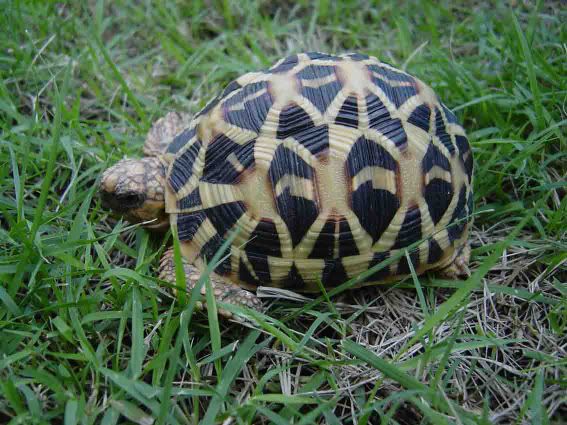
The depressions are not at all normal on the scutes. This is one of the few species that actually pyramid in the wild. Are these G. elegans (Indian/Sri Lankan Star Tortoises) or G. platynota (Burmese Star Tortoises)? G. platynota does not pyramid in the wild, but does not have depressions in their scutes either.
Cheers,
Michael
Columbia
Mar 31, 2006 10:57 AM
They are burmese. I don't know what I'm doing wrong. They eat like crazy, and are happy. I sprinkle powder and everything.
ScottE
Mar 31, 2006 11:42 AM
OK. I suspect your problem is metabolic. I'd move to a phosphorous-free calcium supplement. The scute depressions are likley the result of decreased metabolic bone density combined with growth.
Loose the Kale and Spinach. "Beet greens, kale, spinach and members of the Goosefoot family Chenopodiaceae contain relatively high Ca levels but this is bound up with oxalic acid which reacts with calcium to form insoluble calcium oxalate."
Ensure proper UV exposure, and I'm sure their shells will begin to grow normally when dietary adjustments are made.
Loose the cucumber all together. The high water content may actually decrease gut motility, not an added problem you want.
See: http://www.anapsid.org/dietcons.html
zovick
Apr 01, 2006 06:55 AM
All persons posting here have made good points, including MattJ below. You should be giving the tortoises a much more varied diet, first of all, and supplementing it with both Ultrafine Rep-Cal and Herptevite daily. I have been keeping tortoises pretty successfully for 40 plus years and have never found any need to use a prepared tortoise chow or diet of any kind to keep them healthy and happy. The only time I ever used anything like that was in the 1960's when dog chow was used to encourage rapid growth (before it was discovered that too much protein damages tortoise kidneys and livers).
I may have missed this somewhere above, but what is the exact source of UV light you are using and how many hours daily are the tortoises receiving? My lights are on 16 hours a day, and the tortoises can get into or out of it at will. I use dual bulb fixtures with one Verilux bulb and one Reptisun 7%. I replace them at least every 4 months. Replace one brand of bulb in January and every 4 months thereafter. Replace the second brand in March and every 4 months thereafter. In this way, there is always a fresh bulb in use every two months, and you will get the maximum benefit of the UV exposure. Another point which should be understood is that the closer to the substrate the UV light can be, the more efficient it will be. Mine are about 5-6" above the hatchlings and 14" above the adults.
Finally, to add info to another posters comments, I have a temperature gun and use 250 watt infrared heat bulbs placed about 15" above the substrate. The temperature at the surface under these bulbs is roughly 116F. The tortoises sit under these bulbs for extended periods of time. My Burmese Star adults actually climb up on each other trying to get closer to the heat source. Temperature in Burma where these tortoises live can reach 110F in the summer. Also it can be unbelievably humid in the summer months.
I hope this info will be helpful to you in improving the health of your babies.
Bill Zovickian
Columbia
Apr 01, 2006 08:59 AM
I am using a UVB light.. I'm not sure about the specs, but it's pretty warm in the cage. I pretty much just keep the light on at all times, but there is a shoebox in the cage with a heatpad underneath half of it where they hide for most of the day. The food is located underneath the light, outside of the shoebox, so the tortoises have to crawl out to get food. I bathe them once every 3 days. Thanks for all the input. I'm kind of worried about this.
zovick
Apr 01, 2006 04:52 PM
From your post above, it seems that you may not understand how important it is for the tortoises to get the proper amount and type of ultraviolet light. If they do not get the right UV input, they are unable to absorb the calcium needed to grow bone. Since their shells are all bone underneath the scutes, they need to have a lot of calcium available to them AND be able to utilize it. This is why they need UV light, Rep-Cal, and Herptevite in combination.
The way you posted above, it sounds as though you believe the UV bulb you are using is there to provide heat. That is only a side effect of using UV light, and possibly it isn't all that warm under it. Have you checked the temperature of the substrate? There are other far more efficient ways to provide heat than with a UV bulb.
What is your substrate? Hopefully you are using something which will retain a bit of moisture so as not to dehydrate the little guys. Additionally, I recommend soaking ALL three types of Star Tortoises daily until they are at least a year old.
Columbia
Apr 01, 2006 04:58 PM
It's very warm. There is also a heat pad that covers at least half of the bottom. 84 degrees. I just purchased reptocal and herpevite NOT BY ZOO-MEDS today. I soak them once every 2 days. They aren't dehydrated. Hopefully this problem will go away.
Columbia
Apr 01, 2006 04:59 PM
There is no substrate, but there is a dish so they can drink.
Matt J
Mar 31, 2006 04:28 PM
Both Michael and Scott have made good points. My two cents: Temps and humidity. There is STILL a great deal of debate about both. My opinion (note: I'm NOT an expert and these are only the conclusions I've made over the past 13 years keeping and raising torts). Nothing can be a perfect substitute for natural, unfiltered sunlight and the great outdoors. Torts that I've raised outside generally look 100% WC. Indoors? I've had mixed results. Some of my CBB Pancakes are 'WC smooth' while others have light to significant pyramiding AND they were raised in the exact same enclosure! Go figure... my thoughts are this...
In captivity food uptake is WAY more than the wild, therefore the digestive tract is working much more than in the wild (possibly a poor assumption on my part since I'm not a chelonid biologist). Where is one key problem? Temperature! I personally believe that some (not all) pyramiding issues are a direct result of 'too cool' a basking site. Now, I'm not advocating that you put them under a french fry warming light, BUT, I have pretty high basking temps with my indoor torts and of course ambient hide box temps to keep cool. I believe that HOT basking sites are necessary to metabolize the large quantities of food a lot of keepers feed (myself included). How hot? Not exactly sure, sorry... I need to get a temp gun sometime soon, but the last time I put a digital thermometer under some basking areas at the approximate height of the tortoise shell I'd say 115 to 120 was pretty 'normal'. Now, this too can lead to it's own set of problems (burns, etc) and things must be CAREFULLY controlled. So, I'm not advocating you do this, but it's something to ponder. Also, humidity: I DO believe in high humidity micro-climate hide boxes for all tortoises (yes, arid too). To me it makes complete sense based on observations I've made of their behavoir (not in the wild). ALL the tortoise species I keep which do not dig a burrow, will generally do their best to press their shell into the substrate up and over the front of their carapace. In my opinion that is proof that a micro climate is necessary. I could be completely wrong, but I believe the high humid micro climate is the direct result of them hiding and essential to 'good' growth and health. Okay, enough rambling... maybe this will give more ideas?!
Matt
