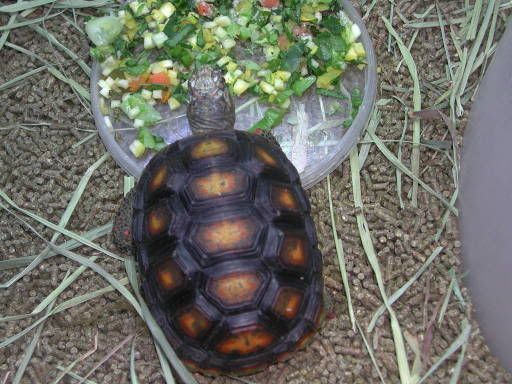
Hello all! i posted this question in the "redfoot" section with little responce, so I figured I would try in this one too. I have a redfoot that's a little over 1 year of age, and he's pyramiding. He's been fed the "typical redfoot diet" that i've read on a million webpages and books (collards, leafy greens, mixed veggies, little fruit), he gets Ca at least once a week, gets soaked in a warm water bath every day and has a UVA/UVB bulb. I've tried just about every substrate too, and the "pelleted grass type" seems to work best. The changes that I have made include: building him a "humid hide" which he spends all night in now, adding an additional UVA/UVB bulb, and reduced his feeding to every other day. Only time will tell if these changes help him any. Are they any other additional changes I could make to stop his abnormal growth? Thanks!!!
Reptile & Amphibian Forums
Welcome to kingsnake.com's message board system. Here you may share and discuss information with others about your favorite reptile and amphibian related topics such as care and feeding, caging requirements, permits and licenses, and more. Launched in 1997, the kingsnake.com message board system is one of the oldest and largest systems on the internet.



Pyramiding Redfoot
Replies (5)
You're feeding too much protein... I don't know what you're feeding but it is too much protein... jus kidding.
Try increacing the temperature to provide a range of at least 75 to 90F. 80 to 100 F would not be bad either. Couple this with the humid hide and see what happens.
>>Hello all! i posted this question in the "redfoot" section with little responce, so I figured I would try in this one too. I have a redfoot that's a little over 1 year of age, and he's pyramiding. He's been fed the "typical redfoot diet" that i've read on a million webpages and books (collards, leafy greens, mixed veggies, little fruit), he gets Ca at least once a week, gets soaked in a warm water bath every day and has a UVA/UVB bulb. I've tried just about every substrate too, and the "pelleted grass type" seems to work best. The changes that I have made include: building him a "humid hide" which he spends all night in now, adding an additional UVA/UVB bulb, and reduced his feeding to every other day. Only time will tell if these changes help him any. Are they any other additional changes I could make to stop his abnormal growth? Thanks!!!
>>
-----
Ed @ Tortoise Keepers
Trying to keep the fun in Chelonian care
People say that pyramiding has to do with overfeeding, but I think that's nonsense. Wild tortoises walk around grazing everyday. Then again, I'm not into limiting food intake with my reptiles unless completely necessary (like my beardie who used to eat tons of crickets and no greens).
I would say pyramiding is just something that comes of inappropriate husbandry. I try to offer good heat and humidity gradients. Humidity plays more of a role in pyramiding than many people think. I noticed over the years that most tortoises (particularly redfoots) that are kept in environments with an overall low humidity (kept on dry substrate) end up with bad pyramiding, whereas those that are kept in an overall more humid environment tend to have well-formed shells. In general, contrary to generally accepted tortoise theory, of the redfoots I've seen locally (well, most tortoises in general), the only ones that had pyramiding were those kept in an open top enclosure. I saw one beautiful redfoot that was kept in an enclosure with only a couple of small vents, kept on what looked like a moist combinatino of cypress mulch and dirt. Then, conversly, I saw some redfoots kept in open-top pens indoors on cypress that had the worst pyramiding I've ever seen first-hand.
I know this goes against what most people commonly accept as general captive care of tortoises, but then again, if we don't look around and think outside the box, we'll never get anywhere close to better husbandry.
So that's my $.02. Higher humidity, and make sure there are good temperature gradients. Another local that keeps redfoots in enclosed terraria with high humidity once told me that if you keep redfooted tortoises, you should keep them just like you would an iguana, except terrestrial. To me this means humid environment. A breeder he works with keeps his cages so humid that there is condensation on the glass.
This is just some food for thought.
i have to agree with the humidity, my red foot, Bea, started to pyramid when i had her living in a kiddie pool when i lived in vermont, i recently moved to Durango, CO where it is much drier, so the kiddie pool idea was out of the question, so i went and bought a bunch of the biggest sterelite containers i could find and took a drill and a dremel tool to it and connected four of them all with closing lids and its has seemed to retard the pyramiding proccess, i mean what is done is done, so you can only hope and try to prevent more. here is a picture of the new enclosure that i designed and made, you cant see it but there is a mister and a small fogger.
adam

-----
1.2 THAYERI
1.2 SPLENDIDA (1.0 ALBINO/ 0.2 HYPO)
1.1 CORNS SNAKES (0.1 SNOW/ 1.0 STRIPEDSUNGLOW)
0.1 REDFOOT TORTOISE
1.0 LEOPARD TORTOISE
0.1 PYXIE FROG
0.0.1 HORNED FROG
0.0.1 TADPOLES
I can't believe I never thought of doing something like that. It seems like it would be fairly easy to move (just unbolt and slide/carry the pieces seperately). Seems like a great idea especially for people that live in apartments (especially because the bins could nest inside each other, so it would be really easy to transport).
I'm thinking about getting a baby redfoot in a few years (since my dad is going to be keeping the russian tortoise when I move out), and housing was something I was worried about, but that seems like an idea I might be able to use somewhere around the house.
yeah, i had to do something, and that was the best idea i came up with and i was able to plan and make it in two days, there are passageways between each container that i cut out with a dremel tool and i drilled matching holes on each side and actualyl Zip-Tied it all togehter in five different areas, and best of all Bea, my tortoise loves cruising around in it she now has multiple water holes to take a dip and a mister and fogger. thanks for looking
Adam

-----
1.2 THAYERI
1.2 SPLENDIDA (1.0 ALBINO/ 0.2 HYPO)
1.1 CORNS SNAKES (0.1 SNOW/ 1.0 STRIPEDSUNGLOW)
0.1 REDFOOT TORTOISE
1.0 LEOPARD TORTOISE
0.1 PYXIE FROG
0.0.1 HORNED FROG
0.0.1 TADPOLES
