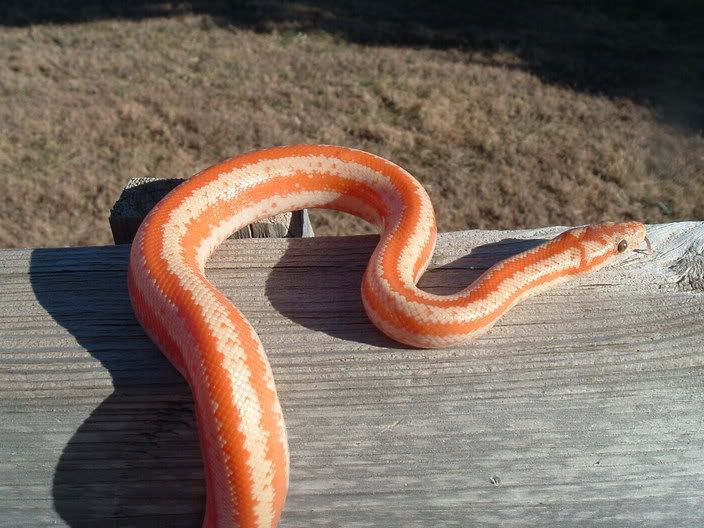
Information like "I have a suboc and it has gotten brighter or faded" is pretty much irrelevant since their diets aren't controlled (i.e. how many carotenoid pigments were present in the rodents they ate? What about what the rodents had been eating?).
There are two issues here and it is really quite simple -
1. What kind of pigment produces the orange coloration in bogeys?
2. Where does that pigment come from?
If you say the pigment is carotenoid, then how do the snakes produce it? Do they get it from the diet or do they manufacture it themselves from lipids in the diet? From what I know, vertebrates don't manufacture carotenoid pigments (but I could be wrong about this). And bogeys eat the heck out of heteromyid rodents. What about the orange enamel on the front of their teeth? What about their orange/yellow fur?
If the pigments are not carotenoid in nature, what are they? Proteins? Is it a derivative of melanin? One of the xanthins?
In the absence of real answers to these questions, we are all just shouting into the wind here.
It could be. If this is the case, then it would be safe to assume the color is dependent on genetic factors.
But would a diet rich in carotenoids make the snakes more orange. I suspect it would. However, this would be difficult to quantify by just feeding one or two animals, it would take a larger sample size to produce any reasonable correlation.
As for the suggestion that it is simple Darwinian selection based on soil color, I balk at that (with all respect to Jack Sites). This is an almost entirely nocturnal species and I doubt shades of coloration has a significant impact on their predation. Although there are higher frequencies of orange snakes in some populations, there are no all orange populations and orange snakes show up from different populations where most snakes aren't orange.
If it is genetic, it is an issue of allele frequencies (assuming it is genetic) within each population. Is that governed by Darwinian selection for matching soil color? I would be amazed if that was the primary selection pressure.
-----
Chris Harrison
San Antonio, Texas


 recently has the most accurate, updated and legit TPRS article ever in Reptiles, and who took the time to write down below this entry in this same forum the SAME EXACT THING THAT I AM SAYING...and yet someone gets on here and totally disregards his and others' expert opinions. In short, they choose to go with the undocumented, unverified rhetoric that is posted on here all of the time.
 I agree to disagree.