Reptile & Amphibian Forums

Welcome to kingsnake.com's message board system. Here you may share and discuss information with others about your favorite reptile and amphibian related topics such as care and feeding, caging requirements, permits and licenses, and more. Launched in 1997, the kingsnake.com message board system is one of the oldest and largest systems on the internet.

Click here to visit Classifieds
Click for ZooMed
Click for 65% off Shipping with Reptiles 2 You

Red coachwhips

KevColubrid May 07, 2006 02:23 AM

Hey all,
So I have two BEAUTIFUL red coachwhips coming my way that I just ordered, I should be getting them on Monday, and I'm excited. Really excited, this is a snake that I've wanted for years, and finally, I've found. I've got a good enclosure set up for them, the two of them are going in a 75 gallon tank, which should be big enough. The male is about four feet long, the female is about 3. I just have a couple of questions.

1. Breeding. Does anyone here breed them? If so, do you brumate them, for how long?

2. Coloration. I've heard that the red in the red coachwhip comes from their diet, does anyone else know anything about this?

Thanks, I'll be posting pictures of these guys once I get them.

Kevin

Replies (17)

mikean May 07, 2006 01:04 PM

Not sure if this is true but I've heard that coachwhips include snakes in their diet. Whether it includes they're own species I don't know. Mine are all kept seperate. The two bigger westerns are fine but the smaller one watches other snakes a little too much, so I wouldn't trust him with other snakes.

If you don't mind me asking, where are you getting the whips from ? I'm after some more but locating them is fairly difficult.

Mike

I know 'sighthunter' has bred lots of coachwhips so he should be able to help you if you are stuck. Hopeing for eggs off my westerns this year myself.

Carmichael May 07, 2006 04:06 PM

That seems like a very small enclosure for two young adult coachwhips.....we keep our's singly in 6' x 3' enclosures and they use every inch of space that you provide. Although they can be kept together, I do know of a couple of confirmed instances of cagemates turning on each other (as in "dang, you taste real good"!). Just something to keep in mind. Also, these are escape artists and traditional tanks and screen lids will probably not provide the kind of secure housing that you'll need with this species.

Our off display "red" coachwhips are set up as follows:
we provide a Power Sun bulb (100 watt) that is directed on to a large, flat and weathered log. The snakes spend a lot of time basking under the heat lamp. Additionally, they can easily crawl underneath the log to feel secure while also staying warm. A pile of well secured flat rocks on the cool side provide access to shady/cool areas. THere is a large, shallow water pan and a few additional branches and that's about it. We use several inches of aspen bedding as the substrate.

I haven't heard that about the diet dictating the "redness" of a western, our's stay brilliant red/pink and are fed a diet of frozen/thawed rodents and quail (with a little vitamins mixed on every third to fourth feeding).

Hope this helps.

Rob Carmichael, Curator
The Wildlife Discovery Center
Lake Forest, IL

>>Hey all,
>>So I have two BEAUTIFUL red coachwhips coming my way that I just ordered, I should be getting them on Monday, and I'm excited. Really excited, this is a snake that I've wanted for years, and finally, I've found. I've got a good enclosure set up for them, the two of them are going in a 75 gallon tank, which should be big enough. The male is about four feet long, the female is about 3. I just have a couple of questions.
>>
>>1. Breeding. Does anyone here breed them? If so, do you brumate them, for how long?
>>
>>2. Coloration. I've heard that the red in the red coachwhip comes from their diet, does anyone else know anything about this?
>>
>>Thanks, I'll be posting pictures of these guys once I get them.
>>
>>Kevin
-----
Rob Carmichael, Curator
The Wildlife Discovery Center at Elawa Farm
Lake Forest, IL


KevColubrid May 08, 2006 12:06 PM

Wow...that's a spacious cage! I'll start looking into getting something around that size immediately. For now, I'll keep them in seperate, 75 gallon tanks, since at the moment, that's the biggest thing I've got. I'm glad I found out about the whole cannibalism thing, I knew they ate other snakes, but didn't know they actually ate each other. I'd love to see some pictures of your enclosures so I can get a better idea of what to look for/build.
Kevin

Sighthunter May 09, 2006 01:38 AM

I hibernate for three months at 55F starting first of December. I pair first of March. I get eggs around June 15th.


-----
"Life without risk is to merely exist."

Sighthunter May 09, 2006 01:43 AM

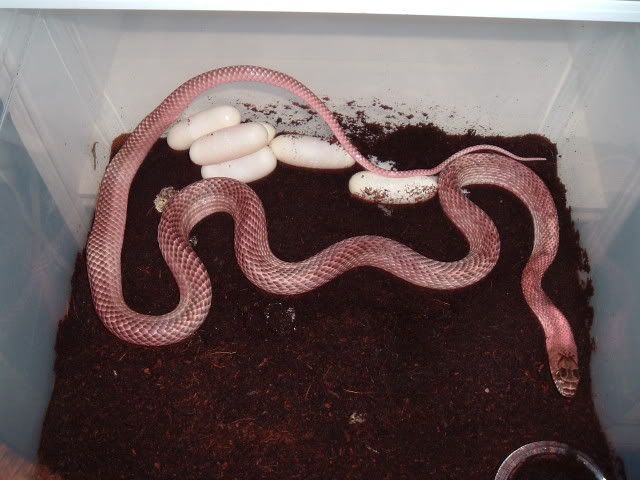
Incubate at 82F for 70 Days and you should see this. Good Luck awsome snakes, my favorite.


-----
"Life without risk is to merely exist."

jodscovry May 09, 2006 06:41 PM

Is that the coconut shavings you told me about , my six foot female eastern is about to drop and i was also wondering if you moistin the coconit or use snap tight lid or just how do you do it, and I've breed indigos and kings and ratsnakes and had good success with all but I hunt alot and i often fing racer eggs in bone dry sand or soil and seem fine...JB

Sighthunter May 09, 2006 11:39 PM

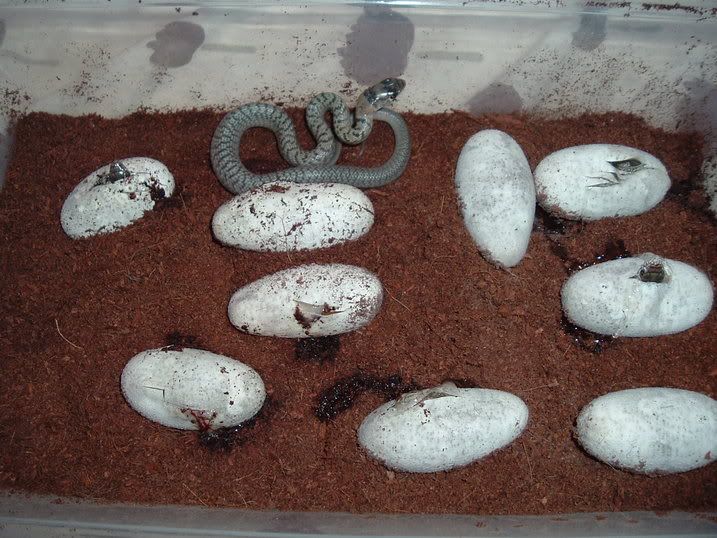
For some reason the high pH in ground coconut husk keeps coachwhip eggs from molding. It should look almost dry but it holds alot of water. If it looks wet it is too wet. I will review my pics for a visual for you. These are eggs from my Blue Rock Lizards and this coconut husk is a little too wet for coachwhips.


-----
"Life without risk is to merely exist."

Sighthunter May 09, 2006 11:46 PM

The picture of hatching coachwhips is a good guage for how wet/dry it should look almost dry but it actualy has quite a bit of moisture in it. It is sold at any pet store as eco-bedding and is in compressed brick form just add water if it looks too wet just set it out so it will dry in the sun or let a fan blow on it for a while.
-----
"Life without risk is to merely exist."

Sighthunter May 09, 2006 01:46 AM

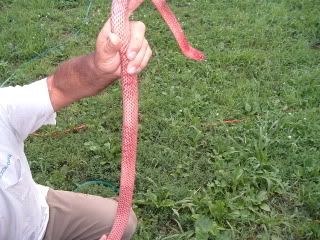
I use carotent to maintain color. This is a wild caught snake without carotene. It fades in about two years without a carotene based diet. I use egg yoke mixed with water injected into frozen thawed rats and mice.


-----
"Life without risk is to merely exist."

mikean May 09, 2006 02:09 AM

Exactly what product do you use Bill ? Is it powder or liquid form and how much do you mix with the egg yolk and inject into the rats?

I know nothing about the carotene, so am not sure what forms it comes in. Will the snakes just hold colours or will it restore the old colour or even make them more red?

I have a red that is more of a salmon pink, and it does look like the colour has faded somewhat even in the short time I've had it.

Thanks

Mike

KevColubrid May 09, 2006 02:19 AM

Sighthunter, have you ever witnessed cannibalism in any of your reds?

Also, what size of enclosure do you keep yours in?

One more thing...I've noticed that with some reds, they have a banded pattern, some are just a brilliant RED (my personal favorite), and some have the salmon-pink color. What's the difference?

Kevin

Sighthunter May 09, 2006 01:50 PM

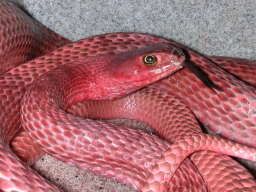
They all seem to have underlieng banding this individual has banding but you normaly cannot tell. Seems when they fade the banding is more evident. I have found that red and pink are found in the same population and red will fade to pink sometimes so diet may be a factor.


-----
"Life without risk is to merely exist."

Sighthunter May 09, 2006 11:58 PM

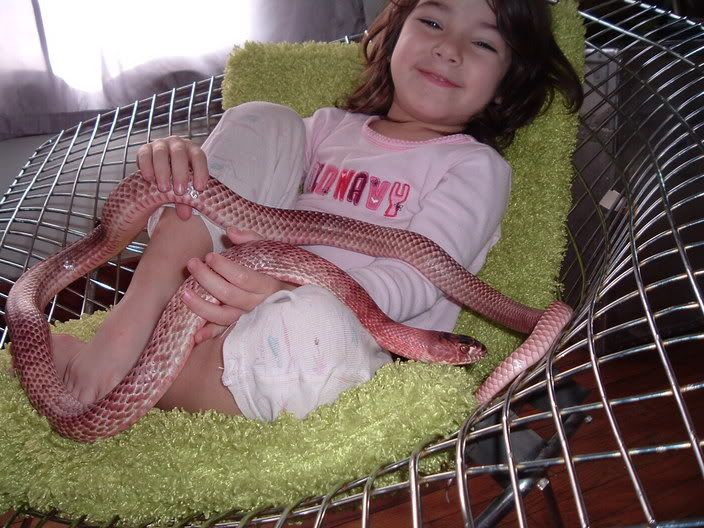
This is a mellow male I hatched out in 1997. I give him small amounts of carotene off and on. I will give him a bunch and show you the difference in a few months.


-----
"Life without risk is to merely exist."

coluberking25 May 13, 2006 09:51 PM

can't too much caroene be harmful to the snake though?

Sighthunter May 14, 2006 01:23 AM

In the form of vitamin A, Yes. Carrots with a water base and egg yoke should pass excess through their system. Rodents have vegetable matter in their gut tract and hatchling birds have yoke in them. I have never had problems with water based carotene.
-----
"Life without risk is to merely exist."

coluberking25 May 13, 2006 09:52 PM

can't too much caroene be harmful to the snake though?

PS-I'm sorry all racer enthusiasts, but i've decided to get some blue tongue skinks instead. however the racer will frever hold a place in my heart.

Sighthunter May 09, 2006 01:06 PM

The safest is simple egg yoke. If you dilute it 50% with water it should do the trick. It is the source for most wild snakes such as hatchling birds eggs and such. I dilute with water since I am removing the albumen from the egg. I just do not want to gum up the snakes digestive tract.
-----
"Life without risk is to merely exist."

Site Tools