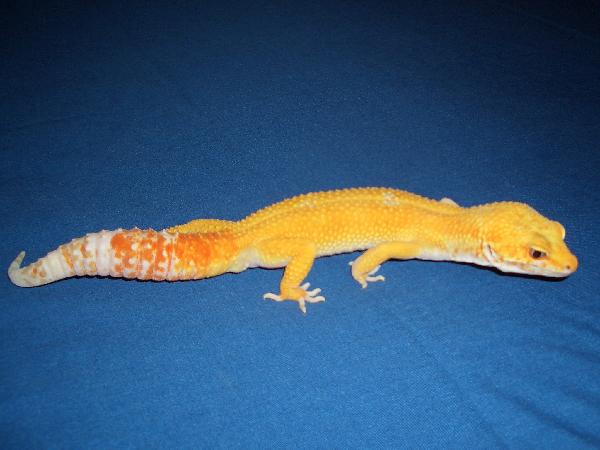
While I mean no disrespect to those that have kept Geckos sucdessfully and bred them, the school of thoughts from vets and from zoos (professors, scientists, etc.)is that UVA and UVB is important to leopard geckos, just not in large amounts. Even though geckos and other nocturnal animals only come out at night, the sun does manage to permeate and give them the small amouunts thsy need. I humbly submit the following for discussion: Below is a quote:
"Lighting: Ultraviolet B is required to maintain healthy leopard geckos. The best source of UVB is the sun, but special bulbs, (fluorescent or mercury vapor) can be purchased from a reptile shop. The flourescent bulb must be placed no more than 12 inches from the basking site, and should be on a timer to provide about 14 hours of daylight and 10 hours of darkness." This is from "Chicago Exotics" An avian exotic animal hospital
Also, the UK has a study:
Variation in skin sensitivity to UVB light.
All living things on the surface of the planet are exposed to ultraviolet light to some extent. Diffused and reflected UVB will penetrate into deep shade and even nocturnal creatures may be exposed to small amounts whilst hidden in their daytime retreats, particularly in locations where daytime UVB levels are high.
It is likely that all reptiles can synthesise vitamin D in their skin when exposed to UVB light. Very few vertebrates do not synthesise its precursor, provitaminD, in the skin.23
Two related studies compared the sensitivity of the skins of four species of lizard - a crepuscular house gecko, a shade-dwelling anole, an anole which basks in sunshine, and the sun-dwelling Texas spiny lizard. The amount of vitamin D3 synthesised by the skin of each of the species was compared. They found that the skin sensitivity was related to the amount of exposure to UVB light the reptiles would normally receive in the wild. The Texas spiny lizard skin was the most insensitive; in a high UVB environment, this thick skin might well be resistant to UV damage and yet still produce sufficient vitamin D3. The house gecko skin was the most sensitive; presumably this gecko would be able to make the most of the smallest amounts of ultraviolet light that came its way.9,16
We have conducted a new study on the way the skin of reptiles from different habitats varies in its transmission of UVB light, by examining the shed skin from a range of species from very different environments. We have found that in general, our findings tie in well with those described above. Lizards which are normally exposed to high levels of UV light have shed skin which lets only a small percentage through to its deeper layers; this barrier would thus presumably have a protective function. Species that would receive lower levels of UVB in their environment have shed skin which lets a higher percentage of UVB light through.
-----
----------------------
1.1 Cats -Siamese Emma, Asian Leopard Cat Hau-Li
2.2.Horses - Percheron Girls - Colea and Ivy - Thoroughbred Machine to Tower and my beloved Brilliant Display (Rainbow Bridge)
2.1 Leopard Geckos -Gamarrah, Gabera and Monster Zero
1.0 Miniature Goat - Betty
1.0 Dog - Bess
1.0 African Grey - Molly




 heh jk