Just wondering from the post eariler. What % of monitors are taken from the wild and how often; again general question. I know some types of monitors are taken in greater numbers than others. For the sake of the question, lets focus on sav, niles, waters, and even tree monitors.
Thanks
Reptile & Amphibian Forums
Welcome to kingsnake.com's message board system. Here you may share and discuss information with others about your favorite reptile and amphibian related topics such as care and feeding, caging requirements, permits and licenses, and more. Launched in 1997, the kingsnake.com message board system is one of the oldest and largest systems on the internet.



What % of wild monitors are taken
roadspawn
Jul 05, 2006 06:45 PM
Replies (18)
FR
Jul 05, 2006 08:07 PM
Most likely there is no way of knowing. The reason is, so little is known about any species of monitor. So this is only a common sense guess.
Less then one half of one percent, possibly far less.
In other words, more are being eaten by snakes this month. Then have been collected in the last ten years. Same sorta thing goes for raptors, they ate more this year, then have been collected for the pet trade, in the entire history of man. In other words, man is a very small part of this. But we know about what we do. We really do not know what other things do. For instance how many monitors are killed by ants?
If there is a problem, its with habitat destruction. With a major problem being the manifacture of artificial habitats, like farmlands and feral fields. These can really overpopulate a species.
Which brings this full circle, many of the areas where "pet trade" collecting occurs is in these artificial habitats. The reason is, natural habitats are much to hard to collect effectively.
I too would like to hear what someone like Daniel thinks about this question. Cheers
odatriad
Jul 05, 2006 08:08 PM
Being that there have been very few, if any population surveys which measured the abundance of varanids in a particular area (much less an entire species), it would therefore be impossible to even make an accurate inference on what percentage is collected for the pet trade.
While the numbers of animals taken for the pet trade do exist (listed as CITES quotas), numbers which accurately represent wild populations simply don't, due to a general lack of studies.
mampam
Jul 06, 2006 09:59 AM
There have been a few attempts at measuring monitor densities. We tried with both savannah monitors and Nile monitors in Ghana. There are a lot of problems, not least because the really important number is the density of adult females, how many babies there are at any one time isn't usually important because the numbers fluctuate massively over different seasons. We were interested in baby savannah monitors because we wanted to know how what proportion were removed by trappers for the wildlife trade. We did it by digging up the babies in the normal way, marking them and releasing them. The results were published in Amphibia-Reptilia I think and although I can't remember the numbers offhand I think trappers did well if they found more than 40% of the babies during a visit. Overall the animals were very common in good habitat (which was farmland) and there was no problem with the numbers taken. It didn't work as well for Nile monitors because the babies and subadults were all clustered along riverbanks, which being linear features makes it difficult to assign a meaningful area. Also made it very hard to capture enough to make a mark-recapture experiment work.
But that was ten years ago and things are very different now. Nobody catches babies anymore, they go for the GRAVID FEMALES. Not only in Ghana but all over Africa and Asia. This allows people to sell animals as "captive hatched" or "ranched" or some other misnomer, but what it means is that instead of removing the animals that would probably almost all die within a year anyway, they are removing the key animals that drive populations. I have said it before, but even the most ignorant hunters in the world know that killing pregnant females is foolish. In the pet trade however it makes the most profit so that is how it is done. It has the potential to be massively damaging, particularly for animals that only occur on small islands. You might read or be told that the females are released back into the wild afterwards, but that is absolute nonsense. They all die. Every one of them. As far as I am aware there haven't been any investigations into how this shift in techniques alters populations, but common sense suggests that if you specifically target reproductively active females year after year populations are bound to decline (either in numbers or in terms of diversity) eventually. This is why I don't agree with Frank that the only problem is habitat destruction, although overall that is the main cause of worldwide biodiversity loss. Targetting gravid females of rare species on small islands is incredibly destructive and something that people don't really like to talk about. But they should do because, in my opinion, it is the reason why the pet trade has the potential to be a real threat to many island endemic species, including many species of Indonesian monitor lizards. Captive hatched/ranched is much less sustainable than old fashioned wild caught. It's something I am going to devote a lot of energy to (and I expect make a lot of enemies at the same time) as soon as I can shake this butaan albatross off my back.....
-----
Mampam Conservation
holygouda
Jul 06, 2006 10:54 AM
It's unfortunate that our love for reptiles and our selfish need to own one has potentially caused this problem. If we are willing to pay for them, people in underdeveloped countries will do anything necessary to get money into their hands; even destroying populations by capturing gravid females and habitat destruction.
Its easier to turn the other cheek and pretend it's not happening, but what are we gonna do when we realize we exterminated one of our greatest loves in life? Just say "oh well" or blame it on someone else?
What can we do to help conserve the populations before its too late? Buy captive bred only? Education?
FR
Jul 06, 2006 03:11 PM
hmmmmmm consider. hahahahahahaha
collecting for the pet trade will stop at a certain point. Its something that can be controlled. Habitat destruction has not been halted, slowed down or hindered by the protection of a species. Until humans understand the world will only tolerate a certain number of us and we learn to use available techniques of birth control. There will be no hope for any of these species.
So don't go around blaming the pet trade for the faults of religion(make more babies), politics(make more babies) and science(better birth control). Common sense tells you, there are already plenty of people. Why on earth, do you have to make more and more and more. This needs to be taught in every class in every school in every country. Is it?
By blaming the pet trade, your spending a dollar to save a dime. Better to save the dollar. Cheers
holygouda
Jul 06, 2006 08:30 PM
Frank,
You seem to think it is so easy to fix. Many countries have attempted to address the over-population issue and although its still a problem, there are other bigger ones. Yes, the planet can only support a certain amount of people and if the baby-making machines(us) don't chill out, then there will be a huge problem sooner than later.
But things like carbon dioxide from cutting down trees and burning gasoline are causing problems as well. Its not just over population that is causing trees to get cut down, its unindustrialized nations that need to survive. Trees may be there only way to provide heat for their family's. And all of these problems will wipe out our population as well as the animals if its not under control. Stopping having babies wont change the fact that people ignore the world falling apart because they can't see it directly. What about the highest amount of the most intense hurricanes last year? Coincidence? Hmmm
So if we can attempt to not destroy the reptile population before we destroy everything else, that would be nice. Lets work on educating people about over-crowding issues, as well as others like carbon dioxide and using wild caught female monitors so we can produce wild caught babies and market them for something else to make a few extra bucks for doing less work. If we work on breeding them here and promote against wild caught stuff, then they wont have anyone to sell to. Maybe then they will find something else to exploit.... and have less babies.
Neal_
Jul 06, 2006 09:32 PM
You are right that people simply not having babies would not be enough to change things, but it would surely be a good start. I personally find it very difficult not to be judgmental of anyone who wants to have children in this day in age. If I were king of the world I would use the military to enforce a mandatory birth control/abortion program. Having more than one or two kids is just obscene.
It seems that you do not have a very accurate picture of what is really happening to forests around the world. Indigenous peoples burning wood for heat is of little consequence. Logging operations especially illegal ones and clearing vast areas for large scale industrial agricultural purposes and the wildfires that are often the result are the real destructive forces. I believe that usually the timber and the profit is usually going to other countries not to the countries where the forests are actually being raped.
holygouda
Jul 06, 2006 10:38 PM
With the logging operations, you indeed are correct. As far as the kids go, the forced deaths of babies that took place in china is not exactly appropriate. They are punishing the wrong party(its not the childrens fault).
But we had the same problem in America a few decades back when it was uncommon to have less than 6 kids to a family. Granted we have toned down a bit, but it takes a while for nature to fix that overpopulation we created since people live more than only a few years. Some countries are just a little behind with catching on that huge familys are not a good idea.
Anyway we have gotten so far off topic. Yes, there are many things to be fixed, having babies, the extensive logging operations and other things. This all started with the screwed up way people are collecting gravid females and selling the babies and killing the mother. Whether its hurting the population or not, its still jacked up. Eventually it will be more destructive than we can predict at this point in time. 
mampam
Jul 07, 2006 11:51 AM
It is a bit off topic, but my opinion, for what it's worth, is that the problem isn't that the world is overpopulated with people, The problem is that a few of us are using far more resources than is sustainable. We know who we are..........
-----
Mampam Conservation
FR
Jul 07, 2006 03:50 PM
Please, where did you get that, I never said or indicated its easy to fix.
I only said, overpopulation IS the root of the problem. Again, I offered no cure(not sure there is one) Slowly lowering the human population is THE only hope. Consider, hope is not a cure.
Messing with or blaming the pet trade is of no real benefit. Its somewhat of a needless bandaid cure. You put a bandaid on a small cut, but half your body is blown off. Putting a bandaid on a small cut will not save the person with half is body blown off. Cheers
mampam
Jul 09, 2006 02:18 AM
Ok point taken. But I was talking specifically about threats to small island endemic monitors in Indonesia, where I believe that the threat from the pet trade is significant and problems of population pressure are less immediate. The population problem is probably at its worst here in the Philippines where birth control is considered "a sin" and human growth is running at close to 2% per year, by far the highest in Asia. It is a real problem but I am uncomfortable with the idea that there are "too many people" when in fact a small minority of us are consuming far more resources than everybody else. There are only too many people because everybody believes (with some justification) that they have the right to live the same way we do..... Seven billion people on bicycles might be scary but seven billion of us with SUVs is definiately the end of the world as we known it.....
-----
Mampam Conservation
FR
Jul 06, 2006 02:00 PM
To clarify, the question was overall percentage, not local percentage.
In the case of Savs, they could take 100% of the savs in those fields and it would not register as .01% of the overall poplation(total range).
When you say tree monitors, indeed collecting blacktrees on a single island would have a higher percentage, But not effect the percentage of ALL tree monitors. As most likely most of their locals are unknown. This most likely includes blacktrees as well.
If you look at the range maps, you see a blacktree type monitors found in extreme southern indo, and middle west indo, and another type in northeast indo. And one or more on mainland indo. The reality is, there are literally thousands of islands between these "known" locals. In recent years, some of these islands have been visited by "pet trade" collectors and they have come up with many "new" types(colors) of tree monitors, there are still thousands of islands and millions of acres left to explore.
A good example of this is, V.kingorum. This species has one of the smallest known ranges, a dot around kunanurra. Only problem with that is, its real range is huge. I personally found them to be very very common over a huge area, larger then many of our western states. Which clearly points out, that varanids are very low of the list of what is being studied. This same senario is common with many of Australias monitors.
Which may indeed point out, its even more common in areas like indo, where there is no interest in varanid species and ranges.
This is a very sad comment and I hate to be the one making it, but if it was not for the pet trade, about 10 species of monitor would be unknown to science. Please understand, I am not protecting or defending the pet trade, but it appears it has benefited science. As science has not got off their bums and done much in the way of work. Another example, in a very short time, I have found as many as five undescribed species of monitors in OZ, all by myself. I am not boasting, I am saying science does not seem to be all that interested.
I talked to a good fella and friend in oz about describing them, he told me, get in line mate, I got 27 undescribed tortosises in front of you.
This relates to this subject because, it shows, what is known to science is only a drop in the bucket, compared to reality. Cheers
mampam
Jul 06, 2006 08:33 PM
The big difference between Australia and Indonesia is that the latter is made up of (mainly small) islands that show higher levels of endemism than almost anywhere else on Earth. So species that occur on one island often don't occur anywhere else. The black tree monitors in the pet trade, for example, are known from the Aru Islands, nowhere else. It's possible that they occur on other islands but it seems more likely to me that other islands would contain different forms (=species). The point is that if these species are endemic to very small islands and they are collected by targeting gravid females that should be a cause of concern. If it turns out that they actually have much larger ranges and are very common throughout then it wouldn't be a problem. But we don't know that and the little evidence available suggests the opposite. My opinion with things like that is that if you don't know you should expect the worst. The fact that we wouldn't know that these species existed if it wasn't for the pet trade isn't justification. In fact it demonstrates the very urgent need for independant investigations.
-----
Mampam Conservation
FR
Jul 07, 2006 08:48 AM
Please Daniel, everything is possible, so stick to what is happening as best you know. At this time, they are not targeting gravid Blacktrees. They do not ranch(steal eggs) from blacktrees, they simply collect them and sell them. There is no influx of babies, like with savs. You know this, so don't confuse one senario and mix it with another to boster your thoughts, use what is real what is actually happening at these very different areas.
Also, you saw that collecting did not effect savs. Not any number or over many years. It only resulted in one thing, more smaller adults. You see thats what happens by harvesting an area without destroying the habitat. This also appears to be the case with Blacktrees. More individuals that are smaller.
You also know that, if you move away from those feral fields to collect savs, you find far fewer and larger individuals and the females are less productive. This is why the locals harvest only the fields, natural(old static populations) are not profitable.
As a biologist, you must try to understand(learn) what their reproductive abilities are and how they maintain populations. Varanids like some other reptiles(snakes) reproduce at a huge range of size and age. Normally all monitors reproduce at 1/2 their average adult size. In predated or heavily collected populations, the area is filled with these young small females. Its a really good stradgy, it takes far less space and energy for small females to reproduce then large adult females. This repopulates the area quickly.
Consider the opposite, old static populations are where there are few individuals, but they are very large. The reproduction is very low. There is no need to, as the area is filled with large adults(static or old population) Consider, a healthy population is one where there is a range of young and old females recruiting.
Simply put, as long as Blacktrees have mangroves, they will be fine, maybe more individuals and smaller, but they will exsist. Once there habitat is gone, they are gone. Once the collecting stops, the population will dwindle and there will be fewer larger adults,Simple.
Now just for fun, go back and study Rich Shines water python study and the guam studies on the brown tree snake. Both had the highest populations know to science. Now study why? Then ask yourself why other natural populations did not have these numbers?
Any more thoughts, just good conversation, cheers
mampam
Jul 07, 2006 11:56 AM
I think you are wrong about that. I think the Indonesian reptile trade favours gravid females of any reptiles. The sad fact is that they will buy anything in order to keep their collectors happy, and throw most of it away. It's an enormously wasteful and unsustaionable trade and because it targets animals that only occur on very small islands it is of great conservation conceren.
You know as well as I do that if it were rare island endemic birds being traded in that way there would be massive efforts to do something about it. But because it's reptiles, very few people care......
-----
Mampam Conservation
HaroldD
Jul 07, 2006 12:43 PM
Frank is correct. Daniel is wrong.
99.9% of V.beccarii imported into the U.S. are adults, recently captured.
The same holds true for all the other tree monitors except V. prasinus. Since Indonesia only issues CITES permits for CB, there is some "ranching" of that species. Still, over 50% of the "CB" imports are more than half grown already
mrcota
Jul 08, 2006 09:54 AM
Although Daniel could possibly be wrong when it comes to those that enter the US, as Harold pointed out, Daniel is right on target when it comes to the Asian trade (what I have seen on this side of the ocean by the large number of hatchling V. beccari last year) and Europe, where EU legislation causes this by demanding that monitors be captive bred. With their quota set at zero this year, there have not been too many moving out of Indonesia lately.
As for what happened in Guam, it was a result of a closed eco-system in which Boiga irregularis was not a regular prey item of any other species and only an occasional prey item of wild/feral pigs (which are not much of a danger to an arboreal species) and Varanus indicus, which in turn are a prey item of Boiga irregularis when they are young. These large populations of Boiga irregularis do not exist in their native New Guinea, where they have a number of predators. I was in Guam when many of the studies were conducted (1989-1991) concerning the problem of Boiga irregularis and would be happy to try to answer any questions you might have concerning the problem of Boiga irregularis on Guam, although most of the studies were published after I had already left, so most are not in my possession.
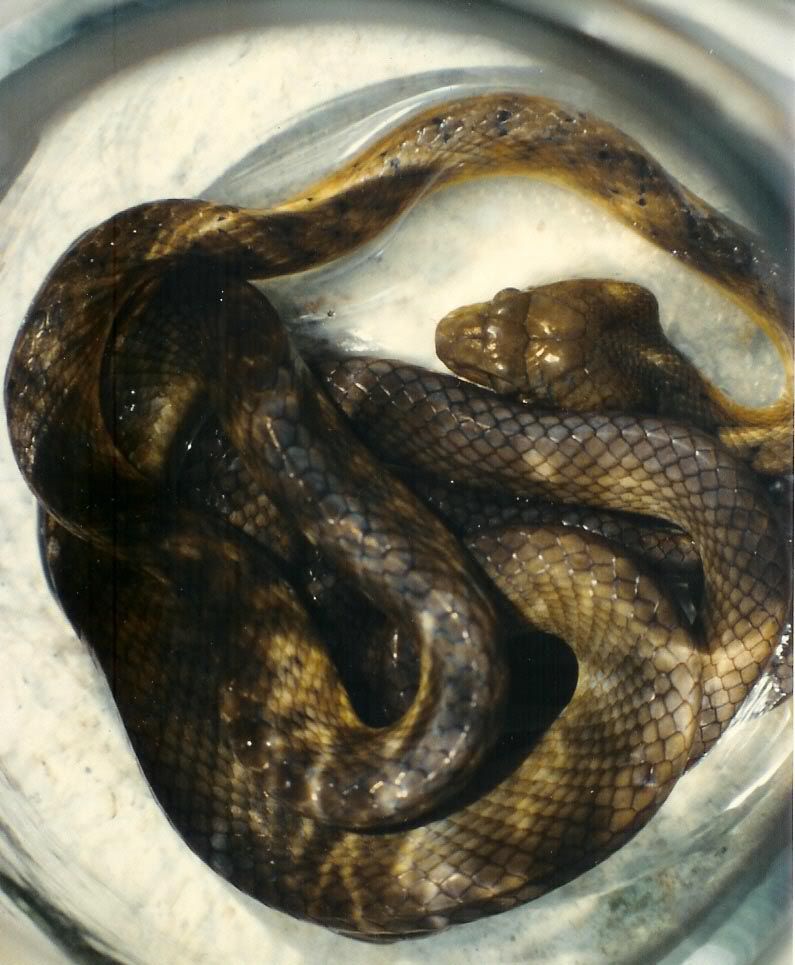
One of the MANY specimens that I collected while I was in Guam.
Cheers,
Michael
mampam
Jul 09, 2006 02:09 AM
Most of the trade in these monitors from Indonesia is probably directed at other parts of Asia. I didn't say that gravid females accounted for all or the majority of trade but that they are PREFERRED by exporters. If the business was being run with sutainability in mind these animals would always be left alone. The fact that most of the USA imports are adults simply indicates to me that not enough gravid females can be found to satisfy demand. I am surprised by Harold's assertion that only 1 in 1000 of the black tree monitors imported into the US are juveniles. Not sure how he arrived at this figure, unless it is derived from CITES declarations, although these don't normally specify age of animals but should include origin (i.e. wild caught, captibe bred,ranched etc). Coming from the man who reliably informed us that the Nile monitor was extinct in Egypt and that Varanus olivaceus supplements a "typical forest monitor diet" with fruit I tend to be very sceptical of his statements...
-----
Mampam Conservation
