Reptile & Amphibian Forums

Welcome to kingsnake.com's message board system. Here you may share and discuss information with others about your favorite reptile and amphibian related topics such as care and feeding, caging requirements, permits and licenses, and more. Launched in 1997, the kingsnake.com message board system is one of the oldest and largest systems on the internet.

Click for 65% off Shipping with Reptiles 2 You
Click for ZooMed
Click here to visit Classifieds

the odd bloodred snake mentioned before

xblackheart Jul 10, 2006 12:48 AM

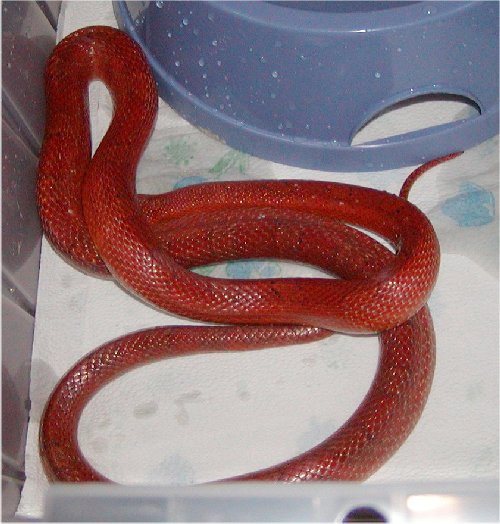
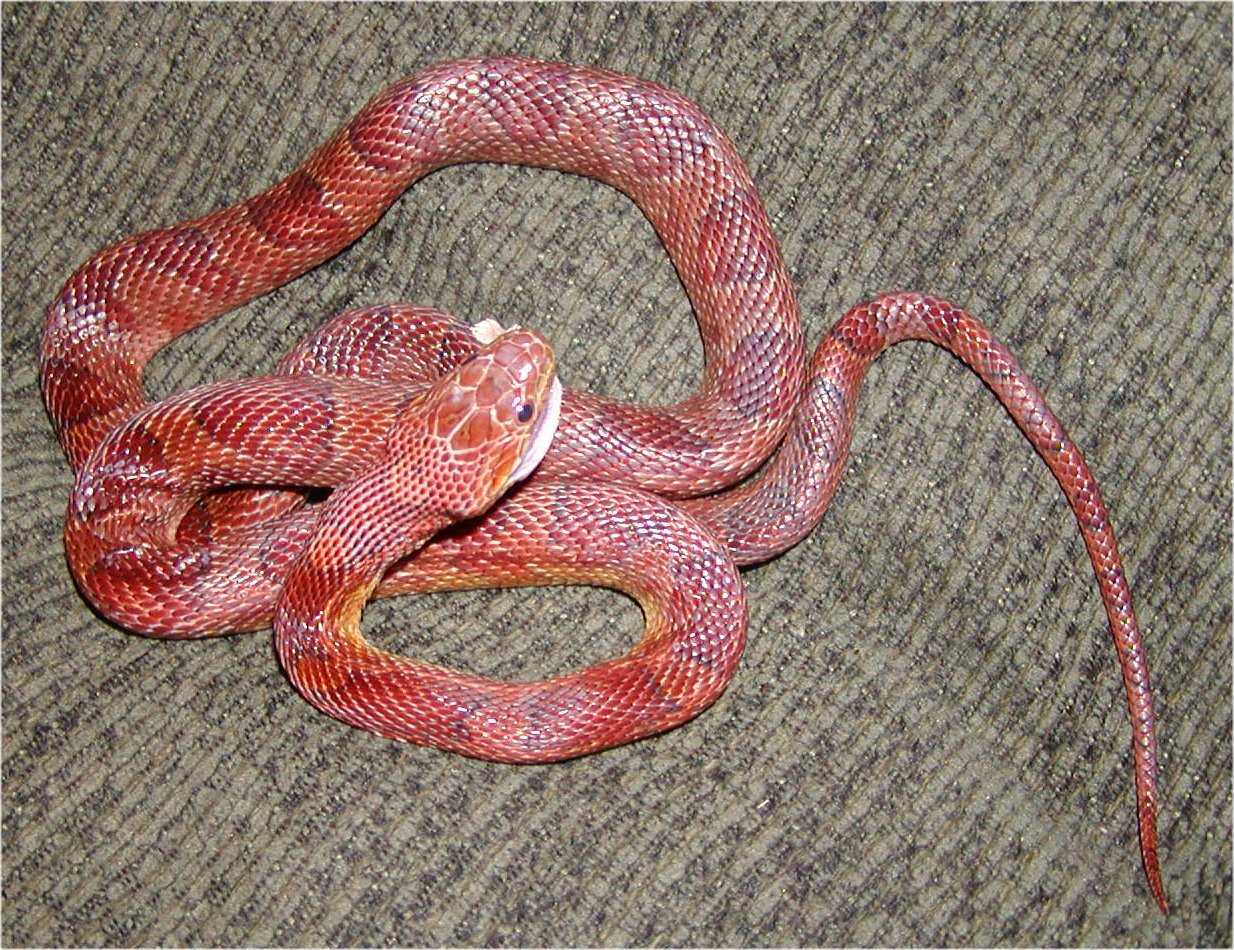
I previously mentioned a bloodred snake that I had acquired. I was waiting for him to shed, so I could get accurate pictures. At least I think he is a bloodred. I do not know of any other corn snake that gets as uniform red as he is. I was thinking that he might be a low end or poor quality bloodred. I took some pictures of him. I took two over view pictures, a side picture, a close up of the head and a belly shot. The belly is what confusses me. There is black in the belly.

-----
****Misty****

"Yesterday was the deadline for all complaints"

The list keeps getting Smaller!
Not counting Hatchlings, this is what I have.........

1.1.2 bearded dragons
7.17.4 corn snakes
1.1.0 jungle corns
2.5.0 king snakes
1.0.0 Sinaloan milk snake
0.1.0 Tri-Hybrid milk snake
0.1.0 rat snake
1.1.0 Leucistic rat snakes
1.1.0 Congo African Grey Parrots
0.1.0 German Shepherd hybrid dog

Replies (50)

xblackheart Jul 10, 2006 12:49 AM

here are the other 2 pics. The first picture is of my other bloodred for comparrison. the second and third pics are of the new guy.

-----
****Misty****

"Yesterday was the deadline for all complaints"

The list keeps getting Smaller!
Not counting Hatchlings, this is what I have.........

1.1.2 bearded dragons
7.17.4 corn snakes
1.1.0 jungle corns
2.5.0 king snakes
1.0.0 Sinaloan milk snake
0.1.0 Tri-Hybrid milk snake
0.1.0 rat snake
1.1.0 Leucistic rat snakes
1.1.0 Congo African Grey Parrots
0.1.0 German Shepherd hybrid dog

blizz Jul 10, 2006 01:24 AM

The belly says not bloodred.
Bloodreds have no black pattern - the pattenless belly is one of the surest signs of bloods.

Possible he is het. for bloodred - sometimes those corns have more red than normals, and reduced pattern on the belly like yours.

shaky Jul 10, 2006 10:14 AM

As Blizz says, It looks like an outcrossed 'blood'. Thew diffusion on the sides is not complete and the belly should have fewer black checks, if not completely white.
Being so bright, though, It should produce some nice 'blood' babies if crossed with a female 'blood'.
-----
...and I think to myself, "What a wonderful world."

tspuckler Jul 10, 2006 08:46 AM

Although it's not a great example of the morph, it looks a heck of a lot better than a lot of snakes I see being advertised called "bloodreds."

I'm not a fan of belly scales determining what a morph is. If a striped corn had a checkered belly, would it not still be striped?

Tim
Third Eye
Third Eye

Kat Jul 10, 2006 10:33 AM

Belly checkers don't "determine" morphs, but they are good indicators. What actually determines whether a snake is het or homozygous for a trait is what GENES it has.

In the case of bloodreds, lack or presence of belly checks are a VERY good indicator of whether the snake is het for bloodred or homozygous. No matter how pretty a snake is and how red and patternless it is on the sides, if it only has one copy of the gene, it is HET. And if it has belly checks, even the slightest partial ones, it's almost certainly only carrying one copy of the gene.

I've never heard of Stripes with belly checks, though I do know they often get speckling on their belly. I have seen Motleys with belly checks though, specifically the banded motleys tend to get atleast some checkers. Heck, I've hatched out banded motleys with partial checkering out of two hurricane motley parents!

-Kat
-----
This Space For Rent

tspuckler Jul 10, 2006 11:12 AM

I was reading "The Corn Snake Manual" and it seems the jury is still out as to if there's such a thing as a "het bloodred," in terms of it being a simple recessive genetic trait. Since this morph has been around since the 70s, I'm beginning to think it is a color morph, like Miami phase or Okeetee phase - therefore there can be a variety of "looks" to the morph.

If this is the case, then there would be no such thing as a "het bloodred" as there is no such this as a het Okeetee phase or het Miami phase.

So tell me, what GENES does a snake need to be a bloodred? Some think excessive red, some say lack of black - some say both. Do you know? Enlighten me.

I have seen plenty of striped and motley corns with checkered bellies (I've visited a number of major breeders and have been to the Daytona, Orlando, and Chicago shows, as well as some smaller ones).

So I stand by my statement that I am not a big fan of belly scales (being used in) determining what a morph is.

Tim

Kat Jul 10, 2006 04:27 PM

The Bloodred morph itself is a combination of both a recessive trait and some line breeding.

People have started calling the gene necessary for bloodred 'diffuse', others just call it 'bloodred'. Either way, an animal only HET for this gene is not a true bloodred.

Animals which are homozygous for diffuse/bloodred can still be pretty blah-looking animals, if they're not line-bred for color.

Think of it as the difference between a hypo and a crimson.
Crimsons are homozygous for hypo, and sometimes you can get normals from crimson lines that show hypo-esque traits, but no matter how nice they look they're not really crimsons if they're not homozygous hypo.

I, for one, would be ticked off at a breeder that sold me something as a bloodred that when bred with another bloodred did not produce 100% bloodreds. Calling something a bloodred implies that it is homozygous for the diffuse/bloodred gene.

-Kat
-----
This Space For Rent

tspuckler Jul 10, 2006 09:42 PM

Have you ever seen a bloodred created by breeding two "hets" together?

HerpZillA Jul 10, 2006 10:06 PM

Timothy, since I am a neophyte, I must say no. But that is a trick question, as there are no hets. But I do think it MAY be possible to get a better looking bloodred from breeding to inferior bloodred. Just do to the variety of off spring. Much like skin color in people. I'm slight olive due to my Hungarian back ground. My wife (Puerto Rican) is very white, due to her Spanish heritage. but my daughter is darker than both of us. This is either due to the genotype genes we carry, or the mailman !

xblackheart Jul 10, 2006 10:55 PM

I would think its the mailman!!!
just messing with ya.
I am not one to get into genetics debates because I know so little.
I have a record book that I am keeping track of all my snakes in and I'd like to know what phase to list this fella under. I think I am leaning toward bloodred maybe Het bloodred. But if he is just Het for it, why is he so red and what phase is he? I asked this in the other post. Should I record him as a normal het for bloodred, bloodred, or what?
-----
****Misty****

"Yesterday was the deadline for all complaints"

The list keeps getting Smaller!
Not counting Hatchlings, this is what I have.........

1.1.2 bearded dragons
7.17.4 corn snakes
1.1.0 jungle corns
2.5.0 king snakes
1.0.0 Sinaloan milk snake
0.1.0 Tri-Hybrid milk snake
0.1.0 rat snake
1.1.0 Leucistic rat snakes
1.1.0 Congo African Grey Parrots
0.1.0 German Shepherd hybrid dog

HerpZillA Jul 10, 2006 11:11 PM

>>I would think its the mailman!!!
>>just messing with ya.

I'm one to joke, and I can also take one. There was no problem at all, actually I set the straight line anyway.

Good topic though, how does one record a semi blood. Gee, maybe thats it? Or maybe a code, even if your own, that describes it.

sports cards use a number system by grading companies 1-10

Coins are graded by names poor, fair, about good, good, very good, fine, very fine, extra fine, abut uncalculated, uncalculated.

If one goes this route, abbreviations would be good. Then a term for each part of a bloods characteristics.

fine for color
good for diffusion
then extra marks, some black checks on belly 20%

That's not a great beginning, but you get the idea. It may do something else too. You can track your snake as it gets older.

My "wannabe" bloodred female is just about 3'. But has a rather small head. If she is a very large 2 year old, she may become a better than I thought bloodred as she is young. But if she is 4, and just has a small head, then I would not expect her to improve as much with time.

There clearly needs to be some guidelines that most people agree on. Contrary to belief, I'm very open minded. We may need this type of system soon for other corns as they become more and more complex in the genetics they contain. Many with some bloodred.

Just my opinion of course.

I was also on cornsnake.com and a few people seem to have a good handle on the genetics, at least part of it. A system needs to start with good and correct info first.

tspuckler Jul 11, 2006 06:45 AM

Thomas,

I'm just trying to get to the bottom of this bloodred business. I wouldn't go as far as to say there's no such thing as a "bloodred het" without seeing if anyone ever bred two hets together and got a bloodred. I am not aware of this ever happening, thus my leaning towards bloodred being a pattern/color like Okeetee and Miami, rather than a simple recessive genetic trait like amel.

Yep, I totally agree that if you took two mediocre bloodreds and bred them that you could get a better bloodred than either parent - just due to the degree of variability in a clutch of hatchlings.

People talk about the "diffused" gene. What the heck is that? I understand that a pattern can be muted (I'm developing vanishing pattern corns), but that does not make a snake red or take away black pigmentation. It seems that most people are in agreement that bloodreds have 1) Muted pattern, 2) More than normal red, and 3) Reduced (or completely absent) black.

I reckon that sounds like three genes to me.

See you on Saturday,

Timothy
Third Eye
Third Eye

carol Jul 11, 2006 10:06 AM

I think Kat did a great job of explaining it. A Bloodred consists of line breeding AND a recessive trait. Like a "Sunglow Motley". There is a trait for Motley, and line breeding for the Sunglow part. There is a trait that is inherited just as a simple recessive with the exception that some "hets" show subtle signs of their genetics. I've always seen this trait cause completely patternless bellies, although I believe there will always eventually be exceptions to the rule. (Like the Mots that have been cropping up with a few checkers) The gene also often causes a "side swiped" effect and the classic Blood head pattern. I say often because you can hatch one that just has the clear belly and the other signs aren't really evident. Much like there are some Motleys out there that you would not call Motleys at first glance.
The selective breeding is what causes Bloodreds to be so red. So you can recover the pattern trait, but the color is not as easily recovered. Again, like that Sunglow Mot, you'll get Mots back in F2, but they may not all look like Sunglows.

Here are some photos of the recovered gene. Both parents were het for the "Bloodred Pattern" or diffuse. It's easier to pick out in these Charcoals because we are not distracted by the red, so the pattern is even more obvious. Three don't carry the gene and one does, can you pick out which one?


Belly comparison of one homo for the trait and one not.


-----
Carol Huddleston
www.lowbellyreptiles.com

HerpZillA Jul 11, 2006 01:59 PM

Timothy, Timothy oh Timothy:

It seems we agree on so much. But I do think the term "het" is for a gene situation that is clearly more simple than the multi events going on in a bloodred. I think you agree?, but do not want to commit that het should not be used for "bloodreds".

If the diffused gene is a simple 1 gene with only 1 allele, then yes, one (me too) can say the diffused portion can be het. A big IF. I personally am not willing to commit to, yet.

Also add in (you said)

1) Muted pattern, 2) More than normal red, and 3) Reduced (or completely absent) black.

Are these separate genes or are they interactive. One gene may play duel roles?
Multigenic or multiallelic or both! blah blah blah.

Timothy, I have an extremely good mentor in this area. I find it hard that you can argue with his point of view.

How was the trip?

Big Tom, sitting in my chair!

HerpZillA Jul 11, 2006 02:06 PM

I am very close to being 100% convinced on the "diffused" portion of the bloodred.

I still would not call a bloodred a het, it implies to much.

I'm very sorry, I'm Polish and Hungarian and a wee bit ole Irish.. Making me have one thick skull!

tspuckler Jul 11, 2006 02:17 PM

Tom, Tom, Tom,

I reckon if you read through the complete thread, you'll see that we all agree (I think) on what a "bloodred" is. I also think this thread has been very educational.

My pics from California are now posted on my hard rockin' website (photo of Cali Pacific Gopher, not a corn snake and NOT het for bloodred).

Tim
Third Eye
Third Eye

HerpZillA Jul 11, 2006 02:25 PM

As soon, as I learn to read, I'll go back over the thread! HHmmm old college joke I'll have to explain.

I think we agree too. And as I said, LONG ago, we need an agreed upon system. Separating the diffused is great. But that is 1 factor, and yet we have the term het used.

Het for what part? "Het" simply does not work well on the bloodreds because of the at least two agreed upon events with in it.

I don;t care what it is called, but in the area of corns, breeders have been better than other herps in keeping genetic terms straight, and correct. Unlike leusistic beardied dragons.

tspuckler Jul 11, 2006 02:36 PM

I don't think a normal looking snake can be het for bloodred. If bloodred is two genes (red and diffused), a normal looking corn could be double het, which means when two are bred together, you'd have a 1 in 16 chance of producing a "real" bloodred.

A diffused pattern snake carrying the red gene could be called a "bloodred het" and a snake visually having the red coloration (but normal pattern) that carries the diffused pattern gene could be "het bloodred" as well.

I think it's misleading when people breed a bloodred to a normal and then sell the babies as hets.

I also am intrigued at how few "diffused pattern" snakes are out there as well as snakes with the excessive red that bloodreds have, but are normally patterned. You'd think these two byproducts of bloodred would be around in greater numbers, just like the byproducts of snow (amel and anery) are around in great numbers.

HerpZillA Jul 11, 2006 03:03 PM

I agree although I sold het bloodreds at one time.

I think the color is far more complex like any corns "phase" can be. And I think there is even more going on in the BR.

I'm getting old these days. I just want to get some nice females to breed. Cornsnakes I mean, of course.

How come Kathy Love has not joined in on this one? At least she has first hand info almost from the beginning?

So a call out to Kathy Love(Special K). She is special and I think the phrase is cool. She's alwasy been helpful with me.

xblackheart Jul 11, 2006 09:59 PM

ya, I was wondering why Kathy had not made a comment on this yet, as well. Maybe it is because her 'puter is down? I'd like to hear what she has to say

-----
****Misty****

"Yesterday was the deadline for all complaints"

The list keeps getting Smaller!
Not counting Hatchlings, this is what I have.........

1.1.2 bearded dragons
7.17.4 corn snakes
1.1.0 jungle corns
2.5.0 king snakes
1.0.0 Sinaloan milk snake
0.1.0 Tri-Hybrid milk snake
0.1.0 rat snake
1.1.0 Leucistic rat snakes
1.1.0 Congo African Grey Parrots
0.1.0 German Shepherd hybrid dog

carol Jul 11, 2006 12:32 AM

Anery A Bloods, Amel Bloods or "Fires" if you will all carry the Bloodred/Diffused gene but had to originally come from het parents. I have two Charcoals het Blood that gave me 3 Charcoals and one killer Pewter.
-----
Carol Huddleston
www.lowbellyreptiles.com

Darin Chappell Jul 11, 2006 09:52 AM

Every single "bloodred" variation (pewters, amel bloods, anery A bloods, hypo bloods etc.) is an example of producing bloodred animals from het bloodreds.

As Kat said, there are two factors at work here:

One is the linebreeding that produces the deep dark red coloration. That line breeding, like miami phase, is not produced by a single genetic factor, and therefore cannot be described in terms of heterozygous or homozygous.

The other, is the genetic mutation which causes the pattern mutation seen in all animals het for the bloodred gene. personally, I prefer the term "episkiastic" to difuse, but to each his own on that.

The point is that an animal can indeed be "het" for that episkiastic gene, and breeding two hets will indeed give yu animals that are homozygous for that genetic mutation. Whether they exhibit the deep, dark red coloration or not, will depend entirely upon the linebreedng behind them (just as true for miamis), but the pattern will be there because of that episkiastic gene.
-----
Darin Chappell
Hillbilly Herps
PO Box 254
Rogersville, MO 65742

stiletto Jul 10, 2006 09:56 AM

Could it be a dark sunglow? The red doesn't seem to bloody to me

tspuckler Jul 10, 2006 09:58 AM

Sunglows are amels. To be a sunglow, it would not have any black and also have red eyes.

HerpZillA Jul 10, 2006 02:30 PM

I had bred a very nice hypo blood (I've posted pics before) to a "het" male. The babies varied greatly. I also had some that looked great from the top, but some black checks on the bottom, much like yours.

I've said for some time that a bloodred does not have hets like other snake morphs. For what ever the genetic reason is.

Tim said it pretty good, so no need to repeat.

But it is a nice bloodred. If you breed it to a nicer bloodred, I would predict that out of 20 babies, 1/2 would be super sweet "true" bloodreds. True means what the guidelines are for a bloodred. The only half will be variations. Maybe some with less black, some with nice color matching between the back ground and patch colors.

All these oddities are what make the bloodred so neat. Imagine selectively breeding a bloodred with great color matching, but select those with nice black saddles. You may? eventually breed into a red corn with black ring saddles?

Bottom line a beautiful snake. No it does not adhere to all the phenotypes of a so called true bloodred.

P.S. I hate the phase true blood red. I asked long ago for some type of system to give the various trades of a bloodred.

She is a keeper for sure.

Tom

HerpZillA Jul 10, 2006 02:38 PM

My first blood red, and I had no idea what she was.

I lost her after her first clutch.

A female I have now, this is a realisic picture of her. Her color makes it very easy to change the way she looks in a picture by changing teh lighting.

By the way, she has a toatally red belly!, but her top is not so great.
Image

HerpZillA Jul 10, 2006 03:06 PM

I think some of these so called het bloods are the best looking corns.

I know this may sound confusing but, I love bloodreds, yet taking a snake as pretty as a corn, with it's almost perfect color combos and contrast, and making it all one color seems counter productive.

xblackheart Jul 10, 2006 09:27 PM

Thanks for the complements on my snake. I just can't imagine it being anything other than a bloodred. I admit that the speckling of black on the belly is odd.

My question to those out there who say the snake is NOT a bloodred, then what kind of corn is it?
Normals do not look anything like this guy. The flash makes the snake look brighter than he is. He is a much deeper rich red.
I got this snake in a trade for a ferret cage that I was not using. I have no idea how old the snake is though.

-----
****Misty****

"Yesterday was the deadline for all complaints"

The list keeps getting Smaller!
Not counting Hatchlings, this is what I have.........

1.1.2 bearded dragons
7.17.4 corn snakes
1.1.0 jungle corns
2.5.0 king snakes
1.0.0 Sinaloan milk snake
0.1.0 Tri-Hybrid milk snake
0.1.0 rat snake
1.1.0 Leucistic rat snakes
1.1.0 Congo African Grey Parrots
0.1.0 German Shepherd hybrid dog

blizz Jul 11, 2006 06:13 AM

Normals can look like this one - sometimes they are het. bloodred, sometimes not.
Perhaps he is a hypo - but you only can know this for sure, when you breed him to a girl, hypo or/and bloodred (best both), het or homo for.

Without that, you will never know sure, what he is.

tspuckler Jul 11, 2006 06:50 AM

The origins of bloodreds are wild caught snakes that were selectively bred to try to get an all-red snake. The origins of Okeetee phase are wild caught snakes selectively bred to have intense orange. The origins of Miamis are wild caught snakes with a grey background color that were selectively bred.

Therefore, bloodreds, Miamis, and Okeetees are all "normal" locality-specific color/pattern phases, right?

Tim

blizz Jul 11, 2006 07:21 AM

Bloodred is both, selectiv breeding AND genetic (diffused).
You find this diffused in some morphs, pewter, sulfur, amelbloodred... that makes, that the pattern to melt - the hatchling shows full pattern on back, later it goes lesser and lesser.

The patternless belly comes from the diffused.
You can look at some ventral-pics here in the gallery unter the bloodred-morphs:

http://www.kornnatterlexikon.de

tspuckler Jul 11, 2006 08:21 AM

Wouldn't it be selective breeding of a diffused pattern already found in nature? Just as Miamis and Okeetees are selectively bred color morphs found in nature?

blizz Jul 11, 2006 08:43 AM

But Okeetee and Miami are not genetic, its only selectiv - it inherited not like a genetic trait like diffued, or motley, or anery and so on.
When you breed a okeetee to a anery, you will only get a normal het. anery, and in the f2 you don´t get okeetees, because its only the look - when you breed a bloodred to an anery, you will get in the f2 bloodreds too - because its genetic.

In the beginning the bloodred was only a selectiv breeding morph - but then they´re shows that diffused, and now all bloodreds are both.
When you have a extreme normal, that looks like a bloodred on back, it can be and that´s ok - but its not a bloodred, when that corn has bellypattern.
You can breed a selectiv normal without that diffused, that shows more red - but you don´t can named it bloodred.

I hope, i wrote understandable - my english is not the best, so sorry for mistakes.

tspuckler Jul 11, 2006 09:23 AM

Of course Okeetee and Miami phase are genetic! They are not simple recessive genetic traits though.

If you bred an Okeetee to a normal, you'd get a bunch of "inbetween" looking snakes. The same would happen if you bred a bloodred to a normal.

While bloodreds have a diffused pattern, they also show increased red pigmantation, and reduced black pigmentation. This would suggest that there's more than just a "diffused pattern gene" at work.

Anery and motley are recessive genetic traits. You are implying that bloodred is too. Have you ever seen a bloodred produced by breeding two hets together?

Darin Chappell Jul 11, 2006 10:08 AM

Yes, the genetic mutation that results in the pattern of the "bloodred" is a result of simple mendelian genetics, just as is true of anery and amel.

No, the red coloration of the "bloodred" is not the result of of simple mendelian gentics, just like the miami phases.

Tim, there are simply two separate issues at work here, but you keep lumping them together for some reason.
-----
Darin Chappell
Hillbilly Herps
PO Box 254
Rogersville, MO 65742

tspuckler Jul 11, 2006 10:24 AM

Nope, I'm not lumping them together. In at least two posts on this thread I stated that bloodred is generally agreed to be: 1) Intense red, 2) Reduced black, and 3) Diffused pattern. I even implied that there may be three genes at work.

I think it's a bit misleading to call an animal with diffused pattern a "bloodred" if it isn't red in color.

Tim

carol Jul 11, 2006 10:50 AM

Hence the name diffused. The whole reasoning behind the separate name was to make a distinction between animals with the line bred color AND the recessive gene that causes the pattern (Bloodreds) vs. the animals with just homo for the pattern gene. I didn't like the new name for a long time. I thought it was easy enough to understand there was a Blood color and a Blood pattern, Bloodreds have both. But maybe this is the thread that proves the new name was a good idea.

I know this is not the case but for another example, imagine that the thick borders in Okeetees were a simple recessive trait. You could recover those borders in F2 and cross it with all kinds of things. As people were saying they had snakes het for these "Okeetee borders", others would repute you can't have a snake het for Okeetee.

The pattern trait in Bloodreds has been recovered in F2 as a simple recessive many times over. Snakes can be het for the pattern, but not het for the intense red color.
-----
Carol Huddleston
www.lowbellyreptiles.com

tspuckler Jul 11, 2006 11:25 AM

I agree. But that puts to mind another question. If a "real" bloodred was bred to a normal corn, wouldn't the offspring be het for diffused - not het for bloodred (assuming the normal did not have the "excessive red pigmentation" gene)?

There's a number of people selling "het bloodreds" where they are simply breeding a normal corn to a bloodred.

I stated that I do not believe that bloodred is a simple recessive genetic trait. And from what I've gathered form these posts, it isn't. If there are two parts to the bloodred equation, red pigment and patternlessness, then it's not a simple recessive genetic trait.

Part of bloodred may be simple recessive genetic, but it doesn't work like amel and anery and I think it's misleading to imply that it does.

Tim

Darin Chappell Jul 11, 2006 01:45 PM

////
-----
Darin Chappell
Hillbilly Herps
PO Box 254
Rogersville, MO 65742

carol Jul 12, 2006 12:58 AM

I agree as well. In the past I liked to call animals that had the pattern and the color "Bloodreds" and ones that did not have the color or had added mutations just "Bloods". Such as Lavender Blood, Anery Blood etc. I assumed most people understood the two part equation to Bloodreds and to me it seems obvious that het Blood would mean het for the pattern. On one hand, it is up to the buyer to be knowledgeable about what they are buying, on the other hand I would never want to deceive anyone either. I have yet to warm up to any of the names for the pattern. I'm sure diffused will eventually grow on me, but I think "Lavender Blood" sounds better than "Lavender Diffused" or any other offered alternatives.
If people buy corns for their hets, they should be educated on the morphs they are looking to breed. I don't vend at shows and if anyone interested in my stock wants to ask specifics about what "het Blood" means to me, they are welcome to ask those questions before making a purchase. I imagine I would get just as many questions, if not more about snakes advertised as a "het diffused". Thankfully most of these ones go to repeat customers that I know are on the same page and understand fully what they are getting.
-----
Carol Huddleston
www.lowbellyreptiles.com

blizz Jul 11, 2006 11:28 AM

When the borders are really a rezessive trait - why there are no morphs with it? Think, a anery "okeetee", or a caramel "okeetee" would look great with those borders.

blizz Jul 12, 2006 12:40 AM

... i understand that wrong, sorry.

Darin Chappell Jul 11, 2006 01:48 PM

That's why I only call them "bloodred" when they actually ARE blood red. Personally, I think anerythristic bloodred may very well be the DUMBEST name ever considered in our hobby/business.

After all, what exactly does a snake that is red as blood, while lacking red pigment look like????

Anery episkiastic...that I understand.
-----
Darin Chappell
Hillbilly Herps
PO Box 254
Rogersville, MO 65742

blizz Jul 11, 2006 10:30 AM

Diffused is a rezessiv genetic trait...
And because of bloodred is homozygot diffused, it is rezessiv genetic.
Really don´t know, what your problem with bloodred is!

It is, if you like to say, a anery is not genetic...

And if you breed a normal to a normal, you can have the same "inbetween" look as if you breed a okeetee to a normal...
Also you can breed a miami to a normal, und all hatchlings look only normal, with no grey/silver.

They are not genetic - only one of much variation in the wildtype, that have breed selectiv - but you can also become a okeetee out of a anery x amel, they never have contact to a okeetee in there line...

And finally - sure have the most of us seen bloodreds out of two hets.
For example, what do you think, how to breed a pewter?
You breed bloodred x charcoal, in the f1 you become normals het. charcoal and bloodred - in the f2 you become bloodreds too - and they´re look like bloodred...

tspuckler Jul 11, 2006 10:47 AM

Right. Diffused is a recessive genetic trait. But is diffused bloodred? I have a "diffused" snake at home that I'd call brown, not bloodred.

If you bred a normal to a normal you'd get all normals. If you bred an Okeetee to a normal you get mostly normal-looking babies with hints of Okeetee (orange). This is what I meant when I said "in-between."

Of course Miami and Okeetee are genetic. Though they are not simple recessive genetic traits.

I never said an anery is not genetic - of course it is. The appearance of anery is affected by genes, as is Miami and Okeetee.

When I say "bloodred" I'm talking about a solid red looking snake. Not Pewter. Have you even seen a solid red looking snake created by breeding two het bloodreds together?

blizz Jul 11, 2006 11:17 AM

Diffused is diffused, and its a single genetic trait - separate from bloodred - but bloodred isn´t separate from diffused.
A bloodred without diffused is not a bloodred.

Its a problem with naming (when you say bloodred, most mean both - diffused and bloodred) - and its a problem with outcrossing, because every selective breed morph loose a bit of his look, when it was breed into another morphs.
The old line is past, and actually you have not very much dark red bloods.

When you like a really, really good bloodred, you must breed selectiv - or have luck. Thats the same at the most morphs, you have genetic and look - and we create the look by selection.
So we have pink snows, sunglows and so on.

But i still don´t know, whats the problem with bloodred, and the corn from the threadstarter.

Your last question must be answered by a breeder, who have breed those, and can show pics. My bloodreds are from bloodred-parents, so they are not presentable.
I know, that there are bloods with good color from het.-parents, but i can´t give you a proof.
But sure there are also bad bloodreds from those parents.

tspuckler Jul 11, 2006 11:37 AM

OK, so what I said about a bloodred (a solid red snake with diffused pattern) is correct then, isn't it? It is not a simple recessive genetic trait like amel.

This would mean that if you bred a bloodred to a normal, the offspring would not be het for bloodred (but definately be het for diffused).

In addition, the babies would be "double hets" because they'd be carrying the red gene and the diffused gene. This means that when the offspring are bred together one out of 16 would be a "real" bloodred. Correct?

Let's go back to the original post. It was a diffused red snake with some thin black outlines and some checkering on the belly. Is it a bloodred, a het, or do we have absolutely no way of knowing, because we are unaware of the snake's parentage?

Tim

blizz Jul 11, 2006 11:45 AM

Perhaps its het. diffused, perhaps he is hypo, perhaps he is a extrem normal without hets - if we like to know sure, what he is, he must breed it to a hypo and / or bloodred/diffused.
There is no other way.

From the pic we can only say for sure, that its not a bloodred, because of the bellypattern.

xblackheart Jul 11, 2006 10:35 PM

I think that is a good idea. I started all this because I wanted to know what to call my snake, for my records. Will I not know for sure until I breed him next year?
-----
****Misty****

"Yesterday was the deadline for all complaints"

The list keeps getting Smaller!
Not counting Hatchlings, this is what I have.........

1.1.2 bearded dragons
7.17.4 corn snakes
1.1.0 jungle corns
2.5.0 king snakes
1.0.0 Sinaloan milk snake
0.1.0 Tri-Hybrid milk snake
0.1.0 rat snake
1.1.0 Leucistic rat snakes
1.1.0 Congo African Grey Parrots
0.1.0 German Shepherd hybrid dog

tspuckler Jul 11, 2006 09:48 AM

The following is from Rich Zuchowski's (Serpenco) website:

As might be easily surmised from the name, this particular cultivar of corn snake is readily identified (at least as an adult) by the relatively uniform orange-red to deep red coloration of the entire body. The abdomen is normally unmarked with black, with a greater majority of white coloration predominating. Many individuals will have the abdomen motled with orange splotches, which appears to become heavier towards the posterior. The typical corn snake pattern can be pretty nearly completely absent in mature adults, but more typically you will see a faint pattern often delineated with narrow black borders. It appears that the large amount of outcrossing of this cultivar has substantially changed the overall look of the Blood Red in that the original dark deep red coloration has been mostly replaced be a more orange-red appearance. Some people will claim that something was lost from the original strain, whereas others may claim that something was gained. Perhaps there is an obscure genetic component affecting the red coloration that at one time may have predominated in this cultivar. A case can certainly be made for this possibility when you look at some varieties of the Miami Phase and Milk Snake Phase corns which can have eye-catching deep red blotches differing from the more normally seen orange-red coloration.

The Blood Red corn is in some ways a mystery, genetically. The original stock was produced as a selective breeding project by Eddie Leach working with animals from an area roughly from Hastings, Palatka, and St. Augustine areas in northeast Florida. The result was a corn snake that nearly lacked all pattern and the abdomen sported mostly or all white coloration, lacking any black pigment usually seen in a normally colored corn snake. Most likely all of the stock currently being worked with came through the hands of Bill and Kathy Love when they marketed this cultivar beginning in the early '80s.

The 'genetic mystery' mentioned above is from the fact that the Blood Red 'traits' are not very predictable when outcrossed. Some indications point to one or more phenotypic expressions being controlled by simple Mendellian genetics, whereas others defy prediction. It is not at all unusual to get F1 animals that may mature to be nearly Blood Red in appearance, yet lack the classic abdominal coloration. Then on the other hand, you may also get animals that will appear to be normally colored, yet have a large proportion of the abdominal area nearly all white or just have traces of black pattern at the very edges of the abdomen. The F2 generation will certainly have you scratching your head as you try to figure out exactly what is what in those hatchlings!

Babies of the Blood Red can throw most people for a loop. They look nothing at all like the adults they came from. Most will typically have oddly patterned, or nearly patternless heads, with what looks like broad saddles down the back. In the best of them, there will be no lateral pattern at all visible. The abdomen is usually a dead giveaway in that it will usually be white with no black markings and only a scattering of the orange mottling.

The Blood Reds got a very bad black eye reputation years ago as being very problematic feeders. In many cases, this was a well deserved reputation, whereas in others it was just a misunderstanding. Many of the Blood Red babies were VERY insistent about being provided green anoles as their only food source, stubbornly refusing to accept our ideas about them accepting pinky mice, and often starving to death as the argument between the keeper and the kept raged. Even the Cuban brown anoles were not acceptable fare for them. Once this little quirk was realized, it was not at all unusual to get the majority of Blood Red hatchlings started and thriving. And once the feeding response was firmly established, scenting of pinky mice with the green anoles was usually always successful in producing ravenously feeding mouse eaters out of them.

This cultivar has recently taken a surprising jump in popularity that has caught many breeders by surprise. The last couple of years, I have been using my breeding stock of this line merely to use as genetic material for future projects and have basically let the Blood Red stocks dwindle. Plagued with problems in the past because of weakened bloodlines, the newer generations are showing the hardiness that the corn snake is famous for. Matter of fact, once you get the Blood Reds started on pinkies, they easily become the most aggressive feeders around here. The abdomen tends to be various percentages of a combination of white and orange pigments. Only a very few will be available this year as the few adults I have are used for future projects more than producing stock for sale. Some obvious projects in the works are Lavender Blood Reds, Caramel Blood Reds, and Butter Blood Reds. Of course, new names will undoubtedly have to be created for these new cultivars and naming them will certainly be a challenge. Especially the Caramel Blood Reds. My mind's eye view of this particular animal keeps bringing up the name of Blood Clot Corn, but somehow I don't think it will be a commercially attractive name to apply to a corn snake. And then there is the problem of the Butter Blood Red. Seems like an AWFUL lot of trouble to go through just to produce a corn snake that should look amazingly like a Yellow Rat Snake.


Site Tools