Reptile & Amphibian Forums

Welcome to kingsnake.com's message board system. Here you may share and discuss information with others about your favorite reptile and amphibian related topics such as care and feeding, caging requirements, permits and licenses, and more. Launched in 1997, the kingsnake.com message board system is one of the oldest and largest systems on the internet.

Click for 65% off Shipping with Reptiles 2 You
Click here to visit Classifieds

Ok, this is it:

boaphile Jul 13, 2006 09:29 AM

Ok, this is it:

First and foremost: This only works very reliably with babies. The younger the animal the more likely it is to be accurate. For whatever reason, the trait I look for becomes less obvious with age. So people with older or larger animals, may of may not observe anything.

Second: The trait I look for is a matter of degrees. Taking one isolated animal and trying to determine if it is or is not a het is not as accurate as it would be to look at all the non-Albino possible het siblings in a litter together. Sometimes individuals can very obviously appear to be a het. I have seen many of them. Sometimes it is more subtle and requires the measurement and comparison of the other babies within the litter. It is a matter of degrees. This cannot be overstated.

Finally, I guess I have been blessed to be observant and logical. Of all the several things I have been fortunate to stumble upon regarding Boa Constrictor breeding, behavior and then this alleged het identification, I have never set out to figure out. I didn't look at litters of possible hets looking for a "marker". I had not even heard of a "marker" until some time after I found it in litters of possible hets. It was a number of years ago that I found it. It was about four years ago that I came out in public saying I had this theory. I came under some criticism at the time just as I had after I wrote the Boa breeding article in 1996 that described how I breed my Boas and that the gestation period can be known etc... I guess it comes with the territory. I have always tried to share what I have learned regardless of the fact that many didn't believe. But that's ok. Nobody argues the length of the gestation period in Boas any more. Although not all Boas have read what I have written, most comply and cooperate delivering those puppies around 105 days after the Post Ovulation Shed. Not all but most. I have to write another chapter in the book to cover those non-compliant animals... LOL

All that being said, I have nothing monetarily to gain telling this theory. The same as I had nothing to gain telling the truth about how the Pastel trait works in Boas. In fact in that case the exact opposite is true. Still, I think the information is accurate and something that will help in the understanding in general of Boas Constrictor genetics and the possibilities that we have just scratched the surface of. So here goes.

When I first posted that I had a theory on this, there were many others who speculated on everything but the thing I had observed. Now some of the other things folks have speculated may very well also be "markers" of hets. I have only keyed in on one thing that has proven pretty stinking accurate for me. I have not looked at any of those other things at all. Now several years after I wrote that I had a theory, many others have begun to notice the same thing I observed. This will simply offer confirmation to those folks.

I was looking at a litter of 66% possible hets. Then I noticed something interesting. Hmmm. I continued to look. Wow! A bunch of these babies had something literally staring me in the face. A smaller number didn't have it but a bunch did. I have made a lot of 66% possible het for Albino babies. A lot. I began looking at others and some had it while others didn't. "I might be onto something here", I thought.

After I found the little "marker" I thought about it. If Albino Boas lack all black pigment, how could this be expressed in a het? What could happen that would might "bleed over" into animals that are het for Albino? Well, Albinos lack all Black pigment. So maybe, just maybe hets lacked some of that black pigment. So how could this be identified? Well for one, any Boa that lacks some pigment could be arguably a little prettier than animals that don't lack any normal black pigment. The reduction in black would make the animals more likely to reveal hidden beauty in the form of greater color as well. One other thing I have noticed, by the way, is known hets on average and Albinos, again on average, have narrower saddles than other Boas. This is not always the case but on average this is the case. So people producing possible hets, assuming they don't keep all the babies, are most likely to keep the prettiest babies right? So most people keeping possible hets in hopes that they are in fact hets, would most often be successful in producing Albinos from those possible hets.

Again remember, I did not set out to figure this out. I spotted something and then tried to think logically how what I was seeing could in fact be a "marker". So I have prolonged the agony long enough haven't I? Here are a couple photos I found on line that I am using here without permission, but I'm sure they won't mind:

These are Linda's, at least to me, very obvious hets:
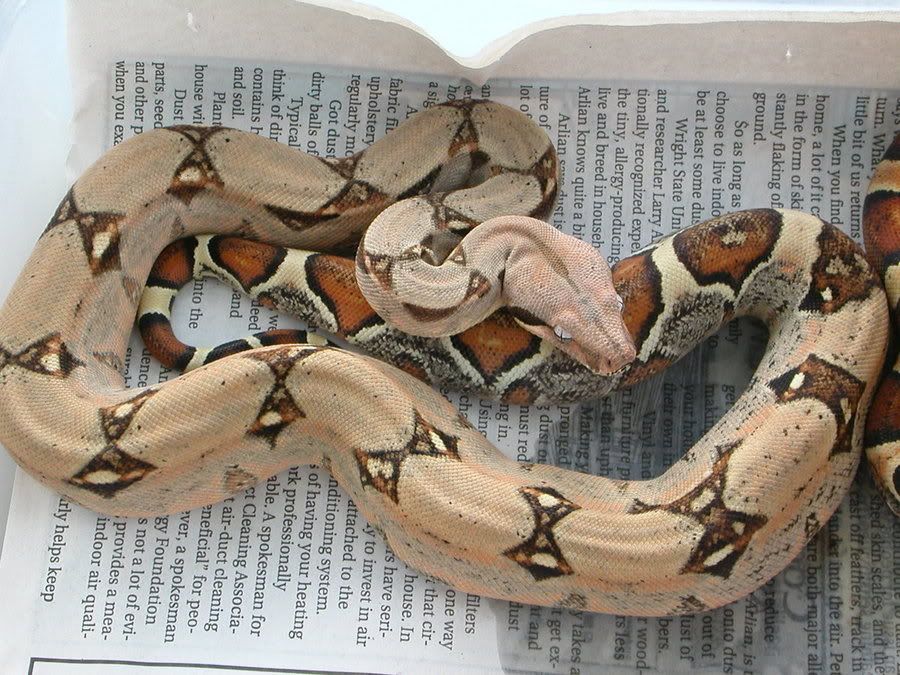
Here's another with her sister, Jazz.
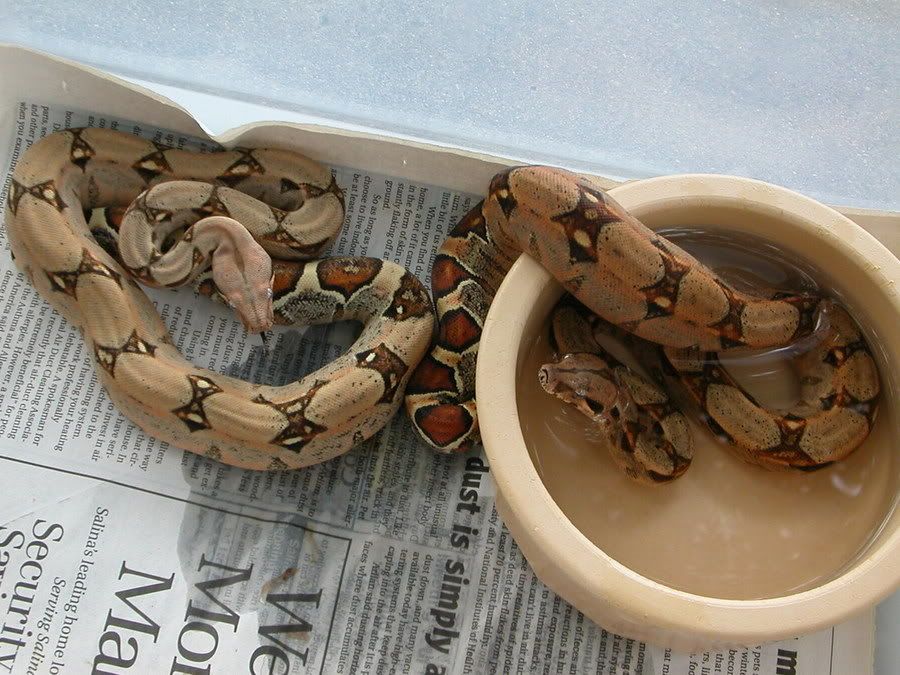
These are going to make GREAT Albinos too! Look at the color of these girls! Nice!

This is one of Spangler's Serpents:
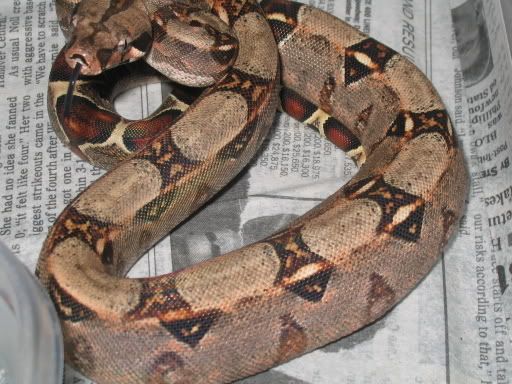
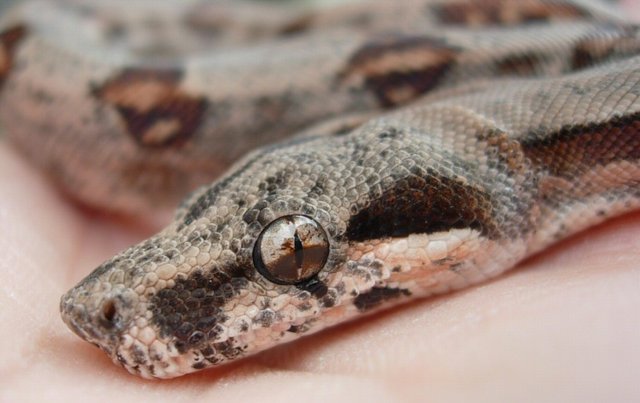
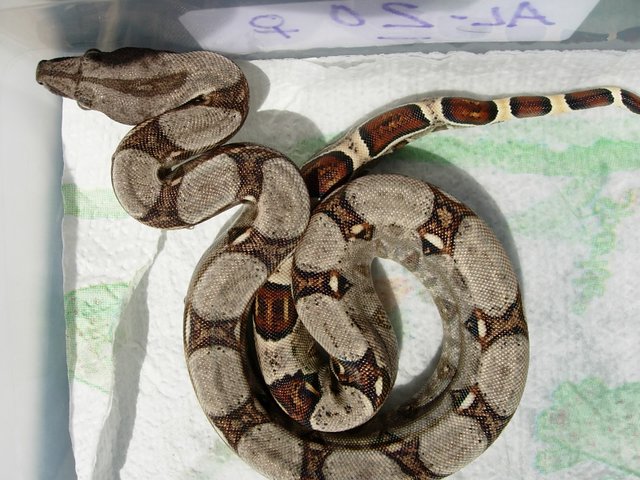
The eyes have it. It's in the eyes. I noticed babies that looked like they had a tiny light bulb inside their heads illuminating the eyes. You often see this same thing in Hypos. The top part of the eye in most Boas is about the same color as the skin immediately adjacent to the eye. In the case of hets, or so goes my theory, the top of the eye is lighter or brighter than that skin adjacent to it. The irregular muddying around the eye should be discounted and only the normal skin color at the top of the eye should be considered. Some Motleys and Hypos seem to be prone to this muddying of some scales on the top of the head next to or near they eye so don't compare to that. This is the "marker". Pretty simple really. But, just to reiterate. Look back at my first two points at the top of the post. Individuals can be identified sometimes. Just because an animal you have does not show this difference now, does not mean that it didn't when it was a little baby. So don't give up on those possible hets you are raising. It is a matter of degrees and given the fact that many will not have the entire litter to compare to, most will not get much satisfaction from knowing this information. When you produce your own possible hets, this will give you greater direction in what animals to keep. I wish it was something that stayed with them throughout life but it is not. This is all I have stumbled upon regarding this topic.

I don't see why this shouldn't also work for Hypos possible het or anything else possible het for albino either. This method may of may not work with other types of Albinos and even other species. Someone else is going to have to figure out if that is the case though. Don't look for me to get any Ball Pythons any time soon...

So all that being said, Albinism is a simple recessive trait right? Well is it really? A simple recessive trait does not exhibit that trait in the heterozygous form. If I am correct and there is at least this one marker for het for Albino animals, doesn't that really make Albinism, at least the Kahl strain of Albinism in Boa Constrictors an "incomplete co-dominant" trait? Now that is sure to stir a little controversy but I'm used to that...

This knowledge has meant one thing for me. That is, I do not sell animals that I do not believe are hets as possible hets if I have sorted through them. The 66% possible hets I have sold, and sorted though, have all been animals I believe were in fact hets. The non-hets have just been sold as regular Boas. It isn't fair to sort through them and then sell the picked over animals as possible hets if they likely aren't. I certainly don't think anyone should use this method to sell possible hets as hets. I don't think this will prove to be 100% accurate. Just as identifying Pastel Boas, there is subjectivity to this as well. It has proven to be very accurate for me but nobody should ever use this to sell an animal as a het that is in fact only a possible het until proven by breeding trial to be otherwise.

Now how about those het for Anerys? What is the marker for them? I have no idea... I do have an animal I am hoping is het for Leucistic though... LOL Oh and for those who have followed my own little forum, my "Polka Dot" male is a het too, or so I theorize...

Replies (44)

locolizard Jul 13, 2006 10:04 AM

I came to the same conclusion after having my recent litters of MoonGlow and a lot of 66% possible hets. Then I had a litter of 100% hets from a coral albino to a ghost male and it was like a "lightbulb" came on There was very noticeable differences in the eyes on the hets and the normals.

Thanks for sharing this information to the community.

Rainshadow Jul 13, 2006 10:34 AM

I'm wondering if anyone has applied this theory,or believes it also works with the Sharp strain?...also,I think the Kahl strain poss. hets that DO NOT show the marker should still be sold as "poss.hets",so that at least in the rare(?)instance that any of them do turn out to be heterozygous people will at least be able to presume to have an idea of how,or why it occured...I think linear continuity,combined with applied genetic theory still carries the most weight,but it's great to have a "tool" like this to use along the way.
-----
EMAIL quit editing my signature!

boaphile Jul 13, 2006 11:22 AM

I agree Mr. Rainshadow. I frankly don't have time to do the sorting these days, and basically just about always wholesale out my possible hets these days anyhow. The only exception to this are Pastels possible het for Albino. None of which I will offer for sale as possible hets unless I think they are. But that is just me. I certainly don't advocate that everyone do this. It is after all, just a theory.

mpuexotics Jul 13, 2006 11:58 AM

It is really great to have someone give good advice and knowledge to
the reptile community!
Thanks Mike
Image

Chris Olson Jul 13, 2006 12:05 PM

Good post....thanks for sharing this. A friend of mine shared the same observation with me and I was able to apply it htis year. I haven't changed the way I label the animals but it did help me decide what animal to hold back!

Chris
-----
www.chrisolsonreptiles.com
Naked I see the camp of those who desire nothing

PanamaRed Jul 13, 2006 12:06 PM

The lightness coming through in hets makes sence to me. A few folks had mentioned white or albino random scales on hets, I'd think that was also a good marker. Calicos seem to be hets that have the albino underneath showing through in an extreme form. If all the hets have this "albino underneath" that would explain why they have these random light or albino scales, the eyes and the light saddles.

As far as some of this fading as they mature that would makes sence too, look at some t albinos they are born very light and may or maynot gain pigment with age.

I think the random white or albino scales would be more of a developing with age rather than fading with age just because thats the way that seems to go, on hets I have observed.

I was thinking a het leucistic would have to be a light colored boa just because in every other type of het leucistic pythons and such the het form is light..

good stuff

Just my .02 cents..
-----
Ed Lilley, www.constrictorsnw.com
www.reptileinsider.com

Rainshadow Jul 13, 2006 12:29 PM

There is another rather well known boa breeder that used this same phrase to describe the "calico" animals...(I certainly don't mean any offense to you Ed,or to him in making this statement,but I feel it needs to be addressed.) This is simply an incorrect assumption. heterozygous albinos DO NOT have homozygousity hiding somewhere below the exterior trying to "bust through" like light from beneath a painted light bulb...I just had to address this particular misconception,because when I first heard it I really couldn't believe that anyone that makes a living manipulating genetic anomolies could actually think this was an acceptable theory.I'm not opposed to trying to explain the elusive,but I think that there are a great many people in this hobby/business that simply don't truely understand genetics.(that's my "theory" anyway! ) there are homozygous albinos that are defective,or best described as "incomplete" because of a biochemical failure in the amelanistic gene expressed in that particular individual,or individuals.("paradox examples." )but, there are no "hets with the albino showing through." *LOL*
-----
EMAIL quit editing my signature!

PanamaRed Jul 13, 2006 05:26 PM

You know I have no idea whats happening with calicos, just doing some speculating in the post there. Thats how it appears to look I can't really see any other way to describe it.

Do calicos breed out to be albinos or hets? I don't know I don't have any...LOL... But at some point they aren't a calico but a paradox albino.. I don't know where the line is on how extreme they must look one way or another, but it sure would be interesting to find out.

I can't explain why some hets have what apear to be albino scales at random either, but I'm always interested to hear speculation...

Don't take my speculations as fact just throwing out some ideas. I don't think anyone has a true full understanding of how it all plays out, or we wouldn't be here.
-----
Ed Lilley, www.constrictorsnw.com
www.reptileinsider.com

PanamaRed Jul 13, 2006 05:56 PM

BTW.. don't take my post wrong it reads kind of defencivly...LOL... I just don't think things are always so clear as to whats going on one way or another. There always seems to be a grey area that plays a role at some point.

Dark pigment is in the outer most layers of skin isn't it?
-----
Ed Lilley, www.constrictorsnw.com
www.reptileinsider.com

Rainshadow Jul 13, 2006 07:31 PM

And,my post wasn't aimed at Jeff's theory in any way.(wasn't meant to change the subject of the thread.) I think even if the marker method proved out,say 65-75% of the time,it is still a notable observation,and a valuable tool by which to make better decisions on which animals to hold back...I don't own any of the "calico" animals either,however I think there is obviously a biochemical flaw responsible for the appearence...common sense tells me that every rule has exceptions,but not every exception has the same explaination.
-----
EMAIL quit editing my signature!

senorsnake Jul 13, 2006 12:22 PM

Interesting. I checked our hets and they all have the mark. But what was more interesting to me was our oldest, largest female (9ft) has it clear as day, moreso than our baby triple het. Her eyes pretty much splits right across from nearly black to bright silver. She's 10 years old, so shes pretty close to the original het stocks from Kahl... I was wondering If perhaps that could be a factor... the brighter the more closer to the original. It seems like it could be ground-breaking for genetics... or maybe the original albino had some dominant eye trait.. or wasn't 100% Columbian and that trait just passed on, and has gotten reduced through outcrossing? Just a thought.
-----
0.1 Het Albino
1.0 DH-Sunglow
1.0 TH-Moonglow

AbsoluteApril Jul 13, 2006 04:06 PM

I was thinking something similar... about the eye color. Perhaps the genetics which are causing this 'light bulb' effect in the hets are close to the albino gene? not on the same allele (can't have two genes on one allele right?) but close to it? On the same locus? Maybe the eye color is dominant when paired with one amelistic gene? It seems to me that the Amelanism (sp?) (albino) has shown itself to work in a typically recessive fashion, so I am hesitant to try to reclassify it.

The proven '98 het that I have was originaly from PK, he does have pretty light eyes, even at 5.5', I'll have to check tonight to see just how 'bright' they are.

Perhaps it is similar to the one-eye defect soemtimes seen in the albinos? Not all albinos have one eye but the defect shows up in the line? Theory being it is somehow connected to the albino gene since (as far as I know) I don't hear about one-eyed hets.

Geez, you can tell I haven't been to science class in a long time huh?

There is so much still to try to understand!
I think that's part of the fun.
Thanks for sharing all this info Jeff!
-April

This was an interesting term I learned at the below glossary.. hmm...makes me think...
epistasis:
The masking of the phenotypic effect of alleles at one gene by alleles of another gene. A situation in which the phenotypic expression of a genotype at one locus depends upon the genotype at another locus.

Genetics Glossary

danktat Jul 13, 2006 12:47 PM

this is my 100% het albino that was purchased from Basically Boas....The eye thing really shows thru on this example..notice the top of the eye is vastly different than the dark coloration on the rest of the head. The saddles however are relatively thick (which I attribute to there being some surinam blood in the genetics to this animal)..It is amazing that you would say that about the eyes because the eyes were one of the determining factors for me purchasing this particular animal.

Tell me if this looks like your theory is correct.


-----
I'M IN SKIN!!!

ajfreptiles Jul 13, 2006 01:09 PM

I would like to thank you Jeff for the loads of info you have just opened to all of us! THANK YOU!!!

I too have also considered the lucistic theory...lol...

The Boa World is on the verge of a massive breakthough!

Cool!

Thanks again, Andy Federico
-----

boaphile Jul 13, 2006 02:07 PM

What about the "incomplete co-dominant" possibility? How about some scientific data from some of you genetics majors. Real scientific points not reptile accepted nomenclature which too often bears no resemblance to science. For instance; Here is an example or a generally accepted reptile misuse of a real scientific term: A "super" Hypo is not a co-dominant animal vs. a non-super being a dominant hypo. The Hypo trait is one or the other. Most believe it is dominant and not co-dominant at all. This is an example of an incorrect application or blatant misuse of a previously clearly defined scientific term. So if you are a scientific genetic wiz kid. What about my assertion that, at least this strain of Albino, that may be identifiable in the heterozygous form and therefore a "incomplete co-dominant" genetic trait and not a simple recessive trait at all. What we have always believed to be true about whatever, isn't true because we believe it is. It is true because it is scientifically accurate and meets all the qualifications of the definition of what a simple recessive trait is. Wiz kids... ideas?

MarcS Jul 13, 2006 02:24 PM

Jeff this is one of my Hypos poss triple het, look at the eyes.

Hypo poss triple het

Poss Super Hypo

-----
Marcs Reptiles

boaphile Jul 13, 2006 02:49 PM

What size Duracells does that first animal take? Wow!

locolizard Jul 13, 2006 03:32 PM

het. it definaetly has the mark for albino, and in my opinion, It is het for anery as well. But that is another theory lol......I would keep that one if I were you

Rainshadow Jul 13, 2006 02:49 PM

"Whiz kids",but I have a basic understanding of simple,commonly accepted genetic theory...will that do? If so then please give me some idea,(ball park anyway.)of the percentage of presumed accuracy of your marker theory? if it is as broadly subjective as you described,and fades from view with age,then I would say "NO" to the presumption of "co-dominance",what are we talking about in terms of accuracy? 75-85-95%? higher? I would tend to doubt it...Amelanism is one of the more common "universal" inheritable anomolies,this simply means that it can be seen,and easily distinguished at a glance,not only in one,or two species,but literally across the board so-to-speak,in almost every known species of vertabrate,(as well as countless intertabrates.)it classifies itself as "simple recessive" through its behavior,not just because you,or I "want it to be real bad." (*lol*) also,I don't think the criteria you're describing shows much dramatic difference in appearence from mild subvective variance seen in non-amelanistic gene carriers (wild type)...that's just my opinion though,and I'm not a genetics expert,you could try running it past Paul Hollander,and see what he thinks?(I'd also love to hear his opinion of animals being homozygous & heterozygous simultaneously! hey,I could be wrong on that one,but if I'm doing a math problem,and get the wrong answer,I don't try to reinvent my pencil,it's usually just ME
-----
EMAIL quit editing my signature!

rainbowsrus Jul 13, 2006 03:50 PM

First off, I don't think "Incomplete co-dominant" is the correct term, just simply Co-dominant.

As I understand it from many discussions on this forum over the last year or so, the simplified defination of Co-dominant:

Co-Dominant - A genetic morph where there are three distinct visual phenotypes:

1) Normal or wildtype, two normal genes for this morph.
2) Heterozygous - One normal gene and one aberent gene.
3) Homozygous - two aberent genes.

The debate comes in as to what defines the visual phenotypes. I would say there has to be a very clear distinction between the three phenotypes. Not to say it has to be big, just clearly identifiable.

I see two possibilities, If the "light bulb" affect is reliable AND is proven to be effective for a high percentage of animals (I dunno...95plus%) both to identify het and to identify non-het, then the trait could be classified as Co-dominant.

There could also be an argument that since the affect can go away with age, it cannot be classified as co-dominant.

From what I've read from these threads, I would still classify it as recessive (with a really good hint for heterozygous)

In order to prove co-dominance, breeding trials would have to be performed, both with and without marker to determine the accuracy of the marker.
-----
Thanks,

Dave Colling

www.rainbows-r-us-reptiles.com

0.1 Wife (WC)
0.2 kids (CBB)

LOL, to many snakes to list, last count:
10.22 BRB
10.15 BCI
And those are only the breeders

lots.lots.lots feeder mice and rats

crxc112 Jul 13, 2006 05:48 PM

First regarding co-dominance - with this you need to think along the lines of blood types. Types A and B each have their own unique molecular markers. Type AB will display both sets of markers, because each allele affects the phenotype in a separate manner. Thus the result is two separate phenotypes, each expressed to their fullest degree in a single animal. If albinism were a co-dominant trait, the heterozygous animals would also display amelanism (and would somehow manage to express the "wild type" simultaneously). I'm thinking this term doesn't quite fit our situation.

Incomplete dominance has more of a "blending" effect. For example, with some flowers when a homozygous red individual is crossed with a homozygous white one the resulting heterozygous offspring are pink. Here the mutant allele expresses a more extreme, more complete phenotype when two copies are present (homozygous) as opposed to only one (heterozygous). Along these lines of thinking, incomplete dominance would apply more readily perhaps to Motleys. Consider this: the homozygous mutant form has a phenotype that consists of dark (blackish-purple) coloration and no pattern to speak of. The heterozygous animals have primarily black, gray, and white coloration, although some have red in the tails. This could be your "less extreme" version of the all black super. Motleys have side striping in place of medallions as well as a very clean, connected pattern and striping in the tail. Is this perhaps the middle ground between fully patterned and patternless? Just some food for thought...... On the other hand, does this apply to albinos? I am hesitant to believe that a slight color difference in the eyes of hets is evidence of incomplete dominance. In my opinion, a partially amelanistic animal (hypomelanistic, anyone?) would display a somewhat more distinguishable phenotype from the wild type. Then again, it's all a matter of degrees.......

Personally I would stick with the classification of the albino gene as recessive, but would like to also point out that this does not exclude the possible existance of a marker. As April touched upon in an earlier post, gene interaction (such as epistasis) is a perfectly reasonable conclusion to draw. Another possibility is we are dealing with one gene that has multiple phenotypic effects (pleiotropy). I guess the best point I can offer here is that genetics are much more complicated than we normally consider them in the hobby. I certainly look forward to reading more conversation on the topic.

Amy

fgs Jul 13, 2006 05:59 PM

Dave:

This might give validity to Jeff's theory. My son was born a toe head (blond). His hair color remained blond until he was about 10 years old. At this time in his life his hair began to change color to a dark brown. The same color my hair is...was...well when I had hair. Too much information.... Could something like this be happening with the light bulb effect. Could these snakes be going through a phase where they show a slight mark, then with age the mark becomes less obviouse.

I'm not an expert by any means, but it is interesting how these changes can accur.
-----
Brian Gundy

www.for-goodness-snakes.com

rainbowsrus Jul 14, 2006 12:54 AM

Just checked my hets

06 known triple het = light bulbs.
04 het = light bulbs
00 proven het coral albino = light bulbs, a bit dimmer though
05 Anery possible het snow = light bulbs This is the grinner!!
05 Anery het snow = light bulbs

All other not suspected hets did not show light bulbs.

Only close exception is my two ghosts have light eyes but not a lot brighter than the ghost coloring.
-----
Thanks,

Dave Colling

www.rainbows-r-us-reptiles.com

0.1 Wife (WC)
0.2 kids (CBB)

LOL, to many snakes to list, last count:
10.22 BRB
10.15 BCI
And those are only the breeders

lots.lots.lots feeder mice and rats

Paul Hollander Jul 13, 2006 07:24 PM

I'm not a genetics guru, but I'm probably closer to it than most posting on this forum.

There is no such thing as "incomplete codominance". There's codominance and incomplete dominance, which have different definitions molecularly, but in both cases the heterozygotes can be distinguished from the two homozygotes. When we lack information about a mutant gene's molecular activity, as is common, we might as well use the two terms synonymously.

As my old genetics prof used to say, the more sensitive the test, the more likely to be able to distinguish the heterozygotes from the homozygotes. Blood typing is extremely sensitive, far more sensitive than eyeballing. In other words, a mutant gene can act as a recessive in one test, a codominant in another test, and produce no detectable difference from normal in a third test.

Dominant, codominant, and recessive are man-made terms, and we use them as if they are as distinct as black and white. But nature is sloppy, and she operates in shades of gray. Then we have to decide which category is the closest fit for our observations. The closest fit does not have to be a perfect fit.

As the eye difference here is pretty subtle and needs testing to see how reliable it is, at this time I agree with Dave Colling. IMO, albino is best classed as a recessive mutant gene, though there is a hint as to which individuals are heterozygotes. More information may change that opinion sometime in the future.

Paul Hollander

MarcS Jul 13, 2006 02:16 PM

You said something about Albino color showing on het scales is false, I have a few poss het snows from one of my litters and one of the babies have these markings on it. Can you explain what these are??? I am not doubting anyones info, I am learning myself. I love to hear any info breeders have on Boas.

These are some pics of one of my poss het snows. Any info would be great.


This is her jaw area. Both sides have it, but no where else on the body


-----
Marcs Reptiles

Rainshadow Jul 13, 2006 03:03 PM

My comments were in reference to the flawed theory regarding calico boas as being "hets with the albino showing through." an albino is either heterozygous,or homozygous...if you breed one of these so called "calico" animals to a homozygous albino of the same strain,and produce all amelanistic offspring,then the animal in question is homozygous,expressing some sort of amel. defect...IF, on the other hand,it produces 50% albino,50% normal looking offspring as a result...well,then...you guessed it, "it's" a het expressing some sort of pigment flaw/anomoly,that may,or may not have anything to do with the gene responsible for albinism...genetic status proven through behavior when bred,rather than trying to re-write everything we know about genetic theory to avoid saying "I don't know". ?
-----
EMAIL quit editing my signature!

giantkeeper Jul 13, 2006 03:45 PM

proving both theories discussed here this next breeding season. We have a Calico hypo het albino produced from 1 of Rich Ihle's first sunglow litters.

I also have a "anery" poss het albino from a snow litter that expresses the eye marker discussed here. I have always thought she was a for sure het, but for other reasons.

The Anery is in quotations up there because I have some questions. I'll post a photo tonight if she sheds and let everyone share their opinions.
-----
Chris & Alliey
www.bloodyleopard.com
E-mail Us

vcane Jul 13, 2006 03:26 PM

.
-----
Vince Pramuk

Jeremy Stone Jul 13, 2006 04:09 PM

Very interesting theory Jeff. Either way, I have to give you a HUGE thanks for helping me many years ago discover the gestation period in boas. I have applied that info to all my animals since, and with over 150 recorded Breedings since I have kept track, it is almost dead on with Plus or Minus 10 days.

As to this theory, I guess I don't understand it. I just had a litter of Striped Albinos and Stripes HET albino. I went to look at all the eyes of the 100 perecent HETS, and there were some that had darker eyes then the skin adjacent to it. I hope you aren't taking this wrong. I guess I just don't understand it. Have you done any breedings with any of the Poss hets that DID NOT have the marker that were HETS? VERY INTERESTING, and thanks for sharing. I would be very interested in hearing your studies behind this like you did in your Reptiles article. That was EXCELLENT data backing your statements.

Best of luck in your breedings this year. I'm sure you are producing some SMOKERS.

Jeremy Stone

PGoss Jul 13, 2006 04:34 PM

I was considering posting. Jeff may have a marker to pick out hets., but that doesn't mean that all hets. have this marker. Let's say Jeff takes a litter of possible hets. and picks out the boas with his marker. They may all be hets. It sounds as though he has been 100% accurate with this technique. However, in those babies that are tossed aside and do not have the marker, there may still be some hets. Jeff has done a great thing. Now breeders can pick out their keepers and raise to produce albinos, sunglows, etc. I still believe that all the other babies should still be sold as 66% hets. Until someone keeps a large number of those babies without the marker, which is unlikely to happen since Jeff has found one, we still don't know that babies without bright eyes are not hets. Just as the case of a super hypo, there are "markers" that lead to the probability of a boa being super, but there have been supers without these "markers". That's all I got.

Phil Goss

Djinn Jul 13, 2006 06:41 PM

This female is 100% het for Anery. She seems to have the eye thing going on. Not as intense as others we have seen, but she is two years old.
I would like to add; Just because something cannot be proven with "Science", does not make it untrue, or not valid. Mans inability to understand something tends to clash with his ego.

-----
sounddjinn@yahoo.com

Things always get cloudy, just before transformation.

BNixon Jul 13, 2006 06:44 PM

Jeff, great post thanks for making it...my question is this, do you think this 'trait' could also go the same for other animals like hypos or anerys poss het albino?
-----
Brandon Nixon

skyslinger Jul 13, 2006 07:36 PM

That was a very generous thing to do. I appreciate it although I don't have any possible hets. It would be interesting to know how long it usually lasts or how old they are when it usually becomes less obvious. I know it isn't rock solid but an estimation would be great if you have one. Also do you think it is fairly accurate in litters of 100% hets? For instance I had a litter that I am unsure of who the father was. I kept them all and am going to breed them out at a later time because they are either DH for striped albinos or possibly het for another yet unproven morph. Thanks!
-----
Ty
Rat Race Solutions
www.ratracesolutions.com

ChrisGilbert Jul 13, 2006 08:15 PM

In engineering we are always told to come up with some crazy ideas in the start that aren't logical at all, but they usually lead to better results in the end when they help others think of something or a part of the idea is used.

SO...

Has anyone used this technique on Sharp Albino possible hets? Do they have a marker as well?
MAYBE, this is ONE of the reasons the two aren't compatible. Especially IF (I know you left this open Jeff) this technique is 100% accurate in Kahls, that would make that strain co-dominant, and the Sharps TRUE (if there is such a thing) recessive.

DO NOT hold back your thoughts to this, I often think about stuff in response to posts but don't post, I want to hear what your thoughts are here. Remember RANDOM ideas are terrific!

ajfreptiles Jul 13, 2006 10:23 PM

Well Chris, it's funny...I had thought the same thing earlier today....and was also wondering more about this involvement along with a possible lucistic theory...

Anyone else think about this? Andy
-----

Rainshadow Jul 14, 2006 04:51 AM

Is the true,"typical" amel strain,and the Sharp is something different.I produced some 50% poss.het Sharps,and I looked through those,(I admit,I don't have a good grasp on what it is I'm looking for with the Kahl marker though.) I looked at some of the Harlequins too,twice they have produced albinos when they "shouldn't have",so naturally I'm curious about that because if the one I just bred this year IS a het,(and not just a fluke,or freak occurance.)it would theoreticlly mean that I have been producing possible hets for Kahl strain for the last nine years,and never knew it.(?)it would also mean that the patternless animals could be poss. hets,since the female that threw albinos this year was a sibling to the sire of the patternless litter...recently,in Europe a breeder proved an imported albino to be compatible with the Kahl strain,this leads me to believe that this strain has a common genetic denominator that may exist naturally in certain populations from Colombia,even today. I've yet to hear of any imports being compatible with the Sharp strain,but that doesn't mean the same couldn't hold true,it may be that animals from that particular race,or locality,just haven't found their way into the right hands,or breeding situations?
-----
EMAIL quit editing my signature!

ajfreptiles Jul 14, 2006 09:08 AM

Thanks Tim,

Have you noticed anything at all different on your Sharp strain hets? Thanks Andy
-----

Rainshadow Jul 14, 2006 09:48 AM

Nothing I could really put my finger on,of course even if I spotted anything,I'd be hesitant to jump to any conclusions until some of them can be bred,and some sort of pattern developed. I chose 2.3 that showed some influence from both parents. I produced a few positive hets from a different pairing that I can use to prove the 50%er's out,so we'll see what happens I guess.
-----
EMAIL quit editing my signature!

ChrisGilbert Jul 14, 2006 10:39 AM

I believe it was a breeder in the UK. He brought in some wild caught Colombian Albinos and bred them to his het Kahls.

You mention the Harliquins that ended up being het Albino, and some other breeders have had other things end up as hets, when there was no known albino history. I think this might just be that the mutation is relatively common. People sell possible hets, and even hets as normals, then there are the ones in the wild that are hets (if albinos are found, there have to be hets) but are not known. With all these variables it is likely to encounter Hets in breedings. The same has been shown with Anerys, T-Plus Colombians, even in Leopards and Bloods (John Berry's Blood het, and the multiple lines of Leopard in Europe).

I want to see the history of the Sharp Albino matriarch, as in collection data. There has to be some reason for not being compatible, and everything in captivity has been derived from ONE animal. Why no random hets with this mutation? Is it Colombian after all?

Rainshadow Jul 14, 2006 05:40 PM

I think it will help strengthen the strain,ultimately...As for the Harlequin/albino theory...The original animals were produced back in 94',I saw pictures of both parents,and neither one was an albino,back then,hets & even possible hets weren't being tossed around like "normals" I can assure you...I produced the female in 02,and her parents in 97',their parents were raised by me from neos,(part of the 94 group)and there were no accidental exposures to hets,or poss. hets at all...it's just another interesting development to play around with,hopefully future breedings will shed more light.
-----
EMAIL quit editing my signature!

ChrisGilbert Jul 14, 2006 08:40 PM

prevent a mutation (random) from occuring allong the way. Aren't Albinos supposed to be a 1/10,000? Maybe one of the animals produced had one mutant allele.

Rainshadow Jul 14, 2006 09:49 PM

Nobody believes in random mutation...do they? (*heh*) it's gotta be some sort of scam to make millions of dollars,yeahhhh,that's the ticket!
-----
EMAIL quit editing my signature!

ChrisGilbert Jul 15, 2006 09:07 PM

Red_Hydra Jul 14, 2006 02:10 PM

Thank you Ronnie for clearing something up for me for a long time, was wondering but never went into it as much as you and you helped me get a better and clearer picture to determine a few of my litters and well help me figure out which to keep

Site Tools