Reptile & Amphibian Forums

Welcome to kingsnake.com's message board system. Here you may share and discuss information with others about your favorite reptile and amphibian related topics such as care and feeding, caging requirements, permits and licenses, and more. Launched in 1997, the kingsnake.com message board system is one of the oldest and largest systems on the internet.

Click for 65% off Shipping with Reptiles 2 You
Click for ZooMed

Bloodred question...actually 3 questions

xblackheart Jul 28, 2006 09:45 PM

1.Is there any way to get normal babies out of a pair of bloodreds?
2.How about if one was just Het for bloodred (diffused)?
3.How about if they both are just hets?
-----
****Misty****

http://www.sneakyserpents.com/

"Yesterday was the deadline for all complaints"

Not counting Hatchlings, this is what I have.........

1.1.2 bearded dragons
9.18.0 corn snakes
1.1.0 jungle corns
1.2.6 California King
1.0.0 Mexican Black king
0.1.0 Blotched (variable) king
0.1.0 Lavender Brooksi king
1.0.0 Sinaloan milk snake
0.1.0 Tri-Hybrid milk snake
0.1.0 rat snake
1.1.0 Arizona mountain king
1.1.0 Congo African Grey Parrots
0.1.0 German Shepherd (hybrid) dog

Replies (38)

nehpets1 Jul 28, 2006 10:03 PM

I'm pretty sure that you cannot have "het" for bloodred.

Technically that is. I don't know the consesus, but I understand bloodred to be a co-dominant gene...meaning, that if it isn't display the characteristics of the bloodred, It doesn't have bloodred in it.

Think of it this way, we don't say that a snake is het for normal if it's an anery.

Normal is the dominant trait . . . in the same way, Bloodred is a dominant trait, and it doesn't make "hets" per say

But hell, I could be wrong...

What is the general Consensus, even though we never seem to have one...
-----
I found the cure for hope.
Stephen Diekmann
nehpets1*at*juno.com

1.0 Anerythristic Motley Cornsnake
0.1 Sunglow Motley Cornsnake
1.0 Unknown, probably normal, poss. okeetee, poss. hypo
0.1 Snow Cornsnake
0.1 Snow het Lavender het Opal Cornsnake
1.1 Butter Cornsnake
0.1 Candycane x Amelanistic Cornsnake
1.2 Ghost Coral Cornsnake
1.1 Hypo Bloodred Cornsnake
?.? 1 Hognose, Origin unknown

HerpZillA Jul 28, 2006 10:41 PM

>>1.Is there any way to get normal babies out of a pair of bloodreds?
*** No

>>2.How about if one was just Het for bloodred (diffused)?
*** No het for bloodred. if het for diffused it would not be a bloodred to start with.

>>3.How about if they both are just hets?
*** No hets

All my opinion. Bloods have a variation of patterns, so how do you het that? My opinion differs than most. I think the bloodred has 1 gene for diffused, a simple dom or res. Or it could be multi allale. Then teh pattern is multi allele or multi gene and multi allele.

Just my guess. So many people have worked with them, I think something similar would have been worked out already. Plus teh complexity of the outcome of bloods breeding with anything.

Again, JMO

Tom

>>-----
>>****Misty****
>>
>>http://www.sneakyserpents.com/
>>
>>"Yesterday was the deadline for all complaints"
>>
>>Not counting Hatchlings, this is what I have.........
>>
>>1.1.2 bearded dragons
>>9.18.0 corn snakes
>>1.1.0 jungle corns
>>1.2.6 California King
>>1.0.0 Mexican Black king
>>0.1.0 Blotched (variable) king
>>0.1.0 Lavender Brooksi king
>>1.0.0 Sinaloan milk snake
>>0.1.0 Tri-Hybrid milk snake
>>0.1.0 rat snake
>>1.1.0 Arizona mountain king
>>1.1.0 Congo African Grey Parrots
>>0.1.0 German Shepherd (hybrid) dog

HerpZillA Jul 28, 2006 10:43 PM

If you had 2 poor bloodreds, you may call then hets, then babies would or could vary greatly, and yes some would look close to normal. But what extra genes would they carry unlike normal normals?

Tom

nehpets1 Jul 28, 2006 11:05 PM

And you're saying that I'm right about that?

Wow, maybe I am leanring about genetics here...

And I thought that I was only an evil mad genius... amazing
-----
I found the cure for hope.
Stephen Diekmann
nehpets1*at*juno.com

1.0 Anerythristic Motley Cornsnake
0.1 Sunglow Motley Cornsnake
1.0 Unknown, probably normal, poss. okeetee, poss. hypo
0.1 Snow Cornsnake
0.1 Snow het Lavender het Opal Cornsnake
1.1 Butter Cornsnake
0.1 Candycane x Amelanistic Cornsnake
1.2 Ghost Coral Cornsnake
1.1 Hypo Bloodred Cornsnake
?.? 1 Hognose, Origin unknown

necroscollector Jul 29, 2006 06:33 PM

How do you determine what's a blood red?

The reason I ask is I purchased a baby last year at the Dixie Reptile show here in Alabama last year. When I bought it seem to be a blood red. Now she still has no black on her belly scales, very faint, and broken black outline on top. Even has the odd faded scale on top of her head. But as she has gotten older she looks less blood red compare to most I have seen.

So I guess my question is she a blood red or maybe she carries the trait?

xblackheart Jul 30, 2006 01:32 AM

Pictures help.
Usually having black on the belly, even faded means it is not a bloodred. It has been debated that they can have flecks of black on the belly, but no checker board. See the pictures I posted in this topic. The two snakes that I bought have flecks of black, but no checkerboard.
Again, pics of the snake you are asking about would help, including pic of the belly.
-----
****Misty****

http://www.sneakyserpents.com/

"Yesterday was the deadline for all complaints"

Not counting Hatchlings, this is what I have.........

1.1.2 bearded dragons
9.18.0 corn snakes
1.1.0 jungle corns
1.2.6 California King
1.0.0 Mexican Black king
0.1.0 Blotched (variable) king
0.1.0 Lavender Brooksi king
1.0.0 Sinaloan milk snake
0.1.0 Tri-Hybrid milk snake
0.1.0 rat snake
1.1.0 Arizona mountain king
1.1.0 Congo African Grey Parrots
0.1.0 German Shepherd (hybrid) dog

HerpZillA Jul 30, 2006 11:13 AM

I got this her late last year from a wholesaler. I talked him down to $40. I thought it was a male by look, later it probed to be a female.

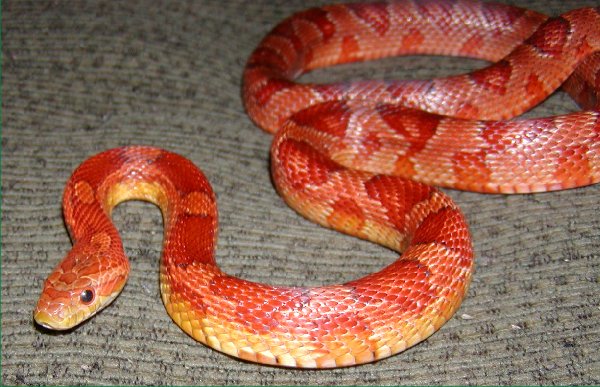
But she has full red belly. I do not consider her a good bloodred. Unless she happens to be very young and still may diffuse more. OK I'm wishing a bit. But she is a good example of a bloodred with a poor top and a surprizingly all red belly.


Image

necroscollector Jul 30, 2006 02:43 PM

Here are th pic's. Let me know what you guys think. Poor quality Blood or what?

whole snake

belly shot 1

belly shot 2

side shot 1

side shot 2

HerpZillA Jul 30, 2006 03:12 PM

Looks like what they call an out cross. That would be a good blood to a normal offspring. The thing is, offspring vary, and no one has been able to predict it. So if you breed to another fair to good bloodred, you will get snakes which very greatly. And hopefully some towards good bloodreds.

I bred a very nice hypo to a diffused corn and babies were all over teh place. But I knew much less then than I do now, and thats scarey lol Anyways I sold off my share of the babies.

But some looked very nice. Some had teh black checks on the belly and less diffusion as they got older.

so, even a poor bloodred may make better babies. Then just cherry pick them.

Unless you have very deep pockets, then buy up super adults.

And get me a few too

Big Tom

necroscollector Jul 30, 2006 03:42 PM

So what would happen if I breed her with a amelanistic? Would they all be normals or just a mix?

HerpZillA Jul 30, 2006 04:09 PM

But i've give my shot. (I am no expert corn snake guru)

An avgerage bloodred bred to an amel, would outcross the bloodred trait even more, I guess, getting snakes that look lcoser to normal and maybe okeetees? My breeding had some that looked like okeetes, just more color than a "normals".

But all would be het for the amel gene.

That is conventional logic.

If you get something else let me know.

Now stand by for the correction! lol

necroscollector Jul 30, 2006 04:16 PM

So my best bet is to purchase another blood red(higher quality) and breed them. So that way I would possibly have a better blood red breed line.

Now what would be the best female to purchase to breed with the amelanistic hmmm?

I am virgin to the breeding game please be gentle.

haha
grover

HerpZillA Jul 30, 2006 04:34 PM

Well, what ever you breed to the amel, the babies will be het for amel. UNLESS the other morph contains amel, like a creamsicle.

I think others will be much better at listing options on that.

BIg Tom

xblackheart Jul 28, 2006 11:26 PM

ok, maybe I asked that question wrong. You take two snakes that are bloodred, you should get all bloodred babies (which is red, with the diffused pattern), right.
What if one snake has all the characteristics of a bloodred. Color red, diffused look, white belly, what ever, but is not bloodred in genetics, and pair it with a bloodred. Any normal babies? would they have the grey head that goes with the diffused look? What if that snake is Het for the diffused pattern, and is red in color. I know bloodred coloring is a line bred thing, but the diffused look IS genetic. I don't know, am I explaining myself at all?

I was trying to be hypothetical about a situation, without getting into the details of the actual situation. Here are the basics. Two snakes were supposedly bred together. Both look to be bloodred to me. Red, diffused pattern, white bellies. One has some black flecks near its mouth. Now, I just assume it is not a prime example of bloodred, but is one, non the less. The person that incubated the eggs says the babies were normals. I was just wondering of the probability of that. I can include pics of the snakes tomorrow to help.
-----
****Misty****

http://www.sneakyserpents.com/

"Yesterday was the deadline for all complaints"

Not counting Hatchlings, this is what I have.........

1.1.2 bearded dragons
9.18.0 corn snakes
1.1.0 jungle corns
1.2.6 California King
1.0.0 Mexican Black king
0.1.0 Blotched (variable) king
0.1.0 Lavender Brooksi king
1.0.0 Sinaloan milk snake
0.1.0 Tri-Hybrid milk snake
0.1.0 rat snake
1.1.0 Arizona mountain king
1.1.0 Congo African Grey Parrots
0.1.0 German Shepherd (hybrid) dog

cornsnake00 Jul 28, 2006 11:33 PM

If no bloodreds were produced, you don't have bloodreds.

xblackheart Jul 28, 2006 11:39 PM

ok, I am very close to possitive that I do. The person who did the breeding is wondering if the person who incubated the eggs, switched them. I am thinking another snake was the father. The snakes are now mine, so I will prove it out next year when I get the snakes fattened up. Its my opinion that the snakes were too small to breed this year to begin with. I am just trying to help the guy with the eggs out, find out all the possibilities.
Thanks for your response though.
-----
****Misty****

http://www.sneakyserpents.com/

"Yesterday was the deadline for all complaints"

Not counting Hatchlings, this is what I have.........

1.1.2 bearded dragons
9.18.0 corn snakes
1.1.0 jungle corns
1.2.6 California King
1.0.0 Mexican Black king
0.1.0 Blotched (variable) king
0.1.0 Lavender Brooksi king
1.0.0 Sinaloan milk snake
0.1.0 Tri-Hybrid milk snake
0.1.0 rat snake
1.1.0 Arizona mountain king
1.1.0 Congo African Grey Parrots
0.1.0 German Shepherd (hybrid) dog

nehpets1 Jul 29, 2006 12:53 AM

That's not necessarily true...

I'm a writer. I tend to think in metaphors and analogies more than in concrete terms.

Think of it this way:
If you have one snake that is definitely Bloodred pattern, and one that is definitely het for the bloodred pattern, your breeding odds are 1:2 bloodred pattern, 1:2 het for bloodred pattern.

This is the same ratio as in a coin toss (almost said toin coss). It is possible to toss a coin 10 times, and have it come up heads all 10 times. Not probable but possible. It is even possible to toss the same coin 100 times and have it come up tails all 100 times. Even less probable but STILL possible.

Are you following so far?

The more times you toss the coin, the more likely it is that the tosses will even out.

Remember, though, that when you deal with ratios and probabilities, the ratios don't change with each toss. This is the princeple that system gamblers seem to forget when playing a progessive system. Each time the coin is tossed, there is still only a 1:2 chance that it will land heads and only a 1:2 chance that it will land tails.

When you deal with genetics, I don't know how much changes, but it seems to me that it is POSSIBLE to breed one snake and one het snake and get all het snakes.

I could be wrong, I'm not saying this is fact, but it's a fun mental problem. When you deal with punnett squares, it's rare to have a definite prediction of anything given unknowns.

Then again, it is possible to toss a coin and have it land on edge, so all bets are off.
-----
I found the cure for hope.
Stephen Diekmann
nehpets1*at*juno.com

1.0 Anerythristic Motley Cornsnake
0.1 Sunglow Motley Cornsnake
1.0 Unknown, probably normal, poss. okeetee, poss. hypo
0.1 Snow Cornsnake
0.1 Snow het Lavender het Opal Cornsnake
1.1 Butter Cornsnake
0.1 Candycane x Amelanistic Cornsnake
1.2 Ghost Coral Cornsnake
1.1 Hypo Bloodred Cornsnake
?.? 1 Hognose, Origin unknown

HerpZillA Jul 29, 2006 07:03 AM

"What if one snake has all the characteristics of a bloodred. Color red, diffused look, white belly, what ever, but is not bloodred in genetics"

Sorry for the subject, but it's what hit me when I read that line above.

I know of no corn that looks and changes like a bloodred but a bloodred.

THERE IS NO HETS. Like no het okeetee, miami, etc.

They claim the diffused is 1 gene. But a blookred is far more than 1 gene for diffused.

OK, this is copied from the last debate. Not posted by me. But may help

The following is from Rich Zuchowski's (Serpenco) website:

As might be easily surmised from the name, this particular cultivar of corn snake is readily identified (at least as an adult) by the relatively uniform orange-red to deep red coloration of the entire body. The abdomen is normally unmarked with black, with a greater majority of white coloration predominating. Many individuals will have the abdomen motled with orange splotches, which appears to become heavier towards the posterior. The typical corn snake pattern can be pretty nearly completely absent in mature adults, but more typically you will see a faint pattern often delineated with narrow black borders. It appears that the large amount of outcrossing of this cultivar has substantially changed the overall look of the Blood Red in that the original dark deep red coloration has been mostly replaced be a more orange-red appearance. Some people will claim that something was lost from the original strain, whereas others may claim that something was gained. Perhaps there is an obscure genetic component affecting the red coloration that at one time may have predominated in this cultivar. A case can certainly be made for this possibility when you look at some varieties of the Miami Phase and Milk Snake Phase corns which can have eye-catching deep red blotches differing from the more normally seen orange-red coloration.

The Blood Red corn is in some ways a mystery, genetically. The original stock was produced as a selective breeding project by Eddie Leach working with animals from an area roughly from Hastings, Palatka, and St. Augustine areas in northeast Florida. The result was a corn snake that nearly lacked all pattern and the abdomen sported mostly or all white coloration, lacking any black pigment usually seen in a normally colored corn snake. Most likely all of the stock currently being worked with came through the hands of Bill and Kathy Love when they marketed this cultivar beginning in the early '80s.

The 'genetic mystery' mentioned above is from the fact that the Blood Red 'traits' are not very predictable when outcrossed. Some indications point to one or more phenotypic expressions being controlled by simple Mendellian genetics, whereas others defy prediction. It is not at all unusual to get F1 animals that may mature to be nearly Blood Red in appearance, yet lack the classic abdominal coloration. Then on the other hand, you may also get animals that will appear to be normally colored, yet have a large proportion of the abdominal area nearly all white or just have traces of black pattern at the very edges of the abdomen. The F2 generation will certainly have you scratching your head as you try to figure out exactly what is what in those hatchlings!

Babies of the Blood Red can throw most people for a loop. They look nothing at all like the adults they came from. Most will typically have oddly patterned, or nearly patternless heads, with what looks like broad saddles down the back. In the best of them, there will be no lateral pattern at all visible. The abdomen is usually a dead giveaway in that it will usually be white with no black markings and only a scattering of the orange mottling.

The Blood Reds got a very bad black eye reputation years ago as being very problematic feeders. In many cases, this was a well deserved reputation, whereas in others it was just a misunderstanding. Many of the Blood Red babies were VERY insistent about being provided green anoles as their only food source, stubbornly refusing to accept our ideas about them accepting pinky mice, and often starving to death as the argument between the keeper and the kept raged. Even the Cuban brown anoles were not acceptable fare for them. Once this little quirk was realized, it was not at all unusual to get the majority of Blood Red hatchlings started and thriving. And once the feeding response was firmly established, scenting of pinky mice with the green anoles was usually always successful in producing ravenously feeding mouse eaters out of them.

This cultivar has recently taken a surprising jump in popularity that has caught many breeders by surprise. The last couple of years, I have been using my breeding stock of this line merely to use as genetic material for future projects and have basically let the Blood Red stocks dwindle. Plagued with problems in the past because of weakened bloodlines, the newer generations are showing the hardiness that the corn snake is famous for. Matter of fact, once you get the Blood Reds started on pinkies, they easily become the most aggressive feeders around here. The abdomen tends to be various percentages of a combination of white and orange pigments. Only a very few will be available this year as the few adults I have are used for future projects more than producing stock for sale. Some obvious projects in the works are Lavender Blood Reds, Caramel Blood Reds, and Butter Blood Reds. Of course, new names will undoubtedly have to be created for these new cultivars and naming them will certainly be a challenge. Especially the Caramel Blood Reds. My mind's eye view of this particular animal keeps bringing up the name of Blood Clot Corn, but somehow I don't think it will be a commercially attractive name to apply to a corn snake. And then there is the problem of the Butter Blood Red. Seems like an AWFUL lot of trouble to go through just to produce a corn snake that should look amazingly like a Yellow Rat Snake.


Darin Chappell Jul 29, 2006 03:50 PM

Well, I don't disagree with EVERYTHING written thus far, but some is incorrect, I believe.

Here's the deal, Misty:

Bloodred to bloodred breeding will yield 100% bloodred babies.

Bloodred to an animal het for the episkiastic gene, will yield 50% episkiastic patterned animals (which may or may not look red enough to be called bloodreds), and 50% animals het for the episkiastic gene (which may or may not look more reddish than normal corns).

Crossing two animals het for the episkiastic gene will yield 25% episkiastics, 50% hets, and 25% normals (any and all of which may or may not tend toward their bloodred ancestry in coloration).

If you bred two bloodreds together and didn't get bloodreds, you either have:

1. One animal that is a het for the episkiastism (maximally expressed), and it just LOOKS like a bloodred...

2. A mix up in the parenting the clutch (a non-bloodred male snuck in with momma)...

3. OR...someone messed up on marking the egg container in the incubation process.

_____________________

Bloodred is the result of combining episkiastism (which does follow simple mendelian genetics, and a snake CAN be het for it) AND the deep red coloration that is the result of the line breeding.

Other animals, such as Pewters are homozygotes for the episkiastism, but, because they are also homozygous for the charcoal gene, they do not express the red coloration (though they may pass it along to their offspring). Therefore, lacking the red coloration, I am not one that called them Charcoal bloodreds back before Pewter cam around.

One of the dumbest names ever concieved is "Anerythristic Bloodred"...and I just hate it that we haven't come up with something else yet.

Finally, when someone says "het for bloodred," I just understand that they mean it carries the episkiastic gene and has the deep red coloration in its linebred ancestry. Nothing more. An animal can't be het for snow, either, but we all understand what is meant when that is used.
-----
Darin Chappell
Hillbilly Herps
PO Box 254
Rogersville, MO 65742

xblackheart Jul 29, 2006 05:06 PM

Finally, an answer that I was looking for. Thank you for the post!
I was beginning to wonder if anyone understood what I was asking.

I still can't find out if another snake snuck in and fertilized the egg, as I have not had contact with either of the other 2 parties involved in the whole egg business. I do have pics of the two snakes, that I will post later.
-----
****Misty****

http://www.sneakyserpents.com/

"Yesterday was the deadline for all complaints"

Not counting Hatchlings, this is what I have.........

1.1.2 bearded dragons
9.18.0 corn snakes
1.1.0 jungle corns
1.2.6 California King
1.0.0 Mexican Black king
0.1.0 Blotched (variable) king
0.1.0 Lavender Brooksi king
1.0.0 Sinaloan milk snake
0.1.0 Tri-Hybrid milk snake
0.1.0 rat snake
1.1.0 Arizona mountain king
1.1.0 Congo African Grey Parrots
0.1.0 German Shepherd (hybrid) dog

draybar Jul 29, 2006 07:11 PM

>>
Very good explination Darin.
perfect.

by the way...just for some of you out there who do not believe a snake can be het bloodred.....

I don't usually like to do this but.....one of the largest breeders in the country and a person that has probably produced as many or more new morphs then any other breeders has this listed on his site.

R.Z.
Serpen Co

2006 - Lavender Corn het Hypo Blood Red
Lavender Corns that have a Hypomelanistic Blood Red as one of the parents. Consequently, they are heterozygous for Hypomelanism and Blood Red.

This is juat one example but enough

with all of the conjecture, speculation, guesswork and uncertanties, I will stick with Darin's assesment until definite proof stating otherwise is brought forward.
-----
Corn snakes and rat snakes..No one can have just one.
"resistance is futile"
Jimmy (draybar)

Draybars Snakes

_____

HerpZillA Jul 29, 2006 09:21 PM

Ok, I'll try to make my point. If there is a het for bloodred, and since bloodred has several factors, what is it het for and to what degree?

The episkiastic gene mentioned is the diffusion gene, I believe?

I said that. That part seems to be agreed upon at least for now.

But the blood has this complex way of making babies with solid red bellies or a little black or a lot of black. At least from not so good bloodred. All I'm saying is this part is NOT 1 simple recessive gene. So you can not call a bloodred het.

If teh bloodred had 2 simple recessive genes and it passed them both, then I would say a het for those two genes and it could be called a het bloodred.

I'm just saying "het bloodred" is a subjective term to most people based on the way the snake looks.

Sorry if I offended anyone. I just do not like a term that has a clear definition used loosely.

Some one was already asking again what defines a bloodred. That is partially subjective, and the quality of bloodreds will vary. So in a sense when you have a het bloodred, you have a variable het.

tspuckler Jul 30, 2006 08:37 AM

That very same breeder states in the Bloodred section of his site: "The 'genetic mystery' mentioned above is from the fact that the Blood Red 'traits' are not very predictable when outcrossed. Some indications point to one or more phenotypic expressions being controlled by simple Mendellian genetics, whereas others defy prediction."

If diffused pattern is a simple recessive genetic trait (which we all seem to agree it is), then what about excessive red pigment? Is it simple recessive or a naturally occurring morph, like Okeetee & Miami? If this is the case, then there isn't such a thing as a bloodred "het," as they are no Miami or Okeetee phase hets.

There might be diffused pattern hets, but if we call a nearly solid red corn a "bloodred," there are no hets for it if the genetics work in the manner described in the paragraph above. (I'm not talking about anerys, pewters, etc. just SOLID RED corns).

If this excessive red pigmentation thing IS a simple recessive genetic trait, then a bloodred bred to a normal would create "double hets," which when bred togather would have a 1 in 16 chance of making a bloodred.

And what about the reduction of black pigment? Is this a third gene? Or is it associated with diffused pattern or the amplification of red pigmentation?

Tim
Third Eye
Third Eye

draybar Jul 30, 2006 09:33 AM

>>Gives you a headache doesn't it?

that is why I have always hated the name bloodred.
that name was coind way before anything was understood about the gentics behind them.

I must seriously restrain from this topic.
I know less everytime I read more.
There are many many projects moving in the right direction to answer these questions but, as in most cases, the answers bring up more questions.
It will still be a while before it is even close to being clear.
-----
Corn snakes and rat snakes..No one can have just one.
"resistance is futile"
Jimmy (draybar)

Draybars Snakes

_____

HerpZillA Jul 30, 2006 11:18 AM

I thought I was explaining that.

My shortest post ever! lol

HerpZillA Jul 30, 2006 11:20 AM

Bloodreds, from this point forward will be called.

Far-Fig-Newtons!

draybar Jul 30, 2006 01:27 PM

>>Bloodreds, from this point forward will be called.
>>
>>Far-Fig-Newtons!

I think I will just call them....long distance
-----
Corn snakes and rat snakes..No one can have just one.
"resistance is futile"
Jimmy (draybar)

Draybars Snakes

_____

HerpZillA Jul 30, 2006 01:36 PM

lol I was going to do the " You can call them Ray, you can call them Jay" etc etc,, F-F-N was an inside joke.

Maybe vampire corn?

Darin Chappell Jul 31, 2006 09:56 AM

Well, why not? Trying to explain them does suck the life right out of you!


-----
Darin Chappell
Hillbilly Herps
PO Box 254
Rogersville, MO 65742

Nehpets1 Jul 29, 2006 07:48 PM

No reason to hate to disagree. I'm still learning genetics: I'm a frickin English major not a biologist

And I thought that I just learned Bloodred genetics fairly well.

Me not smrt

Thanks for understanding...
-----
I found the cure for hope.
Stephen Diekmann
nehpets1*at*juno.com

1.0 Anerythristic Motley Cornsnake
0.1 Sunglow Motley Cornsnake
1.0 Unknown, probably normal, poss. okeetee, poss. hypo
0.1 Snow Cornsnake
0.1 Snow het Lavender het Opal Cornsnake
1.1 Butter Cornsnake
0.1 Candycane x Amelanistic Cornsnake
1.2 Ghost Coral Cornsnake
1.1 Hypo Bloodred Cornsnake
?.? 1 Hognose, Origin unknown

HerpZillA Jul 29, 2006 09:59 PM

>>Well, I don't disagree with EVERYTHING written thus far, but some is incorrect, I believe.
>>
>>Here's the deal, Misty:
>>
>>Bloodred to bloodred breeding will yield 100% bloodred babies.

*** If both parents are very good bloodreds. I agree. But so many now are maybe a 7-8 on a scale to 10. baies could and would probably vary. IMO and In my limited experience.

>>Bloodred to an animal het for the episkiastic gene, will yield 50% episkiastic patterned animals (which may or may not look red enough to be called bloodreds), and 50% animals het for the episkiastic gene (which may or may not look more reddish than normal corns).
>>
>>Crossing two animals het for the episkiastic gene will yield 25% episkiastics, 50% hets, and 25% normals (any and all of which may or may not tend toward their bloodred ancestry in coloration).
>>
>>If you bred two bloodreds together and didn't get bloodreds, you either have:
>>
>>1. One animal that is a het for the episkiastism (maximally expressed), and it just LOOKS like a bloodred...
>>
>>2. A mix up in the parenting the clutch (a non-bloodred male snuck in with momma)...
>>
>>3. OR...someone messed up on marking the egg container in the incubation process.
>>
>>_____________________
>>
>>Bloodred is the result of combining episkiastism (which does follow simple mendelian genetics, and a snake CAN be het for it) AND the deep red coloration that is the result of the line breeding.

I agreed with the rest in my posts. But I have a question so I cann learn something. Who and how was the diffusion gene (episkiastic) determined to be 1 gene and a simple recessive / dominate? Not doubting you, I have read it many places, but never how it was found.

Thanks

Big Tom

Darin Chappell Jul 31, 2006 10:54 AM

Tom,

I would submit that the existence of all of the "other bloodred" morphs serve as proof that the episkiastic gene is one that follow simple mendelian genetics.

If you breed a bloodred to a charcoal, you get 100% hets for the charcoal and episkiastic genes. Breed the F1s back together, and you get some Pewters, charcoals, and bloodreds at predictable rates in the F2 generation.

If we see that same result occuring in a variety of bloodred crosses (and we do...), then the proofs are just compounded. Hypo bloods, amel bloods, anery bloods, lavender bloods, snow bloods...they all agree: Episkiastism is a predictable genetic mutation.

Now, I disagree (shocking, I know!) with many, in that I think that the episkiastic gene is a co-dominant one. That is why, I believe, you find such variability in the "hets" and why it is possible to have a snake that LOOKS like a bloodred, but doesn't always produce like one. I think there are some "bloodreds" out there that are actually maximally expressed heterzygotes instead.
-----
Darin Chappell
Hillbilly Herps
PO Box 254
Rogersville, MO 65742

HerpZillA Jul 31, 2006 11:19 AM

>>Now, I disagree (shocking, I know!) with many, in that I think that the episkiastic gene is a co-dominant one. That is why, I believe, you find such variability in the "hets" and why it is possible to have a snake that LOOKS like a bloodred, but doesn't always produce like one. I think there are some "bloodreds" out there that are actually maximally expressed heterzygotes instead.

************************
Darin, did I ever say that the episkiastic gene was co dom? If I did I did not mean to. It's some times hard to follow the thread as we all post ideas in different areas.

My opinion is just some other genes, in the BR SEEM to act co dom at times. But since no one has a true handle on anything but the diffusion, it's hard to call.

I wanted to get into bloodred 2-3 years ago. But I was talked out of it. He will get far less zophobus in his container this week. And guinea pig food instead of ferret food.

You know who you are!

Thanks Darin.. That last part was not for you obviously, but I love your posts, I learn a lot.

Tom

Darin Chappell Jul 31, 2006 11:26 AM

>>>>Now, I disagree (shocking, I know!) with many, in that I think that the episkiastic gene is a co-dominant one. That is why, I believe, you find such variability in the "hets" and why it is possible to have a snake that LOOKS like a bloodred, but doesn't always produce like one. I think there are some "bloodreds" out there that are actually maximally expressed heterzygotes instead.

************************
Darin, did I ever say that the episkiastic gene was co dom? If I did I did not mean to. It's some times hard to follow the thread as we all post ideas in different areas.

My opinion is just some other genes, in the BR SEEM to act co dom at times. But since no one has a true handle on anything but the diffusion, it's hard to call.
-----
Darin Chappell
Hillbilly Herps
PO Box 254
Rogersville, MO 65742

Darin Chappell Jul 31, 2006 11:28 AM

I don't know what happened there...

However, maybe I wasn't clear in my writing, or I misread your post above, but I actually DO think that the episkiastic gene is a co-dominant one. Most folks don't (or won't say so publicly) and THAT is how I disagree with them.

Just wanted to clear that one up...
-----
Darin Chappell
Hillbilly Herps
PO Box 254
Rogersville, MO 65742

HerpZillA Jul 31, 2006 11:39 AM

I read that first post 4 times trying to figure what was different!. I thought I lost more of my mind!

OK, I've said for years, 3,,, something in the bloodred, is co dom, incomplete dom, multiallelic or multigenic or a combo.

But I am told often there are no co dom genes in colubrids like boas and pythons.

But it truely is guess work so far. I think that is why the bloodred is so much fun. It is such a mystery and stirs up very long threads.

To make matters worse, I think God has a great sense of humor. As we figure something out, the rules get changed!
Like the world is flat vs round, quarks, black hole theories, is bacon good for you, stuff like that!

Have a great one

Tom

xblackheart Jul 30, 2006 01:29 AM

here are pics of the pair that I was talking about

-----
****Misty****

http://www.sneakyserpents.com/

"Yesterday was the deadline for all complaints"

Not counting Hatchlings, this is what I have.........

1.1.2 bearded dragons
9.18.0 corn snakes
1.1.0 jungle corns
1.2.6 California King
1.0.0 Mexican Black king
0.1.0 Blotched (variable) king
0.1.0 Lavender Brooksi king
1.0.0 Sinaloan milk snake
0.1.0 Tri-Hybrid milk snake
0.1.0 rat snake
1.1.0 Arizona mountain king
1.1.0 Congo African Grey Parrots
0.1.0 German Shepherd (hybrid) dog

HerpZillA Jul 30, 2006 11:23 AM

WOW. My first had a bright red belly. She was one of the best I've ever seen. A hypo.

Now the one I have has just a light less black in the saddles, but not near the quality of body color. But mine has a red belly?

There is so much going on in a bloodred.

Big Tom

Site Tools