Reptile & Amphibian Forums

Welcome to kingsnake.com's message board system. Here you may share and discuss information with others about your favorite reptile and amphibian related topics such as care and feeding, caging requirements, permits and licenses, and more. Launched in 1997, the kingsnake.com message board system is one of the oldest and largest systems on the internet.

Click here to visit Classifieds
Click for ZooMed
Click for 65% off Shipping with Reptiles 2 You

so.. what are these babies?

redmoon Aug 06, 2006 08:40 AM

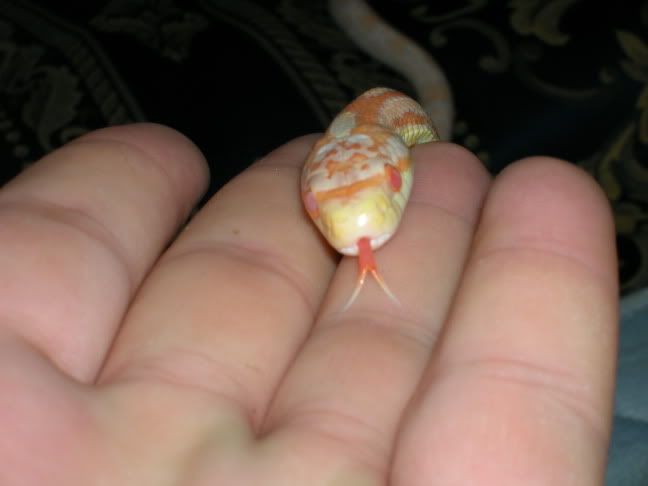
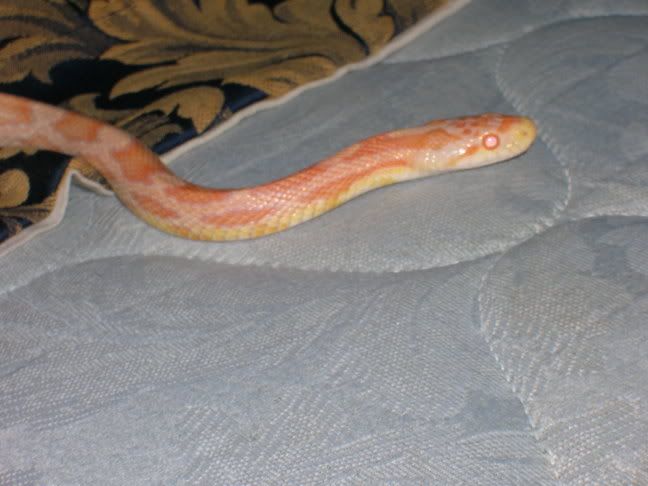
My black rat snakes bred this year, on their own, without any encouragement from me. The male is a two year old and was sold to me as a high-orange albino, and the female is about two and a half, and is brindle. She laid 4 eggs, and 3 hatched out as beautiful baby black rat snakes. Except.. the babies have brown on them.

This leads me to believe that the "high-orange" male that doesn't look like most albino black rats may actually be a texas rat snake. All well and good, I don't mind him being a Texas rat- he's still a beautiful snake, and that explains his temperament better. But now, I think these babies are integrades, which bothers me. And makes me happy there are only 3. For purity's sake, I won't breed the two again. I won't breed the one offspring I keep, and the other two will be labeled as black-Texas integrades.

That is Basil, the father.

Now, the question is- What will these babies look like? Since the mother was brindle, which is a co-dominant trait in black rats, if the father were a normal black rat, they would only have the genes for normal black rats, and not brindle(or brindle, and not normal, but these are a normal phenotype). Since the father is a texas rat.. Will they turn out to look exactly like Texas rats as adults? I'm thinking that will be the case.
If they won't turn out to look like normal Texas rats, anyone know what they will look like?

I'll take some more recent pictures of the babies tonight, as soon as I get my camera back. This pic was when the hatchling wasn't even a day old. They are now all three more than a week old.

Replies (12)

phiber_optikx Aug 06, 2006 12:09 PM

I wouldn't be so quick to assume he's texas....

Just because he is very orange just means he is a better example of albinism (imo)
There is a lot of variability in black rats. I have seen some very brown adults so I am sure there are brown babies.
-----
0.1 Snow Corn "Hope"
1. Orange Albino Black Ratsnake "Chunk" (Goonies)
.1 Orange Albino Black Ratsnake "Peaches"
0.0.1 MO Locale Black Ratsnake "Molly" (Flogging Molly)

As we say in Missouri, "I ain't goin back to Missouri!"

redmoon Aug 06, 2006 03:20 PM

Thanks for the input. I know there's a lot of variability, but I've never seen albinos that look quite like mine. Even that one you posted (which is beautiful, btw) has a lot of pink in it, which mine doesn't have.
There are a ton of brown adults. Look at all the Kentucky locale black rats. But even those are normally black & grey as babies. Yellow is generally the last color to come in on rat snakes, and these guys already have a lot.

Anyone else on here have albinos that look like my Basil?

Elaphefan Aug 06, 2006 08:59 PM

First, it is easy to tell an "albino" Black Rat from a Texas Rat. A Texas Rat will show checkering on its underside while a Black Rat will not.

Second, your F1's look normal in your photos, so I ask the question "Are you sure that the female's coloring is a co-dominant trait?" Isn't the brindle pattern in Black Rats visible from the day that they emerge from the egg?

redmoon Aug 06, 2006 09:22 PM

Erm. Maybe co-dominant is the wrong word?
In a Brindle x Normal pairing, the babies have a 50/50 chance of resembling either the brindle, or the normal. The brindle genes replace the normal genes. You never have animals het for brindle, or het for normal.

So, yes, the F1s are all normal. None of them turned out brindle. Just luck of the draw.

I did not know that you can tell the difference by checkering. He does indeed have some checkering. Some. Up near his head, it's a definite, while farther back, his whole belly is yellow. Would you say Texas?

phiber_optikx Aug 06, 2006 11:51 PM

Correction.....
Sorry to correct you but black rats do have checkers. BUT they do not appear for the first 3rd of the body.
-----
0.1 Snow Corn "Hope"
1. Orange Albino Black Ratsnake "Chunk" (Goonies)
.1 Orange Albino Black Ratsnake "Peaches"
0.0.1 MO Locale Black Ratsnake "Molly" (Flogging Molly)

As we say in Missouri, "I ain't goin back to Missouri!"

Dre Aug 07, 2006 07:19 AM

Your amel looks blk rat from here ....yeah brindle is a recessive trait. Man I would breed those babies !!!!!!!!
I have a nice young normal male breeder blk rat that is reddish brown on the first 1/3 of his body .I got him from another breeder who told me he is het for licorice and poss het for amel and brindle
I'll post pic once I get a new camera
Just my 2 cent !

redmoon Aug 07, 2006 09:35 PM

I'm pretty sure brindle isn't recessive. Wether co-dominant, dominant, or whatever is the proper word, I've always been told brindles bred with anything else have a 50/50 chance of having brindle babies. I've been told by multiple breeders that they've produced brindles by doing that. That's supposed to be what makes black rats unique- they have multiple phases that aren't recessive.

Thanks for the input, anyway.

Dewey Aug 07, 2006 11:25 PM

The brindle trait is definitely a simple recessive trait in black rats. This has been proven out by many reputable breeders. The only co dom trait known is the rusty/copper saddle phase. Breed a normal to a brindle and you get all hets. Other breeders may have taken their brindles to animals whose genetics were not certain (they may have had brindle in them somewhere). So of course they may see them in the F1's. As far as your orange albino, it looks like a black rat to me. They can show a lot of reds, oranges AND yellows. I hatched many babies out last year with yellow bellies. They were nothing special....
Check out some of the archives and you will see the results of brindle breedings. While what I say is only my opinion, I have worked with black rats for quite some time now. But if you want further opinions, I suggest you ask for those of Mike Jolliff, Dwight Good, Darin Bell, or Floyd Presley...all of which have extensive knowledge in the black rat genetics. ( They are the brains I picked when I began my collection of black rats)

Hope this helps you! If you wanna see some pics, check out the link I have in the classifieds. You should see one or two that look like yours in there. Good luck!

Dewey

redmoon Aug 10, 2006 05:22 PM

Guess I was wrong. Thanks for the info. So these babies are het. brindle and albino, which is closer to what I was looking for. I want to see what comes of an animal that contains genes for both albino and brindle, much like people do brindle licorice sticks, or albino licorice sticks. And I'd love to play with more genetics.

Floyd Presley is actually who my brindle came from. He is a GREAT guy, who I consider a personal friend. I've known him for several years, and spend hours talking to him at shows. He gave the brindle to me a couple years ago, when I started showing interest in black rats. Made me promise the next one I bought would come from him. I'm hopefully getting a rusty from him on the 20th. I was thinking it was the brindle that he had told me was co-dominant, but I guess it must have been rusty. I do know I've heard other people say that they're dominant, but, black rats aren't extremely common- there's nothing saying that they didn't actually have rusties instead of brindles. Pictures are rare, and from a description, I could understand people thinking either one could be the other.

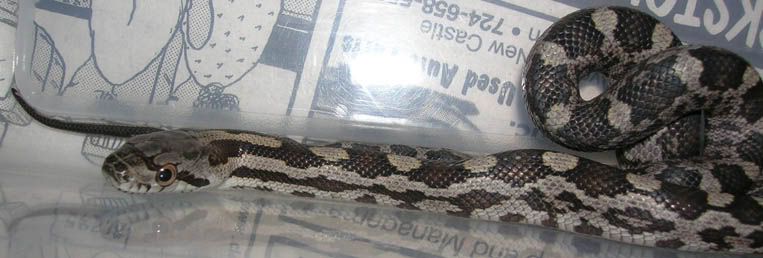
Here are a few pics of the babies. Still think they're pure black rat? I pulled out the male again (who is mean as heck, and never gets handled), and the checkers really aren't checkers. They're the same as the babies have, and more or less what the brindle has- blotches.


Dewey Aug 10, 2006 06:17 PM

Yea, those are most likely pure black rats. I would buy them as being pure. The albino brindle is already out there. I'm not too impressed with it, but that's just my opinion. However, there are a lot of other crosses that make neat lil babies. Keep working with them, and you definitely won't be disappointed.
By the way, who did you get the albino from?

Dewey

redmoon Aug 10, 2006 09:02 PM

Excellent. I've seen pictures of albino brindle hatchlings, but never adults. So.. What could it hurt? Plus, I've thought since I got the male that his bright colors would make nice babies. Take a couple years to do, but I don't have any more pressing breeding projects. I'm not losing money on it. I want to introduce as many different genes as possible into a single animal, and see how they combine. I know those of us who like black rats absolutely love them, but there still hasn't been enough experimentation with them. I can really foresee them being the next corn snakes. I think there's a lot of untapped potential. Look at how much variation there is just in normals, let alone albinos, and the other phases.

I'm not sure who bred my albino. The guy was in from out of town, and was at the Pittsburgh reptile show. He was Australian, too.. Had a couple different types of black rats for sale. I got two males as a trade for a lavendar albino cal king I was desperate to get rid of. I talked to a couple people(Floyd Presley, Brad McCarthy, Tim Koppenhoffer, and a handful of others who I trust, but doubt anyone on here would recognize their names), and they said the person was a decent guy, and to take the trade. Now, I can't remember his name. I had it written in my hatchling/new acquirement records, and the entire notebook "disappeared".

Dre Aug 08, 2006 11:39 AM

You answer your own question ...Did you produce any brindles in that clutch ?
Those babies are odd but there not BRINDLES
I have breed brindles on and off for at least 10 yrs and never produce brindles off the back in [F1's].

You might be thinking about Dimorphism
Brindles: Could be sex just by there color
Males are redder than females all ways

Once again I could be wrong

Site Tools