Hello everyone just wanted to know what type of cameras are you guys and gals using to take such fantastic pictures. I`m looking to get a new digital camera and need some help deciding which one to purchase.
Thanks for any input,
Ray

Reptile & Amphibian Forums
Welcome to kingsnake.com's message board system. Here you may share and discuss information with others about your favorite reptile and amphibian related topics such as care and feeding, caging requirements, permits and licenses, and more. Launched in 1997, the kingsnake.com message board system is one of the oldest and largest systems on the internet.


Cameras
rbond
Aug 10, 2006 07:12 PM
Replies (14)
Hypoboa1
Aug 10, 2006 08:18 PM
>>Hello everyone just wanted to know what type of cameras are you guys and gals using to take such fantastic pictures. I`m looking to get a new digital camera and need some help deciding which one to purchase.
>>Thanks for any input,
>> Ray
>>
Thanks for sharing.As far as what type of camera to get some of the other guys will have to help with that one.Take Care,Eric[Hypoboa]
-----
E&C's Exotic House of Reptiles
rbond
Aug 10, 2006 08:37 PM
Thanks Eric!!!!!!!!!!!!!!!

shot
Aug 10, 2006 08:59 PM
That is a very very very nice sharp. Who produced that beauty?
Marcus
RBOND
Aug 11, 2006 04:49 AM
This female Sharp Strain was produced by Doug Matuszak Of the Boa Basement.
Thanks,
Ray

giantkeeper
Aug 11, 2006 08:18 AM
switched from a trusty Sony S-85 digi 4mp to an Olympus e-500 DSLR 8mp. I have yet to share any photos from the new camera because I am working out the bugs.
If you get a DSLR be prepared to do some learning. All of the auto settings on mine are great...for everything but photos of my snakes....lol.
Guess I'll just have to post some photos this weekend and here what everyone has to say.
Shop wiesely! Batteries, optical zoom (higher number better), and megapixels are what is important!
-----
Chris & Alliey
www.bloodyleopard.com
E-mail Us
giantkeeper
Aug 11, 2006 08:19 AM
n/p
-----
Chris & Alliey
www.bloodyleopard.com
E-mail Us
rainbowsrus
Aug 11, 2006 12:47 PM
I have a Canon EOS 20D, love it. Some of my pics from it:
BCI Male
Albino het anery 2004 
Anery pos het albino 04/02/2006 
Salmon possible Jungle 05/17/2005 
Summit Salmon 05/27/2005 
Stripe 2006 
BCI Female
Anery Het Albino 04/21/2005 
Ghost 2005 
Super Ghost 05/24/2005 
Super Salmon pos Jungle 05/22/2005 
Stripe 2006 
Reverse Stripe 2006 
Albino Arabesque 05/15/2005 
BRB Male
M5 Bullseye Male 
Hypo Mickey 
High Red SA-PO-06 
High Red Rusty 
Females
High Red Savannah 
High Orange Daisey 
Hypo Dottie 
Normal Clover 
Normal C1 
trio of striped BCI 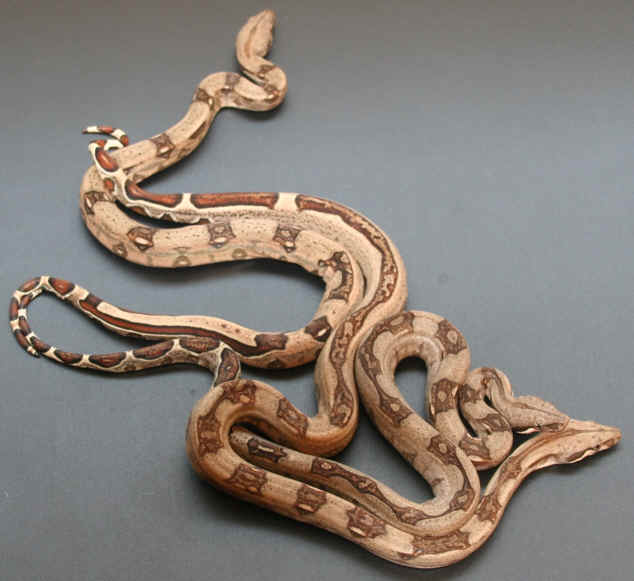
Albino het Anery 
Albino Arabesque and Albino 


-----
Thanks,
Dave Colling

www.rainbows-r-us-reptiles.com
0.1 Wife (WC)
0.2 kids (CBB)
LOL, to many snakes to list, last count:
10.22 BRB
10.15 BCI
And those are only the breeders 
lots.lots.lots feeder mice and rats 
RBOND
Aug 11, 2006 03:52 PM
VERY NICE PICTURES!!!!!!!!!!!!!!!
rainbowsrus
Aug 11, 2006 04:18 PM
I'm beyond amature, this camera is a really nice high end DSLR camera that can take fabulous pictures almost by itself.
No color balancing or post production processing was done on any of those photos. Only cropping and rotating!!
-----
Thanks,
Dave Colling
www.rainbows-r-us-reptiles.com
0.1 Wife (WC)
0.2 kids (CBB)
LOL, to many snakes to list, last count:
10.22 BRB
10.15 BCI
And those are only the breeders
lots.lots.lots feeder mice and rats
liquidleaf
Aug 11, 2006 01:41 PM
I JUST got a Panasonic fz30 last week, my first "fancy" digital camera - not quite an SLR but as close as you can get to one without shelling out the dough. While it's not a photo of one of my boas, this photo was taken the first day I got the camera, on automatic settings... I have a LOT of exploring to do to see what all the bells & whistles do.

-----
Lauren Madar
www.ophidiagems.com
1.1 Hog Island Boas
1.1 Hypo BCI
0.1 Sorong-type GTP
1.0 Normal Ball Python
RyanHomsey
Aug 11, 2006 02:37 PM
Indoors there are two general scenarios in which I take boa pics.
The first being flash shots. I use an sb-800 external flash. It's fairly high end, priced at around $300 bucks if I remember correctly. I typically use a technique called "bounce flash" in which I aim the flash at the ceiling, which bounces the light back down onto the subject. This helps to diffuse and soften the light.
Here are some recent examples of my indoor flash shots:


The other way I do pics inside is without flash. This requires raising something called "ISO" up very high, which adds noise (or grainyness) to the picture. It also requires opening up the lens much more to let in more light (this is done by using a lower F number in aperature priority). The trade-off of opening up the lens more is less depth of feild... meaning less depth is in focus, ie smaller focus range.
Here are some recent examples of indoor shots without flash. These tend to be softer and less contrasty:


Outside there are also two scenarios. The first being direct sunlight shots. I close the lens down to its prime sharpness area (around F12) which gives a very deep depth of feild (ie lots in focus).
Examples:


The second outside scenario being shade shots. I usually raise the ISO level a bit and open up the lens more. There is still more light than in most indoor available light scenarios so there is less of a trade off here.
Examples:


I also should note that I shoot everything in RAW format. RAW allows me to make small exposure adjustments in post processing (ie on the computer) without degrading the picture. It also allows me to adjust white balace without changing/degrading the picture. All of my newer shots (most in this thread) were white balance calibrated using whats known as a grey card. This ensures that the color temperature is exactly where it is supposed to be, regardless of any mis-calibration of my monitor or other factors related to balancing by eye. To use the grey card I snap a shot of it in the frame to calibrate the other shots to. example:

I load the above picture into Nikon Capture and point to the grey card.. it calibrates it.. bam.. perfect white balance. The whibal card is one of the most useful photography tools I have, yet it is the cheapest.
So yeah, I would highly reccomend the Nikon D50. I purhcased an upgraded general purpose lens, the Sigma 18-50 2.8. This lens allows me to open up well for the low light shots, keeping them sharp. It runs $500. But it is not a necessity, the nikon 18-55 kit lens takes excellent shots. The price on the D50 kit these days is extremely affordable. I would say Nikon Capture ($100) and a white balance card are additional necessities however.
>>Hello everyone just wanted to know what type of cameras are you guys and gals using to take such fantastic pictures. I`m looking to get a new digital camera and need some help deciding which one to purchase.
>>Thanks for any input,
>> Ray
>>
-----
Take Care,
-Ryan Homsey
www.topnotchboas.com
RBOND
Aug 11, 2006 03:59 PM
Thanks for the info Ryan!!!!!!!!
RyanHomsey
Aug 11, 2006 10:57 PM
Just wanted to point out that the Nikon D50 is totally capable of excellent shots in fully auto mode, where all you do is aim and shoot.
I just personally like to go the extra step to make things just that much better.
To understand what I mean by shooting in RAW mode, see this link:
http://luminous-landscape.com/tutorials/understanding-series/u-raw-files.shtml
"Reasons to Shoot Raw
— A raw file is comparable to the latent image contained in an exposed but undeveloped piece of film. It holds exactly what the imaging chip recorded. Nothing more. Nothing less. This means that the photographer is able to extract the maximum possible image quality, whether now or in the future. A good analogy with the traditional world of film is that you have the opportunity to use a different type of developer or development time at any point in the future if one comes along that you think might do a better job of processing the image.
— Raw files have not had while balance set. They are tagged with whatever the camera's setting was, (either that which was manually set or via auto-white-balance), but the actual data has not been changed. This allows one to set any colour temperature and white balance one wishes after the fact with no image degradation. It should be understood that once the file has been converted from the linear space and has had a gamma curve applied (such as in a JPG) white balance can no longer be properly done.
— File linearization and colour filter array (Bayer) conversion is done on a computer with a fast and powerful microprocessor. This allows much more sophisticated algorithms to be used than those done in a camera with its slower and less powerful processor and with less space for complex conversion programs.
— The raw file is tagged with contrast and saturation information as set in the camera by the user, but the actual image data has not been changed. The user is free to set these based on a per-image evaluation rather than use one or two generalized settings for all images taken.
— Possibly the biggest advantage of shooting raw is that one has a 16 bit image (post raw conversion) to work with. This means that the file has 65,536 levels to work with. This is opposed to a JPG file's 8 bit space with just 256 brightness levels available. This is important when editing an image, particularly if one is trying to open up shadows or alter brightness in any significant way.
Figures #1 and #2 below shows why. Assuming for this example a 5 stop dynamic range, you can see how much data is found in each of the brightness levels in the image. In other words with a 12 bit file the two darkest levels of the file combined have some 384 brightness levels to work with.
An 8 bit JPG file on the other hand has considerably less. Both the sRGB and Adobe RGB colour spaces use a gamma 2.2 encoding. Gamma encoding reallocates encoding levels from the upper f-stops into the lower f-stops to compensate for the human eye's greater sensitivity to absolute changes in the darker tone range. Therefore an 8 bit JPG file has just 47 brightness levels available in the bottom two stops. (The remaining levels out of 256 are for the f-stops beyond the 5 in this example)."
The great thing about digital photography is that there is so much that can be done in post processing. Not that it has to.
Here are some examples of just straight auto shots I took, no post processing:


Autos with on-camera flash:


-----
Take Care,
-Ryan Homsey
www.topnotchboas.com
RBOND
Aug 12, 2006 08:18 PM
VERY NICE -----I THINK THAT NIKON D50 MAY BE MY NEXT CHOICE.
THANKS AGAIN,
RAY
