Reptile & Amphibian Forums

Welcome to kingsnake.com's message board system. Here you may share and discuss information with others about your favorite reptile and amphibian related topics such as care and feeding, caging requirements, permits and licenses, and more. Launched in 1997, the kingsnake.com message board system is one of the oldest and largest systems on the internet.

Click for ZooMed
Click here to visit Classifieds

Sexual Dimorphism n Young Wat. Monitors?

dberes Aug 11, 2006 01:53 PM

"sex was determined by the following: radiograph of the hips due to pelvic variations between the two genders, social interaction among a large group of animals, and close observation of defication due to the frequency with which hemipenis can be seen in a young deficating male monitor. Sexual dimorphism can also be noted in the shape and proportion of the head and neck even in young animals."

This was posted on another forum I was reading and thought it was interesting. Just wondering if there was any truth to this, because KS forum has way more experienced members with monitors then the one that the above quote was posted on. Thanks.

Replies (5)

mrcota Aug 12, 2006 04:34 AM

>>"sex was determined by the following: radiograph of the hips due to pelvic variations between the two genders, social interaction among a large group of animals, and close observation of defication due to the frequency with which hemipenis can be seen in a young deficating male monitor. Sexual dimorphism can also be noted in the shape and proportion of the head and neck even in young animals."
>>
>>This was posted on another forum I was reading and thought it was interesting. Just wondering if there was any truth to this, because KS forum has way more experienced members with monitors then the one that the above quote was posted on. Thanks.

I have my doubts about the use of a radiograph to determine sex except in more mature specimens, but then sex determination is going to be more apparent in other characteristics anyway. I would like to see more evidence on that. I believe FR or someone else used X-Rays with mixed results. Even more interesting would be to see what a CAT scan or an MRI would show.

The Varanus salvator that I have worked with always defecated in their water and I have yet to see a young male evert its hemipenes except when caught (excited/scared). Is it possible that other V. salvator from other areas that I have not worked with do evert their hemipenes? Sure, it is possible.

Noting sexual dimorphism in the shape and proportion of the head of adults is nothing new, but in young specimens (hatchlings/juveniles even sub-adults), I have not found any differences.

Cheers,
Michael

jburokas Aug 13, 2006 05:14 PM

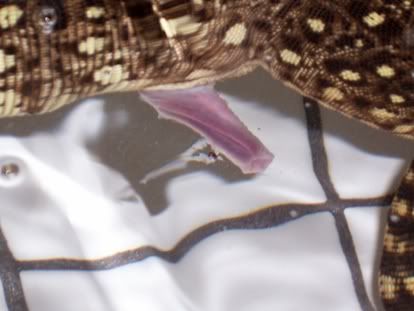
9 month old "male" V. panoptes horni. This is only partially everted vs a second earlier (if you'll take my word for it).
He does this almost every time he defecates in water. I can't speak for V. salvators specifically.

FR Aug 14, 2006 11:29 PM

Again I agree with MrCota, I have averaged keeping a couple hundred monitors at any given time over a decade and a half. And I rarely and by that I mean very rarely have them evert on their own. Of course they do if I manhandle them. But not on their own, in water or not.

I wonder about this. Understand, several people have mentioned their monitors do this all the time. I just wonder why yours do and mine don't.

Also consider I spend each and every day from sun up, to into the night around these monitors. Hmmmmmmmm Cheers

mrcota Aug 15, 2006 04:34 AM

>>Again I agree with MrCota, I have averaged keeping a couple hundred monitors at any given time over a decade and a half. And I rarely and by that I mean very rarely have them evert on their own. Of course they do if I manhandle them. But not on their own, in water or not.
>>
>> I wonder about this. Understand, several people have mentioned their monitors do this all the time. I just wonder why yours do and mine don't.
>>
>> Also consider I spend each and every day from sun up, to into the night around these monitors. Hmmmmmmmm Cheers

FR, the everting of the hemipenes during defecation (when most people are observing this) is often the result of a stressful (more than the usual effort) pushing out of the feces (maybe not enough moisture= slight to very slight dehydration?).

The only monitor that I have had evert the hemipenes on its own was my V. prasinus while it was stretching (arching its back down). This resulted in a quick popping out.

Cheers,
Michael

FR Aug 13, 2006 09:25 PM

There is nothing wrong with those methods you mentioned, but, they are not totally accurate either, to many exceptions. Then consider, you can flip a coin and be 50% accurate. So, what percentage over 50% do this methods deliver???

With young to older adults, its very easy to sex monitors. Many of the characteristics you mentioned, plus popping(to evert the hemipenes) can be combined to be fairly accurate. In fact, most individuals of most species are very easy to determine by sight alone.

The problem is hatchlings to young monitors. This can be very difficult. Individuals of some species can be sexed within a month or two, others cannot.

As hatchlings both sexes have the same organs(who knows if this goes for all species), hemipene in males, hemiclitoris in females. As hatchlings, these are the same size in both sexes. So popping or probing, is problematic. Some individual males do not express secondary sexual characteristics, head shape, larger spurs, hemipene development, until they are full size. Yet members of their same clutch, can have fully developed functioning organs at half the lenght of full grown.

Also with X-ray or sonigrams, hatchlings are not sexable. The problem with many reports is what determines age catagories. For instance, those two methods can work with individuals as young as six months to a year. But those methods are more accurate with older individuals. Some people consider monitors under a year, as young or subadult. Unfortunately, we have bred all the species we have worked with in under a year. So for us, those methods have no value. We need to know at hatch, what sex they are. After six months, most of ours are laying eggs.

So at this time, an educated guess may be slighly better then flipping a coin. Combining a series of methods, may increase that percentage. But none are accurate all the time with all individuals of all age groups. Cheers


Site Tools