Reptile & Amphibian Forums

Welcome to kingsnake.com's message board system. Here you may share and discuss information with others about your favorite reptile and amphibian related topics such as care and feeding, caging requirements, permits and licenses, and more. Launched in 1997, the kingsnake.com message board system is one of the oldest and largest systems on the internet.

Click for 65% off Shipping with Reptiles 2 You
Click for ZooMed
Click here to visit Classifieds

Shortest Brumation....?

phiber_optikx Aug 15, 2006 12:57 AM

I am getting mentally prepped for this spring (first breeding season) and had a few questions. I don't have an ideal place to brumate my snakes. Just an insulated garage. I don't know how cold it will actually get in the dead of winter so I don't want to risk a full brumation period. So my plan is to brumate early at the first signs of cold weather and pull them out of brumation when it gets nasty. This will probably give me a month tops to brumate them. Will this be long enough to get their reproductive cycles going? I know they can reproduce without brumation but want to make sure I do it right. Or at least as right as I am able. I just had a few questions on the specifics....
1. What is the coldest you would allow your snakes to get?
2. If a snake doesn't seem to "settle" into brumation mode, is it best to pull it back inside or just leave it until it settles?

3. The room temperature (inside) is usually 75-80. When pulling them out of brumation should I just bring them inside and leave their heat pads off for a week or so?

4. I have a female (w.c) that doesn't really recognise standing water as a water source.... She usually drinks from mistings and get water from her meals. How should I aproach this with brumation since she can't get water from eating? I don't think it would be wise to mist her at 50 degrees....

Thanks in advance for all of your help!
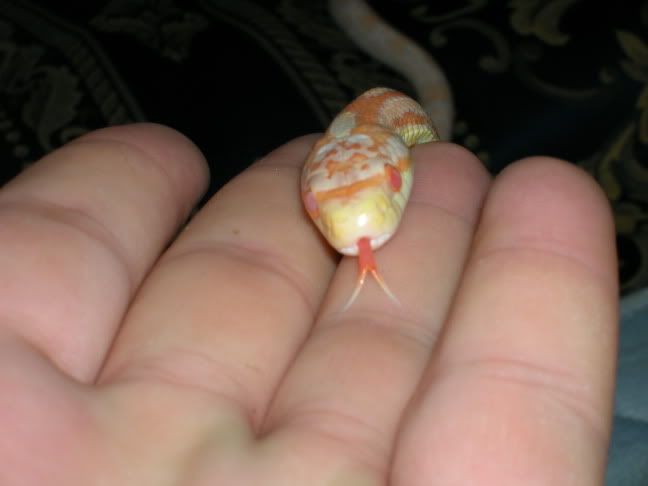
P.S. Not breeding the one pictured. I am breeding her brother though!


-----
0.1 Snow Corn "Hope"
1. Orange Albino Black Ratsnake "Chunk" (Goonies)
.1 Orange Albino Black Ratsnake "Peaches"
0.0.1 MO Locale Black Ratsnake "Molly" (Flogging Molly)

As we say in Missouri, "I ain't goin back to Missouri!"

Replies (16)

Dre Aug 15, 2006 07:57 AM

To answer you question
1. 50 -55 degrees
2.I would just leave her down
3.Yes
4.I would leave her some water
_______________________________________________________________
I brumate starting her in MD the end of Oct until the end of Feb I go 3 months to insure reproduction and getting a break fom daily maintains..lol
Temp 50 - 55 for me
I do seperated the sexes
I leave water in there cages yr around

p.s. Make sure they have defecated before brumating
I think that the longer they brumate the better your chance of reproducing !!!

mchambers Aug 15, 2006 09:36 AM

and not the longest but of 40 years of reproducing of my success : Brumation starts at anywheres of Nov. 15 to the end of Nov. and bringing up in mid / late March to early April. I have done this with any and all colubrids. I have NEVER been able to get temps in even the low 60ties. I put ( as a lot of others ) more emphasis on the photo period instead of a low brumation temperature and always will. I do keep water available in cage at all times. I keep sexes separated during brumation and where they cannot see each other. Ask most of the breeders in southern Cal, Southern Texas , Southern Ala, Miss, LA, Florida what they do. Some employs air conditioners to try to bring brumation period temps down. A lot just darken the rooms / cages. How would you brumate a colubrid say in Tampa Florida at temps even in the low 70ties when your average winter temp is in the upper 70ties and or low 80ties ? Maybe for a very , VERY short time period ! And lets not forget that sightings of wild populations snakes are abundant year round in those same mentioned states. They obviously breed and produce without a low temp. range. I don't know if it was the late Joseph Laszlo or who but they stated that we as hobbyist puts the temperature thing of to importance to re-produce herps where as photo periods are more important. I believe in that ! Not saying that other factors are somewhat important also. Like well fed before and a period of time to defecate is important. A not radically drop in temperature. If going with the photo period a close to natural situation of shorting the light cycle of several days into total / semi - darkness ( but even of the dens / rookeries / lone hibernacular places be it rocks, trees and or tree bark, even AC , etc. these places are not always in total darkness ) .
-----
I may be old , cantankerous, crabby, and cynical, but......

markg Aug 15, 2006 02:05 PM

Fact is, a male's sperm will die if he gets too cold for too long, or if he is too warm for too long, right before breeding.

As long as he maintains the temps he needs to keep viable sperm, then successful breeding can occur.

What gets me is, nobody really knows for sure what the right temps are. We have an idea, maybe, - probably somewhere in the 55-65 range with short stints higher and lower being OK. So the best scenario is to provide a range and let the snakes decide what they need. I would think anyway.

This is why male snakes may be found basking in Spring before females. They are trying to warm themselves to prevent their sperm from dying if they have been too cold. But they are also careful not to bask too long. They know.

I have had snakes reproduce while in cages that had a low of 50 deg and a warm heat pad on the opposite end, which they used sometimes. I've had snakes reproduce with fluctuating "brumation" temps. I've had females lay eggs w/o being cooled as long as the male was given access to cool temps off and on for at least 4 months.

I think this recipe of 50-55 deg for 8-10 weeks may work much of the time but is by no means a rule based on reality. It is a rough rule of thumb that has results I suppose but has somehow become more of a truth to herpers than the actual behavior of the wild snakes.

The only way we can know for sure is to follow wild snakes all Winter and measure temps. But that is very hard to do. And without that info, these caresheet brumation instructions we all read is nothing more than a guess.

And I know photoperiod is very important.

And while I'm going on, all this eggbinding stuff is 100% due to how we keep snakes. Wild snakes don't eggbind like we see in captivity. But 28 qt sweaterboxes and a 6x12 lay box will still be touted as perfect caging.

Wow. I needed that.

Dre Aug 15, 2006 08:12 PM

Here in MD the caves are in the 50's yr round ..Also snakes [in the wild] here are brumating from Oct to April that's 6 months I'm doing the same thing in 3 months at the same temps .I have lost alot of eggs due to warmer temps during brumation. I have learned thru trial and error ...So this recipe I have is Real

P.s. I'm sitting on 4 clutches of eggs from using this recipe
Long live all rat snakes!!!!!!!!!!

markg Aug 17, 2006 12:11 PM

It is interesting that all the way across the US from where you are, here in So Cal in Winter I measure burrow temps at different places in a canyon and up a hill, and generally find temps in the 50s as well and up into the 60s on the hillsides.

Simply based on that, I would say the snakes are exposed to those temps, and they have little choice about that.

But in Spring, the males do warm up before breeding (actually, warm and cool as needed) to ensure motility. That is why a true temp gradient is such a good thing for proper breeding.

It has also been demonstrated that for montane kingsnakes, many times in captivity a longer cooldown (like 5 months) even at relatively warm temps in the low 60s can produce better fertility than a 2 month 52 deg cooldown.

Dre Aug 15, 2006 07:45 PM

Mchamber you made a good point about photoperiods ...But I do believe air temp plays a big part in triggering the start of brumation .I should have said that once you snakes stop eating around the end of the summer regardless of the day / night cycles and / or air temp start brumating.I also have talked to some breeders who use a/c's but that was just to get the jump on the market..lol. There have eggs in Feb while I'm just warming up my snakes.

mchambers Aug 15, 2006 08:34 PM

more. while this photo period has been working for me for 40 years i DO NOT dis-account for air temps but add the baro pressure of it also. But again, here is a contradicting of wild populations in that my studies of observations of crotalus of west, it may be ill-relevant to air temps. Saying it is mostly photo period in my opinion and throw in the other as a not chiefly. Sure it gets cool as the season goes but of what season as several places don't have the 4 seasons in this country ( probably rambling here ). In wild do we know if any of this induces brumation or is entirely responsible. Maybe it might be also something of a food cycle thing too. Mammals / birds / insects , etc are effected by the same situations and if they are.....catch my drift ? Now we know that brumation is not by cool weather of tropical regions or even sub-tropical regions. Right ? Some not all. Did i read a thesis one time on maybe brumation just might be a metabolic thing no matter ? Okay, I totally agree with the coolness of regions of hibernation and brumation but i cannot agree that it is of this in other parts. In fact i would go as far as to say even areas of monsoon regions could throw herps into. There's more but at this time these are my opinionated thoughts.
-----
I may be old , cantankerous, crabby, and cynical, but......

Dre Aug 16, 2006 07:01 AM

In tropical and / or sub tropical regions do they cool down some what[ rainy season]?...What trigger yellow and everglades to brumate in the wild the day/night cycle and or the drop in temp ?

I do believe air temp is just as important in the start of brumate as d/n cycle...were talking about cold blooded animals were temps are everything.

Great topic !!!

tbrock Aug 15, 2006 10:33 PM

Ahh, what the heck! Since I'm kinda new to breeding, but have been successful so far, here goes. I have bred meahllmorum (southwestern rats) twice ('04 and '05) but have brumated since '03 when I started putting the collection together. I am a believer in brumation not only for breeding, but also as a way to prolong a snake's life by providing a needed rest. North American snakes have evolved to become mostly dormant during the winter, and I think it is an important part of their life cycle.

For my snakes, I have brumated them outside in various sheds and boxes, but have always worried about them getting too cold or too hot. I bring them into the house when temps get down to the 40's. This is in south Texas, where temps can go from the 80's to the low 40's in a couple of hours, in the winter time. I know that the snakes I have bred so far, are sometimes active during the warmer days in winter (I have actually caught them during this time). I have brumated my adults for 2 1/2 months, from the beginning of Dec through mid Feb. They have all come through great, so far.

This year, to eliminate worry (and the tedious chore of bringing them in when it's too cold and putting them back after it warms up), I will be brumating them indoors. I am going to keep my snake room (mostly) unheated and when outdoor temps rise, I'll use a window unit a/c to try to keep temps around 65*F.

I am planning on using this method for brumating all of my rat snakes. I wouldn't let any snake (even northern ones) get below about 50*. I don't know how well insulated your garage is, but I would carefully monitor temps. I have read that the occasional highs and lows during brumation are okay, and the average is what makes the difference.

Hope it helps. -Toby

BillMcgElaphe Aug 16, 2006 09:45 AM

Nothing succeeds like success….

You got allot if good input here from good people who succeeded with breeding colubrids. I would agree with all said. I don’t think I could add any new recommendations, only discussion.

All factors, photoperiod, temps, length of brumation, humidity all play a part; how much each plays is up for discussion and the variability in opinions often are based on species to be bred and where the breeder lives.

On photoperiod….
One year when I lived in South Florida, a number of home factors lined up where I had to not to breed my animals. All were kept at 78 F and of course fed because their metabolic rates were still rolling. A window permitted natural light to enter the room and I used a photo sensor to synchronize cage lights with natural lights (although I personally doubt if cage lighting had much of an effect.).
Result – All Florida and south Texas species and variants still bred and produced viable eggs; Corns, Yellows, Everglades, GulfHammocks, Grays, Brooks Kings, Mex Milks, gray-banded kings, etc. Animals that didn’t breed were Black Rats, Foxes, Eastern Milks, etc.

Super important points made:

On Water
DRE said “I would leave her some water”
I personally find it hard to beleive that a wc animal can't find a water bowl.....

On Pre-brumation – Having food in their guts during temp drop can be a disaster:
DRE said “Make sure they have defecated before bromating”
Mchambers said “Like well fed before and a period of time to defecate is important.”
Personally, I stop feeding 3 weeks before cooling and keep temps up for that time.

On Temperature……
Markg said “Fact is, a male's sperm will die if he gets too cold for too long, or if he is too warm for too long, right before breeding.”
This sounds very feasible.

There is probably a different temp for different variants of Rats.
55 – 65 F seems optimum to me. The objective here is to slow their metabolism so if the animal chooses not to eat because of photoperiod, it doesn’t loose the healthy weight it needs to breed.

Toby said “but I would carefully monitor temps.”
This is an extremely important point in that with temperature (and sometimes humidity), don’t guess.
All the large department stores and hardware stores carry inexpensive, indoor/outdoor, digital thermostats that let you know without guessing;
1. Temperature where the unit is.
2. A second temperature where the outdoor probe is.
3. Maximum Temps for both.
4. Minimum temps for both.
The MAX/MIN temp recordings are most important. Most hibernacula don’t swing in daily temps very much because of mass temps not necessarily air temps. If you can insulate your hibernaculum well (even a large cardboard box wrapped in fiberglass) you can lessen the time period it takes for the sleeping animals to change temperature.

Length of Brumation
Your original question = ???????????????????

----------------------------------------------------------------------------------------------------------------
To just add my recipe for the mountains of East Tennessee:
• I feed the last meals the middle of October. Redundant water is checked weekly.
• Put them down the weekend before Thanksgiving (Permits family travel for the holidays).
• They are in a detached, well-insulated shed and hibernate in their cages.
• One small window permits a small amount of natural lights. Cage and room lights, of course, are all off.
• The shed is heated by two separate heaters, each with redundant Ranco etc controllers to set the winter temp at 58F and to cut off at 63F (in case the heater runs away). I have a remote temp/humidity transmitter so room temp/humidity can be monitored inside the house.
Temps are returned to normal over a 1 week period about the last week of February.

This has produced 100% viable breeding of southern Rat Snakes such as Tamulipan, Everglades and Deckert’s Rats and northern Rat Snakes such as E. Foxes, all treated the same!

Separating the sexes would make for another interesting thread!

-----
Regards, Bill McGighan

Dre Aug 16, 2006 03:26 PM

tbrock Aug 16, 2006 07:17 PM

I agree with you 100%, Bill! All very good info, and laid out in a very easy to understand manner. -Toby

phiber_optikx Aug 17, 2006 02:10 AM

Thank you and everyone else who posted. All of your information was very helpfull and informative!
-----
0.1 Snow Corn "Hope"
1. Orange Albino Black Ratsnake "Chunk" (Goonies)
.1 Orange Albino Black Ratsnake "Peaches"
0.0.1 MO Locale Black Ratsnake "Molly" (Flogging Molly)

As we say in Missouri, "I ain't goin back to Missouri!"

Cobra7 Aug 17, 2006 05:43 AM

My friend keeps a pair of corn snakes in a cage together year round in the house with temps 75-80 and he had 42 egg hatch that I am now taking care of. Sean

BillMcgElaphe Aug 17, 2006 06:40 AM

Sean,
How large is the cage?
-----
Regards, Bill McGighan

phiber_optikx Aug 17, 2006 03:01 PM

So would you recommend putting the tank in the garage AND leaving the heat pads on? Will they thermoregulate while brumating or would this cause them to not actually brumate themselves? After hearing talk of males protecting their "swimmers" it made me wonder.
-----
0.1 Snow Corn "Hope"
1. Orange Albino Black Ratsnake "Chunk" (Goonies)
.1 Orange Albino Black Ratsnake "Peaches"
0.0.1 MO Locale Black Ratsnake "Molly" (Flogging Molly)

As we say in Missouri, "I ain't goin back to Missouri!"

Site Tools