Reptile & Amphibian Forums

Welcome to kingsnake.com's message board system. Here you may share and discuss information with others about your favorite reptile and amphibian related topics such as care and feeding, caging requirements, permits and licenses, and more. Launched in 1997, the kingsnake.com message board system is one of the oldest and largest systems on the internet.

Click here for Dragon Serpents
https://www.crepnw.com/
Click for 65% off Shipping with Reptiles 2 You

Mosaic South Georgia Eastern Kings

Keith Hillson Aug 19, 2006 02:25 AM

Alright Im of the opinion that these S. Georgia Eastern Kings that I and Will Still have hatched out are the same thing Kevin Enge has. Enge Mosaics hail from Edisto Island, SC. He has a detailed article on them (link provided below). I just cant buy that the S. Georgia Eastern King pattern anomolies are coming about simply because of Goini genetic flow. If one believes that then you would have to think thats the case with the Edisto Island Kings and they are far far away from the Apalachicola region of Florida ... Here is my post below to ZF

No offense taken but this has been discussed before but I will rehash it for you.
I can trace these snakes back the original WC pair from Echols Co., GA and Tift Co., GA. The former being a county that borders Florida. Does genetic flow go up into Georgia from Florida like Goini genetics ? Im sure it does to some extent but how much ??? I dont absolutley believe thats why these snakes are patterend this way though and here is why. Look at some of the Kings that have come from Edisto Island, SC...They are pretty damn far from the Apalachicola region of Florida. Too far IMHO for Goini influence to reach (check a map). Here are a WC pair of Edisto Island Eastern Kings. The female is a Mosaic and the male is a carrier.

A better shot of the WC female...

This pair was collected by Heyward Clamp of the Edisto Island Serpentarium and given to Ricky Walters of SC. He then gave the pair to Kevin Enge who produced these f1 hatchlings from the above pair...

They sure look alot like Goini huh ? Except that they arent just good ol Eastern Kings (Ill refrain from saying pure lol)They also look alot like these dont they ?
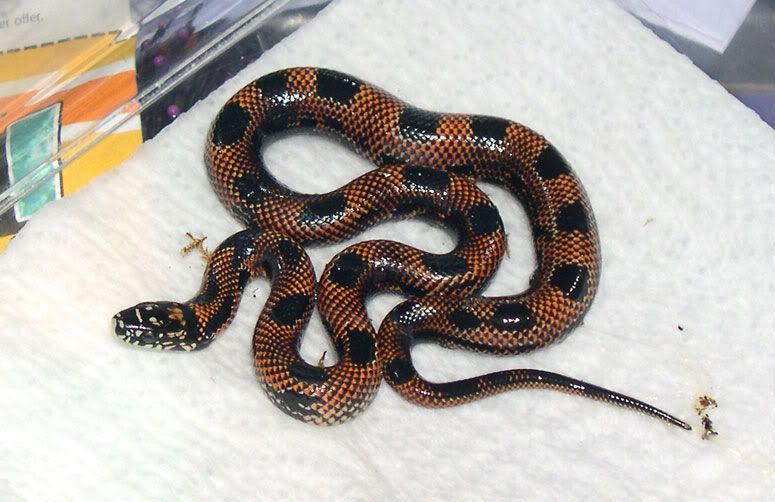
Another one I hatched out

or this snakes Uncle also a Eastern King...

Fact is there may be some Goini influence in these Kings are all the Easterns in S. Georgia but the one thing about Goini was it was isolated. In otherwords if nothing could get to them for quite awhile then they couldnt get out either. Of course now Eastern Kings have pushed their way south and are drowning out Goini. Im attaching a link to Kevin Enge's Mosaic article for you to read if you get a chance and have an interest. He fleshes out the Mosaic history better than I did and offers a explanation on how the mutation works. Enge is also the originator of the S. Georgia Eastern that I and Will Still own (still has the orignal WC pair of S. Georgia Easterns but they are long retired). Kevin has yet to produce the Mosaic type Eastern Will and I have with his S. Georgia Easterns. I might add Enge did breed the Mosaics into his S. Georgia line but well after Will Still purchased his breeding pair from Enge in the late 90's. Enge didnt get the WC Mosaics until 2001 and didnt produce young until 2002 or later I think. For these reasons I think that the pattern anomoly seen in the S.GA Easterns is probably the same thing thats going on with the Edisto Eastern Kings. Thanks for your comments and compliments on my snakes.

Keith

Mosaic Eastern King article

-----

Replies (34)

JETZEN Aug 19, 2006 03:04 AM

belly shots of the "goini" looking easterns you just hatched out. This is very intresting to me, mucho thanks in advance.
p.s.
thanks for the mosaic link i been wantin to put that on file for months

JETZEN Aug 19, 2006 03:25 AM

more than ever that "goini" as well as "edisto" are just mere pattern variants of L.g.getula. And So.GA L.g.getula can be selectivly bred to produce "goini" and possibly even patternless "goini". Future projects anyone?
Image

Keith Hillson Aug 19, 2006 09:02 AM

You may very well be right. Think about it when an animal gets isolated like Goini was inbreeding is more common thus bringing out hidden traits or rapid selection for traits that work in thw wild. The SGA Eaterns ahave been selective bred but the pattern thing popped up from f1 breedings (Frank the Tank is a F2). Also if you check out the Outerbanks King page on my site you will see they too have some Goini like pattern anomolies. Maybe its what the ancestral Kingsnake looked like that seeded the Eastern US ??? Im no scientist Im just talking in thoughts and ideas that could very well be totally off

Keith

Here are some pattern anomolies in Outer Banks Kings...

Image
-----

JETZEN Aug 19, 2006 10:22 AM

i appreciate your open mindedness about my strange theory, thanks.

minicopilot Aug 19, 2006 01:14 PM

The theory sounds legit.

JETZEN Aug 19, 2006 01:36 PM

I suspected it for yrs, then i latched on to a book that re-enforced my thinking. For now it's just a theory to me, until DNA technology will advance far enuff to prove it as absolute fact. Is DNA technology advanced enuff already to prove this out??? I don't know,hmmmm? Maybe, but who want's to spend the money on it?LOL!!!

BlueKing Aug 19, 2006 05:03 AM

It ads some more carbohydrates, fat n' veggies to your brain. . . But good points and it does bring up more questions and maybe even a few answers. Notice that S. Carolina and S. Georgia maybe many miles apart, but latitude they're not. So far no-one has found snakes like this in N. GA. or VA., though the OBKs come close but not close enough climatically speaking.
My point is that all the warmer areas of getula habitat have a realistic chance of bringing about pattern anomalies. At least until someone finds a wide banded E. king in N. Ga.,ALA., NW. SC, or most of VA.
SO having said that: YA' GOTTA LOVE THEM WARM WEATHER E. KINGS!!! They rule - especially with pattern variabilities!

Zee
-----
"I am an expert on everything, but I know so little and have so much to learn!" -Carsten "Zee" Zoldy-

Ace Aug 19, 2006 05:13 PM

>>>>So far no-one has found snakes like this in N. GA. or VA.,

Actually that's not entirely true. I have one article by Jonathan Wright, where he claims "The Easterns with the widest chain markings come from southeast Virginia and are black and white, not brown and yellow. Some are almost 50/50 white to black, according to one source who lives there."

Now, he doesn't site his "source", and it could be just heresay, but HE trusts his source enough to put it into print, for what that's worth. But, apparently there ARE reports of wide bandeds being as far north as Virginia.
-----
Ace

BlueKing Aug 20, 2006 04:40 AM

I would LOVE to see one! And I bet the ones you're talking about are from EXTREME SOUTH-EAST Virginia (which in reality has a climate almost identical to just furthwer south anyway)!
I have seen some nice wide banded ones from VA. Beach area in fact, but not anywhere close to 50/50.

Zee
-----
"I am an expert on everything, but I know so little and have so much to learn!" -Carsten "Zee" Zoldy-

Upscale Aug 19, 2006 09:38 AM

It could be that these pattern anomalies were just a teasing hint of what their potential could be. We in turn get a mental picture of what we think might be happening, and then proceed to selectively breed with our mental expectation the biggest influence on the outcome. If you get results that don’t quite live up to the perceived mental picture, we search for a better momma until we eventually do get what we were expecting. The Bloodred corn was started with a few locality specific oddball redder than normal corns. Not what we now know as Bloodred today. By seeing the potential and selective breeding, the Bloodred was really created from the idea of it expressed as that local morph. Once a pattern variant becomes a tangible thing, it is legitimate to identify it with a name for the hobby. You will unintentionally (or intentionally) create a Mosaic, even if there really was no such thing. It only takes a couple of oddball patterned ones and off we go. It will be so, even if it didn’t start out being so.

Keith Hillson Aug 19, 2006 10:00 AM

I dont disagree with you but I really dont think thats the case. Here is why the most extreme cases of Mosaics so far were either f2 or WC animals.

Here is a WC Mosaic...

Here is a her F1 offpsring

Here is a F2 offspring from WC adults...

In otherwords these are all the result of first or second breedings. In the case of the Georgia animals there was zero intention of breeding a Mosaic it popped up. Now of course they will be bred for pattern and in that case your point hits home but until now they are unintentional (at least with the Georgia's)

Keith
-----

Upscale Aug 19, 2006 10:31 AM

It is known that an egg could be attacked by a fungus or something and influence the color or pattern of a healthy hatchling. It is supposed that that hatchling’s odd pattern is not inheritable. I wonder at what point is there any chance those chemical influences, whatever they might be, could play a factor and actually mutate something early enough to become a part of the genetics. Maybe an egg exposed to a rapid cool night in the process or something that causes a slight “bump” in the code somewhere? It does seem there are factors beyond simple genetic predictability. Maybe it is environmental, as someone hinted at with the “warm weather” king observation. So much yet to be discovered!

Keith Hillson Aug 19, 2006 11:14 AM

Yes Ive heard that temps or fungus can affect pattern. Im not sure if you are hinting thats the case here. From my understanding thats a rare event as every tom dick and harry either cooks their eggs too high or gets fungus on them . For that matter I would expect to see many pattern mutations but we dont. These are warm weather Kings but arent they all ? Snakes are active in warm weather I have days here in Wisconsin that are sometimes warmer than days in the south. Fact is snakes are most active in Spring and Summer when its warm everywhere. I thjink snakes evolve more to blend into the enviroment than for temp reasons. I dont think these snakes are displaying a recessive mutation either in fact Enge talks about this in his article. Did you read it ?
-----

Keith Hillson Aug 19, 2006 11:19 AM

I did not read you post carefully sorry. Im argueing a poiunt you arent making lol duh. I did not know that enviromentally changed patterns could then pass on the same mutation to offspring. Its an interesting thought and would I think speed evolution along or be bad for it. If you had a hot damp summer and many eggs were affected by temps that are an anomoly then that would be bad for survival. I guess I just cant buy that embryo are that easily changed it seems to be counter productive to eveolution and survival.

Keith
-----

antelope Aug 19, 2006 12:20 PM

What I would like to see is for a breeder or two ( I will when I get some) use the most naturalistic incubation medium with slight temp variations to test this theory. Not for a breeder that is into the $ but as an experiment. I know that most people frown on the idea of losing viable eggs but if you really want to see if that is the case, I would think setting up an accurate nest would be of primary importance. I don't know about the easterns, but these "middle" continent kings usually have their nest under a solid piece of surface debris (rock, ac, etc.,) on the ground. maybe with a slight hollowed out depression. That has been my experience. Frank has probably found countless nests in the west (and maybe all over) but I figure a heat source, dark, and a moisture seal are most important. It would be cool if you could duplicate the scenario and see if anything interesting comes of it.
Todd Hughes

FunkyRes Aug 19, 2006 02:24 PM

> It is known that an egg could be attacked by a fungus or
> something and influence the color or pattern of a healthy
> hatchling. It is supposed that that hatchling’s odd pattern is
> not inheritable. I wonder at what point is there any chance those
> chemical influences, whatever they might be, could play a factor
> and actually mutate something early enough to become a part of
> the genetics. Maybe an egg exposed to a rapid cool night in the
> process or something that causes a slight “bump” in the code
> somewhere? It does seem there are factors beyond simple genetic
> predictability. Maybe it is environmental, as someone hinted at
> with the “warm weather” king observation. So much yet to be
> discovered!

I highly highly highly doubt that such an influence could change the genes that a snake passes on. I'm not a biologist, but everything I've read about genetics, it just doesn't work that way.

If a gene codes for a pattern, it is possible for an outside influence to have an impact on how the pattern is expressed, but to change the gene itself is quite rare, they have a lot of redundancy and checks to prevent just that. Mutations can and do occur, of course, but I don't believe in the way you suggest.
-----
3.0 WC; 0.2 CB L. getula californiae
0.1 WC; 10 eggs (7/11) Elgaria multicarinata multicarinata

FunkyRes Aug 19, 2006 02:28 PM

What I'm saying is that environmental conditions can change how the instructions are carried out, but they can not change the instructions themselves (the instructions being the genes that were passed to the new prodigy).

This is why clone cats of identical DNA source look different, but are still clones.
-----
3.0 WC; 0.2 CB L. getula californiae
0.1 WC; 10 eggs (7/11) Elgaria multicarinata multicarinata

Upscale Aug 19, 2006 03:35 PM

I think we do know that different incubation temps can produce all male or all females. That is a pretty pronounced effect directly related to incubation temps. It is not so far-fetched to imagine some type of environmental effect that would cause the chain pattern to be slightly different. The whole thing is something of a mystery, I was just throwing that thought out there. Maybe if we could really get down to analyzing the DNA we would find something like the kings in that area occasionally tangle with a pine snake. If it turns out to be too big to eat, maybe they just #@%$ it!. I like that theory! Let’s not take any of this too seriously!

FunkyRes Aug 19, 2006 04:27 PM

> I think we do know that different incubation temps can produce
> all male or all females.

That is how the instructions are carried out, it is not a changing of the instructions.

btw - I believe that is only the case for some species, such as Tuatara, many turtles, many gecko's, etc. - species where sex is not determined by xx or xy chromosone pairs.
-----
3.0 WC; 0.2 CB L. getula californiae
0.1 WC; 10 eggs (7/11) Elgaria multicarinata multicarinata

Upscale Aug 19, 2006 04:41 PM

I probably love this hobby as much as you do, we have that in common. I use my spell check before I post things. I think that alone makes me seem a lot smarter than I really am. Do not be fooled. My theories are probably KA KA! I’m just sittin’ here bored wishing I had made it to Daytona!

FunkyRes Aug 19, 2006 05:10 PM

My grandmother was having trouble with her low mileage but older luxury car. The dealership could not diagnose what was going on, replaced several parts and still did not solve the problem. A reputable third party shop also could not solve the problem.

I discussed the symptoms with a friend of mine who was a mechanic, but has an IQ somewhere in the 80 to 90 range. He's just not a "smart guy". But from the description of the problem, never having seen the car, he wrote down some things to check. I gave the list to grandma who took the list to the delearship and told them to check those things, and the problem was found and fixed.

Intelligence isn't always all it is cracked up to be.
-----
3.0 WC; 0.2 CB L. getula californiae
0.1 WC; 10 eggs (7/11) Elgaria multicarinata multicarinata

Upscale Aug 19, 2006 05:32 PM

So, like, duh, um, what are you saying?

FunkyRes Aug 19, 2006 06:08 PM

Someone's intelligence doesn't make their view or theory correct or incorrect.
-----
3.0 WC; 0.2 CB L. getula californiae
0.1 WC; 10 eggs (7/11) Elgaria multicarinata multicarinata

snakesunlimited1 Aug 19, 2006 11:09 PM

Most of us know that the temps of the eggs do not affect the sexes of the babies in snakes. If it was everybody would be incubating for females because they are easier to sell.

Later Jason

thomas davis Aug 19, 2006 02:36 PM

or is enge saying it(mosaicismLOL)is NOT a predictable genetic trait? and kieth do you think your "LOCALE" Ga. kings are carriers of mosaicism?,,,here is a w/c edisto, i beleive the carolina kings evolved similiarly but imho have a much differant look than other easterns, now if mosaicism is showing up in Ga.pops, what about extreme NE locales? does it show up there? could it be a random or not so random ABBERANCIE that occurs in LGG maybe in one area so much it is/was named/called, goini,apalatchicola,meansi,blotched?!?!?,,,ahwell guess its just me,,, congrats on your kings kieth they are VERY nice!
,,,,,,,,thomas

Keith Hillson Aug 19, 2006 03:30 PM

Yes its not predictable in a sense that you arent working with hets and you can estimate percenatges that carry the recessive gene. I never said it was a recessive mutation in case you thought I did. Do I think the GA Kings carry the Mosaic trait ? Yes I think they do so does Kevin Enge as per his article. Keep in mind Thomas that Goini in the black areas lighten with age. You can have a blotched animal look almost patternless as an adult. This doesnt happen with the Georgia Easterns at all...not one bit. I personally dont really know whats going on with the Mosaic thing in either the GA Easterns or the Edisto Easterns but I do know we cant simply say its simply Goini influence just because it superfically reseambles a Goini. Again Im not saying there isnt any Goini in these snakes but are they affecting pattern ? I dont think so but who really knows. Makes for good forum discussion if anything.
-
A WC Chesapeak Bay, VA Eastern King

-
WC Currituck Co., NC Eastern King

-
Randolph Co., NC Eastern King

-
Berkeley Co., SC WC Eastern King

-
Berkely Co., SC f1 hatchling from A wc gravid female

My point is there are snakes from all over the range of L.g.g. that look superfically like Goini. Doesnt mean they have Goini genetics in them.

>>or is enge saying it(mosaicismLOL)is NOT a predictable genetic trait? and kieth do you think your "LOCALE" Ga. kings are carriers of mosaicism?,,,here is a w/c edisto, i beleive the carolina kings evolved similiarly but imho have a much differant look than other easterns, now if mosaicism is showing up in Ga.pops, what about extreme NE locales? does it show up there? could it be a random or not so random ABBERANCIE that occurs in LGG maybe in one area so much it is/was named/called, goini,apalatchicola,meansi,blotched?!?!?,,,ahwell guess its just me,,, congrats on your kings kieth they are VERY nice!
>>,,,,,,,,thomas
>>

-----

FunkyRes Aug 19, 2006 05:18 PM

http://www.kingsnake.com/easternkingsnake/va/images/va25.jpg

I love the look on that rangers face. You can tell he really is enjoys sharing the love for snake with the child.
-----
3.0 WC; 0.2 CB L. getula californiae
0.1 WC; 10 eggs (7/11) Elgaria multicarinata multicarinata

JETZEN Aug 19, 2006 09:51 PM

You mentioned that "MUTTLY" is related to your GA. peaches are you sure about that?

Keith Hillson Aug 20, 2006 09:02 AM

Yes Im pretty suure. Rainer purchased a female Eastern from Enge. I guess it coulda been from different animals but the pic I saw of that female he had looked like the same parentage. Kevins WC pair were very prolific in their heyday.

Keith
-----

JETZEN Aug 20, 2006 09:53 AM

If i remember right Muttly's mom (eastern) is 25% "goini"
Image

Keith Hillson Aug 20, 2006 05:21 PM

Your not remebering right. Rainer said he purchased a female Eastern from Kevin and when the next year he went to get a male Kevin apparantly had GoiniXEastern crosses so he didnt get one. Im pretty sure Rainer wouldnt call them Eastern X Brooksi crosses if they were Eastern X Goini X Brooksi crosses do you ?
Ask Rainer he can clarify.

Keith
-----

JETZEN Aug 20, 2006 06:05 PM

Ok, i'll double check it's been a couple of yrs, thanks.

Sean Aug 20, 2006 12:31 AM

Very interesting Keith. Going by the animals Will just produced shown above (especially the striped one), I would say we're seeing the same thing here with the Mosaics. Kevin's animals seem to produce more of an elongated, rectangular blotch pattern but overall they look very similar. How's your first clutch this year feeding for you? Kevin told me many of his Mosaic offspring were hard to get feeding.

Keith Hillson Aug 20, 2006 09:03 AM

They eat right out of the egg. Thats the beauty of it Mosaic pattern and a feeding response thats very good.

Keith
-----

Site Tools