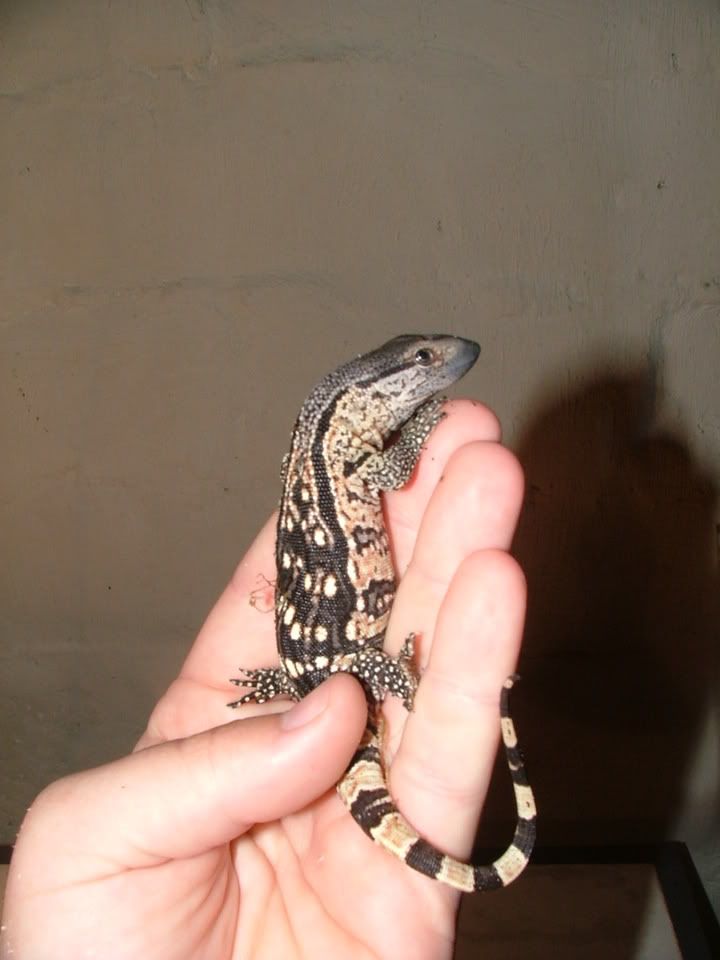
With all this, they can eat this, no, they can't eat that, stuff. Your missing the point.
First, have you ever actually proved an individual albig hatchling was harmed from eating to much on a regular basis? This is a very good question. I get the feeling that you assume it will harm them.
But that does not matter anyway, as hatchling albigs can and do fill up two or three TIMES as day. The catch here is, under what conditions. If your albigs cannot process a full belly everyday, then they are limited by your conditions.
I am not saying your conditions are bad, they are obviously very good, but the monitors still have far more potential then your allowing.
For instance, if we keep hatchling albigs indoors, they can eat daily, but after four or five days of feeding, they often miss a day or so. Outdoors, in our summer, the very same albigs can and do eat their fill two or three times a day. obviously, having our summer heat has a lot to do with it. But just as important is the ability to burrow down to cooler temps. So outdoors they can get FAR hotter, and FAR cooler then indoors. Again, obviously indoors is very limiting, as their indoor performace indicates.
Personally monitors self regulate themselves. If they cannot digest their food quickly, they simply do not feed again until they are ready. I have not seen any harm from offering food.
We may assume lose crickets bothers the monitors. But I have never experienced that. I throw crickets in, and if they are still there the next day, I do not throw more in. I would think anyone that keeps throwing crickets, day after day, in a cage that already has crickets in it, is not all that smart a person and would lose their monitors from all sorts of other problems. I would assume this type of person should not keep living animals.
So what I think is important here is, the amount of food and frequency of food taken and processed is directly related to cage conditions(husbandry) This should be taught and understood.
I would hope by now, we can get passed this silly, they do this, no they do that, no both of you are wrong, they do another this.
What they do, is what they are allowed to do. Period.
A thought for the advanced keeper. I was taught that animals are designed to fit conditions, that is, if they placed in conditions below normal, they will fail. Also, if they are exposed to conditions above what they are designed for, again they will fail. Their beat performance is within the conditions they are designed for. With these and most other animals, they have a range of conditions. In this range, express a range of results from low to high. This is their potential.
The average keeper has surely explored the lower limits of varanid potential. Most often resulting in death or worse, a life of doing nothing. I am not sure any of use have seen what the upper limits of their potential is. I have bounced around thinking I have seen it. Only to have the monitors prove me wrong. For instance, five years ago, I would have said, 8 or 9 clutches a year for ackies would be the upper limit. Then this year, we had two females produce 13 clutches each(one is gravid again) So I was retaught what their limits are.
What this taught me was. It taught me a better meaning for the word, support. What we do is support them. We are suppose to support them, not limit them. In most cases, our results are from limiting them. I would say, 99.9% of our successful results is still limited by us. Cheers


 o grow an albi to smaller than the average, if he lives in a smaller cage than it is recommended?
 Only way to keep them small is to underfeed them, and that will kill them eventually. JMHO.