


Reptile & Amphibian Forums

Welcome to kingsnake.com's message board system. Here you may share and discuss information with others about your favorite reptile and amphibian related topics such as care and feeding, caging requirements, permits and licenses, and more. Launched in 1997, the kingsnake.com message board system is one of the oldest and largest systems on the internet.

Click here for Dragon Serpents
Click for 65% off Shipping with Reptiles 2 You

Albinism 101 please...

Upscale Sep 01, 2006 08:42 PM

From Wikipedia and Answers.com
“Albinism used to be categorised as Tyrosinase positive or negative. In cases of Tyrosinase positive albinism, the enzyme tyrosinase is present but is unable to enter pigment cells to produce melanin. In tyrosinase negative cases, this enzyme is not produced. This classification has been rendered obsolete by recent research.”

Great. I haven’t been able to sort out what the current research is, exactly. There seems to be a lot more to it than the simple tyrosinase positive or negative thing. There are many degrees within albinism also, including what we would recognise in the hobby as simple hypomelanism.

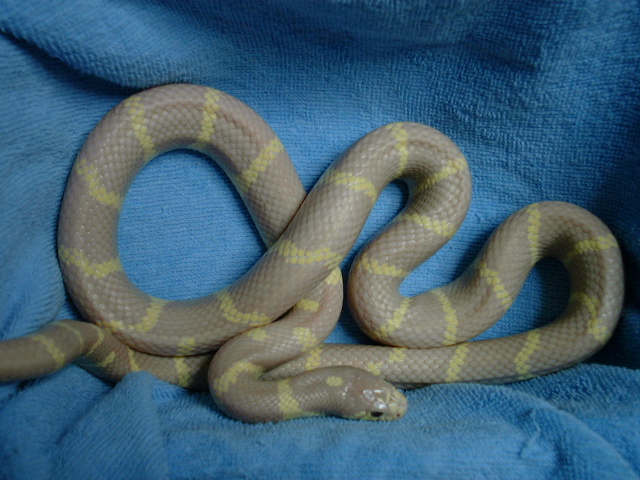
I am including these three photos for illustration and to try to learn something here. They are not mine, I found them online. They show an example of albinos that I call the “Lavender”
Type, where the skin retains just enough melanin to have the faint purple hue.
“Lavender” albino
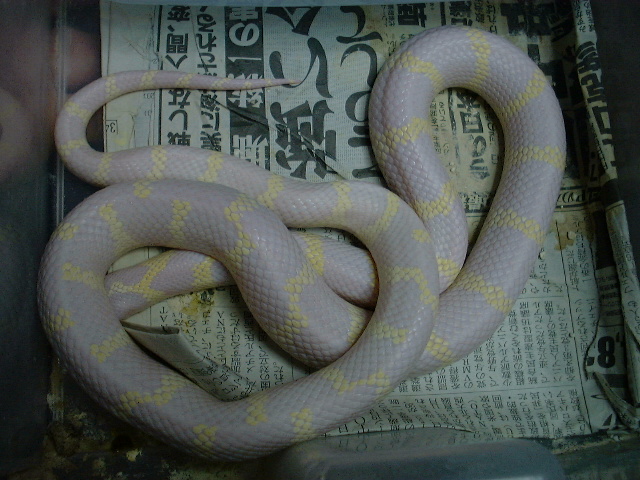
This is an example of the “Brilliant white” type, where the black is replaced either with the color “white” or has absolutely no melanin to tint it.
“Brilliant white” albino
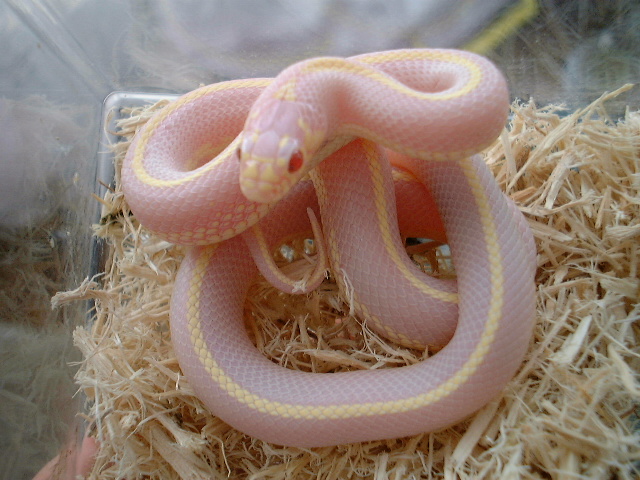
Then there is this example, which I call the “Pink” albino, where the skin looks translucent. No color white, or color of any kind and it looks like you see their veins and blood vessels right through their skin.
“Pink” albino
These seem quite distinct and instantly recognizable “types” of albinism as we see it in the hobby.
My question, is what is the proper “lingo” that we use to identify tyrosinase positive types, tyrosinase negative and what the heck do we call the other type?
I don’t think what we call them is scientifically or genetically correct, but I just want to be able to recognize what is implied in the hobby with the recognized terms we use.
I generally do not like albinos, I really don’t like red eyes, but I am trying to sort it out because everything I buy has some het in there somewhere for one of these forms of albinism (and God only knows what else). I would like to understand it as it applies to Brooks and the albinos that have been bred into them to create all these different looking morphs.
Can you straighten me out on all this?

Replies (34)

FunkyRes Sep 01, 2006 10:27 PM

Notice the pink albino is a baby ...

-=-

btw, my albino king has very poor eyesight. It's pink eye albino, where the base color (black or chocolate) is white, though it seems to have a very slight light lavender hue under the right light.

Is it common for pink eyed albinos to have poor eyesight?

It can see movement, but it misses more than it hits when it strikes.
-----
3.0 WC; 0.2 CB L. getula californiae
0.1 WC; 0.0.10 CH Elgaria multicarinata multicarinata

justinian2120 Sep 01, 2006 11:45 PM

the pigment anomaly you're talking about,more specifically,is amelanism....'albinism' is a very broad term that can include hypomelanism,anerythrism,axanthism,etc....that translucence you're asking about is prominent in hatchlings.i would guess that third pic is of a gorgeous cal king,looks to be 't-' (tyrosinase negative,i.e. lacking tyrosinase)i believe.i didn't know tyrosinase is considered an obsolete definition-and not clear why it would be......depending on who you ask,amels and leucistics(solid white-no pattern-dark blue/purple/almost black eyes) are infamous for having inferior abilities of various types-feeding response,vision,etc...i can't say i've noticed it to be true to any overwhelming degree...hopefully others can add a little more here.hope this helped some.
-----
"with head raised regally,and gazing at me with lidless eyes,he seemed to question with flicks of his long forked tongue my right to trespass on his territory" Carl Kauffeld

Kerby... Sep 01, 2006 11:49 PM

The three pictures you have only show 2 traits: Lavender and Albinism. The two pics of albino are the same gene. Albinos are pink as babies and white as adults.

Another way of looking at it is at one end of the spectrum we have melanism and on the other end we have albinism, with a lot of in-betweens, normal would be in the middle.

There are numerous different hypomelanisms that are different from each other: Ghost, Blue-Eyed Blonde, Lavender (JR strain), Lavender (JD strain), etc...

Kerby...
-----
Lonesome Valley Reptiles
www.lonesomevalleyreptiles.com
Specializing In California Kingsnakes

justinian2120 Sep 02, 2006 12:12 AM

...'lavender' is just a tyrosinase positive form of amelanistic-what people love to simply call 'albino'....i think throwing all these b.s. trendy designer morph names at this guy is not what he is asking for.that would take forever just to cover the cal kings,let alone ball pythons and corns.
-----
"with head raised regally,and gazing at me with lidless eyes,he seemed to question with flicks of his long forked tongue my right to trespass on his territory" Carl Kauffeld

Kerby... Sep 02, 2006 08:37 AM

**....i think throwing all these b.s. trendy designer morph names at this guy is not what he is asking for.that would take forever just to cover the cal kings,let alone ball pythons and corns.**

I was not throwing around all these "b.s. trendy designer morph..." as you call them. I referred to proven recessive genes.

Back to posting pics again.

Grow up.

Kerby...
-----
Lonesome Valley Reptiles
www.lonesomevalleyreptiles.com
Specializing In California Kingsnakes

Upscale Sep 02, 2006 12:51 AM

I lifted those pictures because they were good examples of what appeared to be three different types commonly seen. And because I believe that all the albino genes found in todays Brooks came from these type albino California kings. That’s why I wanted to know more about it. From the responses so far, I guess the third example, the pink albino hatchling, will actually end up as the “Brilliant white” type in example two? There is still only two types- T negative and T positive? The T-positives have tyrosinase present, but is not able to produce melinin. Am I correct that is the one that makes the lavender-looking albinos? The T-negatives do not have tyronisase at all, therefore they would be the brilliant white looking type? Or do I have that backwards?
And these two types are not compatable, so when double hets (T pos x T neg) are bred together wouldn't those all end up being T Positive?
I understand from a purely scientific point it is not so cut and dried, or perhaps not even accurate, but for the sake of the lingo of the hobby (occasionally those two things might be the same thing) which is the T-negative?

Paul Hollander Sep 02, 2006 05:51 PM

>And these two types are not compatable, so when double hets (T pos x T neg) are bred together wouldn't those all end up being T Positive?

F2s would be 9/16 normals and 7/16 albinos. That 7/16 could be broken down into 3/16 T-pos, 3/16 T-neg, and 1/16 homozygous for both mutants. Figuring out which is which may be a little difficult.

Paul Hollander

chrish Sep 02, 2006 08:53 AM

The problem is that we as herpers have tried to oversimplify amelanism based on only some of the facts.

Tyrosinase used to be believed to be (at least in mammals) the only enzyme necessary for the production of melanin, even though the pathway is complex. Therefore, an individual with a faulty version of the gene for tyrosinase will be unable to produce melanin. So defining an individual as tyrosinase negative explains why the animal is amelanistic.

Some individuals, however, have been shown to have functional tyrosinase, but are still unable to produce melanin. These have been labelled T positive amelanistic. However, it is important to understand that this is not an explanation of the mechanism of amelanism in this case, it is simply saying "OK, we know what ISN'T causing this unusual coloration". But there could be dozens of different reasons a snake could be T plus amelanistic.

Another problem is that herpers have adopted this T plus/T minus system and have started using it arbitrarily. If an amelanistic snake comes out and has unusual albino coloration, many are quick to pronounce it T positive. We have no idea whether it actually produces the enzyme tyrosinase or not. Furthermore, it could be that some of our "normal" looking amels actually have the enzyme present and are T plus. We think we can tell by looking, but we have no evidence to back it up in most cases.

BTW - in humans there are two types of melanin. Eumelanin is black/brown, and phaseomelanin is reddish or yellowish brown. It is possible that snakes produce multiple types of melanin as well (any have Bechtel's book?). Maybe T plus snakes only produce phaseomelanins? I couldn't guess by looking.

There is another genetic anomaly noted in mammals where the eumelanin doesn't become completely black due to absence of Tyrosinase-related Protein I (TRP-I). The eumelanin ends up grayish-brown instead. Could this be the cause of T plus snakes?

Could it be one of the genes that affects the production of Melanocyte Stimulating Hormone?

There are lots of reasons why snakes might be amelanistic. When we see variation in the shades of amelanism, we have to be careful not to try and jump to conclusions about what is the cause.

For example, take a look at just SOME of the known causes of amelanism in Budgerigars - numbat.murdoch.edu.au/birds/ACVSc/pg000011.htm. It is unlikely that snakes are any less complicated.
-----
Chris Harrison
San Antonio, Texas

FR Sep 02, 2006 09:59 AM

You mentioned most people simplify albinism into T- and T+, which needs a little conversation. With Cal kings, there are several different T- lines, and as mentioned, several different T+ lines.

As the original breeder of T- albino kings, I know of other non capatable T- individuals that were bred into "Albino" Kings. I do not know of or see a seperate T- line these days, but remember, there are individual carriers out there within the normal T- lines.

Now for a realistic approach. These lines were based on single individuals and not albino kings in general. This means, T- kings out there are only one "cause" of t- albinism. I have mentioned one other T- (non related) The truth is, there are most likely hundreds to thousands of different T- possibilities. This is also true for T+.

What that means is, there are thousands of albinos hatched, die, exsist, in nature. We just don't see them. The problem is, experienced reptile people do not see any percentage of the wild population. I would guess experienced reptile people see far less then .001% of the total Cal king population. Which means, if one albino popped up, then 999 were missed. The question becomes, where they compatable or not? experienced has shown, they are rarely compatable.

What I am getting at is, the poster is trying to make sense of a whole by looking at a tiny piece.

Now consider, the original albinos(founders) were bred to many different locals of Calkings. Now the question becomes, what were all this different individuals HET for? What genetics were they carrying that they did not express?

Which brings up my last concept. Recessive traits never disappear. They only become buried. All animals are a genetic onion. That is, traits NEVER disappear, they only get covered by layers of new expressed traits. Each individual snake is a history of its past.

Inbreeding is one method of surfacing past genetic traits(to release the past) Outbreeding is also a method of releasing recessive traits. In captivity we always do these.

In the varanid world, I was able to release this hidden trait(the pic). This hyloid extention is known from many many species of varanids, from the very large to the very small, Its also known from all areas except africa(so far).

This suggests a very common ancestor with this trait. You see, I did not bring out something new, I only brought out something old.

Which brings this last point up. We are not inventing anything new with all this line and cross breeding, we are only surfacing past abilities. If it was not in their genetic memory, it could not be expressed. (only gene splicing can do that)

So yes, we are trying to make simple, something not so simple. Cheers
Image

FunkyRes Sep 02, 2006 11:29 AM

I had read that there were different lines of albinism in Cal Kings - I think it was on the Applegate website.

I think it would be interesting to find these different lines.
If they are still out there (in captive breeding), maybe I will because I do not like to inbreed if not necessary (IE breeding for some trait).

With respect to bringing out old traits through outcrossing - a herper on another forum reported that she bred a MBK femake with a Nitida male.

Ten hatchlings, interestingly all male, resulted - all resembling splendida. She is going to e-mail me picture of the hatchlings, I'm very curious about it.

Might that indicate that the original getula was similar to todays splendida?
-----
3.0 WC; 0.2 CB L. getula californiae
0.1 WC; 0.0.10 CH Elgaria multicarinata multicarinata

Upscale Sep 02, 2006 12:41 PM

I was trying to find out what the hobby calls a T-neg, knowing that it is probably scientifically not correct. I personally believe there are only T-positive amelinistics with many variations in the inability of the cells to sequester the synthesized melanin into the melanosomes. When we observe two “types” of amelenistics, and breeding proves they are not compatable, it doesn’t automatically mean one is T-pos and one is T-neg, I believe they are both still T-pos. The simple statement that there are amelinistics at one end of the spectrum, normals in the middle and dark melanistic at the other end is simple and correct. The lavender appearing types are T-positive. The brilliant white are hypermelanistic T-positive. Both exhibit the trait for the inability to properly produce melanin. The entire range of possabilities exist within the “T-positive” designation, including the ability for a gradual darkening to occur.
If there is a variation of shades of lavender in a clutch, those are surely T-positives, there is some degree of activity showing. If the entire clutch are identical, without hues of lavender, then I would think they might be T-negative. I am thinking the “pure” true T-negatives are the rare form.

I don’t believe there has been an actual laboratory test to determine the fact that the common observable pink-eyed albino is Ty positive or Ty negative. The expression “T-positive” and “T-negative” is derived from the results of performing an experiment with a hair bulb in a solution of tyrosine. This is the source of the names. If this test was never carried out, then the use of these names in the hobby are not based on anything but trying to relate it to what we know occurs in human albinos and borrowing the terms used there. I am trying to get to the bottom of what the hobby calls a T-positive. It is in actual fact just a name in name only, not proven correct in the testing lab.
Whether it is incorrect or not, could somebody simply tell me is the lavender considered T positive or T negative?

Kerby... Sep 02, 2006 01:47 PM

I do not know the difference bewteen the different T's, but which Lavender are you referring to?

Kerby...
-----
Lonesome Valley Reptiles
www.lonesomevalleyreptiles.com
Specializing In California Kingsnakes

Kerby... Sep 02, 2006 01:49 PM

JD strain

Kerby...
Image
-----
Lonesome Valley Reptiles
www.lonesomevalleyreptiles.com
Specializing In California Kingsnakes

Kerby... Sep 02, 2006 01:50 PM

JR strain

Kerby...
Image
-----
Lonesome Valley Reptiles
www.lonesomevalleyreptiles.com
Specializing In California Kingsnakes

ZFelicien Sep 02, 2006 02:09 PM

i think you were correct in originally classifying these as Hypo, i have one and she's Purple Now, but i know that purple will turn brown into adulthood like that male u posted... if it werre a form of amel wouldn't there be WAY less pigment?... but i guess we'll know if the two "lavender" strains are compatable soon

I'll bet they are not... those maybe the same gene as in the BEB and if they are not then there's tons more to come in the world of cali kings

~Z
-----
Royal Blue ReptileZ
Home of Bklyn's Finest Brooksi

___

signature file edited 4/22/06; contact an admin.

Kerby... Sep 02, 2006 03:45 PM

I haven't bred them together yet, but Bill from Great Valley Serpentarium said he did and got normal looking ones that were double hets.

I am not sure if the BEB is totally different on it's own accord.

Kerby...
-----
Lonesome Valley Reptiles
www.lonesomevalleyreptiles.com
Specializing In California Kingsnakes

vincenta120779 Sep 03, 2006 10:37 PM

i have one of these and want another it's about 9 or 10 months old do you know where i can get one a female well i need a friend to talk to about this stuff i am kinda new also to the snake world but like the [bleep] out of the one i got and want more ! well go to the othe forum and i have a post there that looks alot better then the ones i posted earlier

FR Sep 02, 2006 06:23 PM

Hi Kerby, I am not sure what has happened in the couple of decades I was away from Cal kings, but that individual is not what was originally called a JR(john Ruiz) lavender. Zees pic is far closer to the original lavenders.

That pic you are showing was a somewhat common recessive morph found in many different locals. Somewhat common is something in the range of, one per hundred or so.

Unfortunately, many of the original names have gotten all mixed up. As they moved from person to person. Cheers

Kerby... Sep 02, 2006 07:58 PM

?

Kerby...
-----
Lonesome Valley Reptiles
www.lonesomevalleyreptiles.com
Specializing In California Kingsnakes

Kerby... Sep 02, 2006 07:59 PM

Kerby...
-----
Lonesome Valley Reptiles
www.lonesomevalleyreptiles.com
Specializing In California Kingsnakes

Upscale Sep 02, 2006 01:59 PM

Actually, this all started from trying to decipher the Peanut Butter and Jelly Brooks question brought up last weekend, I think it was? I was thinking, ah these guys, I’ll figure it out for ‘em... I was intrigued by the statement that an entire clutch was Jelly except for one normal-looking one. Also intrigued by the apparent sex-link of light ones being male and females undergoing a color change. Both signs of a T-positive type, and another sex-link factor of T-positive. I simply had to get through the lingo of the hobby, because it seemed these terms are being thrown around that do nothing to help decipher the riddle if they are basically wrong to begin with. So, the thought was Albinism 101, what are the definitions as we are using them in the hobby, as opposed to what they might actually be when deciphering the Peanut Butter and Jelly Brooks. Like I said in the first post, I never cared for albinos. I only really got into researching this because every amelinistic Brooks morph now has California King albino genes buried and you have to factor those influences to decipher the new expressions we are seeing. Now to answer your question, look at the three example photos. The first with the tinge of purple I would assume we call a lavender. Would you also call the second brilliant white a lavender also? I have owned snows and “lavs” without ever researching this before or giving it much thought. I am new to the lingo only.

chrish Sep 02, 2006 03:06 PM

Also intrigued by the apparent sex-link of light ones being male and females undergoing a color change. Both signs of a T-positive type, and another sex-link factor of T-positive.

I have been round and round about this before. This peanut butter thing, whatever it is, is NOT sex-linked. AFAIK, snakes use the ZW system of chromosomal sex-determination. So if there was a sex-linked locus, it would appear more commonly in females than males and males would be able to be het, not females.
It could be a sex-influenced trait, but it isn't sex-linked.
-----
Chris Harrison
San Antonio, Texas

Kerby... Sep 02, 2006 03:50 PM

**Brooks morph now has California King albino genes buried and you have to factor those influences to decipher the new expressions we are seeing.**

I'm not familiar with Brooks, but are you saying that someone introduced the albino cal king into the brooks line?

**Now to answer your question, look at the three example photos. The first with the tinge of purple I would assume we call a lavender.**

Yes, a Lavender (JD strain)

**Would you also call the second brilliant white a lavender also?**

No, an albino.

The first picture is a Lavender, the other two are just albinos, one being a baby, the other an adult/sub-adult.

Kerby...
-----
Lonesome Valley Reptiles
www.lonesomevalleyreptiles.com
Specializing In California Kingsnakes

FunkyRes Sep 02, 2006 04:54 PM

> I'm not familiar with Brooks, but are you saying that someone
> introduced the albino cal king into the brooks line?

My understanding is that the albino in brooksi comes from Cal King.
If someone knows different, I'd love to hear where it did come come, who bred them from WC.
-----
3.0 WC; 0.2 CB L. getula californiae
0.1 WC; 0.0.10 CH Elgaria multicarinata multicarinata

FR Sep 02, 2006 06:13 PM

I am not exactly sure what your getting at, or what your trying to say. You used an example what was already a known, When the Original T- was bred to the original T , it resulted in double hets. Which only means a different allele(sp)

Also what you call bone white albino is merely a T- albino. When the original T- albino(I did the breedings) was bred out, it was originally a San Diego striped. It was bred into many major(expressed different colors and patterns) types of Cal king locals. The resulting offspring were of course hets. Then were then bred to resemble different locals. Such as, black and white deserts, Newporters, etc, etc. These offspring expressed many different degrees of translucents. I.E. desert kings appeared purplish. So you had blueish tones, pink tones, purplish tones, whitish tones. Yet all were the original T- gene. These different colors are due to the genetic makeup of the founders, not T .

I hope this helps you. Cheers

Upscale Sep 02, 2006 06:27 PM

O.k. now one last thing, I swear. You say the original T- was bred to the original T. What was the basis for calling the original T-, a T-. And the basis for calling the T the original T. Is there a visual characteristic that makes it so? Can you tell them apart by just looking, or is this from “proving” it through breeding?

Aaron Sep 02, 2006 11:43 PM

I don't know for sure but I believe the original amelanistic Cornsnakes were tested and found to be T minus. And I believe a type of python was tested once and determined to be T positive.
The corn had red eyes and the normally black parts were white.
The python had ruby eyes and the normally black parts were lavender.
With the other snake morphs that followed the same names were applied based on similar appearences red eyes & white = amel and ruby eyes & lavender = lavender.
This is all fine and you can have perdictible and functionable breeding projects and you do not need to know the scientific name for exactly what is going on as long as you remember the morph names are like common names, they are descriptive not scientific. We can call them Lavender A, Lavender B, Carmel, Hypo I, Hypo II, Amel, etc. You just need to learn which are synonomous and which aren't.
This hobby will probably never know the exact scientific name for it's genetic mutations because most people involved do not make enough money to hire geneticists to figure it out. Instead we give it a common descriptive name and determine modes of inheritance and compatability through test breeding.

FR Sep 04, 2006 12:03 PM

a couple things, first, the terms are good The problem is, some here use them wrong, understand them wrong, and talk as if they are right. For instance, your trying to make sense out of something you do not understand. Then you read information from others who do not understand it either. Then you try to make sense out of that.

You must first understand the internet, anyone can say anything and carry the same value as others, right, wrong or inbetween. Some here have a great understanding, some here have a poor understanding. Now do you tell the difference?????? If you have little understanding you cannot. If you have some understanding, you can tell who doesn't. Sir, that is the problem.

For instance, Its simple to tell a T- from a T , most here should be amazed at you asking that. T-, carry no form of melanin. T 's do, they have shades of dark pigment.

You should understand, melanim is also in the lite colors, not just the black on snakes. The red carries melanim, as does the white. Its not simply the lack of black on snakes.

T effects all the colors differently then a T- albino. Personally I am old school and only call T- an albino. Others call any abnormality in melanin an albino.

As we were talking about kingsnakes, I produced the first getulus albinos T-. Not the first T- albinos of all snakes. Cheers

Upscale Sep 05, 2006 12:10 AM

Strictly speaking in terms of the hobby, I am not as sure as you that the terms are good.
One of the problems that inspired my research into this, is the “old school” thinking that has become accepted as gospel in the hobby. There can be many degrees of abnormality in the expression of melanin, including the total lack of ability to express it at all, that would not mean the animal is in fact T negative. The brilliant white amelanistics, are not automatically T-negative. They very well could be T positive yet completely lack the ability to complete the biological process to produce melanin. They would still be T positive animals. Of course any visual indication of melanin would have to be T positive. I understand in corn snakes, or any snake, an amelanistic that expresses a total absence of melanin in the black, red and white is probably T negative. T positive should mean that the results of a test on that animal would be positive. T negative should mean that the results of a test on that animal would be negative. I was somewhat surprised to find out that these terms are being used in the hobby with no proof of accuracy behind them in many, many instances. The three example photos, I believe, could each easily represent examples of T positive animals. Dang, I guess I'm going to have to go read a book or something. Thanks a lot LOL.

FR Sep 05, 2006 09:23 AM

I guess I should have told you to not take anything as gospel. I know I don't, they are only labels to help you understand what your looking at. No more, no less.

You(all) should understand, there are lots of possibilities, as in, all sorts of things are possible. If fact, why would you think otherwise?

I often wonder why people dwell of "other" possibilities, particularly when they can only "possibly" get in your way.

Yes, I understand if you look deep enough at any subject, you see the flaws and inaccuracies, these are included in all things. The point is, are these flaws a hinderance/benefit, or merely meaningless possibilities?

Once an employee of mine was pointing out the flaws in a Zoo enclosure we were building. He was in charge of this enclosure, his first. He said this and that and that and this. I gave him a odd look and said. Rick(thats his name) Any fool can pick out what is wrong. I hired you and gave you reponsibility to not point out what is wrong, but instead to make this enclosure right. Not any fool can do that, thats why I pay you the big bucks. To make it right. Now tell me Rick, how are you planning on making this enclosure right?

What that means is, upscale, any fool understands these terms are only so accurate, lets see you come up with something better. Cheers

Paul Hollander Sep 05, 2006 09:44 AM

is easy. Persuading other people to use it is like herding cats.

Paul Hollander

Paul Hollander Sep 02, 2006 06:18 PM

>I don’t believe there has been an actual laboratory test to determine the fact that the common observable pink-eyed albino is Ty positive or Ty negative. The expression “T-positive” and “T-negative” is derived from the results of performing an experiment with a hair bulb in a solution of tyrosine. This is the source of the names. If this test was never carried out, then the use of these names in the hobby are not based on anything but trying to relate it to what we know occurs in human albinos and borrowing the terms used there. I am trying to get to the bottom of what the hobby calls a T-positive. It is in actual fact just a name in name only, not proven correct in the testing lab.

A T-positive albino is any albino that is not a T-negative. This covers a multitude of causes much too numerous to go into here. In many cases, T-neg and T-pos are just names in name only.

IN SOME CASES T-pos albino and T-neg albino have been proven correct in the testing lab. This is the origin of their adoption into the herping vernacular. Unfortunately, this has only been done in a few species. It has been done for the corn snake and black rat snake. Off the top of my head, I think it's been done with the California king snake, too. Maybe one or two other species. As far as I know, no boa or python has been tested. H.B. (Bern) Bechtel is the man who did the work. He had a paper on black rat snake mutants in one of the 1985 issues of the Journal of Heredity. Check the bibliographies in his book (cited elsewhere in this thread) for other papers.

Paul Hollander

Paul Hollander Sep 02, 2006 06:22 PM

:

Paul Hollander Sep 02, 2006 02:31 PM

The Wikipedia entry badly needs correcting.

For information about the tyrosinase test, consult H.B. Bechtel's book, Reptile and amphibian variants: colors, patterns, and scales . Try interlibrary loan if nowhere else. His bibliography there probably includes the citation for his paper on tyrosinase testing Cal kings. Good luck.

Paul Hollander

Site Tools
