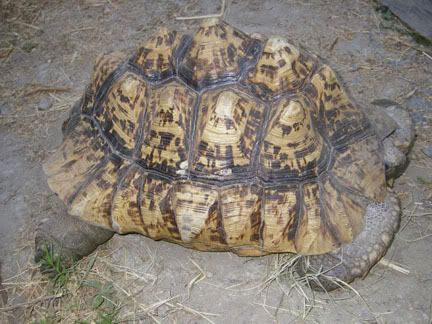
I know how to tell the difference in babies, but a lady just gave me this male leopard. He is 13" SCL and weighs around 20lbs. He just seems too big to be a pardalis babcocki. Can anyone tell if he is a pardalis pardalis? She said she paid around $300 for him as a baby which could be another indication that he is pardalis pardalis.
Reptile & Amphibian Forums
Welcome to kingsnake.com's message board system. Here you may share and discuss information with others about your favorite reptile and amphibian related topics such as care and feeding, caging requirements, permits and licenses, and more. Launched in 1997, the kingsnake.com message board system is one of the oldest and largest systems on the internet.


Pardalis babcocki or Pardalis pardalis?
sned25271
Sep 10, 2006 08:41 PM
Replies (8)
zovick
Sep 10, 2006 09:52 PM
The best source of info in this case would be the person from whom the lady bought the tortoise. If you could speak directly to him he is most likely the breeder and should know what he had (or maybe still does have) or if he is not the breeder, could probably provide the name of same if he acquired it as a baby.
For what it is worth, I have seen some very large babcocki males in years past. I would not dare venture a guess just based on this guy's size, and it is quite difficult/impossible to tell the subspecies apart once they reach a few inches in length and lose their juvenile spots.
simias
Sep 11, 2006 10:38 AM
You really can't tell for certain. Important to remember that leopards grow very large in the north and also south in Africa; we don't really understand pardalis taxonomy well. p. pardalis in the far south is often (not always) large; 'babcocki' from Kenya are small, but 'babcocki' from Somalia can be as large as p.pardalis.
I have found that so. african p. paradalis are more likely to have large dark blotches on the plastron, whereas e. africans tend to have plain yellow plastrons. But this is not always reliable.
Ivory Tortoise
Sep 12, 2006 02:51 PM
Your tortoise is most likely a G. p. babcocki, as the previous owner would have been told it was a G. p. pardalis when she purchased it (they are almost always sold for a premium and specifically identified as G. p. pardalis). Most of the characteristics of your tortoise are also G. p. Babcocki.
My new book on Leopard Tortoises (available at http/www.leopardtortoisebook.com or contact me at richardfife@theriver.com) has some great information on the subspecies. 13-inches is not a big leopard tortoise. Most adult G. p. babcocki are from 13 to 18 inches (all my adult females are between 16 to 18 inches). Actually there are populations of G. p. babcocki that are over 24-inches (that’s right G. p. babcocki) and come from Somalia.
Adult G. p. pardalis are usually between 16 and 19 inches, with some specific localities where they grow to 24-inches. The double spots seen on hatchings are the best indicator of the subspecies but I have pictures, in my Leopard Tortoise Book, of G. p. pardalis, which I found in Bloomfontien South Africa that do not have double spots.
sned25271
Sep 12, 2006 10:43 PM
The lady did mention that she paid $300 for it 10-12 years ago. Were babcocki going for that much back then?
zovick
Sep 13, 2006 06:49 AM
I don't think that babcocki would have brought $300 in 1994-96. Does anyone have any old issues of Reptile & Amphibian or Reptiles Magazine who could check the old ads to verify then-current prices? I was selling Radiated babies for $500-600 at that time and believe babcocki were around $100-125. That being said, though, the breeder may have surmised that this lady purchaser was not aware of the market value of his baby Leopard and charged her more than a savvy buyer would pay for a babcocki. Also, there were not very many people breeding pardalis pardalis then, which further reduces the probability of it being the more rare subspecies.
Have you tried asking the lady to recall the name of her source? That would be a big help, IMHO.
sned25271
Sep 13, 2006 05:10 PM
I think I got to the bottom of this. She purchased it from a pet store in Simi Valley, CA in 1996. She thinks she paid around $300 which would make sense at a pet store. I highly doubt a pardalis pardalis would be in a pet store.
zovick
Sep 13, 2006 10:47 PM
I agree wholeheartedly.
zovick
Sep 13, 2006 07:08 AM
An additional afterthoughtfor conseration: if really concerned about the subspecies, which is commendable as it seems you do not wish to produce hybrids (a definite no-no in my book), I would suggest a DNA analysis of the animal. There are a couple of dedicated zoological veterinarians who maintain DNA profile data on all tortoise species and could probably identify the animal in question readily. One is Dr. Ed Louis who was at the Univ. of Nebraska when I last had contact with him. If you had your vet send him a blood sample, the mystery could be solved (and if he needs the sample to compare to others, the cost could be very minimal).
Ed has DNA tested my Indian Stars, Sri Lankan Stars, Burmese Stars, and also my Indian Travancore Tortoises (collected in India in 1958 by Dr. Walter Auffenberg). Just for the readers' info: Indian and Sri Lankan Stars had identical DNA (making them just different geographic races of the same species), Burmese Stars were quite different (almost as closely related to elongata as elegans as I recall), and the Indian Travancores were most definitely a different species than either elongata or forsteni (which are still mistakenly called Travancore Tortoises by many people despite the scientific article RE-separating the three types into diffent species by Peter Pritchard in February 2000 (Reptile & Amphibian Hobbyist Magazine pp.18-28)
