Reptile & Amphibian Forums

Welcome to kingsnake.com's message board system. Here you may share and discuss information with others about your favorite reptile and amphibian related topics such as care and feeding, caging requirements, permits and licenses, and more. Launched in 1997, the kingsnake.com message board system is one of the oldest and largest systems on the internet.

Click for 65% off Shipping with Reptiles 2 You
Southwestern Center for Herpetological Research
Click for 65% off Shipping with Reptiles 2 You

Paradigm genetics...thoughts on theory?

ChrisGilbert Sep 22, 2006 04:41 PM

Here is an email I just sent to Mike. Let me know what you think of this theory. There is no proof to it, but from what I have gained it makes sense. I would have rewritten it, but I'm really busy, so enjoy:

Mike,
I'm sure you know me for throwing out random theories early, but it really helps me to understand things.

What if Sharp and Caramel are on the same allele?

Because from your breeding:
Sharp X Paradigm (f1: Sharp X Caramel)
you got Sharp and Paradigm, correct?

If the Paradigm was truely DH, shouldn't you also get:
WT het Sharp, and WT het Caramel?
That is to say, you are missing wild type phenotype from your offspring.

If the Caramel and Sharp are on the same allele:
breeding a Paradigm to Sharp will give you all homozygous animals.
Depending which allele they recieved from the sire, they would be Sharp or Paradigm.
Since the only allele they could get from the dam was Sharp.

So the Paradigm is a homozygous animal. If this theory works.
Now to explain the phenotype of Paradigms...

They are basically a combination of Sharp and Caramel, some aspects of each create the morph.
If the two mutations are on the same allele.
Like a red X white flower makes pink.

This is the only theory I can come up with to explain F1 Paradigms, and a FULL litter of them.

Best regards,
Chris

PS: I am posting this email on KS to see what others think of it.

Replies (39)

giantkeeper Sep 22, 2006 04:47 PM

from what I read, he has normals...

"This breeding resulted in 25% Sharp Albinos and the remainder of the litter was ˝ Paradigms and ˝ normals."
-----
Chris & Alliey
www.bloodyleopard.com
E-mail Us

giantkeeper Sep 22, 2006 04:49 PM

read the story, it's all layed out here...
"Paradigm Boas"

-----
Chris & Alliey
www.bloodyleopard.com
E-mail Us

ChrisGilbert Sep 22, 2006 05:02 PM

n/p

ChrisGilbert Sep 22, 2006 05:01 PM

was Paradigm X Het Sharp.

So the results still make sense with my theory.

I was going by the Paradigm X Sharp. Which if I am right, is like a Homozygous X Homozygous breeding.
A good test would be:
Paradigm X Caramel.
if the F1 from that breeding are Caramel, and Paradigm (no other phenotypes produced) I think that would support it further.

Also Paradigm X Paradigm would be either all Paradigm or have Paradigm, Sharp, and Caramel. I think the later would be true. Because a baby could recieve the Sharp end of the allele from both parents or the Caramel from both and not one of each.

I'm actually not sure what would cause Paradigm X Paradigm = Paradigm (exclusive).

giantkeeper Sep 22, 2006 05:04 PM

personally the details make my head hurt, all I care about is that it's passed genetically and is visually different...lol
-----
Chris & Alliey
www.bloodyleopard.com
E-mail Us

ChrisGilbert Sep 22, 2006 05:07 PM

that's why I posted. I am trying to wrap my brain around it.

That is the only thing that makes sense to me so far. Maybe Mike will post his reply here, I will not put it on here without his permission.

rainbowsrus Sep 22, 2006 06:10 PM

The key piece of info is the paradigm boa which has one caramel gene and one sharp albino gene when bred to an albino produced only albino's and paradigm's. The percentages are off and while that may be an important piece of info, IMO the fact that there were no normals (in that breeding) is a strong indicator that the two het morphs could share the same alelle. If not, then I wouold have expected a quarter of the babies (at least some) to have recieved neither morph gene from the paradigm and been normal het for albino.

I agree the clincher will be the paradigm to caramel cross, if only paradigm and caramel produced, bingo, the first identified alelle in boas with three possible genes.

>>that's why I posted. I am trying to wrap my brain around it.
>>
>>That is the only thing that makes sense to me so far. Maybe Mike will post his reply here, I will not put it on here without his permission.
-----
Thanks,

Dave Colling

www.rainbows-r-us-reptiles.com

0.1 Wife (WC)
0.2 kids (CBB, selectively bred from good stock)

LOL, to many snakes to list, last count:
13.26 BRB
11.16 BCI
And those are only the breeders

lots.lots.lots feeder mice and rats

ChrisGilbert Sep 22, 2006 06:14 PM

So Mike any plans, lol?

I think the ratio from Paradigm X Sharp was a fluke, it should be 50% each. However, considering those odds were off, who is to say that he may have MISSED the odds on a Normal.

If that IS the case, then throw this theory out and write a new one!

So I say another Paradigm X Sharp, and a Paradigm X Caramel to prove or disprove it!

Paul Hollander Sep 22, 2006 06:55 PM

Also paradigm x paradigm. This should produce 1/4 Caramel, 2/4 Paradigm, 1/4 Sharp.

Paul Hollander

vcaruso15 Sep 22, 2006 07:07 PM

there will be no 4 gene carring possibility aka homo caramel homo sharp. That will be the true test and may take a while being that it would be a one in 1/16 snake.

ChrisGilbert Sep 22, 2006 07:39 PM

But it could not be phenotypically different from the Paradigm. If that were the case I don't know how you would prove that it carried two seperate structures, ie both caramel//caramel and sharp//sharp.

rainbowsrus Sep 22, 2006 07:49 PM

I agree the homo caramel/homo sharp would be a 1/16 animal and that would prove out the two gene pair theory.

You did not see the other proof though, a normal boa. If the three gene / one gene pair theory is correct, then two paradigm boas crossed would not have one single normal gene between them. So if ANY baby came out normal looking, then that would disprove the three gene theory. If you assume two pairs and both parents het, AND discount the double het offspring, that would account for 5/16 of the babies would be "normal"

1 normal not het for anything (the other end of the 1/16 jackpot)

2 het caramel (not het sharp)

2 het sharp (not het caramel)

>>there will be no 4 gene carring possibility aka homo caramel homo sharp. That will be the true test and may take a while being that it would be a one in 1/16 snake.
-----
Thanks,

Dave Colling

www.rainbows-r-us-reptiles.com

0.1 Wife (WC)
0.2 kids (CBB, selectively bred from good stock)

LOL, to many snakes to list, last count:
13.26 BRB
11.16 BCI
And those are only the breeders

lots.lots.lots feeder mice and rats

vcaruso15 Sep 22, 2006 08:20 PM

There would be normals in the bunch. Anything that is not sharp caramal or paradigm would be normal. It has to carry two non wild type genes to be visible and in a double het breeding you would get some single gene carriers.

vcaruso15 Sep 22, 2006 08:25 PM

Het. caramel, Het. sharp albino,
x
Het. caramel, Het. sharp albino,

6.25% WT (would look normal)
12.5% Het. sharp albino (would look normal)
6.25% Homozygous sharp albino
12.5% Het. caramel, (would look normal)
25% Het. caramel, Het. sharp albino,(Paradigm)
12.5% Het. caramel, Homozygous sharp albino (Paradigm)
6.25% Homozygous caramel
12.5% Homozygous caramel, Het. sharp albino (Paradigm)
6.25% Homozygous caramel, Homozygous sharp albino(Paradigm)

rainbowsrus Sep 22, 2006 09:16 PM

what I was getting at....11/16 would have a visual phenotype other than normal IF caramel and sharp are two different gene pairs. AKA 5/16 would look normal.

But, "IF" this is a tripple allele on one locus, each animal can only have two alleles and if both are paradigm, then NO normal genes exist in this pairing. Outcome would have NO normal boas at all, 25% caramel, 50% paradigm, 25% sharp .

so, easiest way to determine this genetic riddle is to breed two paradigms. if any normals pop out, then there are two seperate gene pairs that are somehow interacting. If no normals pop out, then there are three possible genes that can go into that specific gene pair.

>>Het. caramel, Het. sharp albino,
>> x
>>Het. caramel, Het. sharp albino,
>>
>>
>>6.25% WT (would look normal)
>>12.5% Het. sharp albino (would look normal)
>>6.25% Homozygous sharp albino
>>12.5% Het. caramel, (would look normal)
>>25% Het. caramel, Het. sharp albino,(Paradigm)
>>12.5% Het. caramel, Homozygous sharp albino (Paradigm)
>>6.25% Homozygous caramel
>>12.5% Homozygous caramel, Het. sharp albino (Paradigm)
>>6.25% Homozygous caramel, Homozygous sharp albino(Paradigm)
-----
Thanks,

Dave Colling

www.rainbows-r-us-reptiles.com

0.1 Wife (WC)
0.2 kids (CBB, selectively bred from good stock)

LOL, to many snakes to list, last count:
13.26 BRB
11.16 BCI
And those are only the breeders

lots.lots.lots feeder mice and rats

vcaruso15 Sep 22, 2006 09:22 PM

Yea breeding two together would be the definitive proof.

ChrisGilbert Sep 23, 2006 02:07 PM

You can't use a classic DH example because these aren't classic DH, I don't think they are even DH.

BUT...
A Normal PHENOTYPE in a Paradigm X Sharp, Paradigm X Caramel, or Paradigm X Paradigm would prove my theory as WRONG! Thank you for pointing that out.

vcaruso15 Sep 22, 2006 05:43 PM

It is obvious that the genes are compatible in some form or another. I don't know about the comparison to a red flower x white flower making a pink flower. I always thought that was incomplete dominance. This is similar in some way though I think. In siple terms it is a visual double het, but something else has to be going on. The genes are related in some way that produces a visual result when combined what it is is beyond me at this point. Wheres Paul when you need him lol.

P.S. I think this may be similar to a Paradox Albino in some way. I think there is a hidden gene, that may not be visible, that when blended with the albino gene causes a paradox to occur. Oh Boy things are getting intresting lots of "hidden genes". I knew I shouldn't have shown pics of the Paradox Mom lol. Should we start refering to Boa breeding as the "Boa Game" lol.

ChrisGilbert Sep 22, 2006 06:01 PM

was to illustrate how colors are combined between two mutations. I couldn't and can't think of an easier way to describe the phenotype of the Paradigm.

Hidden genes have hit boas, maybe. Or maybe we have just come across a very possible, but very unlikely scenerio!

I just want to thank Mike for working on selective breeding Sharps, had he not envisioned a better Sharp using the Caramel, this wouldn't exist (yet).

Psycodelic Sep 22, 2006 05:44 PM

The article on the barkers website a carmel albino is a halfway point to being an actual albino. I took out this liitle section from there site.

"A t albino snake is able to create tyrosinase, and then can accomplish the first two steps of melanin synthesis. But a t albino is lacking a necessary enzyme for one of the subsequent steps. There is a different enzyme for each step, but which enzyme is defective is not specified. So we know what a t albino is not (it is not a t- albino) but we do not know what it is, and there can be different causes."

So in my mind it is pointless to do a t positive to a t negative breeding. I dont know what the boa woman hypo is actually so I cant comment on the breeding other than I cant pick out the cross in the picture.

Greg Reinert

ChrisGilbert Sep 22, 2006 05:57 PM

here is hypothesized to be a form of Hypomelanism, I believe they do not have red pupils as do Colombian T-Plus Albinos (What VPI has).
If you look at a picture of newborn T-plus and newborn Caramels they look the most drastic at this point compared to normals.
In the picture of the Sharps and the crosses, the Paradigms have lavender colors, not white, very much like a T-plus Albino. Considering that (from the looks of the picture on the website) they have red pupils must be where Mike got the label of a form of T-plus Albino. It is my understanding that red-pupils denote amelanism (a form of).
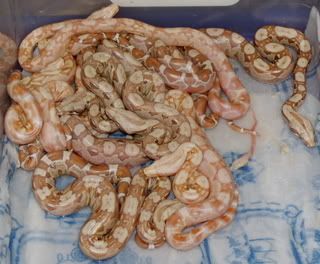
Bottom left, top right, and the ones in the middle (not outlying) are Paradigms. (Darker Albinos)


In this picture the bottom left and bottom right are normals. The others are all Caramels, picture from Sharon Moore, taken off of Jeff Ronne's photo gallery on his forum.

This picture by Dave Barker, taken from VPI.com shows a newborn Colombian T-plus, simply for refference. You can see the difference between them and the Caramels.

styrsnake Sep 22, 2006 06:40 PM

Hey Chris,
You are right about the eye color of the Carmels. They do have black pupils, but the area around the pupil has lots of red in it. To me the Carmels have many of the same visual traits that the T+ Albinos have both as babies and adults. Attached are some pictures of the eye of a Carmel, one was taken at two years old and the second at four and a half years old.
Steve

ChrisGilbert Sep 22, 2006 07:35 PM

a lot of similarities. That's why I want to see designers in both to see what happens. If they both had blue eyes I would swear (in most cases) that they were the same mutation.

Paul Hollander Sep 22, 2006 06:24 PM

Trouble is, a tyrosinase positive albino animal does not have to have any melanin. And some tyrosinase positive animals with some melanin have abnormal tyrosinase. Both cats and mice have tyrosinase negative albino mutants. The Siamese cat is light colored because it has an abnormal tyrosinase enzyme that can produce SOME melanin. This is an allele of the tyrosinase negative mutant gene. The mouse has several mutants that produce abnormal, yet partly functional, tyrosinase, and all are alleles of the tyrosinase negative albino mutant.

It's brutal facts like these that slay the tyrosinase positive/tyrosinase negative dichotomy.

Paul Hollander

ChrisGilbert Sep 22, 2006 06:30 PM

The names are just assigned to make it easier. However, they might be wrong.

In rat snakes there are two Amels, both with no melanin, one is positive the other negative. This is the only case I have heard where the mutations were tested.

Paul Hollander Sep 22, 2006 06:05 PM

>What if Sharp and Caramel are on the same allele?

Small terminology correction. Sharp and Caramel are not ON the same allele. Alleles are different versions of the same gene and have the same location in the same chromosome. In other words, if Sharp and Caramel are different versions of the same gene, then Sharp is an allele and Caramel is an allele.

>Because from your breeding:
Sharp X Paradigm (f1: Sharp X Caramel)
you got Sharp and Paradigm, correct?

>If the Paradigm was truely DH, shouldn't you also get:
WT het Sharp, and WT het Caramel? That is to say, you are missing wild type phenotype from your offspring.

>If the Caramel and Sharp are on the same allele:
breeding a Paradigm to Sharp will give you all homozygous animals.
Depending which allele they recieved from the sire, they would be Sharp or Paradigm.
Since the only allele they could get from the dam was Sharp.

>So the Paradigm is a homozygous animal. If this theory works.
Now to explain the phenotype of Paradigms...

>They are basically a combination of Sharp and Caramel, some aspects of each create the morph.
If the two mutations are on the same allele.
Like a red X white flower makes pink.

More terminology corrections: If Caramel and Sharp are alleles, then breeding a snake with a pair of Caramel genes to a snake with a pair of Sharp genes produces babies with a Caramel gene paired with a Sharp gene. As the Sharp and Caramel genes are different alleles, the baby snakes are heterozygous. By definition, "homozygous" means that the two genes are the same. By definition, "heterozygous" means that the two genes are different. See www.dictionary.com.

I'm going to make a list of possible gene pairs if there are three possible alleles. "//" means a pair of chromosomes. There will be a name to the left and another name to the right of the "//". If the pair is "normal//Sharp", it means that the pair of chromosomes has a normal gene on one chromosome and a Sharp albino gene at the same location on the other chromosome.

If there are three possible alleles (normal, Sharp, Caramel), the possible gene pairs are as follows:
1. normal//normal. Two identical genes = homozygous.
2. normal//Sharp. Two different genes = heterozygous.
3. Sharp//Sharp. Two identical genes = homozygous.
4. normal//Caramel. Two different genes = heterozygous.
5. Caramel//Caramel. Two identical genes = homozygous.
6. Caramel//Sharp. Two different genes = heterozygous. This is the Paradigm.

Double Het or DH means heterozygous in two gene pairs. The Paradigm is Caramel//Sharp, which has only one gene pair heterozygous.

>This is the only theory I can come up with to explain F1 Paradigms, and a FULL litter of them.

Works for me. The same theory has been advanced for the amelanistic and ultra mutants in the corn snake and for the tyrosinase positive albino and xanthic mutants in the black rat snake. H.B. Bechtel reported on the black rat snake in one of the 1985 issues of the Journal of Heredity.

This is from www.paradigmboa.com:
"Our first breeding was a Paradigm X Sharp Albino, the results were astounding. This breeding resulted in 75% Sharp Albinos and 25% Paradigms."

Using pairs of genes, a Paradigm x Sharp Albino mating would be
Caramel//Sharp x Sharp//Sharp -->
1/2 Caramel//Sharp (Paradigm)
1/2 Sharp//Sharp (Sharp Albino)

Perhaps the difference between the litter cited above and the expectation was caused by a small litter size.

Paul Hollander

ChrisGilbert Sep 22, 2006 06:11 PM

I may still have worded that wrong, oops.

Anyway, I was saying that the Sharp (gene, allele, whatever it is) is paired with the Caramel.
So that the Paradigm is still homozygous.

I'm trying to figure this out, I'll look back over what you wrote again.

rainbowsrus Sep 22, 2006 06:19 PM

It's Paul we are talking about

If we are correct in that the caramel, sharp albino and a normal are three alleles of one single gene pair (terminology?)
then any one of the three paired with any of the other two would be het.

Paul, would the following be an appropriate way to word the three het possibilities????

Het caramel/sharp albino,
het caramel/normal,
het sharp albino/normal

>>I may still have worded that wrong, oops.
>>
>>Anyway, I was saying that the Sharp (gene, allele, whatever it is) is paired with the Caramel.
>>So that the Paradigm is still homozygous.
>>
>>I'm trying to figure this out, I'll look back over what you wrote again.
-----
Thanks,

Dave Colling

www.rainbows-r-us-reptiles.com

0.1 Wife (WC)
0.2 kids (CBB, selectively bred from good stock)

LOL, to many snakes to list, last count:
13.26 BRB
11.16 BCI
And those are only the breeders

lots.lots.lots feeder mice and rats

rainbowsrus Sep 22, 2006 06:21 PM

>>Het caramel || sharp albino,
>>het caramel || normal,
>>het sharp albino || normal
-----
Thanks,

Dave Colling

www.rainbows-r-us-reptiles.com

0.1 Wife (WC)
0.2 kids (CBB, selectively bred from good stock)

LOL, to many snakes to list, last count:
13.26 BRB
11.16 BCI
And those are only the breeders

lots.lots.lots feeder mice and rats

ChrisGilbert Sep 22, 2006 06:26 PM

that the following are homozygous conditions:
Caramel//Caramel
Sharp//Sharp
Caramel//Sharp

Heterozygous conditions being:
Caramel//WT
Sharp//WT

So if the snake has one Sharp and one Caramel, it is a form of homozygous state. I don't know if this makes sense now.

rainbowsrus Sep 22, 2006 06:30 PM

>>that the following are homozygous conditions:
>>Caramel//Caramel
>>Sharp//Sharp
>>Caramel//Sharp
>>
>>Heterozygous conditions being:
>>Caramel//WT
>>Sharp//WT
>>
>>So if the snake has one Sharp and one Caramel, it is a form of homozygous state. I don't know if this makes sense now.

By definition het is having two different genes, so:
caramel || sharp albino would be het

Problem comes in how to say it correctly since most of us (myself included) are so used to the two choice per gene pair game. Het always before meant one morph gene paired with one normal one. Now there are more choices
-----
Thanks,

Dave Colling

www.rainbows-r-us-reptiles.com

0.1 Wife (WC)
0.2 kids (CBB, selectively bred from good stock)

LOL, to many snakes to list, last count:
13.26 BRB
11.16 BCI
And those are only the breeders

lots.lots.lots feeder mice and rats

ChrisGilbert Sep 22, 2006 06:32 PM

SAME genes, but different phenotypes.

Two mutations can have different genotypes but the same phenotype.

I think here they have the same genotype and different phenotypes.

Paul Hollander Sep 22, 2006 06:45 PM

that the following are homozygous conditions:
Caramel//Caramel
Sharp//Sharp
Caramel//Sharp

Agree that Caramel//Caramel and Sharp//Sharp are homozygous conditions.

Disagree that Caramel//Sharp is a homozygous condition.

Heterozygous conditions being:
Caramel//WT
Sharp//WT

Agree with this.

A lot of herpers are hung up on a heterozygous animal having to look normal. There is NO requirement for appearance in the definition of "heterozygous". The only requirement is for the two members of a gene pair to be different. If Caramel and Sharp were the same, then Caramel//Caramel and Sharp//Sharp snakes would look alike. But they look different, so they must be different mutant genes. That makes Caramel//Sharp a heterozygous gene pair. Consult the definitions on www.dictionary.com.

Rainbows-r-us:

Het Caramel//Sharp is good terminology. Het Caramel//normal is also good terminology and is synonymous with het Caramel. In het Caramel, the normal allele is assumed rather than stated. However, when messing with multiple alleles, stating both genes in the pair is better.

I prefer to use the "/" character instead of the "|" character because the "|" character requires hitting the shift key. But there is no law broken if you prefer the "|" character.

Paul Hollander

Paul Hollander Sep 22, 2006 06:57 PM

:

ChrisGilbert Sep 22, 2006 07:37 PM

I understand how Heterozygous and Homozygous work. I'm one of few you will hear say Het Hypo for instance. I hate the improper names.

But if Caramel and Sharp are the same genotype (different phenotype) is it really wrong to say that a Caramel//Sharp is homozygous?

rainbowsrus Sep 22, 2006 07:57 PM

As paul posted earlier, homozygous (applied to genetics) is defined as haveing two of the same gene in a gene pair.

Think of it this way with three pairs of socks:

brown socks represent normal genes

White socks represent sharp genes

and tan socks represent caramel genes

if you picked up one tan sock and one white sock, would you have a matched pair? No.

same way with the genes, a sharp and a caramel are not a matched pair. They may work well together, but they are not matched.

>>I understand how Heterozygous and Homozygous work. I'm one of few you will hear say Het Hypo for instance. I hate the improper names.
>>
>>But if Caramel and Sharp are the same genotype (different phenotype) is it really wrong to say that a Caramel//Sharp is homozygous?
-----
Thanks,

Dave Colling

www.rainbows-r-us-reptiles.com

0.1 Wife (WC)
0.2 kids (CBB, selectively bred from good stock)

LOL, to many snakes to list, last count:
13.26 BRB
11.16 BCI
And those are only the breeders

lots.lots.lots feeder mice and rats

ChrisGilbert Sep 23, 2006 02:03 PM

but that is why it is a theory.

My feeling, right now, today, is that...

... Sharp and Caramel have the same Genotype.

Just different Phenotypes. So when combined the allele pair up (since they are the same genotype) but the phenotype is altered because of the differences in the phenotypes of Sharps and Caramels.

joshhutto Sep 23, 2006 01:07 AM

After reading all of this I think chris is on the right track but not completely. These genes are showing a very high similarity to the lesser/mojave/lemon/butter complex in ball pythons. All of these animals are different looking (phenotypically) however when bred to each other they all produce a white snake. Some have concluded this white snake is not a lucy but a trait caused by a null gene that eliminates the pigmenting process. However, when one of these white snakes is bred to a normal, you get an almost equal ratio of the 2 morphs used to create the lucy. For instance one lucy x normal breeding produced 3 lessers and 5 mojaves. No lucy x normal breeding has produced a normal baby which goes toward the theory they are different mutations of the same allele. It is impossible for the lucy parent to pass on a normal copy of the allele to any offspring since it doesn't have one itself.

This could be the same thing going on with these mutations but on a simple recessive level. If they were 2 seperate mutations of different alleles it would be impossible for a breeding of the 2 to produce a homozygous animal of either trait. To prove or disprove this theory one would have to take the offspring of the crossed litters and pair them up. Theoretically they would be CCSs (homozygous carmel het sharp_ and SSCs (sharp albino het caramel). If an integrade was produced of the two genes that was visably differnt that animal would need to be raised up and bred to a het of each gene. In this theory if any normals are created which they should if it was 2 seperate alleles involved then this theory is nullified. If all homozygous appearing animals are produced which could only happen if both of the double homozygous genes interacted with the het gene of the other animal being bred. This process would be a very drawn out process but beyond genetic testing could be the only way to completely figure this out. Wow it's much more simple when dealing with co-dom traits, lol.
-----
Josh & Krysty Hutto
J&K Reptiles

Various Ball Pythons:::

1.0 striped vanilla
1.2 Citrus Ghost and hets
1.2 Albino and hets
2.3 het Pied
1.1 Pastel (male has additional gene going on with him)
a bunch of female holdbacks and several rescue normal males

0.1 columbian boa, she's a feeding monster, controls my
over production of rats, lol
0.1 brazilian rainbow boa, another rat eating monster
1.1 corns

a BAD dog is MADE not bred, support the American Pit Bull Terrier as the greatest breed of dogs on Earth!!!!!

ChrisGilbert Sep 23, 2006 02:45 PM

the Blue Eye hets last night.

I'm one of the guys who doesn't believe they are real leucistics, and I've gotten some pretty interesting replies on it, but none from the breeders that are producing them, lol.

Anyway, this should be a fun game to play!

Co-doms are easy because the heterozygous ad homozygous are all visual and different, why does the Paradigm exist?

That was the question I asked myself before I started this thread, and this was my answer to myself. We'll just have to wait and see.

Site Tools