I've posted about this before, but I just wanted to follow up. I hatched out three turtles who all had white spots on their shells. But I've had them inside for about 3 weeks now, and it seems like they have more dots and the ones that were there already are whiter. They started out as little white specks situated in a circle, but over time it becomes a solid white dot. One of my hatchlings just has a few, and other is nearly covered in them. I found a hatchling in my yard a week or so ago, definately from a different turtle, and he didn't have any of these dots. Now, it is starting to form some of the same dots on his carapace. I am just wondering what this is. I want to find out if this is some type of fungus that I need to treat. None of the turtles I see pictures of have these. These are three toed box turtles, and these are not the yellowish marks that are sometimes on the scutes. Their tank is kept at a humidity of 60-80%. When I posted earlier, I was told that these go away as they mature. Any help is really appreciated. Thanks.
Reptile & Amphibian Forums
Welcome to kingsnake.com's message board system. Here you may share and discuss information with others about your favorite reptile and amphibian related topics such as care and feeding, caging requirements, permits and licenses, and more. Launched in 1997, the kingsnake.com message board system is one of the oldest and largest systems on the internet.


White Spots on Hatchling's Shells
Replies (10)
some hatchlings come into this world with shell markings, some do not, what you discribe sounds perfectly normal.
here are some pics of my hatchlins for you to compare..
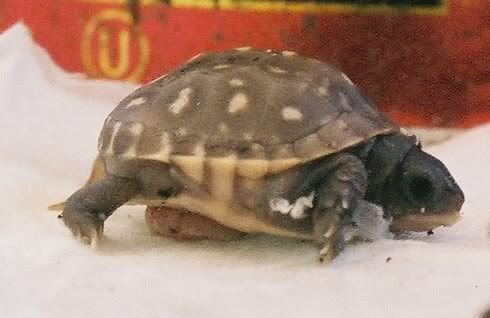
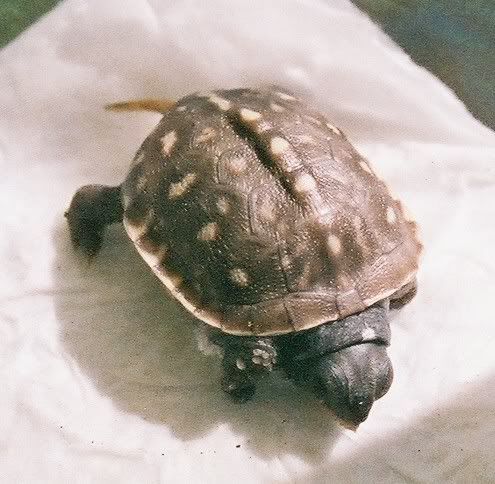
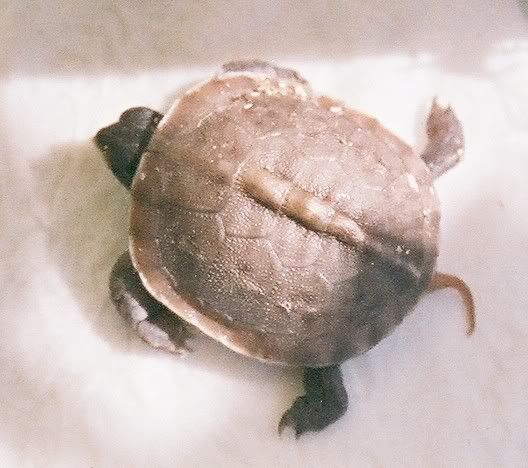
In the pictures you posted, those white markings are colors of the scutes. These white markings are sometimes significantly bigger and have no pattern to them what so ever. Some extend over two different scutes, but are not continuous since the only thing breaking it up is the division between the two scutes. And the other thing is that I can't explain is the turtle I found later had none of these and is now beginning to form some on his shell too.
if you could post pics it would help us help you.
Well I don't have a digital camera, but I think I can get a buddy over soon and have them take a picture or two for me. I'll get them on here ASAP. If anyone else has any ideas or has had this happen before, please let me know.
The pattern/ patterns of white on your boxie's shell you have described are discerning. Especially spots growing on the skin that weren't there several weeks ago.
Boxies do have white spots and do develop them as they reach various stages in their life cycle; but much more slowly then what I believe you are describing. Also, they have a definite pattern to them. You also stating "the white was appearing from one scute to the other and the small white dots have become much bigger with no pattern."
Irregular shaped, changing patterns of white on a hatchling's shell, having formed after being buried for an unknown duration of time; coupled with white irregular patches forming on it's siblings and also on unrelated boxies suggest an abnormal possibly contagious condition.
While a clear photo will confirm normal/ abnormal growth; I believe from your posts, there is an imminent condition here and advise you to take your hatchlings to a vet asap.
With health concerns affecting young hatchlings, time is the key. I'd rather err on being too cautious then miss much needed treatment.
Ric K.
From what you've described it doesn't sound like the white spots are markings that are developing, but may be some drying issue, a reaction to an environmental issue, or even some sort of fungal/bacterial infection. Until you can determine what the problem is, keep the hatchlings separate from eachother and practice the best hygiene you can. Discared any substrate you're using and keep them on newspaper or paper towels for the interim, too.
May sure you maintain high humidity with good air circulation, too.
They are on Spagnun moss, keep at a 60%-80% Humidity. I am starting to leave one part of the tank unmisted, but don't notice any preference towards this side. They are still found all over the tank. As far as air circulation, I have them in an aquarium without a lid. Is an open top tank enough air circultion. Also waiting on a reply from the GCTTS, a local turtle group, and see what they say (I got their mom from there). Still working on getting a picture. Thanks.
I also have a baby turtle with unknown white spots.
I recently got a baby Eastern Box. There were small white spots on the turtle's shell which I thought were just water spots. The spots are near the spine in the nooks and crannies of the spine. I "adopted" the turtle from a Turtle/Tortoise group so I figured they were healthy. The white spots look "chalky" and are not soft and spongy. They go away when the turtle is wet, which again makes me think they are water spots. However, I've tried to clean them with a cotton swab without any success.
Does any of this sound normal?
I was thinking of trying a shell conditioner.
Thanks for any insights you can offer.
Just for future reference, the shell conditioners available in pet stores are really unecessary and could even be harmful, especially for a hatchling.
I have seen those 'chalky' white spots before on adult wild turtles. I don't know what they are or what causes them to appear, though.
"I have seen those 'chalky' white spots before on adult wild turtles. I don't know what they are or what causes them to appear, though."
The chalky white spots are cause by a buildup of water deposits. That's why they seem to disappear when the boxies having them, enter water. Wild boxies can acquire these when soaking in a favorite mud puddle during warm weather. But rarely as they are not subject to an extreme hard water buildup as captive boxies are in an enclosure with water bowls often being filled up when low, slowly adding up the concentration of calcium carbonate. Cacao3 and other minerals depending on your local water supply. Pond water also in an enclosure slowly evaporates building up the concentration . Also... When boxies are sprayed via a mister the main reservoir is constantly refilled and over time the minerals build up.
Now with wild boxies they are in larger ponds they have lower concentrations of minerals and rain water being soft, they usually don't have this problem; which boxies love to soak up in.. It would keep their shells from accumulating a mineral or chalky buildup.
You can prevent this in a captive enclosure by filling a clean /new plant sprayer with distilled water and making sure the PH is slightly acid. Mist your boxies with the slightly acid distilled water. In time the distilled water with dissolve the chalky spots and your boxie will love you for it; as it allows him to moisturize his shell and take in rays that were blocked by the mineral deposits. His shell will almost glow afterwards.
If one were to look at a hatchlings shell under a microscope; they would see a shell that resembled miniscule sandpaper.
It's a perfect medium for collecting moisture---Water at such a tender age is invaluable to young hatchlings; but they weren't intended to be covered and blocked with concentrated hard water deposits.
Ric K.
