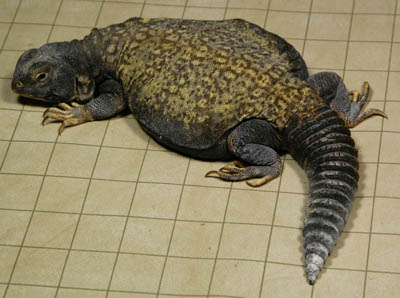
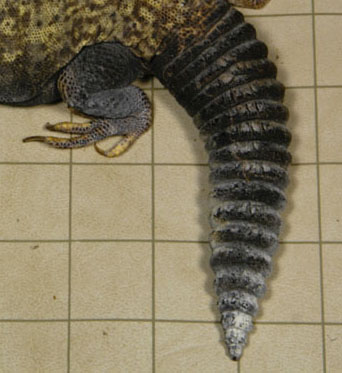
I'm our herp club's monitor rescue person, and I just picked up a rescue that was billed as a chuckwalla. However, from the shape of the head, and those cute little scales that look like the edges of a moustache at the back of the mouth, I'm pretty sure it's a Uromastyx. But all my (limited) experience with Uromastyx tells me they have spines on their tails. They aren't called spiny-tailed lizards for nothing, and I have the dents in my arms and legs to show for it. This one, however, has the segmented (whorled?) tail, just like a Uromastyx, but NO SPINES. The whorles are smooth. He/she looks something like a Mali Uromastyx in pattern. Is there such a thing as a smooth-tailed Uromastyx? I'm mystified. Can someone help? Thanks.
Reptile & Amphibian Forums
Welcome to kingsnake.com's message board system. Here you may share and discuss information with others about your favorite reptile and amphibian related topics such as care and feeding, caging requirements, permits and licenses, and more. Launched in 1997, the kingsnake.com message board system is one of the oldest and largest systems on the internet.



Uromastyx without spines?
dragonfire1
Oct 01, 2006 03:40 PM
Replies (14)
el_toro
Oct 01, 2006 05:38 PM
Is there a way you can post some pictures? Maybe there was some sort of tail infection resulting in the loss of spines. There are people here who keep both uros and chucks and should be able to tell you what it is.
-----
Torey
Eugene, Oregon, USA
1.1 Saharan Uros (Joe and Arthur)
3.1 Mali Uros (Spike, Turtle, Tank, and Lilly)
1.1 Ornate Uros (Scuttlebutt and Shazzbot)
0.1 Collared Lizard (Rorschach)
2.1 Green Anoles (Bowser, Sprocket, Leeloo)
1.1 Chubby Housecats (Roscolux and Jenny)

dragonfire1
Oct 01, 2006 07:09 PM
I have pictures up on my website. You can view them there. I'm not sure how to post pictures here.
Raider's Page
John-C
Oct 01, 2006 08:38 PM
Although I haven't seen one since I had my spineless uro,
I would think this is somewhat of a rarity. Not sure what
the cause is. Possibly an itchy tail and they just scratched
off the spikes? Or, maybe they hatch with this slight deformity?
Unless someone hatches out one I suppose we'll never know.
Here's two of to of my male mimic females. The one of the right
is Mimi who's a nice honeycomb patterned female with normal
tail spikes. The one on the left is Smoothie. I called her this for
obvious reasons although she did have one spike on the upper
left side of her tail. She has a nice spineless tail with no evidence of aggression or scars to the tail whorls or to the ventral side. Her tail is by the way fully functional in what ever functions they need a tail for. Most likely for balance, dueling or simply having a little extra leverage for the males while copulating ... lol.
Anyway I acquired Smoothie from Doug some five or six years
ago. It took me three years to finally get a male to breed her and it wasn't from their lack of trying either. Could be from lack of friction from the absence of tail spikes? She finally produced on that third year.
BTW, yours is definitely a U d maliensis (mali) and by your great
pics, which show a smaller narrower head and pear shape torso,
my guess is that it's a really fat male-mimic female and a nice one at that.
John

dragonfire1
Oct 01, 2006 10:19 PM
So, could you please tell me what is a "male-mimic" female? I know nothing about these animals.
Actually, that's not quite true - I had two of them, a very pretty ornate and a Mali, back in 1999, as rescues when the local SPCA shut down a reptile shop here in town. Neither of them liked me. Whenever I tried to pick them up to clean their cages, they would hammer me with their tails - and boy, did that hurt! If I put them down on the floor while I was cleaning the cage, they'd whack at my ankles. When one of them shed, I kept part of the tail shed to remind me of those dents I received. This one also tries to hammer me with her tail when I pick her up. At least she doesn't have any spines!
benedita
Oct 02, 2006 07:10 AM
"male mimic" describes when a female of a sexually dimorphic animal has the coloring & patterning of a male.
--benedita
benedita
Oct 02, 2006 07:11 AM
no post
dragonfire1
Oct 02, 2006 09:05 AM
Thank you all for your help! I really appreciate it. Now, all I have to do is fine this nice little gal a good home.
dragonfire1
Oct 02, 2006 11:38 PM
Hm. I note from a web search that this "cross-dressing" seems to happen quite often in Uromastyx. Or perhaps it's just discussed a lot on the web? I didn't it notice showing up much in other species, though - almost all of the references were to Mali Uromastyx. Do you know if this happens in other lizards? Almost NONE of my experience with lizards deals with sexually-dimorphic lizards. I did notice something about this in relation to dragonflies, though. Strange. Is there something that triggers it? Or are they born that way and stay that way all their lives?
John-C
Oct 03, 2006 09:45 AM
In some uromastyx it occurs to a higher degree as in low land benti, bandeds, moroccans, and less
often in mali to name a few. Some to a lesser degree as in the ornates which are referred to as high
color females. In more extreme cases of the male mimic mali for example, they will mimic the males
so well that their ground color (both dorsal and ventral) are a dark shiny black throughout including
points (head, legs and tails). They can also display a nice bright yellow pattern whether it be bands
or honeycombs as in the two females I showed in my previous post.
I've found that this occurs in maturing female mali as they seem to exhibit the "usual" maliensis female coloration from hatchling to a few years of age before a small few might begin to mimic.
John
-ryan-
Oct 03, 2006 09:40 PM
I've seen a 'spine-less tail' on pics of uromastyx that recovered from tail rot. I can't remember exactly what causes it, but the spines fall off. I would research it if you can find anything about it, to make sure there's not special care requirements.
-ryan-
Oct 03, 2006 09:48 PM
Also, assuming that this might have something to do with a possible case of tail rot in the past, keep in mind that tail rot stems from poor care in general. Many have believed it to be simply too much moisture in the environment, but it might be more likely that it has to do with a lack of gradients. Uromastyx spend time outside under the hot sun basking on objects that reach surface temperatures well over 150f, but they spend even more time underneath the surface of the ground in humid burrows, reserving water.
Just something to keep in mind if you research tail rot a little bit. I haven't done any research on it in a long time, so I'm not exactly sure how much info you're going to be able to find. I just seem to remember similar things happening in mild cases of tail rot (losing the spines).
dragonfire1
Oct 03, 2006 11:00 PM
I've seen tail rot in other lizards, and it tends to leave scars. If you look at the picture above, she doesn't appear to have any scars on her tail. It looks as though it grew that way. Since I've heard from someone else, and seen other pictures now of Uros without spines on the tail, I would assume it must be a natural occurrence. Whether or not it's considered a "birth defect", I would have no idea.
-ryan-
Oct 04, 2006 02:04 PM
'tail rot' (whether that's what it is or not) is what we typically call the effect of excess water building up between/beneath the spiny plates on the tail (usually caused by water trapped between the plates...for example if the uro is soaked and then cannot dry properly from low temperatures). From my observations here and elsewhere, the plates typically fall off in a similar fashion to being shed, however the plates beneath are not fully developed yet.
I have seen photos of tail rot in uros with scaring, but I've also seen it without (probably moreso).
It can also be caused by other things I assume, but I'd wager we're looking at something similar to that. I would not say it is genetic and unless you have the time/animals to prove it out for sure, no one can.
-ryan-
Oct 04, 2006 02:06 PM
It would look like it grew that way, since the tail would continue to shed as before, just without spikes.
Birth defects? It's a possibility...but not one I would place too much stock into. You have to remember that uro care is still not quite where it could be yet, but in years prior it was simply horrible, and no one knew anything about them regarding basking temperatures and such.
