

Reptile & Amphibian Forums

Welcome to kingsnake.com's message board system. Here you may share and discuss information with others about your favorite reptile and amphibian related topics such as care and feeding, caging requirements, permits and licenses, and more. Launched in 1997, the kingsnake.com message board system is one of the oldest and largest systems on the internet.

Click here to visit Classifieds
Click for ZooMed

A note on cannibalism

Colchicine Oct 23, 2006 07:36 PM

At this past weekend's meeting of the Va Herp Society, I picked up a circular by Joseph Mitchell, "Cannibalism in Reptiles: A Worldwide Review" at the auction. Although it was published 20 yrs ago, it was the first thorough review of the literature on the subject.

Although I was certain I'd find a report on Heterodon in there, there wasn't a mention of them. But I did find some info that has a lot of relevance to hogs.

Mitchell spent some time discussing the differences between observations of cannibalism of snakes in the field and in captivity.
Field = 60
Captivity = 106

No other order had more observations in captivity than in the field.

I think this clearly highlights a question that frequently comes up on this forum. Although there is positively some value of keeping snakes together for enrichment, it should not be a permanent arrangement. Many instances of cannibalism have been reported on this forum over the years, and it should be clear that keeping two of ANY snake together is a huge, and unnecessary, risk. Hogs have very strong feeding responses and don't discriminate against (potential) food items once the response is elicited and the item is in its mouth. Mitchell states that a lot of cannibal events are from 2 snakes eating the same food item at the same time, and the larger snake simply overtaking the smaller. I have experienced this in captive Northern watersnakes, and have seen it even in neonate rough green snakes.

Certainly, many people have kept snakes together without any problems, but just because I have driven 13yrs without an accident doesn't there weren't plenty of close calls and that I am somehow immune to such an event. The laws of probabilities will catch up even to the most attentive owner.

I want to encourage all of you recommend to future posters that keeping hogs together is an unnecessary risk. One's concern for an animal's health should supersede any amount of inconvenience or reasonable financial constraints.
-----
Virginia Herping
http://groups.yahoo.com/group/VaHS
Virginia Herpetological Society online store
http://www.cafepress.com/vaherpsociety

"The irrational fear of snakes is the only excuse a grown man has... to act like a complete sissy" - Colchicine

Replies (6)

Dillybird Oct 24, 2006 10:31 AM

Hi,

May I copy your post to the Cornsnake forum? There is a question on there right now about co-habitation.

Thanks,

Nanci
-----
*****
0.0.1 Normal Corn, 0.0.1 Cali King
0.0.1 Eastern Hognose, 1.0 Eastern Box Turtle
0.0.2 Desert Torts, 2.0 Feral Pigeons

Colchicine Oct 24, 2006 01:08 PM

Sure thing, it isn't limited to hognoses. I don't have the book in front of me now, but there was an entry for corns in captivity.
-----
Virginia Herping
http://groups.yahoo.com/group/VaHS
Virginia Herpetological Society online store
http://www.cafepress.com/vaherpsociety

"The irrational fear of snakes is the only excuse a grown man has... to act like a complete sissy" - Colchicine

Steve_Craig Oct 24, 2006 05:00 PM

Very good information Colchicine. I think this question is raised atleast once a week over on the corn forum. You have folks that say they have done it for years. Good for them. So long as they understand that there is a "Risk" It's not worth it to me.

Steve

phwyvern Oct 25, 2006 06:01 PM

>>Very good information Colchicine. I think this question is raised atleast once a week over on the corn forum. You have folks that say they have done it for years. Good for them. So long as they understand that there is a "Risk" It's not worth it to me.
>>
>>Steve

I think there is a difference between snakes simply living together and being fed together while in the same enclosure. When I have multiple snakes living in an enclosure I never feed them in it. I always remove them to separate feeding containers. After they have eaten, they get put back (together) to their normal enclosure. I have not had problems with this method. The snakes recognize the difference between a feeding container and their living quarters. They are not trying to attack each other when back in their living quarters. Now, each snake does have their own feeding container and I do try to make sure only that snake is ever put into it.
-----
_____

PHWyvern

FloridaHogs Oct 25, 2006 09:09 PM

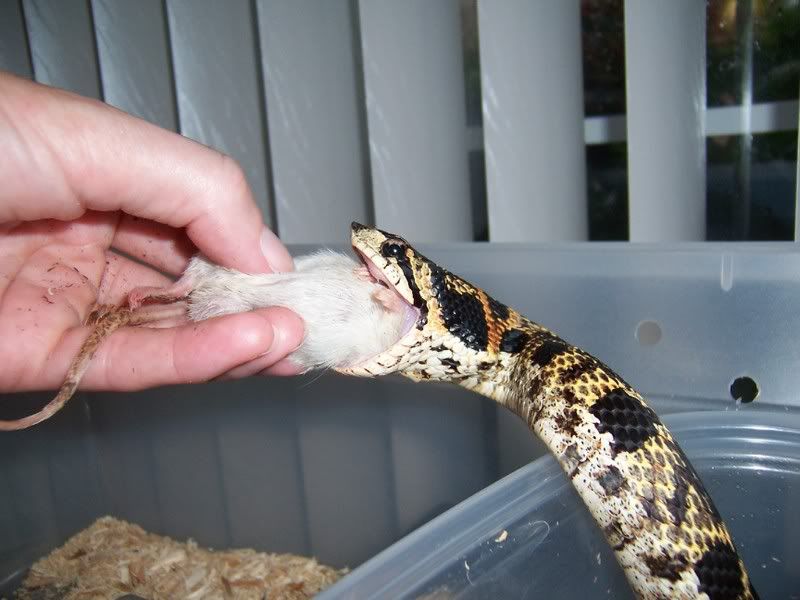
The article talks about cannabisim occuring during feeding (ie. 2 animals latching onto the same prey) I also feed in seperate containers, and do not put them back together until they are truly out of feeding mode. I am extra careful with those that have aggressive feeding responses, and give them more time. Others are extremely gentle feeders, which I feed by hand. I do not recommend this, however this WC girl will not eat if just put in a bin. She is a bit spoiled, and will only eat if hand fed. I let her finish in my hand to keep her out of the substrate. She has only been in captivity since May, and is only calm when housed with a male. It is very odd, but there is a definate personality change between being housed alone or with a male. I have only noticed this with the WC Easterns.


-----
Jenea

2:3:1 Tricolor Hognose (plus babies)
4:2 Eastern Hognose
1:2 Western Hognose
0:2 Southern Hognose
0:0:3 Florida Redbelly Snakes
0:1 Gulf Coast Box Turtle
1:1 Red-eared Slider
1:2 Eastern Fence Lizards
2:0 Cats
1:1 Kids
1:0 Spouse

Colchicine Oct 26, 2006 07:36 AM

The responses by Jenea and Wyvern show there certainly are levels of responsibility that cohabitation can be explored. I'd say those are the ideal situations with cohabitation, separate feeding containers and attentiveness to feeding modes. But as regulars of this forum and others, I would hope they would agree that cohabitation should be discouraged in newbies because of the assumed inattentiveness of the owner.

Jenea, a hognose researcher I communicate with has observed some type of coupling between a male and a female. As in, they seem to show a preference for each other and tend to be near each other. I haven't come across anything like this in the literature, so it would be nice to have someone explore this. I think it could have huge implications for captive husbandry if there is some kind of social aspect to their nature.
-----
Virginia Herping
http://groups.yahoo.com/group/VaHS
Virginia Herpetological Society online store
http://www.cafepress.com/vaherpsociety

"The irrational fear of snakes is the only excuse a grown man has... to act like a complete sissy" - Colchicine

Site Tools
