Reptile & Amphibian Forums

Welcome to kingsnake.com's message board system. Here you may share and discuss information with others about your favorite reptile and amphibian related topics such as care and feeding, caging requirements, permits and licenses, and more. Launched in 1997, the kingsnake.com message board system is one of the oldest and largest systems on the internet.

Click here to visit Classifieds
https://www.crepnw.com/
Click for 65% off Shipping with Reptiles 2 You

what is this?

redmoon Nov 13, 2006 09:51 PM

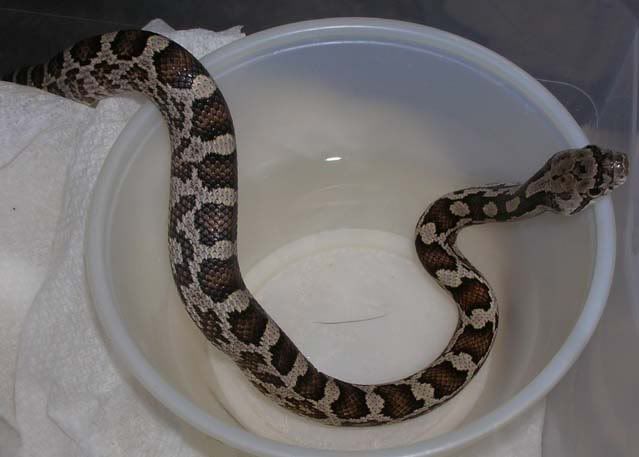
This guy was sold to me as an albino black rat. I trusted that, and then began to question it. You might remember me posting on here before, questioning it. People reassured me that he is a black rat, not an integrade.

Now, as his offspring grow, I'm questioning it again. First off, we have some pictures of him.


He's always been a little bit fussy, compared to the black rats I've had. What cued me at first was his color, but I can see that a lot of albino black rats are bright & fancy, and not all are mostly white like the common ones you see.
Now, I had never really noticed before, but his head is flatter than my black rats. I only have one adult black rat to compare him to, but I've had other juvies, and even as juvies, they seemed differently shaped.
He has borders around his saddles. I don't know if this is common in black rats or not- I've never seen it, but that's not saying anything.
Another- Has anyone seen the spots on the tips of the scales in any species? I don't think I've ever seen any rat that has those. But, once again, a minor feature that would be easy for me to pass over.

Another thing I had never noticed, or known, but is one more thing that makes me believe he is an integrade is that he has a postocular stripe.
this post: http://forums.kingsnake.com/view.php?id=1156892,1157939
was the first I've even heard of a postocular stripe, and the poster in question does point out that it's not 100% reliable.

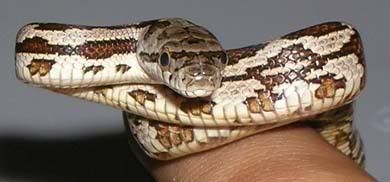
Anyway, here are the babies. They started out looking like normal black rats.

Then, they started to lighten a little bit.

And more.
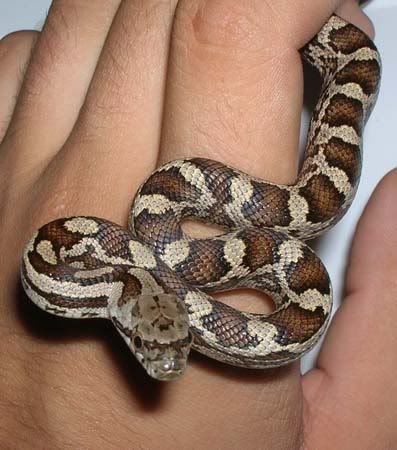
The most recent pics of a hatchling are

The babies show postocular stripes. As well, they show the saddle borders. On a surprisingly light background. Those babies look to me like they have some Emoryi blood in them. But, I don't know Emoryi very well.. I've never kept them, and don't know a lot about them. I've just seen a few pics, and I think these guys look similar.

They definitely don't look like pure emoryi, but, the mother of these was definitely pure black rat. That would make them at least 50% black rat. The father could be anything, so that would explain why they don't look 100% like the Emoryis I've seen.

What do you guys think? Does anyone at all agree with me that he looks like he might be an integrade? I really question it.. I have several times, and like I said, I've been reassured, and I'm questioning again.. The fact that I keep questioning it makes me think that that alone might be grounds for questioning. I've never questioned any of my other animals genetics based on their appearance. They've all looked like what they are.

Replies (21)

chrish Nov 13, 2006 10:04 PM

>>What do you guys think? Does anyone at all agree with me that he looks like he might be an integrade?

Well, first of all, they wouldn't be intergrades, they would be hybrids because Black Rats and Great Plains rats are separate species. Intergrades are crosses between subspecies.

I think they look like 100% obsoleta. They might be from a population that doesn't get completely black, but they don't look unusual to me.
-----
Chris Harrison
San Antonio, Texas

phwyvern Nov 13, 2006 11:39 PM

for those bright amel colors I would suspect at the very least a corn x emory blood line mixed in with something else.
-----
_____

PHWyvern

hermanbronsgeest Nov 14, 2006 04:15 AM

I think you worry too much. The albino looks exactly like your typical 'red albino' Black Ratsnake, I must have dozens of these here on this forum. The juveniles also are really very typical Black Ratsnake juveniles. Postocular stripes or a contrasting bright background color are in no way atypical whatsoever.

One thing though. I'd like to point out that subspecies do not really exist within Pantherophis obsoletus. There are no distinctive characters to tell a Black Rat from a Texas Rat, or a Black Rat from a Grey Rat. Certainly, when you compare textbook examples of these geographical races they look very different, and the image of a polytypical Pantherophis obsoletus intuitively seems quite right. But wether you move from north to south, or from east to west, one geographical race just gradually transforms into the other, and this goes for all of these so called 'subspecies'.

redmoon Nov 14, 2006 07:32 AM

I may be worrying too much, but, I worry about that. There are a lot of integrades (and hybrids) out there, and I'd rather keep my lines pure.
I've never seen a "typical 'red albino' Black Ratsnake" that looks like mine. Every typical red albino I've ever seen has had one big difference, asides from none of them ever quite showing his colors(which are indeed variable, and a bad thing to base anything taxonomic off)- There's always been a gradual fade from head to tail. This guy doesn't. At all. He has a little bit more white saddling near his tail than at his head, but that's it. Every albino I've seen on these boards begins out orange, red, or pink, and fades to white, cream, or a blend of something.

So, like I said, I really may be worrying too much. But, the only reassurance I get is, "no, that's normal." And I've never seen one that looks like him. Some that look fairly close, but they always show the traits that he lacks that are exactly what are making me think he's not pure.

And finally-
I know it's difficult to tell the difference. But there are differences there. The tongue colors between Everglades and yellows. The personality differences between Texas and Blacks. And there's mDNA, is there not?

hermanbronsgeest Nov 14, 2006 10:03 AM

Interesting point. Based on an analysis of both morphometrical characters and mDNA, Burbrink et al concluded that Pantherophis obsoletus (formerly known as Elaphe obsoleta) does not exist as a polytypical species and split it up into three separate species (four if you include bairdi): Elaphe alleghaniensis, Elaphe spiloides and Elaphe obsoleta. From their point of view, Black Ratsnakes do not exist as a taxonomical entity. Since then there has been much debate about this subject but, controversial as it is, they (Burbrink et al) actually do make an interesting point about the validity of Pantherophis obsoletus as a polytypical species. To most taxonomists, the subspecies of Pantherophis obsoletus are dead.

Bottom line: Black Ratsnakes are just a variant within a wide range of clinal variation of a highly diverse species. Black Ratsnakes do not exist as a taxonomical entity.

redmoon Nov 14, 2006 09:15 PM

Can you explain P. allegheniensis to me? I've seen a couple descriptions of allegheniensis as being a hybrid between black rat & Everglades, black & yellows, or yellows & Everglades.

What was allegheniensis known as before the taxonomic shift?

hermanbronsgeest Nov 15, 2006 10:12 AM

I believe Elaphe alleghaniensis used to be a synonym for Elaphe obsoleta. Burbrink et al resurrected the name and applied it to all populations of former species Pantherophis obsoletus (sensu Utiger et al) east of the Appallachians and Apalochicola River.

So it includes some of the easter most populations of Black Ratsnakes and Grey Ratsnakes, as well as the Greenish Ratsnake, Yellow Ratsnake, Outer Banks ratsnake, Gulf Hammock Ratsnake, Everglades Ratsnake and Deckert's Ratsnake.

Until now this taxonomical revision is regarded as highly controversial by most taxonomists, and consequently doesn't get much following.

phwyvern Nov 15, 2006 07:01 PM

>>
>>Until now this taxonomical revision is regarded as highly controversial by most taxonomists, and consequently doesn't get much following.

the most official designation I could find was this...

Pantherophis obsoletus - Western Ratsnakes: a distinct lineage found west of the Mississippi River (including gray rat snakes, texas rat snakes, black rat snakes)

Pantherophis alleghaniensis - Eastern Ratsnakes: a distinct lineage found east of the Apalachicola River and Appalachian Mountains (including black rat snakes, yellow rat snakes, everglades rat snakes, gray rat snakes)

Pantherophis spiloides - Midland Ratsnakes: a distinct lineage found between the Apalachicola River and the Mississippi River (including gray rat snakes, black rat snakes)
-----
_____

PHWyvern

hermanbronsgeest Nov 16, 2006 04:21 AM

Yes, you're right, these are the official names from now on. Yet these new 'species' are still subject to debate, and quite a lot of autorities on herpetology and taxonomy do not agree with the methods used and the arguments provided by Burbrink et al. Therefore this revision of former species Pantherophis obsoletus has been ignored by many, including me.

Rivets55 Nov 16, 2006 06:50 PM

Well here we go again - "Pantherophis" vs. Elaphe, jeeze people - look it up! The offical names are determined by an international commision, which has not ruled on this issue to date. If I am wrong, please let me know.

I'm sorry, but "Pantherophis" is NOT the official name at this time. The offically recognized name is still Elaphe obsoletta. The subspecies recognized are those that are obvious and don't require a portable DNA lab to tell apart.

Because Burbink, et al, proposed the name change, and some other herpetologists recognize it (and even some hobbyists, sad to say), does NOT consitute offical recognition by the international scientific community.

Witness the recent conference on Pluto.

I personally feel this revision of Elaphe obsoletta to be a pointless exercise in scientific semantics. I do not support it or recognize it.

As hobbyists, or scientists, we can call these snakes whatever we like - the snakes sure don't care. However, when we start talking about offical names, then the conventions must be observed.

John D.
-----
I am so not lesdysxic!

0.1 Creamsicle Cornsake "Yolanda"
1.0 Bairds Ratsnake "Steely Dan"
0.1 Desert Kingsnake "FATTY"
0.1 Black Rat (WV Rescue) "Roberta"

phwyvern Nov 16, 2006 07:20 PM

The Elaphe / Pantherophis genus naming convention might still be in contention, but the separation of the obsoleta species into 3 species and doing away with the subspecies is pretty much a done deal from an official standpoint far as I can see. See The Center For North American Herpetology:

http://www.cnah.org/nameslist.asp?id=6
-----
_____

PHWyvern

hermanbronsgeest Nov 17, 2006 09:28 AM

Yes, I know, I understand, I disagree. And I am not alone here.

Regards,

Herman Bronsgeest.

PS. The Center For North American Herpetology, by the way, is not the one and only leading autority on taxonomical nomenclature.

hermanbronsgeest Nov 17, 2006 08:07 AM

I think you are mixing things up here.

Burbrink et al are the ones who split former species Elaphe obsoleta (including E. o. bairdi) into 4 separate species:

1. Elaphe alleghaniensis
2. Elaphe bairdi
3. Elaphe obsoleta
4. Elaphe spiloides

Utiger et al are the ones who reclassified all ratsnakes formerly assigned to the genus Elaphe. They were the ones who renamed former species Elaphe obsoleta (including E. alleghaniensis, E. obsoleta and E. spiloides sensu Burbrink et al, excluding Elaphe bairdi) to Pantherophis obsoletus.

I don't think Utiger's thesis is a pointless excercise in sematics at all. If you're not into phylogenetic systematics in general or cladism in particular, well then I guess it all doesn't make much sense. But was the situation before this reclassification really that more sensible? Oocatocus rufodorsatus, Orthriophis taeniurus, Euprepriophis mandarinus, Pantherophis guttatus all as members of the same genus (Elaphe)? Utiger et al provided us with nice and clean monophyletic groups, a classification which makes a lot more sense when it comes to interspecies relationships. Hobbyists should be grateful for that.

ratsnakehaven Nov 19, 2006 04:37 PM

>>I think you are mixing things up here.
>>
>>Burbrink et al are the ones who split former species Elaphe obsoleta (including E. o. bairdi) into 4 separate species:
>>
>>1. Elaphe alleghaniensis
>>2. Elaphe bairdi
>>3. Elaphe obsoleta
>>4. Elaphe spiloides
>>
>>Utiger et al are the ones who reclassified all ratsnakes formerly assigned to the genus Elaphe. They were the ones who renamed former species Elaphe obsoleta (including E. alleghaniensis, E. obsoleta and E. spiloides sensu Burbrink et al, excluding Elaphe bairdi) to Pantherophis obsoletus.
>>
>>I don't think Utiger's thesis is a pointless excercise in sematics at all. If you're not into phylogenetic systematics in general or cladism in particular, well then I guess it all doesn't make much sense. But was the situation before this reclassification really that more sensible? Oocatocus rufodorsatus, Orthriophis taeniurus, Euprepriophis mandarinus, Pantherophis guttatus all as members of the same genus (Elaphe)? Utiger et al provided us with nice and clean monophyletic groups, a classification which makes a lot more sense when it comes to interspecies relationships. Hobbyists should be grateful for that.

I agree, Herman, and accept Utiger et al.'s proposals, until something better comes along to group the various related and unrelated ratsnakes.

When a person publishes his/her findings and makes a proposal, scientists or hobbyists alike can accept or reject the proposal, depending on how good of a study they think it was. Changes must withstand the test of time. Personally, I choose to accept Utiger et al, because it makes good sense. I choose to reject Burbrink, because his findings don't make sense, and the data seems weak. Remember, he also proposed to make three corn snake species, and his data is just not strong enough. A new subspecies has been proposed for the middle group, Slowinski's corn, Pantherophis guttatus slowinskii, to take the place of his new species, Elaphe slowinskii. I just can't accept major changes to a stable system based on feeble evidence.

Just my opinions on a topic I care a lot about. Thanks...

TC

BillMcgElaphe Nov 14, 2006 08:31 AM

All responses you've gotten are great opinions.
I might add Texas Rat or western Black to the list.
But...
Any animal obtained through a captive breeding network, especially morphs, is always subject to suspicion when trying to tie them to a natural variant, unless you personally know the breeder and personally consider them credible.
Either way, you have a beautiful North American Rat Snake….

-----
Regards, Bill McGighan

tspuckler Nov 14, 2006 10:22 AM

I've bred black rats for several years. Both normal and albino phases have highly variable-looking babies. Those snakes could very well be "pure" black rats, although you'll never know for sure - since there's probably a heck of a lot of crosses out there that no one has kept records on.

Tim
Third Eye
Third Eye

cochran Nov 15, 2006 03:10 PM

They look like black rats to me.The adult looks alot like a male I had a few years ago.I'll post a pic later. Jeff

cochran Nov 15, 2006 03:28 PM

Here's a pic of an old pic of the male black rat I had a few years ago. Jeff

ratsnakehaven Nov 19, 2006 04:53 PM

Doesn't look like an Emory's rat, or any type of western corn. Doesn't have much head pattern and the postocular stripe doesn't seem to extend beyond the corner of mouth. You could also look at the ventral pattern under the tail.

TC

phwyvern Nov 20, 2006 09:06 AM

>>Doesn't look like an Emory's rat, or any type of western corn. Doesn't have much head pattern and the postocular stripe doesn't seem to extend beyond the corner of mouth. You could also look at the ventral pattern under the tail.
>>
>>TC

The brightness of the amel colors would lead me to believe it probably has corn in the bloodline somewhere. I have never seen an amel black rat look like an amel corn in terms of yellow/orange color.. they were always more of a red/white combo. And we all know that it is possible that even though the snake doesn't have some of the visible characteristics of a corn, doesn't mean there is no hybrid/intergrade blood in it. Look at jungle corns (corn x king). I had one that looked pure corn but wasn't! The jungle line had been back bred to corns enough to hide the king features. There are also some jungle breeders that back breed to kings which in turn hides the corn features. The only way to disprove the possiblity of hybrid/intergrade blood is to know who bred the snake and hope they know where their stock came from and if it could be trusted, etc.
-----
_____

PHWyvern

ratsnakehaven Nov 20, 2006 04:51 PM

The only way to disprove the possiblity of hybrid/intergrade blood is to know who bred the snake and hope they know where their stock came from and if it could be trusted, etc.
>>-----
>>_____
>>
>>PHWyvern

Yeah, either that, or maybe an instant dna kit, or somethin'...heheh!

TC

Site Tools