


Reptile & Amphibian Forums

Welcome to kingsnake.com's message board system. Here you may share and discuss information with others about your favorite reptile and amphibian related topics such as care and feeding, caging requirements, permits and licenses, and more. Launched in 1997, the kingsnake.com message board system is one of the oldest and largest systems on the internet.

Click for 65% off Shipping with Reptiles 2 You
Click for ZooMed
Click here to visit Classifieds

will the geckos eat......

reptilelord Nov 27, 2006 02:25 PM

meal worms that are basically the length of their head? i have 2 young leopard geckos and i haven't seen them eat meal worms yet (i have only had them for like 3 days). last night i saw one of them eye up a meal worm and he looked like he wanted to eat it but he turned his head and walked away. i noticed while he was looking at it that lengthwise it was about the length of his head, so my question is was the meal worm to big for it to eat or was my gecko just being odd?

on a side note i threw a few medium sized crickets in the tank (my sister has a frog that eats them) and they weren't there when i just checked, well one was there but the other 6 weren't. so if you said that the meal worms were to big then do you think that it would be good idea to stick with crickets only for a while, or should i just go crickets only, or should i only put meal worms in the tank and just pray they are smart enough to eat? and if i go crickets only, later once they are big enough to eat meal worms will i have a problem making the transition back to meal worms?

Replies (13)

xagros Nov 27, 2006 02:43 PM

i only feed pinhead crickets for my baby till he is big enough to eat meelies.

I would start with crix asap and see how that goes. Plus mealies have harder shells which could be difficult for younger leos to at. how old is your?

AndrewFromSoCal Nov 27, 2006 03:48 PM

My leo wouldn't eat mealies at first because he had been raised on crickets. He transitioned, just keep trying.

reptilelord Nov 27, 2006 04:03 PM

well thats not my problem i just need to know if the meal worms are to large for them to eat? (refer to the first post)

sleepygecko Nov 27, 2006 06:11 PM

Why are you insisting on feeding mealworms if crickets are available? We feed crickets almost exclusively for psychological reasons. If you gecko wants to eat crickets and is refusing mealworms, the right size or not, you may not be able to "train" it out of him. I'm not quite up on my mealworm sizes, but the way he is acting towards them I would guess he thinks they are too big. (As opposed to being "to" big, I was very confused by your posts at first.)

A gecko should be allowed to hunt for his prey, not be forced to eat out of a bowl, IMHO. If it wants and eats crickets, while refusing offers of other food, it is your responsibility to obtain and feed them crickets. That's what having a gecko, or any pet, means.
-----
0.1 Albino Leo Gecko
0.1 Crested Gecko
1.0 Dear Boyfriend
Departed: Harvey and Spock

reptilelord Nov 27, 2006 06:17 PM

ok i am going to get it a different bowl and test if that was the problem because i heard that the bowl i am using might be turning them off, i have a lid to a jar but theres a little bit of dried glue in it, would that be a problem. I'll throw a few crickets in there too and see what they want, if they want crickets then thats what i will give them, but i will keep some meal worms in there just in case they decide thats what they want to eat.

slimforte Nov 27, 2006 07:59 PM

i had a simmilar ? about meal worm size a while back. i had just gotten an new really small leo and was worried cuz the thing was chomping down worms way longer than it's head. like you i did not get an actual answer to the ? therefore i can only tell you that nibbles is doing great and getting quite big. i had no problems with the worms being too big. she will not however eat out of a dish. she likes it when i drop the worms outside of the hide she is in. she will come out and eat till she is full then go back in her hide. i feed one or two at a time. and i still leave a dish full in the tank. one other option if the size does bother you is to check out phoenix worms. i just got some and nibbles really likes them. they are also really high in calcium. for size comparisons i have pics on www.myspace.com/tjforte

hope this helps
-T

chameleonphill Nov 28, 2006 12:01 AM

Perhaps this should be in the diet section but then again I think I say this to everyone here:
Do not feed crickets to your leos if you care about them. Raise them on meal worms and you will never have a problem with prey selection and activity levels of the prey items in question. Crickets are a horrible source on any nutrient but do give some moisture. I have my doubts about gut loading and dusting and here's why. Leos don't eat plant matter and therefore do not have the enzymes required to digest it even if it's packed neatly into a cricket. Only the just recently enzyme dissolved material within the cricket may offer any nutrients. If you think dusting works read any lit. out there on vitamin consumption in humans and tell me if you think manufactured vit.'s do much good in herps as well. Use proven supplements such as Vionate and Osteo-Form within the feeding dish or in another dish for geophagy. As for the size issue I have seen juv.s take down worms longer than their head but with herps the more appropriate the size prey the better the digestion process and therefore nutrient efficiency there will be. -phillip

AndrewFromSoCal Nov 28, 2006 01:06 AM

What about roaches? Lobsters primarily.

chameleonphill Nov 28, 2006 05:21 PM

"I" like them but don't use them with leos since i prefer to kep prey activity levels on a norm. Basically if it gets use to high movement it may not want to go back to worms. Now, with chameleons many individuals prefer high variation and in that case roaches work wonders. Nothing beats field harvesting from an area you can prove has not been chemically treated (pesticide or herbicide).

AndrewFromSoCal Nov 28, 2006 07:47 PM

I was planning on raising some. I hear cresteds eat them to, correct?

chameleonphill Nov 28, 2006 09:16 PM

I don't see why not; although i don't keep crested geckos. Can't think of ever hearing about geckos not eating them.

sleepygecko Nov 28, 2006 10:22 AM

While I fully realize I am walking smack into a trolling comment... the fact of the matter is, please review nutritional sources on your own before believing such blanket statements. A lot of new people come here and just trust what is said blindly. May I suggest, anyone reading the above comment, please research prey insect nutritionals (posted many places on the web, very easy to find) to identify what the nutritional needs of your lizard are. No one prey item is complete, but some are better than others... for many reasons. It goes the same for supplements.

As for dusting ALL prey items should be dusted... just like all humans really should take a multi vitamin. Point blank, we don't live in the environment we were originally intended to. If we did, we'd get all our vitamins and minerals from natural sources. Vitamin tablets, as any first year biology/nursing/ect class will tell you, are a poor substitute yes, but are better than nothing and do a lot of good "filling in the blanks" nutritionally. (The fact they are not wonder drugs is related to RDA: that's the minimum you need to have in order to not get rickets or scurvy, interesting reads if you are into medical stuff. You could take 2 vits a day and feel wonderful, but then someone would OD on iron, because they wanted to take 3 instead, so we keep the RDA, lowest possible dose.)

And to quote Phil, don't believe everything you read about "your leos if you care about them".
-----
0.1 Albino Leo Gecko
0.1 Crested Gecko
1.0 Dear Boyfriend
Departed: Harvey and Spock

chameleonphill Nov 28, 2006 05:13 PM

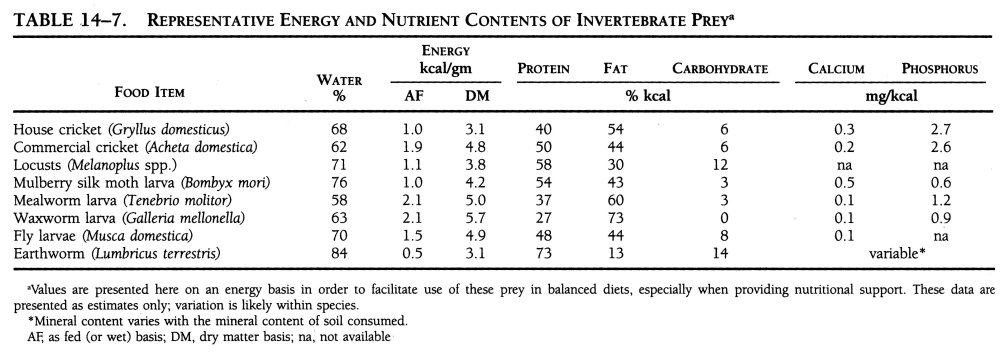
First of all I don’t troll for replies but thanks anyway. In this post I am attaching a table from Dr. D.R. Mader in his book Reptile Medicine and Surgery so that people have some help reviewing this on there own. While I fully believe all that I post when I say:

I have my doubts about gut loading and dusting and here's why. Leos don't eat plant matter and therefore do not have the enzymes required to digest it even if it's packed neatly into a cricket. Only the just recently enzyme dissolved material within the cricket may offer any nutrients. If you think dusting works read any lit. out there on vitamin consumption in humans and tell me if you think manufactured vit.'s do much good in herps as well.”

, I am leaving the floor open and allowing people to draw their own conclusions. As for dusting I don’t believe it to be necessary when using supplement such as Vionate and Osteo-Form as suggested in The Herpetoculture of Leopard Geckos (Vosjoli, Tremper and Klingenberg, 2005). My leos readily eat these powders with or without worms on and in them and no dusting required. These are proven supplements in many animals for overall health not just prevention of metabolic bone disease. Just because an animal is healthy doesn’t mean the dusting is the reason. I am a biologist and can’t remember much of my first year but not because I wasn’t paying attention. It’s more of a time issue. However, just like many first year students you have the right idea but not the whole story. Just like human geckos don’t get their “natural” diet. That is to say what their metabolism is currently evolved for; which happens to be scorpions and spiders mostly if I’m not mistaken. A predator of other predators that have animal remains and the stable isotopes associated with that in their system not plant matter. Vit. C is not Vit. C is not Vit. C. The manufactured supplements many people “rely” on daily do not react with their system as they believe resulting in expensive urine. While c from a lime and from a pill register very similar on a burn test from a spectrograph that doesn’t mean they are the same. If taking pills make you “feel wonderful” then keep doing it but if they are not derived from plant materials then it’s probably psychosomatic. You are very right, if not a bit caustic, with your last statement and your concern overall. So check out the table and remember, not all high numbers=good and ratios can be important; particularly phosphorus and calcium ratios.

Site Tools
