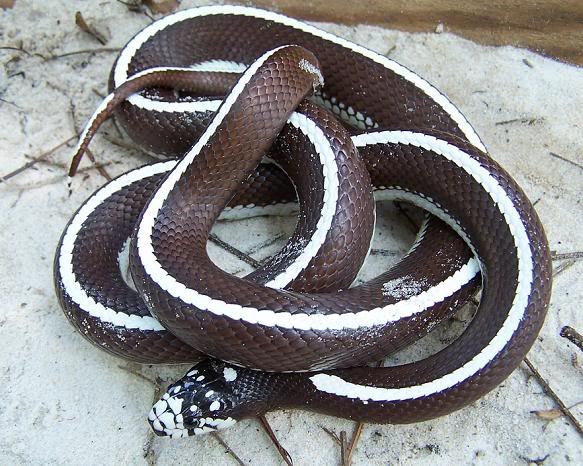
heres Freckles 


Welcome to kingsnake.com's message board system. Here you may share and discuss information with others about your favorite reptile and amphibian related topics such as care and feeding, caging requirements, permits and licenses, and more. Launched in 1997, the kingsnake.com message board system is one of the oldest and largest systems on the internet.


heres Freckles
Very nice .
Very Nice. Even with all the fancy breeds, colors and morphs I see on these post every day, the desert phase cals are still my favorite. Something about that black white contrast catches my eye I think. My next buy will probably be a nice striped one like that. I hope. Thanks for sharing.


and all desert stripers are locale specific pure, unlike all the other cal kings you might see for sale. So you purists.. pay attention!
In the wild these are only found near Scissors Crossing in the Borrego area in extreme southern california. Other striped cal kings (oastal phase) are found over a very large area and so are banded desert kings. If you have a desert striper YOU HAVE the real thing. Other desert cal kings are mix and mesh of other locales. Same thing with the yellow coastal phases and morphs.
Whenever I see people with a desert striper I wonder if they know the natural history. I wish they knew what a beautiful zone they are found in and what a small area they exist in. IMO these should be protected but classification would make it problematic since they are still classified as a "normal" cAL KING.
Anyway, love your snake. Thanks for sharing your pure locale specific cal king!
makes sense and good point. anyway nice snake and i like the looks of your than the one i used to have, mine was more of a yellowish cream stripe.
how do you know thats a "pure" locale calking rainer? i have several mixed calkings that very often throw stripes like the one pictured,along w/bandeds and everything in between i understand your statement about locale deserts being striped and have a small range etc., but i see noway to tell from that pic it is indeed one, please share why you think it is,,,,,,thomas davis

Posted by: thomas davis at Wed Jan 10 15:14:56 2007 [ Report Abuse ] [ Email Message ]
how do you know thats a "pure" locale calking rainer? i have several mixed calkings that very often throw stripes like the one pictured,along w/bandeds and everything in between i understand your statement about locale deserts being striped and have a small range etc., but i see noway to tell from that pic it is indeed one, please share why you think it is,,,,,,thomas davis
*Yellow bands and stripes are "coastal phase cal kings"
*Black and white striped and bandeds refer to "desert cal kings"
You are corect in that the "coastal phase cal kings" have been mixed for many years. They are the ones in your picture that have the yellow stripes. But the Black and white striped cal kings can only come from Scissors crossing. The pic was of a black on pure white stripe. When hobbeists refer to a desert cal king they always mean ablack and WHITE cal king. Never a yellow phase. Now you could say someone might have bred a coastal phase into a banded desert phase to get white stripers. But IF someone was to try and breed a coastal (yellow phase) into a desert black and white BANDED the yellow would still appear. It might take many generations of back breeding and selective breeding back to the desert to get a pure white stripe. And that would not be easy.
Also a lot of the 50/50 desert black and white bandeds or "high whites" where originally produced from breeding the desert cal kings into Bananna kings circa 1987.
In all, the deserts banded have been bred to death to acheive a nicers cleaner WHITE bands that do not turn yellow on the sides of the scales or belly of the snake. What you and I see in the hobby today is not what is found in the wild pops. What e see is captive breeding over many gens and selective breeding to acheive the whitest of whites on jet black. Absolutly georgeous animals and what many a herper could only dream of in the 80's.. About the best desert banded cal kings you will see in the wild are those that Shannon Brown posted here a month or two ago. It is difficult to find a sub par desert cal king. ...
anyway getting off the subject a little with some backround history. Hope this does not confuse as to what I was saying about the desert stripers.. Not to confuse the desert stripers with anything else. They ARE pure locale specific.
heres one same parents some are yellow some cream and some white like this one,would call this a "pure" desert?,,,,,thomas

See the sides on yours and the one in the first post. The sides are yellow. Check out these side to side pics of yours and you can see there are a lot of differences. Besides didn't the camera wash out the top stripe on yours a bit?
[KIKI's] scissors (desert striped) locale:

[Pac-Mans] scissors (desert striped) locale:
Coastal striped locale:
Also notice the white whites and jet black on the desert stripers. The coastals has neither of these.
so does that mean Spot is a desert cal king?
-----

so does that mean Spot is a desert cal king?
Things are not as simple with the deserts that are bred in captivity. The only thing we know for sure on locale are the scissors crossing (black and white stripe) dester cal kings. The rest is a little more complicated.
For one many cal kings get washed out on pics taken with a flash. So a cal king that appears white on a pic may not be as white in person. Also a lot of cal kings found in the desert areas are not white. They have creme to yellow bands with black to light brown bands and everything in between.
Early in the 80's people started crossing locales of desert kings in hopes of getting the perfect black and white cal king. This is similar to what people were doing with Florida kings before the hypos came along. There was a lot of selective breeding going on to produce the yellest florida kings and the whitest black and white cal kings. But the difference with cal king is the "albino coastals" (I don't think there ever was a albino desert cal king found) were being bred into the deserts in hopes of getting a white banded albino. When the hypo florida king came along people dropped the breedings of the yellowest flordidas because there was no need to improve them. Not so with the cal kings because they wanted to improve the albino into something different..
So the question is if you snake is a desert. I would say from what the pic depicts, yes. But the deserts have been crossed with mnay locales to get some of the whites and blacks you see today. For instance the first locales being bred into other deserts locale cal kings was the Joshua Tree cal kings. These had wide white bands. But they problem was the black bands were more washed out brown. SO people bred the Joshua Tree locales into other desert locales black and white banded cal kings to achieve a jet black and wide white bands.
Then fast forward to the banana kings. Then people strtaed breeding these new and improved desert cal kings (with the wide white bands) into the (coastal phase) bananna kings (Bannana = Newport cal king X various coastal stripes). What they were trying to do was create a desert cal king with lots of white or ALL White. You can see these today for a very nominal price tag I remeber the first rerally good bannana cal kings I saw at a show in San Deigo about 86 were going for $750. each. Lots of folks just don't know the work that went into them to get the high whites to look like that.
Since I am into locale specific snakes, I may check into those Scissor's Crossing locality cal kings in the future.
Good stuff!
-----
Genesis 1:1
actually... I took that pic with my cell phone... no flash... right at the moment, he looks pretty dull because he's gettin ready to shed, but he's got very clear bright white and black, no yellow, no washing out... I was just curious as to your opinion...
He's also being extremely photogenic this evening.... I just can't seem to take a good picture.... 


Still hard to tell how white he really is. But like I said in my post above he is definetly a desert "phase(if the pic is true to it colors).
Allow me to explain what I meant by desert "PHASE". There may be several generations of coastal in that snake and sevral generations of desert bred into it. Then fast forward 40 gens later and its pareants were selected due to being more white than yellow and everntually bred and produced a cltch that your snake was in. Then yours may have been the whitest of the clucth while its clucthmates may have been more yellow and thus being called a coastal PHASE ..see where I am going with this. It no longer has anything to do with WHERE THE SNAKE IS FROM!!!
It is a desert PHASE that we in the hobby use to describe a cal king from the extreme east deserts (the closer you get to the west the more yellow they are due to intergrade zones)with the exception of the scissors locale...thats what so interesting about the Borrego/scissors crossing striped cal kings. They are not that far from the ocean. Its a huge mountain that seprates the life zones and comes straight down on the other side into the desert. You can walk from the pine tress into chaparrel into marsh green swap and right into dry rocky cacti in 10 minutes.
Brian Hubbs is coming out with a new book on cal kings and other kings of the united states. He is THEE formost authority on Cal kings. Unfortunatly he knows nothing of what people have been doing in their basement snakes rooms in the last 4 years, He only can tell you about what the cal kings should and DO look like from each locale...If his new book is anything like his other book on mountain kings it will be exhaustive and I am sure he will have a lot to say about the different locale california cal kings. We may even see a resurgence of interest in breeding pure locale cal kings after his book release.
I understand phase, and I understand breeding for traits...
One thing I didn't realize until now was how much I was missing out on not knowing the breeder I bought from and not asking about bloodlines or history behind my particular snake... I also didn't realize that the amount of work put into these snake lines is just as intense as the work put into the breeding of champion quarter horses... I guess it just didn't dawn on me that for some of you guys these snakes are more then a hobby... but I do know I'm happy that someone put that much work into creating such beautiful animals... My life definatly would not be the same without Spot in it...
Hey Rainer,
It's funny how you take things for granted, until you don't have them anymore. I was born in SoCal and due to my Dad being in the Army I moved around a lot, but eventually settled in San Francisco, until my wife joined the Army and now we are in Virginia. Anyways, to make a really long story, somewhat short. I saw a lot of Cal Kings in the field, while in the process of looking for Rosy Boas. They never caught my interest, and at times would actually annoyed me, especially when a friend would yell out "A Snake!" and it was ONLY a Cal King. Needless to say, years later, my interests have changed and I'd be damn glad to have some of those local specific Cal Kings. I have Brian Hubbs' Mountain Kings book, another group of Lampropeltis that I'm really in to, and I can't wait to see his Kingsnake book. I got an e-mail from him in the Fall and he was shooting to have it out by Christmas, but I haven't heard anything since. I'm also really looking forward to his next project, Milksnakes. Oh Yeah! I think your right, I could see a renewed interest in local specific Cal Kings. Thanks for the info.
-Phil
There must be something in the air because there is a general increased interest in locality Cal Kings. Even those that don't have any particular sought after morph trait.
A couple people have contacted me asking when I'm going to be breeding my Redding locale snakes.
I'm looking for locale mates for my Antioch locale, and I'm looking for some locale specific (preferably from recent wild take) stripers - not desert, but the chocolate and yellow stripers.
You can see some brown in Redding locale, but they are not as brown as farther south. Interestingly, I found a piece of a several month old DOR cal king in downtown redding that is more brown than the live ones I've found here in north redding, pretty close to the tip of the valley (about 5 miles north and you start climbing in elevation)
Maybe the aged DOR had its color fade, maybe the influence of the darker cal kings in the mountains just north of me is influencing the cal kings where I am at more heavily than the cal kings just a few miles south where I found the DOR skin.
I need to find more local Cal Kings to know. Could be that the ones I've found by luck are just darker or the one found in downtown redding was just sun bleached (it was only a piece of skin, rest of snake was long gone).
-----
3.3.4 L. getula californiae
1.1 L. getula nigrita
1.0 Boa constrictor constrictor (suriname, fostering/rescue)
2.3 Elgaria multicarinata multicarinata
I got in a little bit of trouble in Redding when I was in college. Oh the good ole days! Man, she was good looking too, worth getting in trouble with! LOL! 
-Phil

He's not from the desert, nor does he have yellow.
His cream is not as brilliant as the pet trade desert phase banded, but it is not yellow.
Now - his offspring with this gal -

have varying degrees of yellow, not as brilliant as hers - but definitely there.
-----
3.3.4 L. getula californiae
1.1 L. getula nigrita
1.0 Boa constrictor constrictor (suriname, fostering/rescue)
2.3 Elgaria multicarinata multicarinata
Pure desert stripers occur in several areas. Of course, lower banner grade and San felipe creek(that crosses by scissors crossing) is amoung them. They also occur in other areas where there are drainages that go westward from the desert.
About high yellows and high whites. They were created with a california city abberant(natural occuring) That animal was crossed to many costal morphs. That was mid seventies. Cheers
FR,
I recall that the first real high yellow banannas came from the Newport cal kings but you were the one producing them along with Ruiz and Lemke, so I guess you would know more than I >
Later weren't those "banannas" then mixed with the California city locale as well as the Clark County- Nevada, San Felipe, Baja California locales to produce the high whites? or were you already out of kingsnakes by then? Also do you remember there were some guys (forgot there names but were well known at the southern herp society in the valley) were working on the albino deserts circa 1980.
I have also collected the cal kings in california city and all the ones I saw had a very high band count. Do you happen to have a pic of this california city locale from back then?
Please, if you have the time..give us a short history lesson on the high yellows and high whites.
I saw an desert striper this guy Brian Gurdy (not Brian McGurty) had. He claimed it came from a true albino wc desert phase from the Mojave desert somewhere, I believe. He did not seem real into locality and I could not veryify any collecter info at the time so I am somewhat skeptical as to the true origins. Regardless it was a very different looking albino, pure white bands and the albino backround color had a very slight but noticable bluish tint.
sounds cool but was it any different from the other albino desert kings that were manufactured? I mean there were different strains of albinos used. Can anyone post pics of banded california amel desert kings? Would love to see some since they kinda faded away since the early days and I have not see any in a while.
Kerby?? Where you at? Post some pics and share some info!
Yeah, where is Kerby? Hey, holidays are over Kerby, time to get back to work! LOL!
-Phil
Really don't know if it was different from the manufactured desert phase albinos as I haven't seen any up close.
Very interesting!!! heres a few pics of my babies. i LOVE striped cal kings  in case noone noticed
Skunky:

Dweezil:
Speckle:

~kin
-----
~Sober Serpents~
~~~~~~~~~~~~~~~~~SNAKIES~~~~~~~~~~~~~~~
Corns:
.1 Normal (Gertrude) [just a pet...she started it all]
1. Orange normal (Romeo)
1.2 Miami Phase (Hector, Emily, Charlotte) thanks jeff!
2. Miami Phase part zigzag (Starkey, Mcvitty)[Emilys F2]
1. Amel het Blizzard (Dunesbury) .1 Blizzard (Detta)
1. Classic het Hypo, poss het Amel, Anery (Cobra)
1.1 Classics (Henry VIII, Cassy) [Emilys F1 babies]
.1 Deep Red Amel (Pepperoni) *1. Deep red amel coming soon!
1.1 Hypo zig zags poss HET Caramel (Bernard, Abegail)
.1 Hypo HET Stripe (Gracie Lou) 1. Hypo Stripe (Gideon)
1.1 Anery HET Motley (Lleroy, Persia)
.1 Candy Cane (Peaches HoneyBlossom) [Just a pet]
1. Abbotts Okeetee (Albert) [Charlottes son]
1.1 Snow (Crickle, Isis) .1 Green Snow (Maya)
1. Caramel poss HET Butter (Topher)
.1 Anery stripe (V) [husbands snake...he named it]
.1 Orange Reverse Okeetee (Lonna)
1.2 Bloodred HET Amel 1. Amel HET Bloodred
Others:
1.1 Black rats (Willard, Cecily)
1.1 Striped Cal Kings (Dweezil, Skunky)
1. High-white Reverse Spotted Cal King (Wishbone) *.1 soon!
.1 Albino Stripe Cal King (Eve)
.1 Bananna spotted/stripe cal king (Speckle) Thanks Jeff!!!
1.1 Thayeri (Giuseppe[MSP], Cheyenne)
1.1 Creamsicle HET Motley(Orangejello, Genevieve)
1. Creamsicle motley (no name) Thanks Jimmy!!
~~~~~~~~~~~~~LEOPARD GECKOS~~~~~~~~~~~~~
.1 Blizzard (Blitz)
.1? High yellow (no name)
~~~~~~~~~~~~~TURTLES~~~~~~~~~~~~
.1 white cheeked mud (Opel)
.1 snapping turtle (no name, ideas welcome)
I think people are confusing the striped cal kings with the Borrego striped cal kings. The Borrego (scissors crossing stripers are jet black and white. The common coastal stripers are yellow and brown.
The middle pic you have is a local specific cal king I was reffering to in my post as being rare and coming from a very small area in calif. The other pics are the common cal kings found all over calif.
Wow Kin!,Dweezil is Smokin" Jeff
....so then what would you call this guy????

:Mark
-----
Surrender Dorothy!
a damn gorgeous snake lol...
From my untrained eye, I say that that is a scissors crossing Cal King? Gorgeous too! On a side note. Do you remember JETZEN's solid brown Cal King? In my personal opinion, that and $5 will buy you a Starbucks coffee, was another gorgeous Cal King.
-Phil
Rainer I'm gonna have to disagree that all captive born desert stripers are defacto 100% pure Scissors Crossing locality. You could get a pure black and white striper by breeding for example a banded Clark County, NV to a Scissors Crossing striper. First gen you would probably not get full stripers but you would get pure black and whites which would carry the stripe gen and could then be breed back to the original Scissors Striper and you would get a few stripers that would be every bit as black and white as a good pure locality Scissors striper.
BTW extremely nice desert striper pac-man. Very top of the line colors but I would not call it a Scissors locale unless the breeder actually could verify that.
And yes Rainer I do agree to the uniqueness of the wild Scissors, they are distinct but I think you can also make indistinguishable fascimilies with other recipies.
Sure you could breed a Scissosrs crossing to a Clark Co and then back breed the parents to get stripers. But they will not look the same. I have seen some that have the side mottled with white or the color of the black was washed out. Basically not as clean.
I also don't think there were to many of these "artificial" stripers produced. I did some breeding of the stripers to bandeds from the scissors crossing area and got nice stripers. Since the gene is already in the bandeds from that area it does not change the look of the scissors locale..(yes I use the scissors locale as the name but am aware that the stripers are found in the drainages and grades in that area.)
Well my experience is alot less than yours I'm sure as I have never even seen a wc Scissors but I did have a true Scissors locality striper which the original collecter and breeder of the founders was Randy Limburg. It was a very old lone male he had left over from many years previous and this thing was nowhere near black in color. In fact it was every bit as brown as an average coastal phase and the stripes and belly were cream colored not bone white.
I also had some Jason Van Kirk banded Scissors and after about 18 months the black was turning brownish.
Then there was two striped Scissors I had purchased from Brian Gurdy that were from a Tim Turmezi line and those did stay pure black and white b ut again I only had them for about 18 months.
My point is in my experience some of the captive Scissors lines don't always stay pure black and white. I think that is probably true for the wild ones but again I am only going off the cb's I have seen and haven't seen any wild Scissor's in person.
Well my experience is alot less than yours I'm sure as I have never even seen a wc Scissors but I did have a true Scissors locality striper which the original collecter and breeder of the founders was Randy Limburg. It was a very old lone male he had left over from many years previous and this thing was nowhere near black in color. In fact it was every bit as brown as an average coastal phase and the stripes and belly were cream colored not bone white.
hmm. Maybe Randys was an intergrade zone? I will call him and ask.
I also had some Jason Van Kirk banded Scissors and after about 18 months the black was turning brownish.
I had tons of pics from kings in that area but lost them in storage a few years back. I wish I still had them so to refer to the wildcaught bandeds in that area. Sometimes you just never know when pics could come in handy.
Then there was two striped Scissors I had purchased from Brian Gurdy that were from a Tim Turmezi line and those did stay pure black and white b ut again I only had them for about 18 months.
I would consider Tim Turmezies line from near scissors crossing.
very nice congrats, calkings are one of my faves for sure ,,,,thomas davis


Very nice relly cool markings. here is a pic of my stiped cali a little smaller than yours
very nice cool markings here is apic of my striped cali just a little smaller than yours

beautiful stripe pacman
but i'm kinda curious about what my guys are now lol


-----
1.1 cal kings
1.0 rat snake
but i'm kinda curious about what my guys are now lol
I think that everyone is mistaking my post about locales in general.
Your first snake is a coastal blend and the second a blend of perhaps coastal X desert (and perhaps) X scissors (?). There is actually no way to tell with the menagerie of cal king morphs/locales today. They are all mixed up. People have been breeding the different locales of cal king togther for so long that the only way to get a locale specific banded or striped coastal is to catch one yourself or get some from someone who does keep his lines locale specific. Try and remember that in the mix are also different reccessive traits that folks have been breeding together as well. SOme are culled for the pet trade. SOme are kept as projects and some are sold to other herpers. This has been going on for a long loooong time.
My point in this was that the scissors crossing cal kings are locale specific. They have a completly different look... Maybe I see it because I have caught them and been playing with cal kings going into my 4th decade. Sure there are other white top stripe cal kings. But they don't look nothing like a scissors crossing. With others there is no way to tell unless its from one of the northern locales up near Fresno areas abd such. Also some of the reccessive traits like the wrongly named "Ghost" are locale. But these have been outcrossed into other cal kings about 12 years ago by Brian Barzyck, so no way to tell on those either. The mendotas and such Kerby can explain better...
I wish Kerby would chime in here. He may not have the early experiences that I have but he sure is up to date on whats going on with the northern type Cal kings today.
KERBY U OUT THERE??? Where the hell are ya when I need ya??
Your first snake is a coastal blend and the second a blend of perhaps coastal X desert (and perhaps) X scissors (?). There is actually no way to tell with the menagerie of cal king morphs/locales today. They are all mixed up.
thanks, thats about what i thought, pretty much just mutts, pretty mutts tho lol
-----
1.1 cal kings
1.0 rat snake
but i'm kinda curious about what my guys are now lol
tecnically not mutts at all. They are the same spp. Just different seprate locales that have been seperated for thousands of years give each place a different look. Most cal kings DO intergrade with each other. But many isolated populations like the scissors crossing area do exist because of the life zones.
You have to remember Calif is very different from the rest of the country. You can drive up a mountain from the desert floor and every couple miles stop and check the plants and trees with be different.
tecnically not mutts at all. They are the same spp. Just different seprate locales that have been seperated for thousands of years give each place a different look. Most cal kings DO intergrade with each other. But many isolated populations like the scissors crossing area do exist because of the life zones.
You have to remember Calif is very different from the rest of the country. You can drive up a mountain from the desert floor and every couple miles stop and check the plants and trees with be different.
well all domesticated dogs are the same ssp right? and over hundreds of years have been spasificly bred for cirtian traits. manmade isolation in a way, and if givin the oportunity will breed with any dog they can (labradoodle for example) so mutt really isn't a bad anology, from my view point anyway.
and i used to live all over the state (navy brat lol), and boy do i miss it, the south just doesn't do it for me lol
but i do see what you're saying, it's been almost a decade since i was there, you forget things lol
-----
1.1 cal kings
1.0 rat snake
It is possible that domestic dogs, and probable that domestic cats, even though they have a scientific name - are actually man made species resulting from hybrids of what natural selection produced.
Brian Hubbs should be publishing a book at some point (won't say soon, only he can say that) on getula that is suppose to have a huge section devoted to the different wild types of California Kingsnake. Something like 19 (more??) different identifiable phases of the Cal King that are region/locale dependent.
The differences can happen in under 100 miles.
The Cal Kings I use to catch in Walnut Creek look just like the Cal King in the Stebbins field guide - but in the same county, just a few cities over (IE Antioch), they aren't quite as brown and the banding is a little dirtier - at least from what I've seen.
The difference may be that Antioch is closer to the Delta where the Sacramento river and the San Joaquin river meet. It would be interesting to see what they look like further into the delta, on some of the islands in the delta, etc.
I know there are gopher snakes on some of those islands, so I assume there are cal kings too (especially now that we have bridges going to them).
-----
3.3.4 L. getula californiae
1.1 L. getula nigrita
1.0 Boa constrictor constrictor (suriname, fostering/rescue)
2.3 Elgaria multicarinata multicarinata
I lived in Davis for a year, and the Cal Kings there looked very different from any others that I have seen in the Bay Area and surrounding areas. There went another missed opportunity. I know Dr. Rick Staub still has some available every now and again.
-Phil
That's my word of the day! Thanks for the laugh, oh my ribs hurt!
-Phil
don't forget Schnoodle, Cockapoo, Yorkipoo and Puggle lol
-----
1.1 cal kings
1.0 rat snake
I lived in Germany for many years too. Schnoodle sounds a lot like something I used to eat as a kid. LOL!
-Phil
it made me think of strudle/strusle (i cant spell forign pastries lol), so not so far off? lol
-----
1.1 cal kings
1.0 rat snake
don't forget the Cockinese or the Dameranian....
seriously though, you gotta give people credit for finding ingenious ways of making some money off the mutt puppies they got by accident cause they didn't get their dog fixed...
into this picture? There was a post below by Byron.d with a pic of his Nitida. The Nitida are another unique looking "Local?".
This Cal King species is getting more interesting by the minute.
-Phil
I've heard a couple different reports that Nitida X MBK produces something that looke eerily like a splendida.
Anyway - in the kingsnake world, we have subspecies that clearly are visually distinctive being sucked and lumped together.
But in the treefrog world, they are now telling me that Pseudacris regilla now has several different subspecies, and may in fact be several species. But you can't tell them apart visually, you can only tell them apart by comparing mtDNA with other specimens from other locals.
Me thinks there are some taxonomists with some loose screws.
-----
3.3.4 L. getula californiae
1.1 L. getula nigrita
1.0 Boa constrictor constrictor (suriname, fostering/rescue)
2.3 Elgaria multicarinata multicarinata
I definitely agree on that !!!!!!!! I've read that there are Hyla that can only be seperated by call, yet they inhabit the same areas, yet hybridize in captivity? I have to guit, my head is starting to hurt. 
-Phil
Help, tips & resources quick links
Manage your user and advertising accounts
Advertising and services purchase quick links
