Has anyone heard of a striped pure kenyan? If anyone has could you explain to me how the morph is made and if it is compatible with other kenyan morphs and how much they usually sell for? Thanks alot!
Reptile & Amphibian Forums
Welcome to kingsnake.com's message board system. Here you may share and discuss information with others about your favorite reptile and amphibian related topics such as care and feeding, caging requirements, permits and licenses, and more. Launched in 1997, the kingsnake.com message board system is one of the oldest and largest systems on the internet.


"Striped Kenyans"
herphaven1
Jan 10, 2007 03:18 PM
Replies (11)
AncientDNA
Jan 11, 2007 12:25 PM
Try these two links to posts from June
http://forums.kingsnake.com/view.php?id=1103141,1103141
http://forums.kingsnake.com/view.php?id=1103765,1103765
-----
Thanks,
-JC
rosyboas.to
1.1 San felipe (CB'93)
0.1 ghost San felipe (CB'98)
1.0 ghost San felipe (CB'03)
0.1 het ghost San felipe (CB'04)
1.0 ghost-line San felipe (CB'98)
1.1 hypo Borrego (CB'99)
1.1 albino Whitewater (CB'02)
1.1 double het for snow (CB'95)
1.0 snow rosy (CB'04)
1.1 Joshua Tree (CB'96)
1.0 Bagdad (CB'99)
1.1 Harquahala Mts. (CB'04)
1.1 Temecula albino (CB'02)
0.1 Temecula albino (CB'05)
1.1 Hemet anery (CB'05)
0.1 Boa constrictor (CB'92)
herphaven1
Jan 11, 2007 01:30 PM
Okay thanks,I never knew that the genetic stripes werent pure.
chrish
Jan 11, 2007 04:09 PM
The appearance of a stripe in Kenyan Sandboas was bred by selective breeding the most striped individuals to each other. It isn't a simple locus like albinism.
But it is derived totally from captive lines of Kenyans. There is no "impurity".
-----
Chris Harrison
San Antonio, Texas
herphaven1
Jan 11, 2007 04:47 PM
What I met is that they have bred other species into the genetic stripe bloodlines from the links that "AncientDNA" Gave me. I know that their are Kenyans that do the stripe and that are from years of selective breeding. If you look at the second link the "AncientDNA" gave me you will see what I met.
RMB
Jan 11, 2007 05:14 PM
..
CBH
Jan 11, 2007 07:36 PM
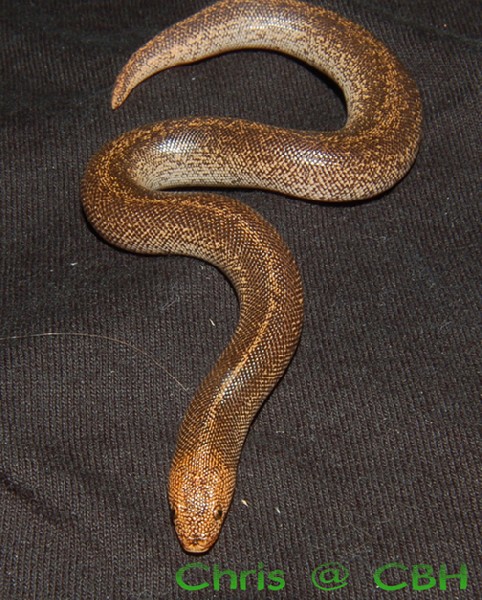
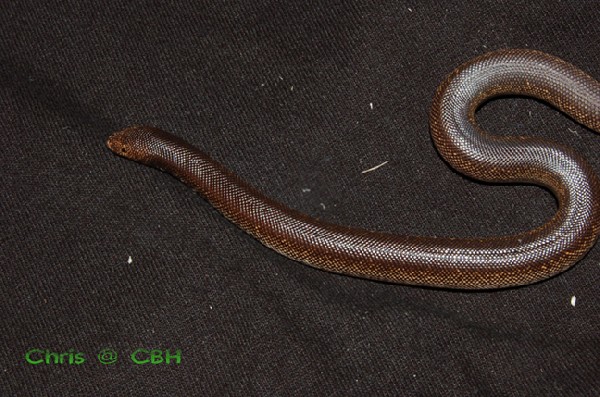
The striped phase from the second post is from a normal morph cross with a "rufescens phase" morph. The rufescens phase is the same species as a normal looking kenyan just from a different locality.
PICTURES: 1st and 3rd are of the "pure" rufescen phase locality. The 2nd is a 75% rufescen phase.
Chris

-----
Christopher E. Smith
Contact
Captive Bred Herps
chrish
Jan 12, 2007 12:18 AM
Looking at those rufescens makes me wonder what an amel would look like.
Would they have orange with a peppering of pink spots?
Or is there a normal spotted pattern under the rufescens hypermelanism that would show through? If that was the case, they would look similar to normal amels.
I suspect the former case, i.e. that the rufescens morph is a result of the disruption of the normal brown/black spotting and that this gene would still control pattern even in the absence of melanin.
-----
Chris Harrison
San Antonio, Texas
herphaven1
Jan 12, 2007 12:25 AM
I apologize I did not know I thought that rufescens were another eryx species.So they are just a locale or morph?
SRX
Jan 12, 2007 08:20 AM
Actually, I am working towards the axanthic "granite" Rufescen's...Black and White speckled(or Salt and Peppers)!!! I imagine that they will be more visibly stunning, but if you crossed Rufesen's with some of Saving Grace's amel's, now they may be pretty hot.
SRX
Jan 12, 2007 08:22 AM
Brian Emmanuel had some Ruffies het for amel some time ago, but did not produce any amelanistic Rufescen's. I believe he has since sold all of his Rufescen's to Mark Bell.
CBH
Jan 12, 2007 03:04 PM
I think the rufescens phase will eventually bring forth some very interesting morphs. I will be breeding them into Amel het anery this season...and snows in 08'.
Looking forward to see what the first amel, anery, and snow crosses will look like.
Chris
-----
Christopher E. Smith
Contact
Captive Bred Herps
