I would agree with the previous statement, that not much is known about crested genetics...
I'll throw out a few scenarios, with photos of offspring.
First, let's do a Harlequin X Harlequin ( some might say flame) pairing.
Male: ( produced by Anthony Caponetto)

Female: ( produced by Dave Armador)

In my experience, nice flames/harlequins bred to nice flames/harlequins produce almost entirely flames/harlequins. You may end up with 25% or so of the offspring with less pattern than either adult, 50% with similar pattern to the adults, and 25% ( or less) that are above and beyond what either parent looks like. Out of our different flames/harley groups, we have had no memorable patternless/tiger/dalmatian geckos.
Here's a juvie from the above pairing:

Next scenario, Pinstripe X Pinstripe
Parents ( male right, female left, both produced by Allen Repashy)
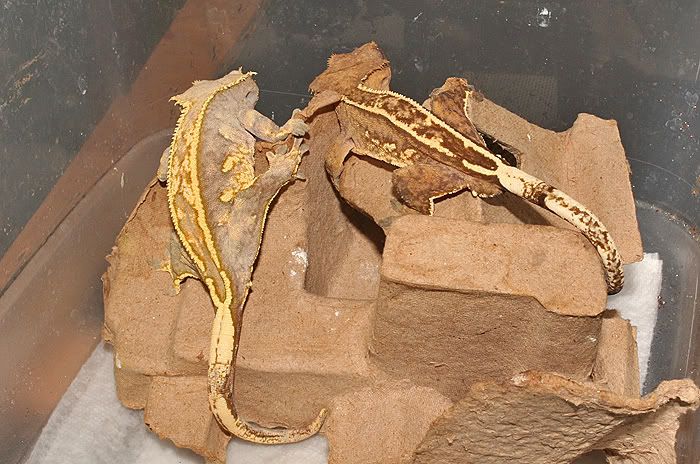
clutchmates:

I'd say the one with minimal patterning is definitely an abnormal outcome ( atleast for both parents having so much pinstripe). I'd say most of our pinstripes from 99% pinstripe male, and 99% female, will be 75-100% pinstripes, with very few below the 75% mark. If you do say a 100% pinstripe male, to a 75% pinstripe female, or vice versa, you'll get only a couple full pinstripes in a year, mostly 75% pinstripes, and a few below the 75% pinstripe mark.
Scenario three:
Male 100% pinstripe ( purchased from Randy May, produced by Allen Repashy):

Female, yellow/orange with a few dalmatian spots ( unknown origin):

Offspring from Pinstripe X non-pinstripe pairings In my opinion produce about 50% offspring with 25-75% pinstripe, 25% with very minimal to no pinstripe, and 25% with 75% pinstripe or more.
Here are two offspring from the above pairing to give you an idea. Here's one with a typical amount of pinstripe so far from this pairing ( straight out of the egg):

and here's one named 'sideburns', as it has really long lateral stripe scales:

so far the color is ranging from a base slate or yellow, similar to either parent, but none have reached adult hood yet.
Scenario Four:
Male ( red/yellow flame, unknown origin):

Female ( Dark/cream flame, unknown origin):

I would say out of this pairing, we've had about 50% mostly patternless geckos, and 50% flames. Of the patternless, all have been red, and of the flames, all have been red and creamy/white, except one which took the mothers coloration.
Here's to show you two of the mostly patternless cresteds, one in it's plain phase, and one in it's colored up phase (clutchmates):

and here's one of the red/cream flames:

Scenario Five:
Male ( dark/cream harlequin, unknown origin)

Female ( extremely light, patternless, unknown origin)

From this pairing, I'd say we got 50% mostly patternless geckos ( minimal tiger pattern), and 50% flames, with varying degree of pattern ( only 1 or 2 I would consider harlequin):

and a few like this:

( adult coloration unknown on most of these, as they are hatchlings-juvenile in size, but one could make a good educated guess from the parents  )
)
Hopefully this helps in educating you further on what you can/can't expect from any given pair. It's something that makes Cresteds extremely interesting to work with, because you never really know what you're going to get, but I think it's also a turn off for others. Obviously there are hundreds of possibilities for what pairings you choose to put together. Currently I feel it's important to try to create something as interesting as possible, with a specific outcome in mind, as opposed to something that may be quite predictable, and somewhat normal. ( All of this is my experience. All percentages are generalizations, and should not be used as fact).
Andrew Gilpin
L.A.C. Herps
Living Art Creations Herpetoculture



