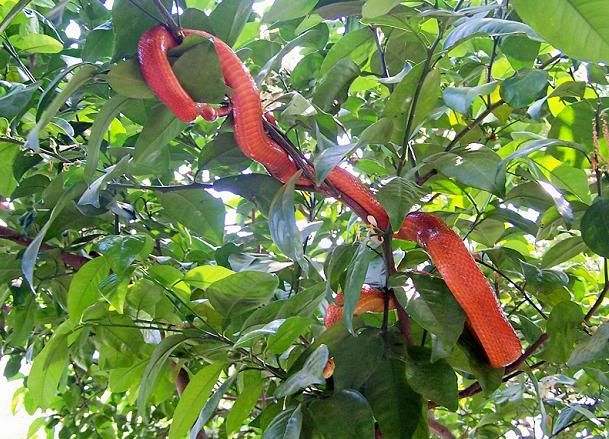
. . . piebaldism?
I recently got some WS yellow rats (yeah, not kings, but since this pattern mutation occurs in kings, I figure I'd ask here as well), and I'm thinking it is a form of piebaldism.
Thanks!

Welcome to kingsnake.com's message board system. Here you may share and discuss information with others about your favorite reptile and amphibian related topics such as care and feeding, caging requirements, permits and licenses, and more. Launched in 1997, the kingsnake.com message board system is one of the oldest and largest systems on the internet.



. . . piebaldism?
I recently got some WS yellow rats (yeah, not kings, but since this pattern mutation occurs in kings, I figure I'd ask here as well), and I'm thinking it is a form of piebaldism.
Thanks!
There are no whitesided yellow rats.
What you have are whitesided everglades rats. They just visually look like yellow rats when the whitesided reccessive trait is applied.
-----
I still don't need no spell chack.
Yeah, so they are really Everglades.
But back to my question: is white-sided a form of piebaldism? Thanks!

In addition, your "white-sided Everglades" should have a reddish colored tongue, as opposed to a black tongue(Yellow Rat).
at least it is in the "purest" forms of the "Everglades Rat".
best regards, ~Doug
-----
"Better to be silent and thought a fool, than to open mouth and remove any doubt!"
"Posted by: DMong at Mon May 7 16:48:12 2007 [ Report Abuse ] [ Email Message ]
In addition, your "white-sided Everglades" should have a reddish colored tongue, as opposed to a black tongue(Yellow Rat).
at least it is in the "purest" forms of the "Everglades Rat". "
The tongue color can be effected by the WS gene so it really is not a telltale sign for anything.
I bred the ws everglades to the ws blackrats. They all had pink tongues.
here are a pair of adult whitsided everglades from original wc stock.
-----
I still don't need no spell chack.
Well, that's true,....it's possible the white-sided gene would tend to lighten the tongue pigment up as well if it had something else in it's lineage,......but from what Bill Love told me many years ago, and from the ones I've seen, the true Everglades Rats have reddish pink tongues along with the typical orange coloration, in addition to having thinner, less pronounced longitudinal stripes.........basically, I was only trying to say that under "normal" circumstances,everglades would typically have a reddish/pink tongue. Other snakes that many would suspect as possibly being an everglades also have yellow gene-flow, thus making the tongue somewhat darker.......wouldn't you agree?
~Doug


-----
"Better to be silent and thought a fool, than to open mouth and remove any doubt!"
Mark!,.......that's a real "screamer" you got there!!
I hope you didn't think that the standard wild-caught yellow Ratsnake that I posted was supposed to represent an "everglades"!LOL
I will however, say that is a gorgeous representation of one that you posted!....that's a beauty!
~Doug
-----
"Better to be silent and thought a fool, than to open mouth and remove any doubt!"
One of my favorite wc snakes.
:Mark
-----
Surrender Dorothy!
AHHHH! My EYES! Screamer!
Todd Hughes

what have you got "brewing" in those eggs!LOL, are they Kings?
~Doug
-----
"Better to be silent and thought a fool, than to open mouth and remove any doubt!"
Old pic of '05 specs. No eggs here yet, hopefully soon, one splendy in the lay box and one in shed.
Todd Hughes
I have never caught a nice “Everglades” rat in or near the “Everglades” as in near Everglades National Park or in any predominantly “glades like” habitat. Those were always yellow rats, or a pretty sorry example of Everglades rat at best. The very nicest true “Everglades” rats were from brackish slews and muckland riversides that were populated by fiddler crabs and cypress and mangroves. Maybe because I looked there more, but the area of Pompano where Palm Air was created was great, some areas along New River in Ft. Lauderdale and through the Emerald Hills area of Hollywood were great. All my favorite places are now basically completely developed and lost forever. Those were the nice orange eye type classic Everglades rats. I always thought maybe the color was influenced like the color in a Flamingo, up through the food chain from the chitin in the little shrimp into the snakes, because yellow rats were found sometimes just a few blocks away in drier fields where you’d find garters and coachwhips. They seemed to be a very highly fragmented thing throughout the range, if you could call it that. I’d be interested in the observations of some people familiar with field collecting them. But Crimson King, I never saw one that good!
I used to find similar ones back in the '70's by shining a flashlight in the Australian pines. Even then, you could tell a "good'n" from a normal yellow easily.
:Mark
-----
Surrender Dorothy!
but from what Bill Love told me many years ago, and from the ones I've seen, the true Everglades Rats have reddish pink tongues along with the typical orange coloration, in addition to having thinner, less pronounced longitudinal stripes.........basically, I was only trying to say that under "normal" circumstances,everglades would typically have a reddish/pink tongue. Other snakes that many would suspect as possibly being an everglades also have yellow gene-flow, thus making the tongue somewhat darker.......wouldn't you agree?
Yes what Bill is referring to are the normal phenotype. The tongue color would not fall into this description of an everglades with the WS gene. The everglades rats do have some gene flow but these whitsideds have been around for a long lomg time*. I saw the hets and parents. They are pure everglades and not yellow rats.
Its a good thing I save old pic's. You never know when one might come in handy. Here is a pic of a WS everglades crossed with a WS blackrat ( I know because i did the cross right after the WS blackrats from Miskimmon showed up on the scene). As you can see the tongue is still reddish. Now if Bills theory would be true this should not happen:
Here are some more pics of the cross and how they came about.
As you can see the white sides are a lot cleaner. The Whitesided blackrat and Whitesided everglades are allelic. In other words thier genes match up and do not create hets. These are all 1st generation.
WS Blackrat x WS Everglades neonate:
WS Blackrat x WS Everglades neonate:
WS Blackrat x WS Everglades subadult:
WS blackrat:
WS everglades:
* I kinda coined the phrase Whitesided everglades. These were around for quite a while known as "Ghost Glades". I decided to change the name to "Whitesided" after the Miskimmon whitesided blackrats came on the scene (he called them licorice stick) and the ws bulls. IMO all these stupid new names just confuse people in the hobby. Just recently we saw posts of Kerbys cal kings which are misnamed and Shannon Brown who is an experienced keeper and breeder of colubrids even had to ask him what all these misnomers meant. Can be very confusing and i wish we would all stick to the proper names of genetics as well as listing species names with hybrids. end rant
-----
I still don't need no spell chack.
yeah!,...I understand every bit of what you're saying. I also remember many mutations through the years being misrepresented!
Shannon and I see eye to eye on many milksnake subjects as well.
I remember the so-called "anerythristic" Yellow Ratsnake that was first sold by(I think Gold Coast Reptiles) only because he didn't know what else to call it!LOL.......but being a light grey coloration with dark/normal stripes, It was clear to me that I was looking at a "hypoxanthic" animal, only because it had some yellow remaining around the face,....otherwise it would be an "axanthic" animal(void of all yellow), are these animals responsible for the genetics in the WS?, or are they one in the same?, and have always been "Everglades", and not "Yellow Rats"?
Normally, I would already know all this, but I've been way to busy in some other areas, and haven't been to many shows like I have in past years.
~Doug
-----
"Better to be silent and thought a fool, than to open mouth and remove any doubt!"
**Just recently we saw posts of Kerbys cal kings which are misnamed and Shannon Brown who is an experienced keeper and breeder of colubrids even had to ask him what all these misnomers meant.**
True, but I'm not the one who "labeled" them. The Palomars have been called "Ghosts" for quite some time now. I'm not even sure that Brian from B.H.B. is the one who labeled them that but he has had them for 10 years or so....and to change the name would also be confusing..ya think?
How about those Davis "black bellies", there's nothing black belly about them LOL
And let's talk about the "Lavender" cal kings...no, on second thought let's not LOL
Or how about the Lavender Albinos or Albino Lavenders or Red-eye Albino
Or Blue-Eyed Blondes, almost all cal kings have a blueish eye 
Or how about the "Snow" cal kings..do they mean High Whites or Blizzards?
Or how about the "Banana" cal king, which really has very little yellow...but the Albino Banana is almost ALL YELLOW
Of course there are probably...too many to count..."hypo" cal kings
Kerby...
-----
Lonesome Valley Reptiles
www.lonesomevalleyreptiles.com
Specializing In California Kingsnakes
Kerby,
How about the Ghost Glades that i changed to WS everglades? The names "Ghost Glades" was originated by the founder.
How about the licorice sticks which i changed to WS blackrats. That name Licorice stick was originated by the founder George Miskimmon.
how about the many hybrids which I started calling by their ingredients like:
Jurassics which I call Honduran x Florida/cal
Imperials which i call Cal x pueblin
Painteds which i call Cal x pueblin
It all has to start somewhere. Those people who originated these animals are long gone or most people don't even know who originated them anyway. YOU are in a position to straighten things out. If it ever comes back to BHB about the palomars or wahtever or whoever you know that they cannot argue with your reasoning. They know you are correct. Its up to you man.
This should be a new trend in herpetoculture and this topic should also have its own thread.
-----
I still don't need no spell chack.
I agree, as I have been talking to people about the same topic in Pits. The thing is it is even more important for some this particular year and here's why.
The White Sided Bull was originally thought to be Anery. It was bred to Hypos and Albinos and those double hets created offspring that looked like Snows and Ghosts so that's what they were and still are called by many.
However Axanthic Bulls are now established in the hobby and this year it is a good bet that "true" Snows and Ghosts will be produced and this is going to unleash arguments, copy cat pricing and confusion.
I think Rainer is right Kerby. It is also very complimentary to be put in a position where people [I am sure many people] would take what you have to say about naming these snakes very seriously. I only can think of two other breeders whose names are brought up as commonly as yours when it comes to Cal Kings and you have more variety than both of them. It is also safe to assume you are crossing them and experimenting with them before most will too. I know it is not your resposibility to correct and rename things, but if you do I think people will listen.
Tom Stevens
-----
TomsSnakes.com
So if I decide I want to breed my Cals, since I still don't know what to call my female, I'll just call them Fry-Spots and everyone here will know what I'm, talkin about...
My Male - Spot

My Female - Fry

-----
"Not one shred of evidence supports the notion that life is serious."
This is also a problem, people give names for one reason or another and sometimes a name which is far from the best choice sticks...... Tom Stevens
-----
TomsSnakes.com
yeah, I have no desire to try to name anything... Especially since I don't even know for sure what I've already got...
-----
"Not one shred of evidence supports the notion that life is serious."
**It is also very complimentary to be put in a position where people [I am sure many people] would take what you have to say about naming these snakes very seriously. I only can think of two other breeders whose names are brought up as commonly as yours when it comes to Cal Kings and you have more variety than both of them. It is also safe to assume you are crossing them and experimenting with them before most will too. I know it is not your resposibility to correct and rename things, but if you do I think people will listen.**
Tom, thanks for the compliment. I have been thinking for some time about doing a "Genetics Page" on my site for my cal kings...but I now think that I will submit an article for Reptiles magazine (more exposure) and see if they will print it.
And yes, my plan is to breed every possible combination of recessive genes in cal kings using a simple matrix. Eventually producing cal kings that display 2, 3 and 4 recessive genes at the same time. I too want whatever labels we put on those cal kings to be accurate.
Kerby...
-----
Lonesome Valley Reptiles
www.lonesomevalleyreptiles.com
Specializing In California Kingsnakes
The originating locale for the Whiteside morph produces primarily yellow rat snakes, with the occasional orangish rat snake here or there, but rarely anything you could call an Everglades rat. Being that the whitesided Everglades rat snakes are about colorless anyway, I think it'd be pretty hard to determine whether the original animal was anything close to Glades rat or not. More than likely, whoever originally bred them thought it would be cool to breed them into Glades instead of yellows.
Agreed.
:Mark
-----
Surrender Dorothy!
White sided is a form of leucism.
I believe piebald is also a form of leucism.
There is a specific reason why white sided are white sided - I don't remember it, but it is a different cause than the white in piebald leucistic individuals.
-----
3.6 L. getula californiae - 5 eggs (Cal. King)
1.1 L. getula nigrita (MBK)
1.0 Pantherophis guttatus guttatus (Corn)
1.0 Boa constrictor constrictor (suriname, fostering/rescue)
3.3 Elgaria multicarinata multicarinata (Cal. Alligator Lizard)
Help, tips & resources quick links
Manage your user and advertising accounts
Advertising and services purchase quick links