I know this has been asked a 1000 times but where was there more info about substrateless incubation? A link would be great!
Thanks in advance!
John
mwreptiles.com

Welcome to kingsnake.com's message board system. Here you may share and discuss information with others about your favorite reptile and amphibian related topics such as care and feeding, caging requirements, permits and licenses, and more. Launched in 1997, the kingsnake.com message board system is one of the oldest and largest systems on the internet.


I know this has been asked a 1000 times but where was there more info about substrateless incubation? A link would be great!
Thanks in advance!
John
mwreptiles.com
Here is how I like to set them up (the egg box pictured is much larger than it needs to be, but works fine). Very wet perlite layer in the bottom. Plastic grid material from the lighting section of the home improvement store. Tight fitting lid (but not quite air tight). Set and forget (I open my boxes about once a week for a quick inspection and to change the air...more often during the last couple of weeks).

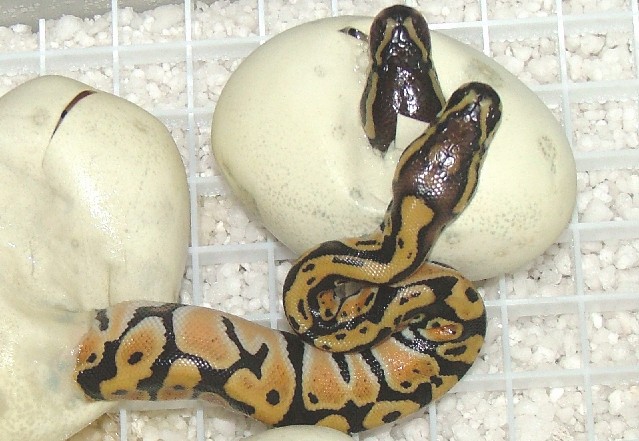

Shameless plug for a great lookin snake too!! 
yep...that was a nice looking classic jungle. Too bad we don't understand how that phenotype is inherited. I am expecting another clutch this year from the same pairing, so who knows....maybe I'll get lucky again. That particular snake ultimately died. It's the only snake I've ever hatched that didn't thrive. It never ate on its own, and needed to be assisted. I went away to visit family that Christmas, and when I returned it had died...
Approximately what size of rubbermaid should be used? 12qt? Also how deep should the layer of water/perilite be? 2-3 inches?
also...I may have inverted an egg when moving it from the mom.....is that really an issue?
thanks again!
My layer of perlite is usually about 1.5 to 2 inches...could be more, I wouldn't use less.
As far as the size of the egg box, just shoot for something big enough to hold the clutch and small enough to fit in you incbator. Like I said, the ones in the pictures are big enough to hold 2 or 3 clutches...you can go quite a bit smaller.
"They" say that you should not rotate eggs after they have been laid for a day or two, but I'm not sure that anyone has really researched this. I recall reading a post from a guy that puposefully rotated a clutch of burm eggs every couple of days throughout incubation and had only a slightly higher than normal egg mortality. I try to set mine up right after they're laid, and then not rotate them after that. I bet you're fine...
Thanks!
I set it up for the first time and used an 18qt rubbermaid, the clutch was rather big...(but probably overkill)
I have about 4 inches of perilite and water, the water is obviously at the bottom and the perilite floats to the top, it shows about 1/2 and 1/2 on the container.
I used 4 "legs" made from the egg crate to hold it up.....
I probably used too much water didn't I? All it needs to be is soaked and then the egg crate doesn't need legs it just rests on the top?
Theoretically you could use just water in the enclosure right? Assuming you used legs of course.....
what does the perilite get you? (just curious)
Sorry for all the questions...I have heard nothing but good things about this method and like how easy it is to setup.
Thanks in advance! (also...are there more posts on how this works somewhere?)
Well, you search this forum for more info, but I've never had much luck with the search forum.
It sounds like 18qt is a bit too large, but if it fits in the incubator, it will probably work. You don't want to have too much inside space though...this method works by having the air inside the egg box at very near 100% humidity.
I think you did use too much perlite. But it should be fine. The perlite will float on the water, so I don't see how "legs" are necessary. Poor out the excess water to be safe. The egss sit on the platic grid so they stay completely dry.
In theory, you could use just plain water with no perlite, but I decided to go with perlite for several reasons:
1) more mass in the gg box equals more thermal stability
2) stagnant water at 90 degrees for at least 2 months sounds like a breeding ground for nasties
and 3) - Most importantly - it increases the surface area from which the water is evaporating, making it a more effective humidifier.
I'll be away for the rest of the day, but I can check back tomorrow if you have further questions...
not "too much perlite"....long day...
Help, tips & resources quick links
Manage your user and advertising accounts
Advertising and services purchase quick links
