helpful information and opinions..?
I believe most of what Chris Gilbert said is accurate.
I dug around on my computer and here's what I have for the history of the Aztec Boas. The original Aztec male was acquired by the Potts' from someone locally who had been keeping the snake as a classroom pet. The individual had the animal for about 4 years in his home and another 10 years as a classroom pet.
He retired from teaching and could no longer keep the boa at home. Bob took the male and bred it to a few normal females and produced some healthy litters but had very bad odds. So he ended up with a small group of Aztecs. Shortly after this breeding the male passed away (most likely from old age because Bob and Andrew are guessing that the animal was probably around the 17 or 18 years old when he died).
Bob held back all the babies that were originally produced, raised up a male and bred it to a few different normal females and was able to produce a total of 14 Aztec Boas a couple of years ago. We were able to acquire one of the males and our animal was the first one outside of their collection.
So we know at the very least that they are dominant. We won't know if it is a co-dominant morph until an Aztec x Aztec breeding is done. Hopefully Bob and Andrew will be able to do something towards that in the near future!
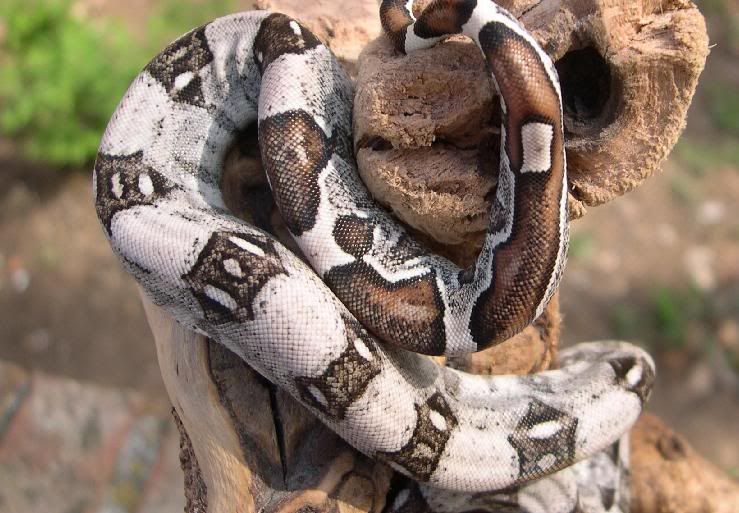
As for distinguishing characteristics for the morph - these guys seem to be another one of those color AND pattern morphs. Of all the Aztecs I have seen, they not only displayed a drastic pattern variation, but also intense red, pink and orange coloration throughout their entire base body color. Just scroll down and look at every single individual that Andrew Potts posted photos of in the thread below. You can easily see how much color those animals are displaying and the coloration tends to intensify with age. Unfortunately, I think this will be overlooked in the Aztecs just as it frequently was/is in Jungle Boas (although I think it has gotten a little better now). Also, the saddles are not brown on these guys but a very vibrant reddish color.
On the pattern, I think the distinguishing characteristics for the morph include squared-off or pentagon/hexagon shaped markings all down their backs with connected saddles. The saddles themselves are stretched out with quite a bit of patterning within them. The amount of pattern within each saddle varies from one to another but they are definitely connected creating a "motley-look" to the animal. Except with the Aztecs, you don't have circles down the back but rather, you have squares/pentagons/hexagons.
They also have somewhat reduced side medallion patterns. It's almost somewhat faded or pixilated on the Aztecs, especially if you compare them to some of the other "Aztec-looking" boas out there. The connected saddles also create squared off, upside down trapezoid patterns all the way down the side of the snake. I think one of the best ways to describe an Aztec Boa's pattern is "controlled chaos". They have an extremely chaotic appearing pattern but if you really look at it, you can see how incredibly symmetrical the pattern is all at the same time. That's what gives the Aztecs such a unique look!
As for the tail, they all have either striped or ladder tails. Some of them have broken striping or broken ladder tails to some degree. They also have varying degrees of striping on the underside of their tail from the vent area to the tip. Our male also has an incredibly unique looking, colorful belly. It is completely patternless down the center with two lines of circular black speckling down either side of the stomach. It is also intensely BRIGHT orange. I don't have any belly shots but will try to take a few next time I am taking photographs.
The Aztec gene does not act like the Coral in Albino Boas for example. When the babies are born, they are either very clearly Aztecs or normals with no question at all which category they fall in. From what we have been told, it is very clear cut in babies - being more similar to say, how the Motley gene is distinguishable from normals rather than the Jungle gene for example.
We have yet to produce a litter of Aztec Boas (hopefully this will change by the end of this season) but I have seen a litter of Aztec Boas including normal siblings in person. From what I have seen, all of the Aztec Boas have been extremely evident where there was no question at all that the snake was not a normal boa. I have seen varying degrees of the characteristics listed above in the Aztec Boas, but even the individual with the least expression did not leave any room for doubt as to its genetics. The normals in the litter that I have seen have all been completely, totally normal appearing babies as well.
I have seen photos of Andy's "Aztec-looking" individual before and it is certainly a beautiful looking snake - there's no question about that. It looks like she's been growing very well for you as well Andy! Is she an Aztec though? I don't know and neither does anyone else until she is bred and either proven and disproven to be genetic and then possibly bred to an Aztec to see if what she is carrying is a compatible gene or something entirely new and different. We don't even know if the Aztecs have a super form. So there's still more work to be done with the Aztecs themselves.
I would have to agree with Chris McAra on this one though in that "possible-Aztec" is kind of a stretch. If the animal came from an Aztec x normal breeding and whether or not it carried the Aztec gene was in question, the "possible-Aztec" would be a fair and accurate description for the snake. Just like in animals you see represented as "possible-Jungles".
If you produce a very aberrant, yellow-ish, high colored boa from a breeding that had no known Jungle genetics, you really shouldn't call that individual a "possible-Jungle" because it didn't originate from a known Jungle line. Does that mean the animal isn't a Jungle -NO! It could very well be a Jungle but really shouldn't be referred to that way unless it was produced from a known Jungle lineage and the only thing in question was if it did or did not carry the Jungle gene.
In this case, for example, we don't even know if the pattern variation that Andy's boa is displaying is genetic or not let alone an Aztec. Is it a "possible-Aztec"? In my opinion - no, I wouldn't call it that. Is it an "Aztec-looking" or "Aztec-ish" boa? Sure, why not? There's no arguing that it displays some similar characteristics to the Aztecs so I think that would be a fair assessment.
The problem with this is that it is a gray area. I think the biggest concern here is not to try to cause too much confusion in the gray area. We have new morphs appearing all the time and so many new people getting into Boas which is great. However, with new morphs and more individuals involved comes confusion on names and how to refer to things and the proper identification for certain animals, etc. etc.
It can be confusing enough to just come to terms with all the proven genetic morphs and designer morphs let alone all the line bred morphs, possible-this and thats, and "-ishes" (Jungle-ish, Motley-ish, Aztec-ish), etc.
Bottom line - it's all semantics LOL.
Anyways, here are some photos of various Aztec Boas I have taken in the past including the Potts' animals at the 2005 Daytona Reptile Expo, a normal Aztec-sibling, and our male Aztec.
I hope this information helps.
Bob and Andrew - If anything I mentioned above is incorrect, please correct me or, if you can offer any further insight, please share!
Thanks,
Celia
p.s. Sorry this was SO long! It didn't start out that way (they never do!)...LOL...
A litter of Aztecs with a normal sibling in the bottom center...


Some photos of our male as a baby...


And here he is as an adult (sorry for the bad photo but it's the only recent picture I have of him)...

-----
Celia Chien
Celia Chien Photography
www.ExoticsByNature.com
www.BoaConstrictorMorphs.com
www.BallPythonMorphs.com
www.CornSnakeMorphs.com