Way way back in 1993 I acquired a mess of baby Boas from a fellow who has long since left the Boa hobby. I traded some Peruvian Red Tail Boas for a mess of baby Boas, 1.3 of which I kept. The fellow sent me a couple pictures of some really colorful babies and I had to have them. He also sent a little cash to make the deal complete and I was in the "Prodigy Boa" business. I just didn't know it yet.
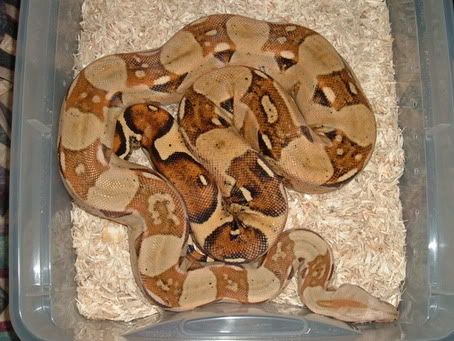
I raised the babies and eventually bred one of the females. The other two females from the group, were actually much more beautiful than the one that I did breed successfully. I never did breed the other two females. The female that was bred successfully produced her first litter in 1999. Clay English acquired a group of 1.2 of those babies in the Spring of 2000 pictured below shortly after he received them:

Clay bought them despite my relatively high price of $180.00 for each animal that was not identified as anything other than a beautiful baby Boa. I never mentioned to Clay that at least one of them was in fact het for Prodigy Boa. Clay called these his "High Orange" Boas for years. In fact the mother of these babies is Clay and his family's favorite Boa and has been for years. Her name is Delilah. She is pictured below:

This is the picture used to actually create his web site's logo. Here is his logo:

I had not posted them for sale with the name of the bloodline though most of the time I do. I did not even have the foresight to call them "Prodigy Boas", so short sighted was I. Clay would have to take the bull by the proverbial horns and do that himself. Often I can be a little slow.
In the mean time, Clay is looking on kingsnake.com and finds this great looking nearly white Pastel Colombian male for sale for, I believe $85.00. He was nearly white as a little fella. Clay had to have him so his purchase was wisely made. Clay calls him the "California Dude". Here is a photo of the Dude and Daddy of the Prodigy Boa babies:

Both Delilah and the "California Dude", as Clay calls him, have produced babies in the past. However, nothing freaky had every popped up before the litter born on April 20, 2007! Here is a picture of the two of them in the throes of passion taken this past fall:

Nothing could prepare Clay for what he would find in that litter as a morph whacko Clay is not. He loves his Boas but has resisted getting into any of the high end morphs because Boas have been a fascination and a hobby which is how Clay wished it to stay. However, on that morning in April, Clay was dragged kicking and screaming into the high end Boa world like it or not!
This is the sight Clay was greeted with that morning:

Click here for a large image of the babies in the goo!
The weird thing was, Clay had not been expecting anything like this to happen. I hadn't prepared him for this inevitable result from breeding these two animals together. Of course I hadn't told him because I had not idea obviously either! Here is a shot of the entire litter in a tub together:

It is patently obvious we have approximately a one in four ratio of babies pointing the likelihood that both parents are in fact both het for a simple recessive trait, that trait being the "Prodigy Boa". The actual ratio was almost three in four but that numbers. Sometimes a little more than 25% and sometimes a little less. There were 22 babies in the litter of which seven are "Prodigy Boas". Neither parent exhibits these traits, despite the breeding two completely unrelated parents, so far as we know, they happen to both be het for Prodigy. Is that cool or what? A very exciting occurrence to be sure.
Clay emailed me and Mark Miller that morning asking about "some new form of Hypo" that must have had born. Oh yea baby! A new form of Hypo all right! Both Mark and I knew what he had and were very very happy for him. I knew that those babies came from a female that came from me and after a bit of detective work, I confirmed my suspicion as far as the bloodline the female had come from. Needless to say, I too am a happy Boa keeper today.
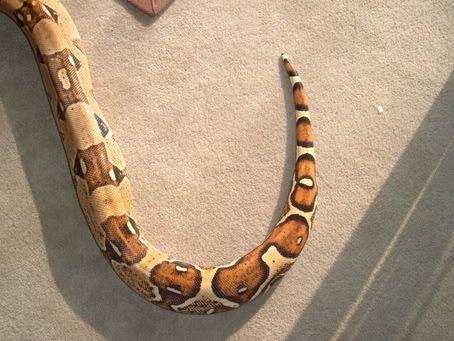
They have since shed and Clay has turned into quite a good photographer snapping tons of pictures of them. He wears me out making me look at the hundreds of pictures he keeps taking. I can't imagine why he is so excited can you? Here are several pictures of the tails of some of the Prodigy babies along side their normal siblings tails:


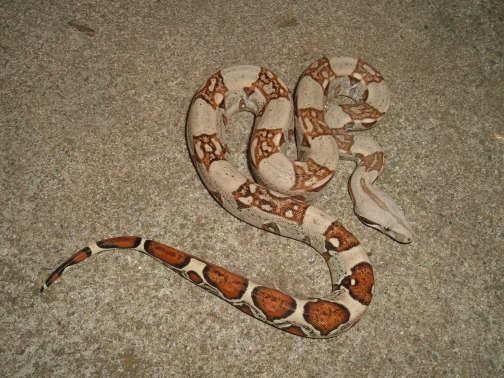
Here are a couple shots of the Prodigy babies since they have shed:


Most of the Possible hets from the litter appear to be Pastels as well and really beautiful in their own right. What tails on these puppies! Here is one of the Possible hets from the litter:

There is a runty male Prodigy Boa that Clay likes the best of all. I guess I can see why. Here he is:

I think the "Prodigy Boa" future looks bright. It seems there are several bloodlines of "T-Positive" appearing animals out there today. The Paradigm Boas, the VPI Caramel Albinos, one produced by Gerry of ssscales.com fame, one of them found on someone's table last year in Daytona and sold as just a regular Boa, and another fellow I know in Florida that produced three "T-Positive" appearing babies. There is going to be a lot of cool stuff happening out there. I don't believe anyone has actually had a test done to find out if any of those animals in fact are Tyrosinase positive or not. It matters technically I suppose, but in practical application, the look that is seen is what we really care about. This genetic clear reduction in black production is going to make many different types of Boas just that much better. I and Clay look forward to bringing the Prodigy Boa genes into everything else we possibly can. It is going to great fun making Prodigy Motley Boas. Prodigy Jungle Boas. Prodigy Hypomelanistic Boas. Prodigy Pearlescent Boas. The future is endless.
Has this been an unbelievable year for Boas SO FAR or what!?!?!?
-----
Boaphile Home
All Original/Boaphile Plastics
The Boa Network