Today is the 30th day since one of my snakes first hooked up. She is going through her Pre shed. We are going to build the incubator tomorrow (cooler with a heater ect) and i got the vermiculite today but i do not know the water ratio. I am getting the nesting box ready today. It has been almost 4 years and i am finnaly breeding snakes so i hope this one turns out right. Any tips would be great.
Reptile & Amphibian Forums
Welcome to kingsnake.com's message board system. Here you may share and discuss information with others about your favorite reptile and amphibian related topics such as care and feeding, caging requirements, permits and licenses, and more. Launched in 1997, the kingsnake.com message board system is one of the oldest and largest systems on the internet.


Question
fighterpilot
May 27, 2007 06:45 PM
Replies (38)
Bluerosy
May 27, 2007 06:55 PM
Ditch the incubator and use perlite. Wait 2 days after she lays and then offer as much food as she will take in the next two weeks.
-----
"Yeah ya told me, and ya wrote it down too. But how the hell am I supposed to remember!"
fighterpilot
May 27, 2007 08:19 PM
I have vermiculite but if i didnt have an incubator they would die from the rapid temp change. The ratio for vermiculite to water is it 1:1 by weight or 1:3/4 (vermiculite to water)by weight?
daveb
May 27, 2007 08:36 PM
what ways are the rapids temp changes too high or too low? an incubator will not give you much protection against very high temps, the incubator should be in a more stable environment. temps, water, air all fluctuate throughout the incubation cycle in the dirt or under a log out in the wild. the eggs will survive reasonable change, some feel they do better with some fluctuation. hard to argue against that.
btw, using perlite as rainer mentioned works very well, too. many ways to cook (=incubate) an egg, depends on your tastes and what won't burn the egg.
daveb
Bluerosy
May 27, 2007 10:21 PM
if i didnt have an incubator they would die from the rapid temp change
what rapid temp change? I don't know what info you have been given but eggs can withstand day and nightime temps.
-----
"Yeah ya told me, and ya wrote it down too. But how the hell am I supposed to remember!"
fighterpilot
May 27, 2007 10:26 PM
I live in california and we have the weirdest weather down here sometimes its 50-60 degrees and other days its well over 100 degrees and we dont have any AC. I set up a real simple incubator and its at a steady 82 degrees.
antelope
May 27, 2007 10:39 PM
Go with your gut on this one fighterpilot, the guys have given you the answers you asked for, now you determine what you feel is the best route for you. I know many people who use an inc and many who do not. Use the Force!
Todd Hughes

fighterpilot
May 28, 2007 12:47 AM
I want to use an incubator on this one because its been four years of raising this little girl to get her to breed so i want to have it as succesful as possible. i have already perchased the vermiculite because me and my dads friend thats been breeding for 30 years or so now recommended i use it. im just super nervous about this one.
first 2 pics are this year last pic is from 4 years ago


Bluerosy
May 27, 2007 10:40 PM
I lived in Calif and never had a problem with temp changes. Just put the showbox on top of a closet shelve.
On the perlite. Well I used vermiculite for 20 years before I used perlite. IMO perlite is a much better medium. I had a lot more problems with vermiculite than I ever had with perlite. You will not get as much mold with perlite. Perlite also alows for better airflow to the eggs and thats what you want for several reasons.
-----
"Yeah ya told me, and ya wrote it down too. But how the hell am I supposed to remember!"
FunkyRes
May 28, 2007 04:47 AM
I'm in similar situation in Redding.
I do have a swamp cooler which keeps thing cooler inside than out.
So far the indoor temps have been cool enough, but what I did last year with alligator lizard eggs that icubated in hot time of year - I did double container incubation. The container with the incubating eggs was inside a bigger container - and I worked to control the ambient temp of the bigger container, both to warm and cool it.
Outer container was a tank with styrofoam insulation to help keep inside temp stable. I used way way way more hatching medium than I needed because water makes a good thermal capacitor, stabalizing the temps of the incubation medium.
On very hot days I used glasses of ice water placed in the outer container but not touching the inner container. Use glass, not plastic - you want heat to flow from the air into the glass to melt the ice.
As the ice melts it cools the air in the container. I also put a damp towel over of the container - to give additional evaporative cooling (as the water in towel evaporated, it drew ambient heat from the container).
At night, a UTH kept warmed the air in the outer container.
I was able to keep it at about 80 even when it topped 90 inside.
-=-
This year I'm using an incubator set at 80F for my cal king eggs - the incubator is plugged into a cheap on/off thermostat to power off when the room itself hits 76F (hasn't happened yet).
Cal Kings are due to hatch in July - right when it *starts* getting super hot.
If it starts getting too hot - I'll move the incubation into the bathroom on the north side of the house, which stays cooler than any other room in the house. If it turns out to be a real problem, I'll add one of those single room AC units (not the window kind, the ones where you cut a small exhaust hole in the wall) - but I would need to hire an electrician to add an circuit for it, so that won't happen until next year - if it is really necessary.
-----
3.6 L. getula californiae - 18 eggs (Cal. King)
1.1 L. getula nigrita (MBK)
1.0 Pantherophis guttatus guttatus (Corn)
0.1 Pituophis catenifer catenifer (Pacific gopher)
3.3 Elgaria multicarinata multicarinata (Cal. Alligator Lizard)
tspuckler
May 28, 2007 07:18 AM
Unless you can cool the eggs when the temperature gets over 82 degrees, you could run into problems. When eggs are incubated at a steady temperature and then there's a spike in incubation temperature, babies with kinked spines can result.
Since you live in California and are breeding Cal Kings, why not just go with natural temperatures in your house?
Tim
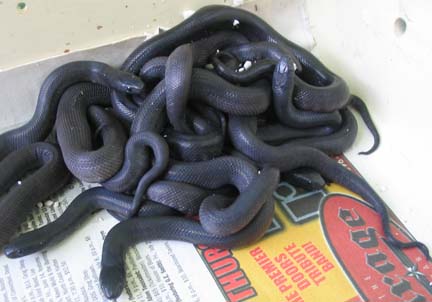
Third Eye
FunkyRes
May 28, 2007 07:54 AM
are regulated more than temps in a house are.
They (Cal Kings) lay under ground in burrows surrounded by a lot dirt and cut off from all light. The ground which has a lot of water in it keeps a much more regular temperature. It can be 110F outside and remain in the 70s where the eggs are laid due to the thermal capacitance of the ground they are laid in - it takes a lot to raise and lower the temperature.
On hot summer days it is nice to go to the Shasta Caverns and take the tour because it is always in the 60s inside those caverns - always - wether it is 70F outside or 115F outside.
In my case, my swamp cooler keeps my house 10 to 20 degrees cooler than outside - depending upon how hot it is and the humidity. Hotter days it doesn't work as well because the sacramento river adds humidity to the air, and it has trouble keeping up - and it isn't uncommon to hit 90F in my house in mid July and August. Too warm for Cal King eggs. It may be the same case with the OP.
I suffer w/o central air because I don't want the humongous power bill, and since I'm not old, I can survive. Besides, it gives me an excuse to have a nice cold beer.
Where the snakes lay their eggs, underground where it remains in the 70s even on hot days, it isn't an issue. Don't give the snakes an opportunity to find and pick such a spot, and it is an issue.
-----
3.6 L. getula californiae - 18 eggs (Cal. King)
1.1 L. getula nigrita (MBK)
1.0 Pantherophis guttatus guttatus (Corn)
0.1 Pituophis catenifer catenifer (Pacific gopher)
3.3 Elgaria multicarinata multicarinata (Cal. Alligator Lizard)
tspuckler
May 28, 2007 08:28 PM
"...nature's temps are regulated more than temps in a house are."
Do you have any data (actual temperature readings for the duration of a wild clutch's incubation period) to support that idea?
Tim
FunkyRes
May 28, 2007 09:40 PM
I don't - but I've seen such data before.
I suspect your standard geology textbook may explain the thermal properties provided by moisture containing ground, such as rodent burrows.
-----
3.6 L. getula californiae - 16 eggs (Cal. King)
1.1 L. getula nigrita (MBK)
1.0 Pantherophis guttatus guttatus (Corn)
0.1 Pituophis catenifer catenifer (Pacific gopher)
3.3 Elgaria multicarinata multicarinata (Cal. Alligator Lizard)
zach_whitman
May 29, 2007 01:29 AM
Yes I have measured the temps in sea turtle egg nests.
The SUCCESSFUL nests usually stay within 2-3 degrees constantly despite surface sand temps varying by more than 50 degrees from day to night.
Obviously the deeper nests are more stable.
Now king eggs are probably buried more shallowly (I have never found a wild clutch) so they can withstand some variation. But I would say that the more stable the temps the better is a safe statement.
The ground is an amazing thermal insulator and provides extremely consistent humidity as well.
I don't know if you keep potted plants, but think about how much more water they need than those in the ground.
tspuckler
May 29, 2007 06:33 AM
"I suspect your standard geology textbook may explain the thermal properties provided by moisture containing ground, such as rodent burrows."
No, that's not the type of information that geological textbooks provide. Anyhow, who's to say that kings regularly lay their eggs in rodent burrows? What I am looking for is actual temperature readings from a clutch of incubating eggs in the wild from a North American snake.
Only then can we make the call that wild temps don't vary as much as indoor house temps, right?
"The ground is an amazing thermal insulator and provides extremely consistent humidity as well."
Yes, but who's to say that putting the eggs in a box with vermiculte or perlite and then putting that box in a styrofoam container on a shelf in your house isn't just as good, or for that matter, even better?
Tim
FunkyRes
May 29, 2007 07:53 AM
Different species of snakes lay in different conditions.
Some like to lay in rotting material at the surface (IE leaf piles, logs, etc.) but my understanding is that kingsnakes, at least L getula if not all getula, in the wild lay where the sun don't shine - where it is completely dark, humid, and proper temp.
As far as vermiculite etc. - in a proper incubator the temperature is probably just as stable if not more stable than where they lay in the wild.
In a house where the room temperature doesn't rise above 82F it is probably good enough.
If like the OP or me, internal room temperature hits 90F on the hot days - then unless you take measures to provide cooling to eggs, they will be warmer than where the wild kings lay their clutches.
Typical 6 qt sterilite tub will have about 200g - 250g of water in it. That's not a lot. Most of the thermal capacitance of your incubating media will be from the water. Out in nature, there's a lot more water so it takes a lot more energy to raise the temperature of an underground nesting box. The ground above acts as insulation to the chamber where the eggs are laid - just like basements tend to be cool on very hot days. btw - the local indian tribes, when they built their shelters - they dug into the ground for the same reason, it provided cooler temps.
Go out in your garden on a hot day - and dig down just 12 inches - it will be cooler than the surface.
On the really hot 110F days it certainly is cooler in my house than outside - but at >90F insude it still warm enough to kill eggs of the same species of snake that breed on the hill behind my house if I don't take additional measures.
Soil, largely due to water content, makes for far excellent insulation - and kings lay underground.
Take a typical tub of incubation medium stabilize it to 80F. Then put it in a room that is 90F - it doesn't take long for it to heat up to the egg killing danger temps. There just isn't enough water to resist the thermal change.
-----
3.6 L. getula californiae - 16 eggs (Cal. King)
1.1 L. getula nigrita (MBK)
1.0 Pantherophis guttatus guttatus (Corn)
0.1 Pituophis catenifer catenifer (Pacific gopher)
3.3 Elgaria multicarinata multicarinata (Cal. Alligator Lizard)
tspuckler
May 29, 2007 09:29 AM
Perhaps. But we still don't know the range of incubation temperatures that wild king snake eggs are exposed to, therefore we cannot make accurate statements as to if eggs in a house, in a styro, in a box of perlite are exposed to a wider or lesser range of temperatures than those in the wild - can we?
Tim
zach_whitman
May 29, 2007 11:54 AM
No but we can go from experience.
I don't have a snake room. My snakes are in my living room. My apartment changes temperatue quite rapidly. from 65 some night to 90 some days, then if I get too hot and turn on the AC it might go right back down to 75. I also live in an attic apartment, which gets very hot when the roof bakes in the sun. If I am not here with windows open etc it can get pretty steamy in here.
For years I used an incubator. And for years I had good results. Actually I had unheard of results (knock on wood) for three years running I didn't loose a single good egg. One year I tried just using a styrofoam box. No heater, just insulation from quick changes. Worked great for the two test clutches I put in it. I had one egg go down.
But last year I tried the "Just stick em on a shelf" method. I figured all the big people on here do maybe I am just being paranoid. I lost half of my 1st clutches of eggs. When I double clutched my females I went back to an incubator and went back to nearly 100% hatch rate.
I am sure that in some homes the temps are constant enough, but other homes are just not.
Bluerosy
May 29, 2007 12:05 PM
But last year I tried the "Just stick em on a shelf" method. I figured all the big people on here do maybe I am just being paranoid. I lost half of my 1st clutches of eggs. When I double clutched my females I went back to an incubator and went back to nearly 100% hatch rate.
Thats just pure happenstance.
-----
"Yeah ya told me, and ya wrote it down too. But how the hell am I supposed to remember!"
zach_whitman
May 29, 2007 03:33 PM
Yeah your right loosing three great looking clutches of eggs for the first time in my breeding career is probably just a coincidence. Probably had nothing to do with the fact that it was the first time I exposed clutches to drastically changing temps. Those clutches were probably just bad from the start.
Why is it so hard to believe that while some peoples homes provide a suitable environment other homes do not? And if the first year that I went without an incubator my hatch rate plummetted can you give me one good reason why I wouldn't use one? Why because it works for you???
Good for you... not in my collection though.
cheers
Bluerosy
May 29, 2007 06:16 PM
Noun 1. happenstance - an event that might have been arranged although it was really accidental.
The closet I keep them in is an upstairs closet. The sun warms them up during the day and then they experience a drop during the night. No problesm and have been doing it way for a number of years. In early spring here in Georgia the temsp get pretty cold in that closet (say 72F) and they rise during the day to about 88F.
-----
"Yeah ya told me, and ya wrote it down too. But how the hell am I supposed to remember!"
zach_whitman
May 29, 2007 06:32 PM
Here in Vermont my apartment was 63 degrees this am. This afternoon it hit 89.
Bluerosy
May 30, 2007 12:38 AM
Thats something between you and your energy bill.
I don't like the cold so I turn up the heat at night when it gets to cold.
-----
"Yeah ya told me, and ya wrote it down too. But how the hell am I supposed to remember!"
zach_whitman
May 30, 2007 02:10 AM
Or just a really crappy gas heater in the far corner of the apartment. No one said 1/2 the radiators didn't work BEFORE I signed the lease. 
What ever, I am out of here in a few weeks.
Got any advice on how to get a couple dozen snakes to Colorado?
Bluerosy
May 30, 2007 10:11 PM
Got any advice on how to get a couple dozen snakes to Colorado?
Take them with you or ship them.
If you have a vehicle big enough to fit all the snakes inside where the air is on then great. But if it is a long trip with stops along the way I would ship them . Less stress.
One thing I would not try is putting them in a cooler and sticking them in the back of a truck where there is no air conditioning.. That can turn out to be a nightmare.
-----
"Yeah ya told me, and ya wrote it down too. But how the hell am I supposed to remember!"
tspuckler
May 29, 2007 12:44 PM
I don't see how a person can make statements comparing captive incubation temperatures to those in nature if they don't know what the temperature range in nature is for North American snakes.
Sure, you know what temperature your home or incubator may be, but that's only one half of the equation.
Tim
markg
May 29, 2007 02:42 PM
Someone on the field forum posted on finding a clutch of snake eggs under rotting wood. He returned to visit the eggs from time to time, and he noted temps during the day of upwards of 90 deg, while the night temps dropped into the low 70s. The eggs hatched. Apparently, constant temps are not necessary, and high temps are OK as long as the time duration is limited.
I hatched Cal king eggs in a classroom where daytime temps got up to 88 on some days and night temps in the mid 70s. All hatched just fine.
Temperature trnsmitters in Gila monsters show the animals spending vast amounts of time at very cool temps (60s)underground even when surface temps are well above 100 deg F. Goes along with FR's conservation of energy idea. I don't know what the egg sites temps were, because the researchers didn't know where the eggs were layed in the study I read.
-----
Mark
zach_whitman
May 29, 2007 03:40 PM
How did they know that they were king eggs? Different species have eggs that are adapted to much different types of conditions.
But with ALL of the field herpers on this forum, infact of ALL the field herpers I know. I don't know of anyone who has ever found a clutch of kingsnake eggs. Hmmm I wonder why... maybe its because they are hidden deep underground. That would seem to go along with what my females try to do by laying in the tightest darkest, bottom most corner of their nest boxes.
Again I am not trying to say that nest temps in the wild don't vary. I don't know that. I am just saying what I observe and what has worked for my eggs.
Here is the real question. Is there any harm in using an incubator?
markg
May 31, 2007 01:53 PM
No harm at all. And you are correct - kings are subterranean snakes much of the time, and likley they lay eggs down there by far most of the time. You are also correct that very likley the temp does not change much because the Earth (even just 4 inches below the surface) is a tremendous insulator due to its large mass.
King eggs can withstand some varying of temps, as long as the extremes are not too extreme or held there too long. Python eggs for example cannot survive a 10 deg F change in 12 hours like kingsnake eggs can, or so I'm told.
I wish we could find kingsnake eggs and monitor the humidity and temp. Would be so enlightening. I'm guessing though it would be in the 75-80 range with an ambient humidity that isn't too high but enough to prevent the eggs from drying out - you know, the water absorbed through the egg shell membrane roughly equals the water lost.
-----
Mark
antelope
Jun 01, 2007 12:39 AM
I found a clutch of nine speckled king eggs in 2005, 5 were eaten, 4 were good, on top of soil under a stove, about 4 feet from a permanent water source just above the high water mark. They were hatched out and all 4 were perfect holbrooki. If that wasn't a fluctuation I don't know what is!
Todd Hughes


zach_whitman
May 29, 2007 03:35 PM
I am not trying to compare to nature. I am doing what works well for me. You asked if there was any data about constant temps in wild nests. I volunteered what I know, maybe its not directly applicable to the kings we are talking about but its just another piece of the puzzle.
daveb
May 27, 2007 08:26 PM
in my experience, you can use a ratio of 0.7 water to 1 vermicultite up to a 1:1 ratio. 1:1 seemed a little wet to me when i used it so i cut the water content. it probably is better to use the lower ratio in the medium you incubate in to allow air to circulate better, especially if the vermiculite you use consists of very small particles. there is enough water in that mix to keep eggs from drying out.
not a bad idea to introduce the nest box early- like before she sheds-, so the female is comfortable with it and has a nice humid spot prior to ecdysis and egg deposition. however the vermiculite will make a messy mess as she crawls in and out. long fiber sphagnum moss would be a less messy alternative. there are no magic ratios with moss. soak it, wring it out very well and pack it in the box tight.
best of luck
daveb
MikeFedzen
May 27, 2007 10:06 PM
I agree with the moss.
I usually use vermiculite, or perlite... I haven't seen a difference in hatching ratios between the two, as well as moss. With a water bowl on one end... And I spray the medium until it is wet... And it dries out a little over a few days, by then the eggs are laid, ready to go in the "incubator"... Placed in a dark spot in the snake room. Then the waiting part.
-----
Mike
KingPin Reptiles Inc.
www.kingpinreptiles.com
^ Updated 5/27
ChristopherD
May 28, 2007 07:42 AM
long fiber spagnum is excellent lay box medium.
years ago i used vermiculite in lay box,and found a very gravid and Dead Honduran Milk and with a mouthful of Vermiculite I think? i was feeding Live the day before, it was a sad find
zach_whitman
May 27, 2007 10:06 PM
Make sure that your nest box is dark and full to the top with nesting material
As far as eggs... there are a lot of ways to go... but here is my .02
Keep the eggs inside a closed (w/ a few air holes) covered container. This stops cold air from rushing over the eggs every time you open the incubator. Also the larger the container the more thermal mass it has, and the more it will resist temperature change.
Keep your incubator clean as you build it. Wash your hands and the container before you touch the eggs. Don't delude yourself, the eggs are far from sterile, but the less weird molds/bacteria that get in there the better.
I personally incubate on spagnum because the pH helps kill microbes. But it is easy to make it too wet if you are not careful. Your vermiculite will work fine. I have used a 1:1 ratio. As another post mentioned, this may seem too wet at first, but the eggs can absorb lots of water early in incubation. Its at the end that they are more sensitive to too much moisture. I tend not to add much if any water during incubation, so starting a little too wet lets it dry out over the 2 months.

Elaphefan
May 29, 2007 01:51 AM
The ratio is done by mass and not by volume. I read one paper where a 2:1 water to vermiculite ratio was used and it worked fine. As long as the eggs are in contact with moist, not wet material, they should do fine.
zach_whitman
May 29, 2007 02:14 AM
obviously by weight.
I should have specified. But if he had tried it by volume he would have gotten vermiculite soup
And you definitly can make eggs to wet. If they are buried and are too wet they can suffocate. But even if they are only partially buried they can absorb too much water and split the shell. Sometimes this split doesn't even kill the egg. To much moisture also encourages mold.
Something interesting I have noticed...
When eggs are kept too moist some don't make it. Some split, some get moldy, and others just deteriorate. But the ones that do make it are noticeably larger healthier more robust appearing hatchlings. Seems like its a balancing act
This pic was my first attempt at incubating on spagnum many years ago. I made it WAY to wet as you can see. Only two of 4 eggs hatched. But to this day these are the two largest cal kings I have ever hatched. Twice the weight of some of my other dryer clutches.

fighterpilot
May 29, 2007 09:08 PM
Thats interesting i used about 4 cups vermiculite and 1 cup water. and i have a 1:1 ratio i put them in plastic bags until i use them
