

Reptile & Amphibian Forums

Welcome to kingsnake.com's message board system. Here you may share and discuss information with others about your favorite reptile and amphibian related topics such as care and feeding, caging requirements, permits and licenses, and more. Launched in 1997, the kingsnake.com message board system is one of the oldest and largest systems on the internet.

Click here for Dragon Serpents
Click for ZooMed
Click here for Dragon Serpents

Tyrosinase for Dummies:

boaphile May 31, 2007 05:18 PM

Tyrosinase for Dummies:

I consider myself one so, before you get all bent out of shape, I AM the DUMMY to which I refer. Anyone wanna argue that point? OK, So since we all agree on that one, I will make my logical if not completely scientific observations.

When the first "T-Positive" Argentine Boas appeared more than about ten years ago now, they were shortly known to be a simple recessive trait but were not called "T-Positive" Albinos as they are called today. They were called what I logically thought they were, not being scientifically savvy, Argentine Hypos. Simple recessive Hypos. Hypomelanism in every Reptile that I am aware except Boa Constrictors has always been a simple recessive trait. It doesn't matter if there are additional exceptions to that or not, the fact is in nearly every instance Hypos are Homozygous forms of a simple recessive mutation. So when the Hypo Boas first appeared, it took a little different thinking to let it all sink in. It has certainly made it's way into the main stream reptile knowledge base today.

It was only around eight or ten years ago that these simple recessive Hypo Argentines became known as "T-Positive Albinos". So what was a "T-Positive Albino" I asked. I asked around and here is the basic, although apparently scientifically inaccurate definitions of the two types of Albinos:

"T-Negative Albinos": In T-Negative Albinos, all production of melanin is interrupted completely resulting is an Albino devoid of any black influence whatsoever.

"T-Positive Albinos": In T-Positive Albinos, part of the production of melanin is interrupted resulting is an Albino that still retains some level of melanin influence.

Those are the simple definitions I had believed, and since I am pretty simple minded, that was easy for me to comprehend. Inaccurate though it may be, that is what I thought.

So now we find that the "true" Albinos we have always assumed were T-Negative Albinos are not necessarily so. The visa versa is true of what we thought were T-Positive Albinos heretofore. So what in the world is a simpleton like me supposed to believe, know or even think? Well this is what I think. This is only what I think and since I am an admitted simpleton, don't believe it OK?

So if we are going to go with the technically correct definitions, then we don't know what any of these animals are. There isn't any way everyone is going to drop what they have always thought was true regardless of the accuracy of it. So people will call them what they will and some will continue to argue because it isn't technically correct. I am all for being scientifically accurate by the way, but we just don't know what most of this stuff is or isn't scientifically. So what are we going to do? I have to get my little brain around something to have an accurate understanding of anything. That is often a tall order as this one is here and now.

So for me and my little brain, it's back to basics. I am back to believing what I had believed for more years before the "T-Positive" name had been tossed around like cord wood. The "T-Positive" appearing animals may of may not actually be true "T-Positive" animals. But they are absolutely at the very least simple recessive Hypomelanistic Boas. There is the exception of the Paradigm Boas which is a horse all it's own. With that one exception, all the other animals, if in fact proven to be simple recessive as we know some are already, are simply at least simple recessive Hypos. That is simple enough for me to understand. The "T-Positive" Argentines were "Hypos" long before they became known as T-Positive. The change of name either direction has absolutely no impact on the unique desirability of the animal. So I will think of all the "T-Positive" appearing animals as simple recessive Hypos. Other can, will and should call their animals whatever they want to. In fact if the "T-Positive" moniker remains the norm for all the T-Positive appearing animals, I too will be calling them T-Positive. If the name "T-Positive Albinos" continues to be the norm, I'm going to stay with that too.

So while many of us know that scientifically or technically, the term "T-Positive Albino" is not necessarily accurate, we all know what we actually mean when we use that term. After all, we are not writing for a scientific journal. We are hobbyist talking shop in such a way that everyone understands what we are talking about. Which makes me wonder why I bothered to open my big mouth to begin with. I'm going to go contemplate that one now and if I come up with an answer, I'll post it later.
-----
Boaphile Home
All Original/Boaphile Plastics
The Boa Network
Replies (20)

Craig K. May 31, 2007 05:53 PM

But I do appreciate the rundown, has anyone been keeping track of how many animals are being called t ? I know to me it seems like a ton, and that is why I have been very slow to invest in them. I don't have a clear enough understanding or them, and many as adults look very much like normals to me. Thanks again Jeff. Craig Kade

ChrisGilbert May 31, 2007 05:59 PM

The list:
VPI Colombian strain
Argentine version
Nicaraguan strain
An Insular version from NERD
The Blond from Europe
Paradigms
Prodigy
-----
http://www.GilbertBoas.com/

Craig K. May 31, 2007 06:07 PM

Thanks, I should have known you would be on top of that, I thought there were more then that even. Thanks. Craig

ChrisGilbert May 31, 2007 06:12 PM

However there may be more.

Since this topic has come up again I would like to mention I have begun looking into what will need to be done to run the tests on all of those as well as Kahl and Sharp Albinos. I am going to start with Kahls and Sharps. I've spoken to many breeders to secure blood and shed skin samples. At this point I just need to find the time. My school is good about funding research and I should be able to secure funding for the tests.
-----
http://www.GilbertBoas.com/

PBM May 31, 2007 06:58 PM

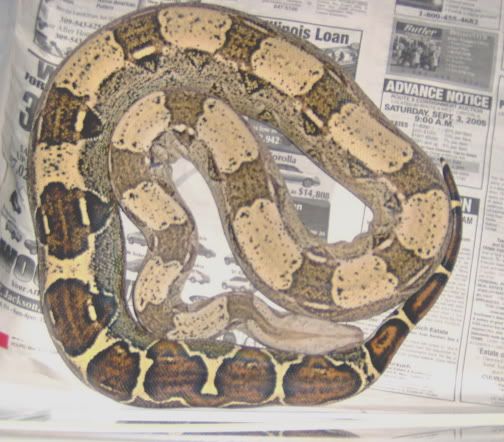
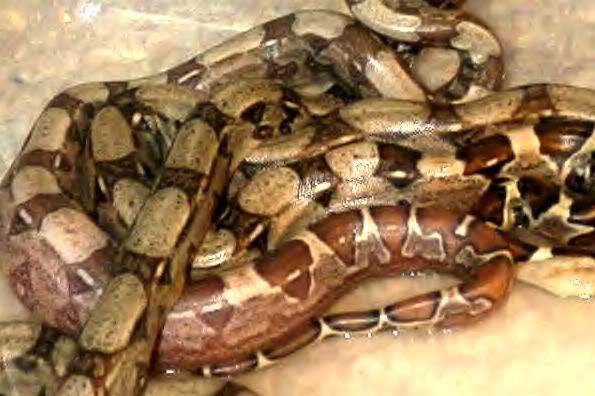
Have told me they think what I named my "Alabaster Boa" is a T positive. I don't know, and honestly don't care if she is or not. Here's a pic of her with normal siblings at birth and one a bit older, but not real recent. She is definitely different, and one thing that stands out is her sheds have always came out perfectly clear. For an animal with this much pattern and flecking to shed out clear is odd. I bred a pair of her siblings and though the litter wasn't the greatest, there is an albino from the litter that is definitely different. Oh yeah, she is 100% het Kahl albino (Kahl Albino x normal produced her) so if she is anything genetic, atleast she's already a DH which is pretty cool. Take care

Paul
Image

PBM May 31, 2007 06:59 PM

Sorry, here's the baby pic...
Image

boaphile May 31, 2007 07:05 PM

- Sharon Moore boastore.com Caramels actually were first produced before any of them back in the mid 1980's.

- Gerry at ssscales.com has a single animal that popped up last year. Unproven as of yet but no reason to believe that it will not prove to be a simple recessive the same as all the others have so far. I will be shocked if it doesn't. But until proven, I suppose, it isn't.

- BCI Joe picked one up at Daytona last year off a table as just a regular Boa as well. Again unproven but looks like the real thing as well.

- There is another fellow in Florida, who likes to maintain a low profile, who produced three last year as well. These were from two separate females. A friend of his posted pictures of them here on kingsnake.com last year along with normal siblings. Pretty clear what he has. One female produced one and the other two obviously. The females were communally bred with multiple males so the actual fathers are unknown. All the animals in the breeding project were siblings from a litter he produced in about 2001. The father of that original litter was born in Cannon Falls Minnesota but is completely unrelated to the "Prodigy" bloodline animals. Interesting huh?
-----
Boaphile Home
All Original/Boaphile Plastics
The Boa Network

ChrisGilbert May 31, 2007 07:20 PM

I only included proven ones, and I didn't put Boawoman Hypo/Carmel on the list because talking to Mike and Sharon they both have said it is not a T-plus Albino and just Hypomelanistic.

Thanks for pointing those out though. Joe Rollo's and Gerry's both look like they will be the same as the VPI. Celia Chien from EbN also has one that is unproven but should be like VPI's as well.
-----
http://www.GilbertBoas.com/

boaphile May 31, 2007 07:54 PM

However, we don't know what are, and what are not, "Tyrosinase Positive" using the scientific definition. We do know, using previously believed definitions, that there seem to be different "degrees" of T-Positives. I speak concerning as far as the more classic characteristics are concerned, and not the basic attractiveness. I think the attractiveness, while certainly genetic, is likely more a result of polygenic influences and not the simple recessive gene itself.

I don't think anyone has ever looked at the Sharon Moore babies with the kind of scrutiny that they will the next time they are produced. I hope somebody makes some soon so we can see how they look once again as babies with the new cameras everyone seems to be using now.

So, I think they are all essentially simple recessive hypomelanistic ("T-Positive Albinos" animals having varying degrees of black reduction, which seems to last varying lengths of time as the animals age and grow. This is the infancy for nearly all of these bloodlines and it remains to be seen how most of them will change as they grow older and larger.
-----
Boaphile Home
All Original/Boaphile Plastics
The Boa Network

ChrisGilbert May 31, 2007 08:23 PM

some new pictures with better cameras taken when new Carmels are born.

When I was talking with Mike he said they did not have red pupils like the VPI and Paradigms do. I'm not sure of the pupil color on the other morphs. I think the VPI and Paradigm are most worthy of the T-plus Albino name because as babies (talking right out of the chute babies) they look like a form of Albino.
-----
http://www.GilbertBoas.com/

zenzinia May 31, 2007 08:33 PM

We know what a T positive is for humans and some other animals, cats,.., genes and phenotype are identified ! Not for boas and reptiles in general.
There are also some forms of albinisme that allow eumelanine devellopement with age with more or less phaenomelanine , some not, in some formes that devellopement is located only on some area of the body, ....
So to understand the reptiles, we have to learn from other species mutations.

Paul Hollander Jun 01, 2007 12:37 PM

>So to understand the reptiles, we have to learn from other species mutations.

100% correct. And one thing that we have learned from other species is that this stuff is much too complicated to reduce to simple T-negative/T-positive terms.

Paul Hollander

iamsnakeshack May 31, 2007 07:30 PM

Here’s another; the 3Tone Albino from Olaf Schal Of Germany. Not proven yet, but man that’s one crazy (but cool) looking snake!

ChrisGilbert May 31, 2007 08:25 PM

is related to the "freak" Snow produced by Ralph Davis. Both were produced from DH Snow X DH Snow breedings.
-----
http://www.GilbertBoas.com/

PBM May 31, 2007 06:47 PM

If you really try to get into albinism, and understand it, the simplicity of T-neg. and T-pos. are out the window anyway. There are many misconceptions regarding albinism within the reptile hobby, but there's probably no re-inventing the wheel at this point. I know this information is human based, but I found this particular quote fairly interesting. This is from the NOAH(National Organization for Albinism and Hypopigmentation) website.

"A common myth is that by definition people with albinism have red eyes. In fact there are different types of albinism, and the amount of pigment in the eyes varies. Although some individuals with albinism have reddish or violet eyes, most have blue eyes. Some have hazel or brown eyes."

Genetics are definitely not as cut and dry as we try to make it, but as you indicated, we're hobbyists not scientists. Have fun looking into it, but don't lose any cage building/cage cleaning time over it-LOL! Take care

Paul

ChrisGilbert May 31, 2007 07:22 PM

That is talking about the color of the iris and not the pupil.
-----
http://www.GilbertBoas.com/

PBM May 31, 2007 07:44 PM

The point is that most people think albinos must have red eyes...IRIS OR PUPIL. Most people are not going to think someone with blue eyes is an albino...Correct??? Not all albino humans are pasty white, with white hair and pink eyes. That is the gist of the conversation. This is because there are several types of albinism, and even more types within those types, each with it's own expression. What we try to argue within this forum is basically pointless because we are very short on genetic experts here. I'd say we have exactly....none!

stconstrictors May 31, 2007 07:26 PM

Im trying to prove out a female I purchased years ago as a het recessive hypo. I have 1 of the 2 females from that litter. The father was a T POS?hypo? looking bci. Shes a beautiful snake.I put her with my male 100% VPI t plus male.

PBM May 31, 2007 07:51 PM

That could be an interesting result. Keep us up to date, and best of luck! Take care

Paul

horridus May 31, 2007 10:16 PM

Interesting thoughts, we seem to think alike..is this a good thing? I don't mind being a Dummy I guess...I remember seeing that first Argentine in Orlando and wondered why they changed names on me...I have yet to be able to afford one and regardless of what they are called, I still want them. I didn't mean to ruffle any feathers. I, like you obviously just wondered why things were being reffered to the way they were at this point in the hobby. Like I said in my first post, I most likely am 100% wrong. As we all will most likely be proven to be, at least in the strictest scientific sense. I was told by someone recently when we were discussing the identity of some Ball Python mutations that there are at least 50 different genes responsible for the color Black in cattle....that's a mindblower and certainly puts it into perspective for me as to how little we really DO know and the infancy at which this hobby is on compared to rodent or cattle genetics....

So, Boaphile, if you and I are calling all the T positive animals recessive hypos from here on out....I say we also come up with a new name for the original hypos (the incomplete dominant/dominant ones) since they exhibit more than just a reduction in black pigment and affect the pattern as well.
If we are going to change the world, might as well really screw things up

Hey...Salmon Boa sounds good....wait, oh nevermind...

Site Tools
