i am interested in buying a BRB and i wanted to see what would be a great cage to keep them in? easy access maybe from the front instead of the top . also what would be better a mister or fogger for it too any thoughts?? thanks
Reptile & Amphibian Forums
Welcome to kingsnake.com's message board system. Here you may share and discuss information with others about your favorite reptile and amphibian related topics such as care and feeding, caging requirements, permits and licenses, and more. Launched in 1997, the kingsnake.com message board system is one of the oldest and largest systems on the internet.


rainbow boas ?
underdog125
Jun 05, 2007 10:45 AM
Replies (15)
run26neys
Jun 05, 2007 10:59 AM
Before getting a BRB, I thought they were hard to keep due to humidity requirements, but they are fairly easy to care for.
I now have cages designed for snakes, and they seem to keep humidty really well. I just have a fairly large water dish over the heat source, and have a moss pit. I do not mist at all.
The moss pit is a plastic shoe box with A couple of fairly large holes drilled in it. The bottom of the shoe box has one inch of moist peat moss, with an inch or so of damp green moss on top of the peat moss.
Dave Colling can post pic's of his moss boxes, as I just use his design.
Baby BRB's do need very high humidity, and they need less as they age.
If using any type of screen venting - most all of the vents should be covered, so humidity can be held in. For a while mine were in glass tanks with screen top covers. I had the screen tops 90% covered with plastic wrap and a towel. I still had to use damp cypress mulch and mist once or twice a week to keep proper humidity.
Jeff Clark also has a great care sheet for BRB's.
-----
Mike
2.4 BRB
1.2 Spotted Python
1.0 Cal. King
Jeff Clark
Jun 05, 2007 11:02 AM
CARE OF NEWBORN BRAZILIAN RAINBOW BOAS
Epicrates cenchria cenchria
By Jeff Clark
Brazilian Rainbow Boas (BRBs) make great pets. They are very hardy and typically grow to around 6 feet in length. Many BRBs have been kept in captivity for over 20 years. Their size is much more manageable and practical than many of the other Boas and Pythons. They do require high humidity. This is especially important when they are small. If kept too dry they will dehydrate. Minor dehydration will cause feeding and shedding problems. Major dehydration will kill them. Baby BRBs should be maintained with close to 100% humidity in their cages. This can be accomplished by using damp substrate and limiting the ventilation. They do require some ventilation but in cages with large screen sides or screen tops the humidity will rapidly escape from the cage. Ideal substrate material for little BRBs is paper-towels or newspaper. The advantage of paper-towels and newsprint is that it can be easily changed. Damp substrate will quickly grow mold. It should be changed often. BRBs drink more water and pass more liquid urine than most other snakes. Substrate that is kept in the cage too long will become contaminated with urates which are very acidic and this will harm the snake’s skin. Many people use mulch and chipped bark substrates. Some of these substrates are excellent but you should be careful not to use one that is too acidic or one from a garden center that may have parasites in it. I especially like the cocoanut husk chunks and chips substrates for BRBs. It is vitally important to not use cedar substrate. The oils in cedar and similar woods are toxic to snakes. Pine shavings and aspen shavings are also not suitable for BRBs. Did I mention that you should change the substrate often? BRBs require cages with a cool end in the low 70s and the warm end in the high 70s to very low 80s. If you keep them in cages that are too small to maintain a temperature gradient in the cage they should be kept with the entire cage in the mid 70s. Temperatures higher than this can quickly cause dehydration and death. Most reptile heating products are too hot for Rainbow Boas. These snakes are nocturnal and secretive. Using overhead lights to heat their cages will create too much stress for a BRB. Cage temperatures must be controlled with a proportional thermostat or a carefully set and monitored rheostat. Don’t guess what the temperature is down in the cage where the snake spends most of it’s time. Invest in good temperature measuring equipment and use it often to make sure you do not overheat your BRB. BRB temperature requirements are 10 to 15 degrees cooler than what is required for many other boids including Ball Pythons, Boa Constrictors and Burmese and Reticulated Pythons. People who try to keep BRBs hot like they keep their other boids often kill them. Extra care should be taken when transporting BRBs. If left in a closed car in the sun the temperature will rapidly rise and kill them. BRBs should be provided with caging with hiding spots so that they can avoid light and activity. Small plastic containers like margarine is packaged in with a small entry hole cut into the side of the container work well. Place substrate material such as damp moss or damp papertowels in the hiding container. BRBs need a waterbowl in their cage that is large enough for them to submerge. They will often soak in the water for several days before shedding. However, when they do not have a good hiding spot they may have to use the waterbowl for a hiding spot and spend too much time in the water. Adult BRBs can be set up in elaborate naturalistic caging. They look especially nice in large cages with exotic plants. However they will spend much of the daylight hours hiding in or under the plants. It is best with a new little BRB to keep the caging simple to make sure the snake is doing okay before adding too many variables that may cause problems. After the snake is acclimated and doing well you can make small changes in the caging and try different substrates and plants making one change at a time. Little BRBs should be fed small live mice at first. Many will also take live pinky rats for their first meals. They will feed much more readily on a live meal than a dead meal. They also like mice that are large enough to run around much more than they like pinky or small fuzzy mice. I have actually fed full-grown adult mice to BRBs for their first meal. They can handle very large prey but are more likely to regurgitate if fed extremely large meals When they have become accustomed to eating live prey they will easily switch to eating fresh killed and then frozen and thawed prey. Thawed prey will work best if it is heated to around 105 degrees for the first feeding attempts with it. BRBs are always more likely to eat undisturbed in the dark than when being closely watched in bright daylight. Do not force-feed a BRB. Force feeding is very stressful and stress is often the reason that one will not eat. These snakes are eating machines. If your BRB does not eat it is because of stress or improper husbandry. Eliminate the stress and correct the husbandry and they will eat readily. The most common husbandry problems are keeping the snake too hot or too dry or subjecting it to too much light or activity. Little BRBs have a very simple outlook on other living things. Anything it sees moving is either a predator or prey. When first born they will often strike and bite. The bite of a little BRB is not painful and usually does not bleed. If you handle the snake for several minutes everyday it will quickly become tame. If it bites or strikes it is because it is afraid of you or it thinks it can eat you. Just let it bite and hold on and chew if it wants. By doing this it will learn that you are too big to eat and that you are not harming it and that striking and biting will not make you go away. If you do retreat when it strikes you will reinforce the striking and biting behavior. Little BRBs can be handled for as much as an hour per day. Too much handling can cause stress and stress may cause them to not feed. It is okay to have them out of their cages in humidity much lower than 100% for short handling periods.
If you have any problems with your BRB email me at jclarksnakes@comcast.net
Visit the Rainbow Boa forum on kingsnake.com to get answers to any questions you may have about Rainbow Boas. The archives of posts there are full of information. My Rainbow Boa website has information on breeding Rainbow Boas and also has information about and photographs of the other subspecies of Rainbow Boas. The website is located at http://www.corallus.com/cenchria/index.html
underdog125
Jun 05, 2007 12:53 PM
thanks guys for the help. i love the input and they really seem like great boas my friends are all pressuring me to get one they all have them and they can help me too.thanks to all
rainbowsrus
Jun 05, 2007 11:03 AM
I like the new plastic cages such as Boaphile, Have several of those. Drop front doors easy access, I even have a stack that has dividers so I can reconfigure as the collection changes. One downside is IMO, they don't hold heat that well so not good for a cold space. If keeping the cage in a colder space then 3/4" thick wood products will work much better.
Misters/foggers - forget about them. Set the cage up with a large surface area water bowl, a damp moss hide box and limit the ventilation and the humidity will take care of itself.
Again, my opinion!
-----
Thanks,
Dave Colling

www.rainbows-r-us-reptiles.com
0.1 Wife (WC and still very fiesty)
0.2 kids (CBB, a big part of our selective breeding program)
LOL, to many snakes to list, last count:
21.29 BRB
19.19 BCI
And those are only the breeders 
lots.lots.lots feeder mice and rats 

rainbowsrus
Jun 05, 2007 11:05 AM
I use a sterilite 1754 sweaterbox for my damp moss boxes. I cut two access holes. Note the holes are "U"
shaped so if multiple sections of snake are going through at same time, it can lift the lid if necessary.
I had two kinda stuck one time with a round hole. One had it's body going both in and out while a second also
was going in one direction for a total of three body widths at the same time. They probably woulda been fine
and worked it out on their own but I didn't like it so I opened the top of the holes to the current "U" shape.
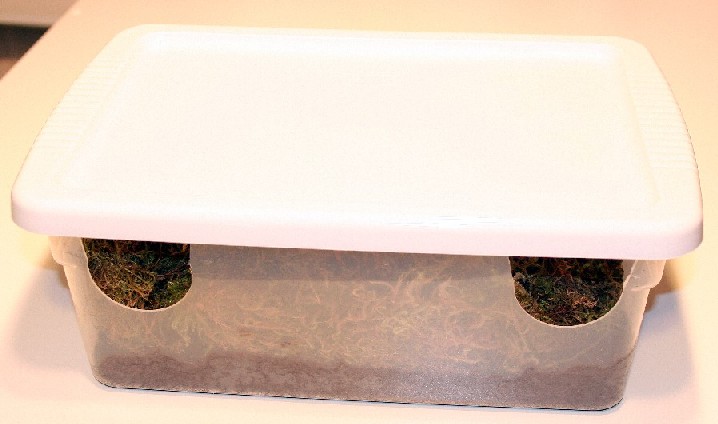
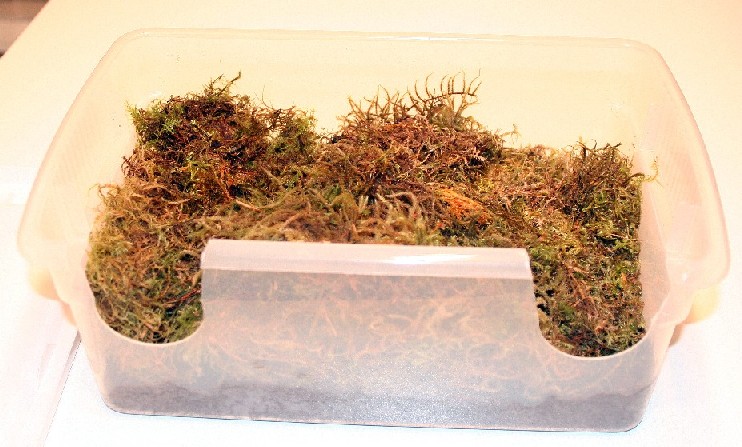
With the top removed you can see the green moss and the "U" shaped holes in the sides. I only use an inch of
green moss but it does expand to about two inches when damp.
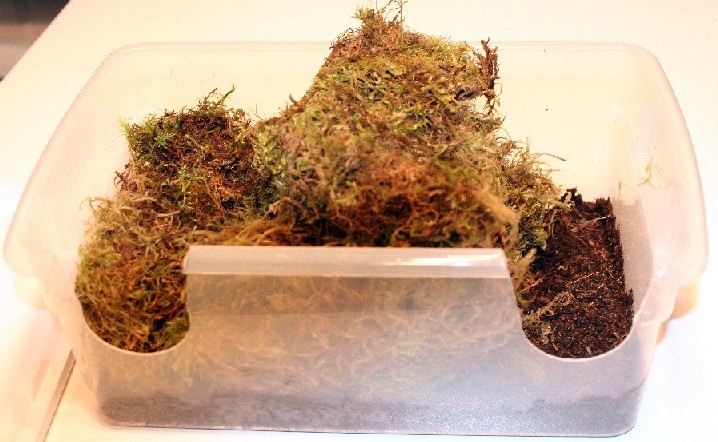
Pulled up the corner of the moss to show the layer of peat moss
underneath. This serves two purposes, adds mass for water and heat retention and provides a bit of drainage
for when they urinate. They will urinate and deficate in the box. I pull the solids and replace the entire
contents about monthly give or take depending on circumstances. For example, they will go longer between
changes right now with no food intake.
-----
Thanks,
Dave Colling
www.rainbows-r-us-reptiles.com
0.1 Wife (WC and still very fiesty)
0.2 kids (CBB, a big part of our selective breeding program)
LOL, to many snakes to list, last count:
21.29 BRB
19.19 BCI
And those are only the breeders
lots.lots.lots feeder mice and rats
rainbowsrus
Jun 05, 2007 11:06 AM
Rainbow humidity 101
Since this topic comes up from time to time, I've created a document with all my answers. Not steadfast rules and/or guidelines, just what works for me.
Being from tropical rain forests, Rainbow Boas require high humidity. There are three basic factors to humidity:
Evaporation - is the process of water molecules becoming airborne.
Dissipation - The natural tendency of airborne water particles is to spread out as far apart as possible.
Condensation - warm moist air contacting a cooler surface will cause the water molecules to condense into droplets on the cool surface.
The number one mistake made with rainbow boas is to give them lots of ventilation. They really do not require much oxygen. They've even been reported to submerge under water for up to 30 minutes at a time. That ventilation will allow all those precious airborne water molecules to dissipate into your house. Unless your house is humid, many more will leave than enter. This will result in the enclosure drying out.
Many keepers use misting regimens to keep humidity levels up. IMO, you need to set up the environment so it will automatically be humid. Here are the steps I take to provide that environment.
1) LIMIT VENTILATION - my cages at around 6 cubic feet only have one two inch round vent each. More than enough for air exchange.
2) Provide LARGE surface area water bowls. Remember, the larger the surface area, the more water will evaporate.
3) I provide damp hide boxes. A sweater box size for adults with holes in the sides. An inch of peat moss and another inch of green moss. All kept damp
4) Depending on your enclosure you can fine tune your system by moving the water bowl around. Closer to the warm end and more evaporation, closer to the cool end and less.
My cages:
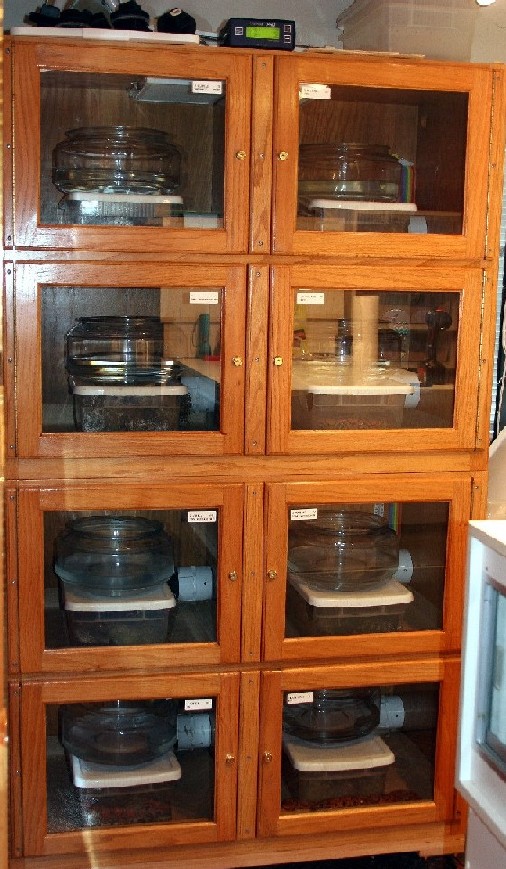
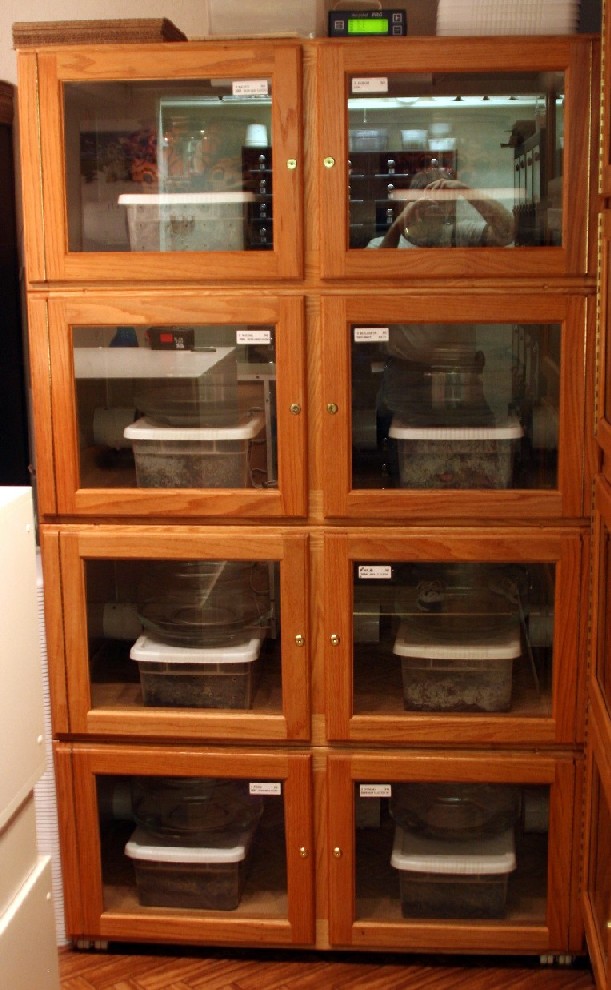
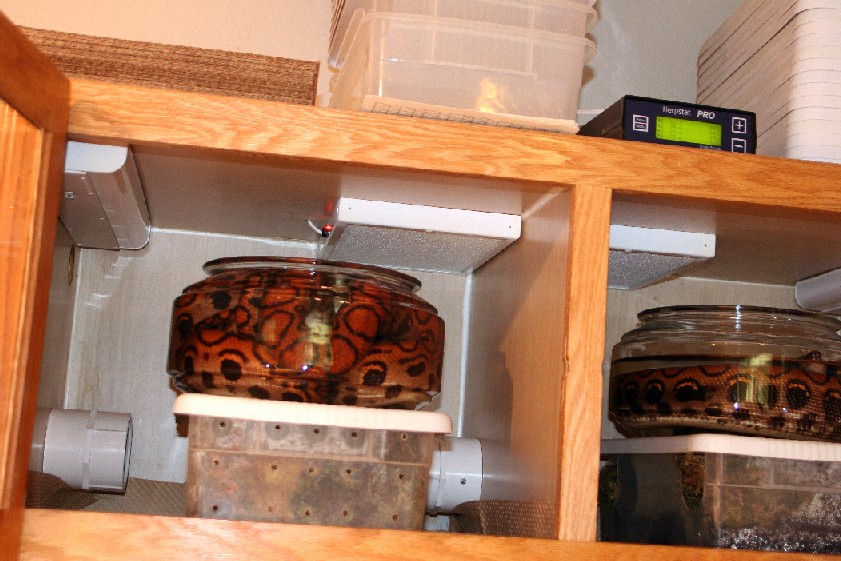
A moss box:
Thanks for reading and I hope this helps.
-----
Thanks,
Dave Colling
www.rainbows-r-us-reptiles.com
0.1 Wife (WC and still very fiesty)
0.2 kids (CBB, a big part of our selective breeding program)
LOL, to many snakes to list, last count:
21.29 BRB
19.19 BCI
And those are only the breeders
lots.lots.lots feeder mice and rats
run26neys
Jun 05, 2007 11:14 AM
I use a shoebox size storage containers for my moss pits beacuase I do not have any adult BRB's. I will have to upgrade them in the future.
BTW - I think these moss pits are like a day spa for BRB's, and the only problem is the snakes will spend a ton of time in them. Thus, you will not see your brb too much.
-----
Mike
2.4 BRB
1.2 Spotted Python
1.0 Cal. King
rainbowsrus
Jun 05, 2007 11:18 AM
Agreed, I also use shoeboxes for subadults with one hole in the lid. And yeah, they will spend MOST oif their time in there but they will be healthy and their skin will absolutely glow!
OOppss, did I just give out a trade secret?
-----
Thanks,
Dave Colling
www.rainbows-r-us-reptiles.com
0.1 Wife (WC and still very fiesty)
0.2 kids (CBB, a big part of our selective breeding program)
LOL, to many snakes to list, last count:
21.29 BRB
19.19 BCI
And those are only the breeders
lots.lots.lots feeder mice and rats
run26neys
Jun 05, 2007 11:38 AM
I still don't get the great pics that you do... but my last few pics of Mickey were getting much better.
The good news is that I am a 2 to 3 years off having to take decent pics to sell babies. Sometimes I am a slow learner, but I feel I can learn by then.
-----
Mike
2.4 BRB
1.2 Spotted Python
1.0 Cal. King
FRoberts
Jun 05, 2007 12:30 PM
I would say you could keep in rubbermaid containers till the snake gets some size on it. Then get a vision or boaphile cage, 4 foot version would suffice, no mister or fogger necessary in my opinion, large water bowl and moss hide would suffice.
-----
Thanks,
Frank Roberts
Roberts' Realm Of Reptile Research

underdog125
Jun 05, 2007 01:11 PM
so use an under the tank heater. and no daylight lamp heaters? what about a night light or do they need light at all. i noticed on ur websites and other a lot of others. ppl use racks and all how do u get light in them or do you just use heat mats dont thay need light? can anyone explain in lamemans terms for a good setup b/c its confusing, also they NJ weather its weird too humity and temp changes like the wind here too so ill have to take that into accountthanks
rainbowsrus
Jun 05, 2007 01:29 PM
Seems to work good to increase the cage size with the animal, as it grows, the cage needs to be larger. Of course that is also favorible to larger collections, not having a large cage for every specimen. BRB's don't need any real light, just need a photoperiod where there is difused light (daytime) and darkness (night time)
Racks make sense for multiple smaller animals. There is a heat element either under the tub (belly heat) or at the back of the rack (back heat) Either way the only heat is towards the back. That way the front is cooler and the snake can move around to find a temp it likes.
Typical full grown BRB cage should have about six square feet of floor, give or take. So 2 foot x 3 foot although I house mine in smaller they have 4 square feet of floor space Plus water bowl Plus they get to travel through tubes to other sections.
If I were to recommend one specific setup, based on my experience. Get a Boaphile 322T 3 foot x 2 foot x 18 inches tall and divided into two cages by a removable divider you can take out later.
-----
Thanks,
Dave Colling
www.rainbows-r-us-reptiles.com
0.1 Wife (WC and still very fiesty)
0.2 kids (CBB, a big part of our selective breeding program)
LOL, to many snakes to list, last count:
21.29 BRB
19.19 BCI
And those are only the breeders
lots.lots.lots feeder mice and rats
strictly4fun
Jun 05, 2007 01:30 PM
If you can help it don't use a uth especially if you get a plastic cage, flexawatt will suffice but if you do then you MUST have it controlled. About the lights, they don't like bright lights and are not basking snakes, hell you prolly won't see your brb during the day to much unless it pooped in its hide and don't want to smell it lol
Bob
run26neys
Jun 05, 2007 01:31 PM
I use undertank heat in my cages (delivered this way from Boaphile) and also use UTH when I had used a glass tank too. I have never provided any additional light for them. The room I have them in (my dining room) gets enough indirect natural light, and I do not supplement this. Once I get my snake area ready in my basement (no windows) I will use a light to provide a light cycle. This will probably be one overhead buld for a 10 by 10 area.
A key with BRB's is using a thermostat. They need much cooler temps than many other snakes.
-----
Mike
2.4 BRB
1.2 Spotted Python
1.0 Cal. King
qiksilver5
Jun 05, 2007 02:24 PM
foggers/humidifiers lead to respiratory issues, remove the fogger and the issue goes away. don't use them when you get one, there are much better ways to maintain humidity
