I understand to prove out a super I must breed to a normal and get 100% hypos.What if I bred a possible super to a hypo what would I have to see to still prove out a super? Just food for the mind.
Thanks,
Andrew M.
Reptile & Amphibian Forums
Welcome to kingsnake.com's message board system. Here you may share and discuss information with others about your favorite reptile and amphibian related topics such as care and feeding, caging requirements, permits and licenses, and more. Launched in 1997, the kingsnake.com message board system is one of the oldest and largest systems on the internet.


Probables and supers??
zerickone
Jun 07, 2007 02:31 AM
Replies (8)
liquid-leaf
Jun 07, 2007 05:39 AM
Yes, the only really concrete way to prove a super/dominant hypo is to breed it to a normal and have 100% of the babies be hypo. Even then, if it's a small litter, it's all chance and probability (nature doesn't always play by the 50% normal / 50% hypo babies for a non-dominant hypo x normal breeding).
The problem with super hypo x hypo breedings is that while some super hypos may show certain "markers" which might point out that they are super, this isn't always correct. Snakes that have been labelled as nearly certain as a super have shown to be normal, and "plain old" looking hypos (from a hypo x hypo breeding) have proven to be supers, so you can't trust visual clues, either.
Since you just can't tell for sure if a hypo baby from two hypo parents is dominant or not (until you raise it up and breed it), there's no way to know for sure with a breeding like that if one of the parents was super or not.
Sorry - I was just thinking about this, because I have a possible super male and already have a hypo mate set up for him when they are old enough, but also want to prove him out to be super, so eventually I'll have to find a normal female, too.
-----
Lauren Madar - OphidiaGems.com | CageMakers
1.0 BP, 1.0 Hog Is., 1.1 Hypo BCI, 1.1 Surinam BCC, 0.1 GTP
liquid-leaf
Jun 07, 2007 05:41 AM
Sorry, by "nearly certain as a super have shown to be normal", I mean normal non-dominant HYPOS (not normal wild-type BCI).
-----
Lauren Madar - OphidiaGems.com | CageMakers
1.0 BP, 1.0 Hog Is., 1.1 Hypo BCI, 1.1 Surinam BCC, 0.1 GTP
rainbowsrus
Jun 07, 2007 10:45 AM
LOL, saw that, stumbled over it, figured wht you meant and went on.
A possible super to a hypo breeding can really only be used to prove the possible is NOT a super. AKA if any babies appear normal, then the possible cannot be a super. IMO the reverse (all babies are hypos) does not necessarily prove the possible is a super. IF it's a good size litter AND there are only hypo bbaies, then it's a good probability your possible really is a super but not proven.
I know what you mean about wanting to know. and may have to do smoe trilas to prove mine out as well. In addition to smo e possible super hypos, I have 2.2 ghosts all possible supers. All from different sources. Would be nice to know which are super and which are not. ie super ghost to super ghost = litter of super ghost babies. Gotta be more valuable and more marketable then possibles. But if you don't know for certain both parent are supers then.....
-----
Thanks,
Dave Colling

www.rainbows-r-us-reptiles.com
0.1 Wife (WC and still very fiesty)
0.2 kids (CBB, a big part of our selective breeding program)
LOL, to many snakes to list, last count:
21.29 BRB
19.19 BCI
And those are only the breeders 
lots.lots.lots feeder mice and rats 

zerickone
Jun 07, 2007 11:18 AM
Thanks for the information.I'm not really planning on breeding him but he's been complimented as a "super"!
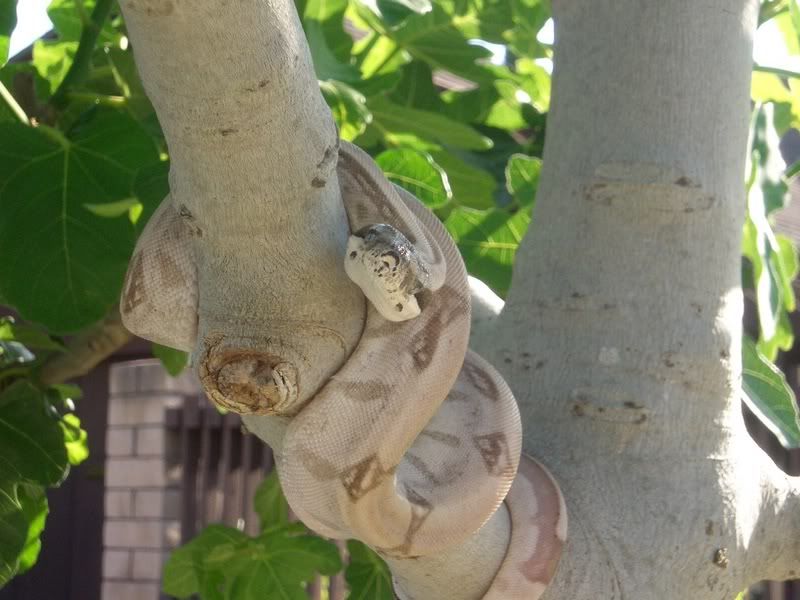
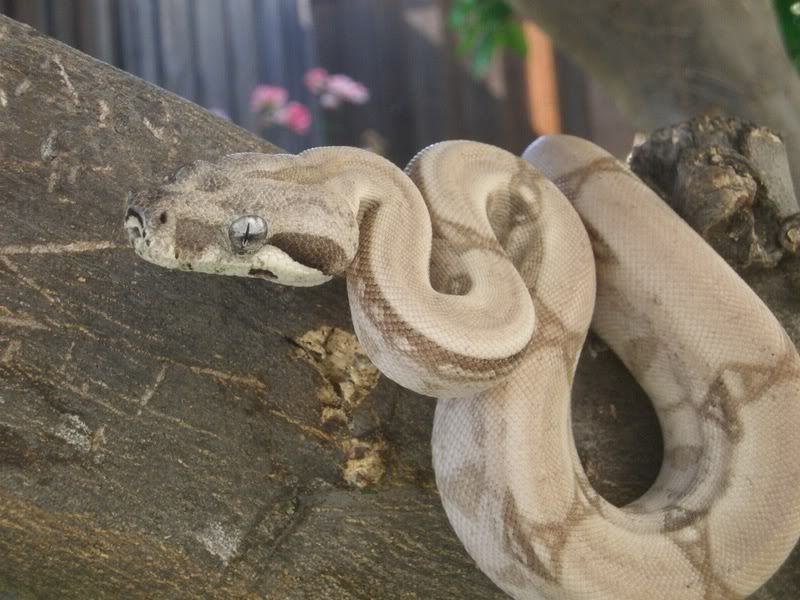
Thanks,
Andrew M.
ajfreptiles
Jun 07, 2007 02:01 PM
Where did you get that animal?? I have a male that could be his twin....I would love to know more about him...Please e-mail me...Thanks Andy Federico
-----

Paul Hollander
Jun 07, 2007 11:57 AM
>What if I bred a possible super to a hypo what would I have to see to still prove out a super?
This can be done. The best you can do, though, is to get a probability that the snake in test is a super, meaning that it has a pair of salmon (AKA hypo) genes.
Mate your possible super to a normal, and if any normals show up, the possible super is 100% certain not to be a super. If no normals show up among the babies, then the formula for the probability it's a super is 1 minus 0.5 to the nth power, or 1-(0.5^n), where n is the number of babies. The usual cutoff for a test is 99% probability. You can make up a table as follows:
n 1-(0.5^n)
--------------
1 1-(0.5) = 0.5 = 50%
2 1-(0.5*0.5) = 0.75 = 75%
3 1-(0.5*0.5*0.5) = 0.875 = 87.5%
4 1-(0.5*0.5*0.5*0.5) = 0.9375 = 93.8%
5 1-(0.5*0.5*0.5*0.5*0.5) = 0.96875 = 96.9%
6 1-(0.5*0.5*0.5*0.5*0.5*0.5) = 0.984375 = 98.4%
7 1-(0.5*0.5*0.5*0.5*0.5*0.5*0.5) = 0.9921875 = 99.2%
So if you get seven babies from a possible super x normal mating, and none of those babies is a normal, then the probability is just over 99% that the possible super is an actual super.
The probability from a possible super to a hypo mating is found by the formula 1-(0.75^n), where n is the number of babies. Again, if one or more normals show up among the babies, it is 100% certain that the possible super is not a super. A table of probabilities can be produced like the one above (but I will not complete it):
n 1-(0.75^n)
--------------
1 1-(0.75) = 0.25 = 25%
2 1-(0.75*0.75) = 0.4375 = 43.8%
(skipping many values of n)
17 1-(0.75^17) = 0.992483053 = 99.2%
So if you get 17 babies from a possible super x hypo mating, and none of those babies is a normal, then the probability is just over 99% that the possible super is an actual super.
More non-normal babies raises the probability, of course.
Paul Hollander
iamsnakeshack
Jun 07, 2007 12:10 PM
Ouch! Are we going to be test on this material? I’m a mechanical engineer so I haven’t done statistical math for 20 years! Thanks for the explanation, I enjoyed it.
Rick Staub
Jun 07, 2007 07:57 PM
Thanks Paul. Very helpful. I got 9 hypo babies out of probable super bred to a hypo (definitely not a super) this year so 92.5% chance she is a super. Pretty good odds IMO. It is interesting how the probability does not increase as rapidly as you increase n. If she had laid one more hypo baby, the probability that she is a super only increases to 94.4%.
-----
Rick Staub
